Gygax, Armor, and Appendix (N - 1)
Let’s not kid ourselves, Gygax got this right
Before there was CHAINMAIL, there was the Domesday newsletter. Specifically, Domesday 7 from September of 1970. Readership at that time included Gary Gygax, Jeff Perren, and Dave Arneson (members 2, 4, and 7 respectively). A side note for the #BrOSR: even your gaming club needs to have ranks and rankings . . . do you even grade your club members, bro?
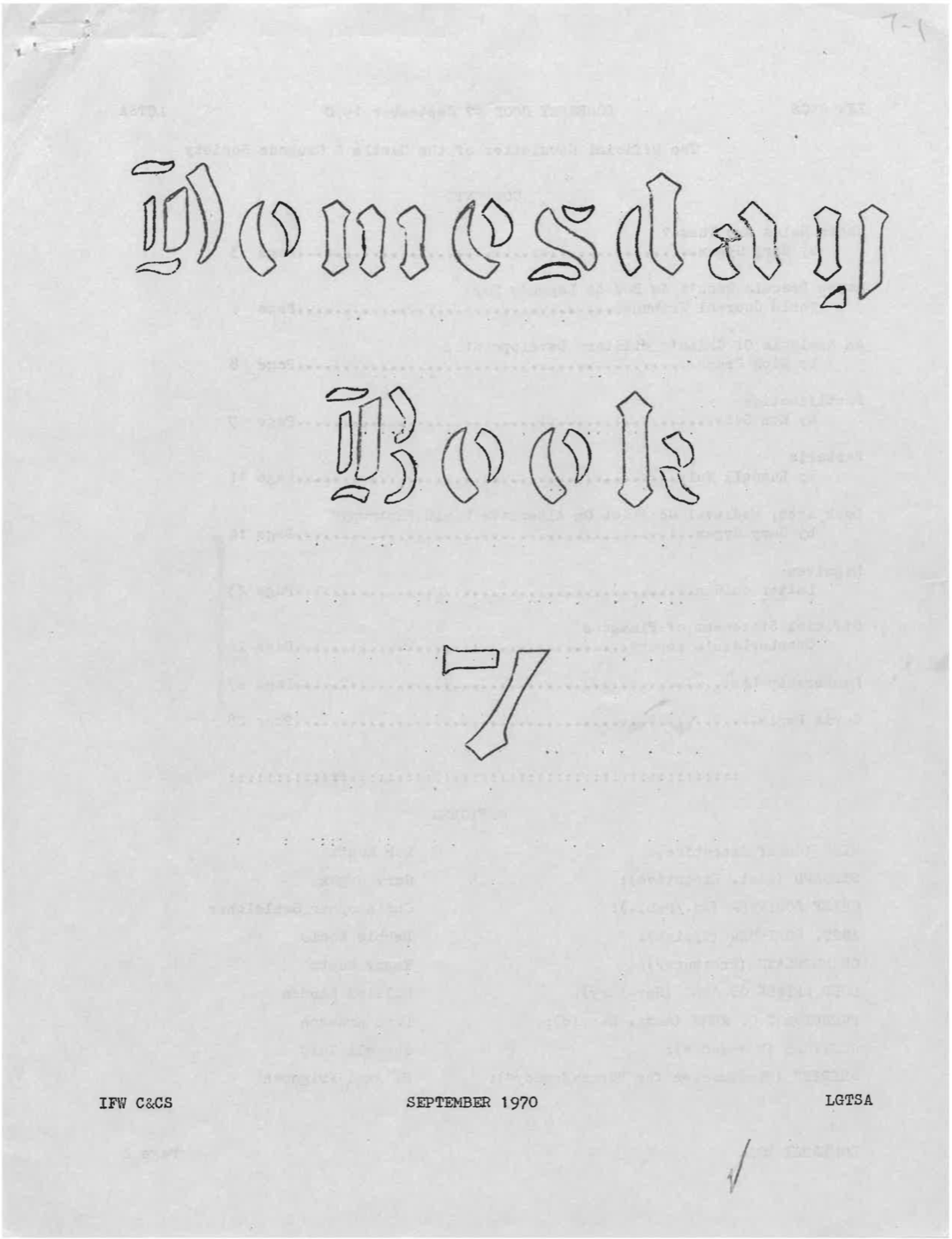
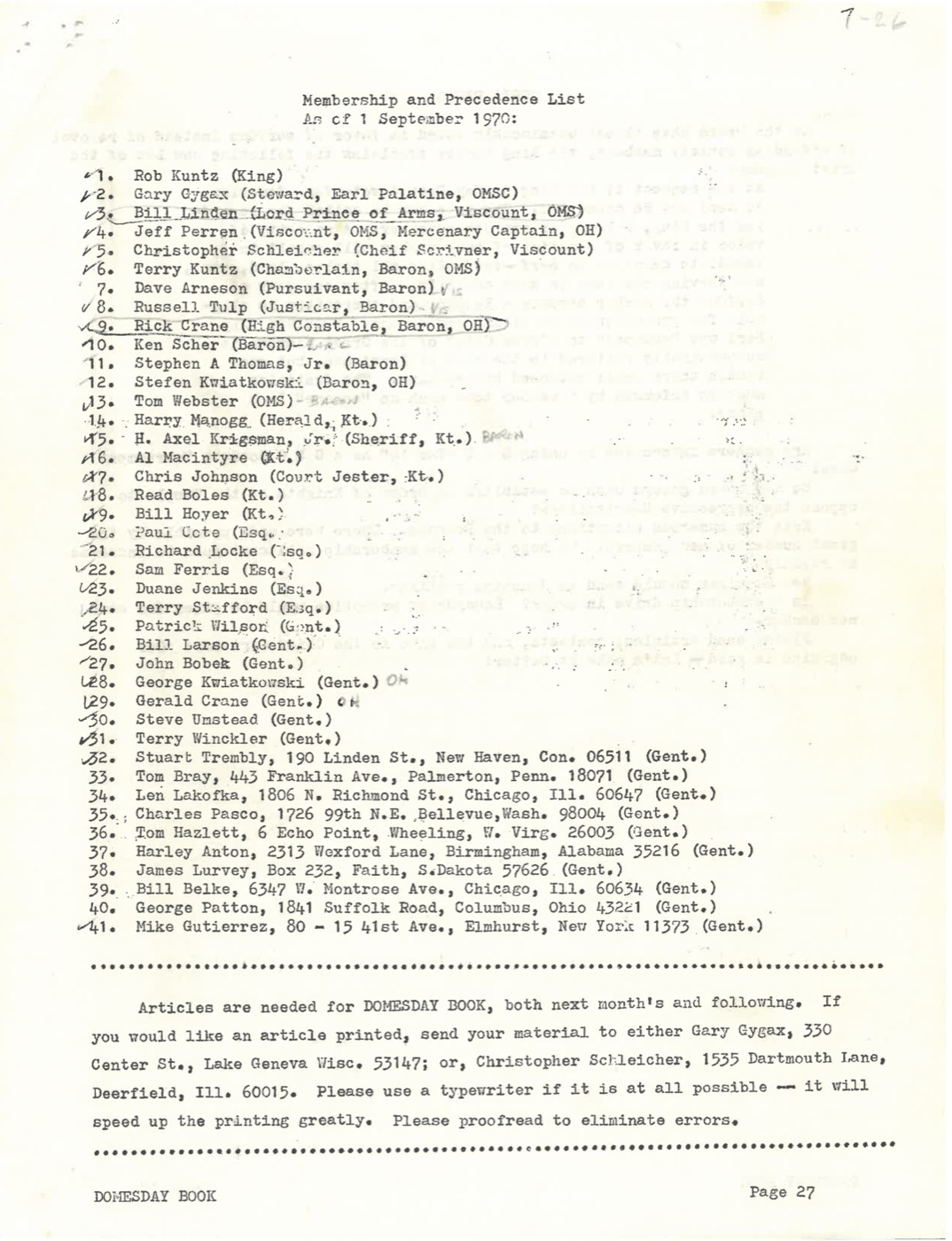
On pages 19-20, one contributor to this 41-person enterprise has sent in a Bibliography. I like to call this Appendix (N-1). One of the titles appears in Gygax’s magnum opus, the 1st edition AD&D DMG. Another title is the source of the cover illustration for CHAINMAIL.
E. Gary Gygax - Movie Reviewer?
This article from Dragon Magazine #62 has not aged well
Oh Gary. You have no idea what you are talking about here.
“I never intended to review THE SWORD & THE SORCERER, because it was neither good enough nor bad enough to rate such attention. Compared to the Conan film. however, it is superb.” — E. Gary Gygax, Movie Reviewer
The Review
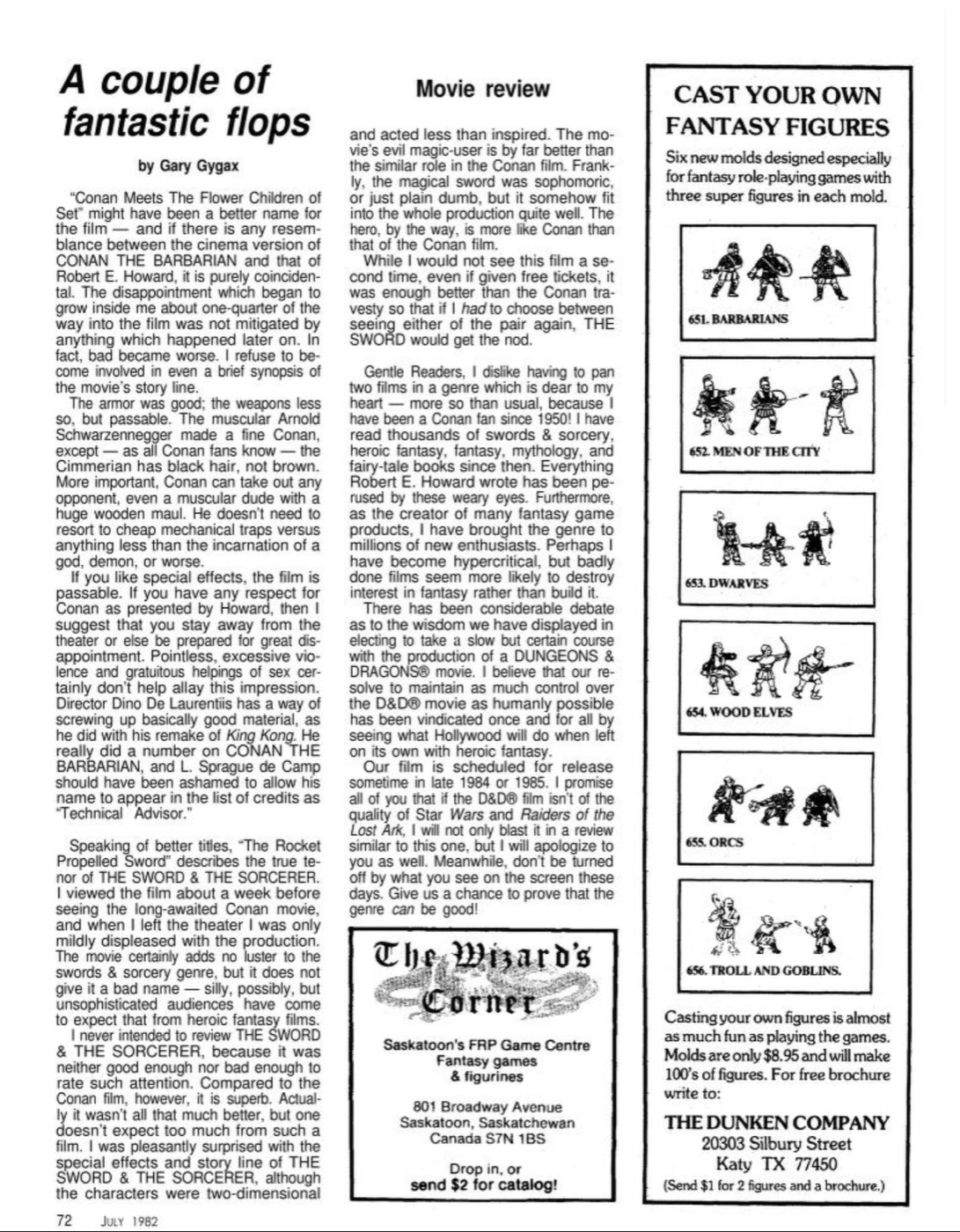
Before getting into the meat of the review, I’d like to point out that Dunken is still in business, though it has relocated to Tennessee. I have made an inquiry with the owner about his stock. I have been thinking about getting into casting for a while. Dunken stocks fantasy, dark ages, and medieval molds of sizes small and large. The Wizard’s Corner is long gone. There is one reddit thread talking about how you would roll 1d10 to get a discount, presumably from 1% - 10% not 0% - 9%. The latter range would be cruel . . . “Zero huh? No discount for you kid!”
Is David Wesely the Origin of Polyhedral Dice in RPGs?
Reviving an old interview almost lost to time
This interview by Claude Clyde L. Rhoer, III of David Wesely was uploaded on August 30, 2010. The original mp3 interview file from episode 60 of Rhoer’s Theory from the Closet show can be found on the wayback machine: https://web.archive.org/web/20131220174736/http://www.theoryfromthecloset.com/shows/tftc_show060.mp3
The discussion about polyhedral dice runs from approximately 01:21:37 to 01:30:50. Wesely tells the story of seeing numbered plastic geometric solids in his high school geometry class, later connecting them to a 12-sided teetotum referenced in Totten’s Strategos. Wesely bought a set of polyhedrals from the Edmund Scientific catalog for about $6, and introduced them to the Twin Cities gaming group.
On Heraldry & Social Class in Early D&D - Part 3
Is this the flavor that’s missing from your old school game?
Gary Gygax wrote, rather extensively, in both the 1st edition DMG (pp. 88-90) and in Dragon magazine (Issue 25, May 1979) about the perils of incorporating social class into the core rules of the game. In Gary’s mind, this was something that ought to be setting specific. I agree.
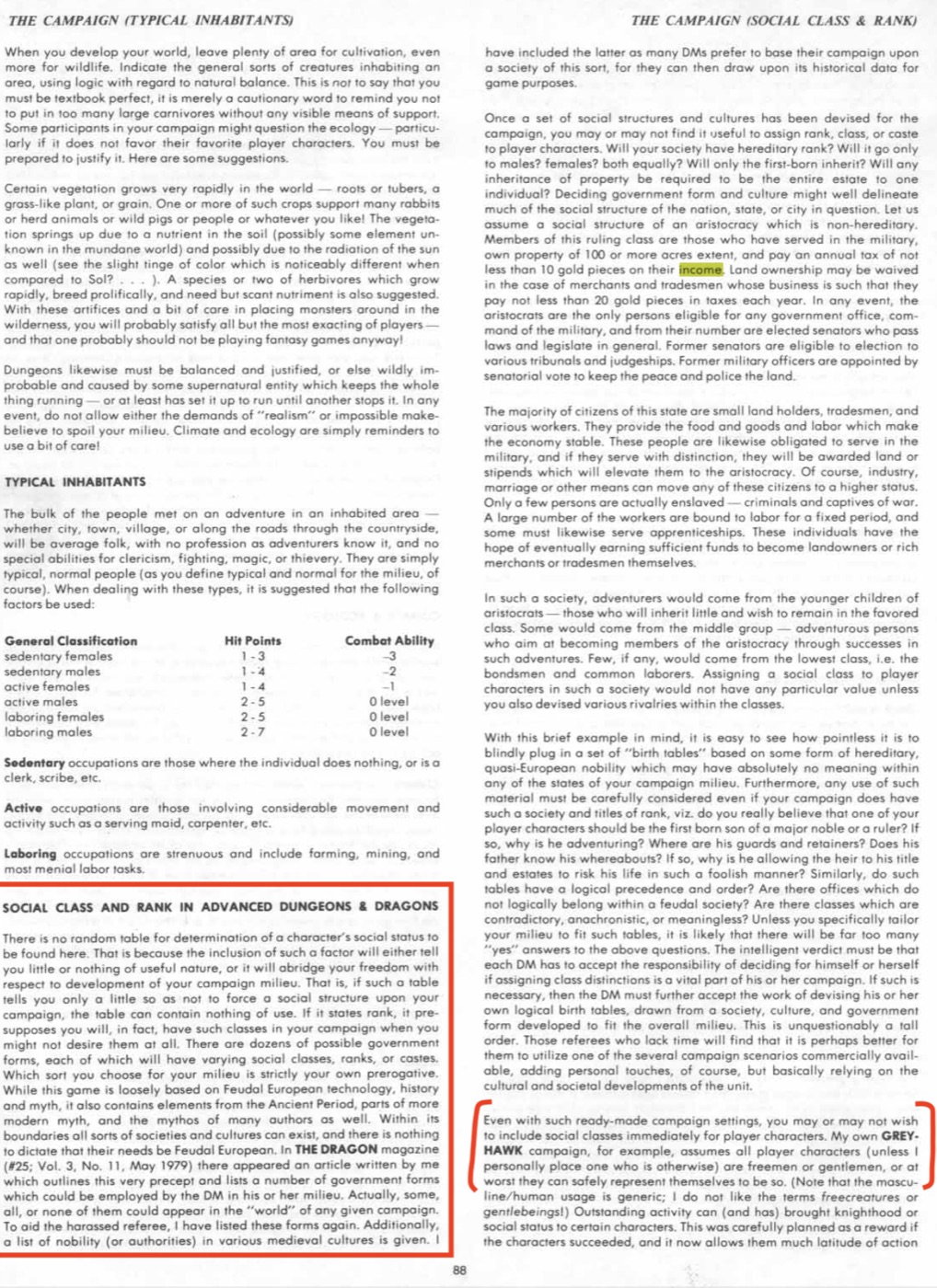
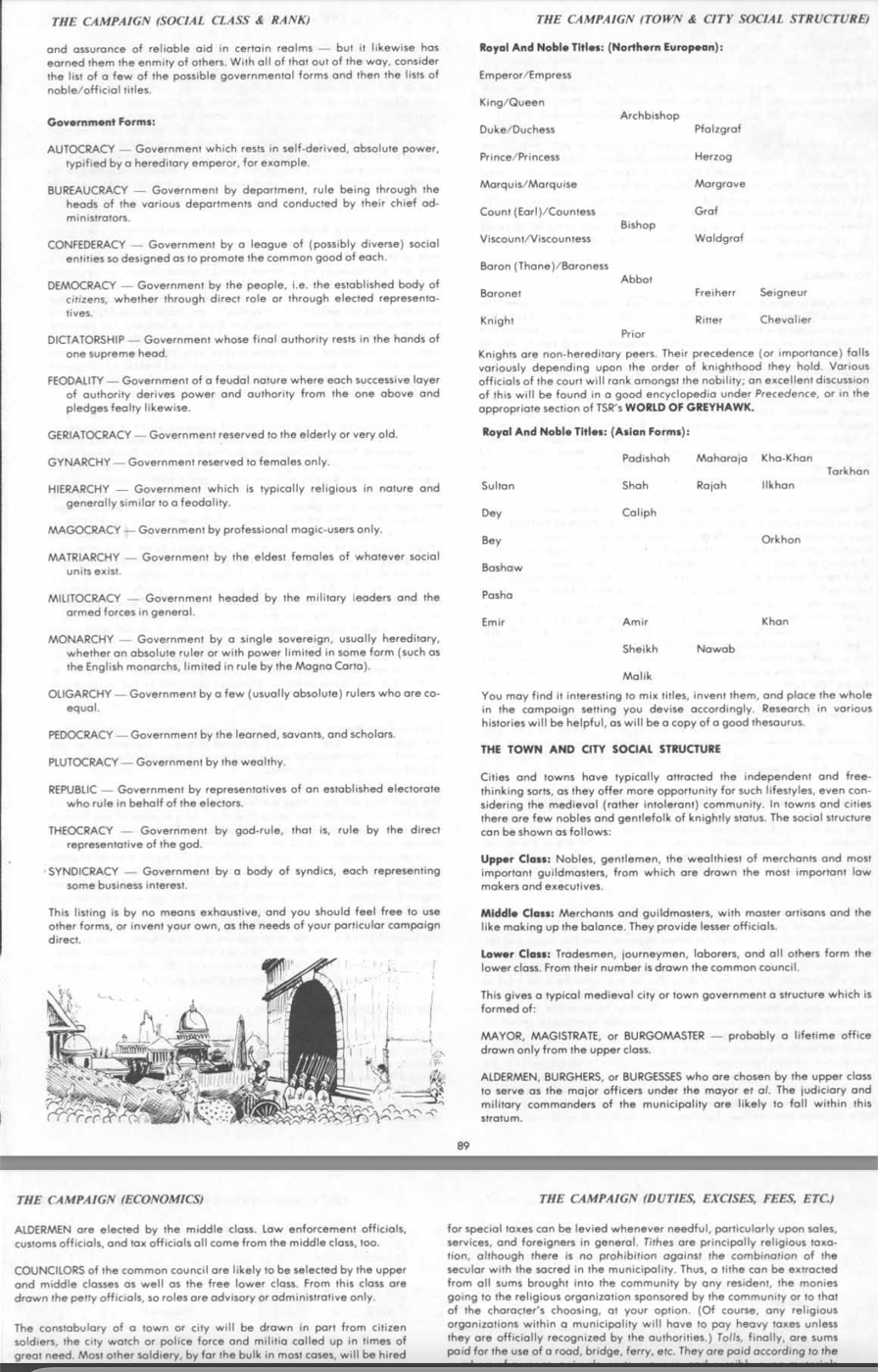
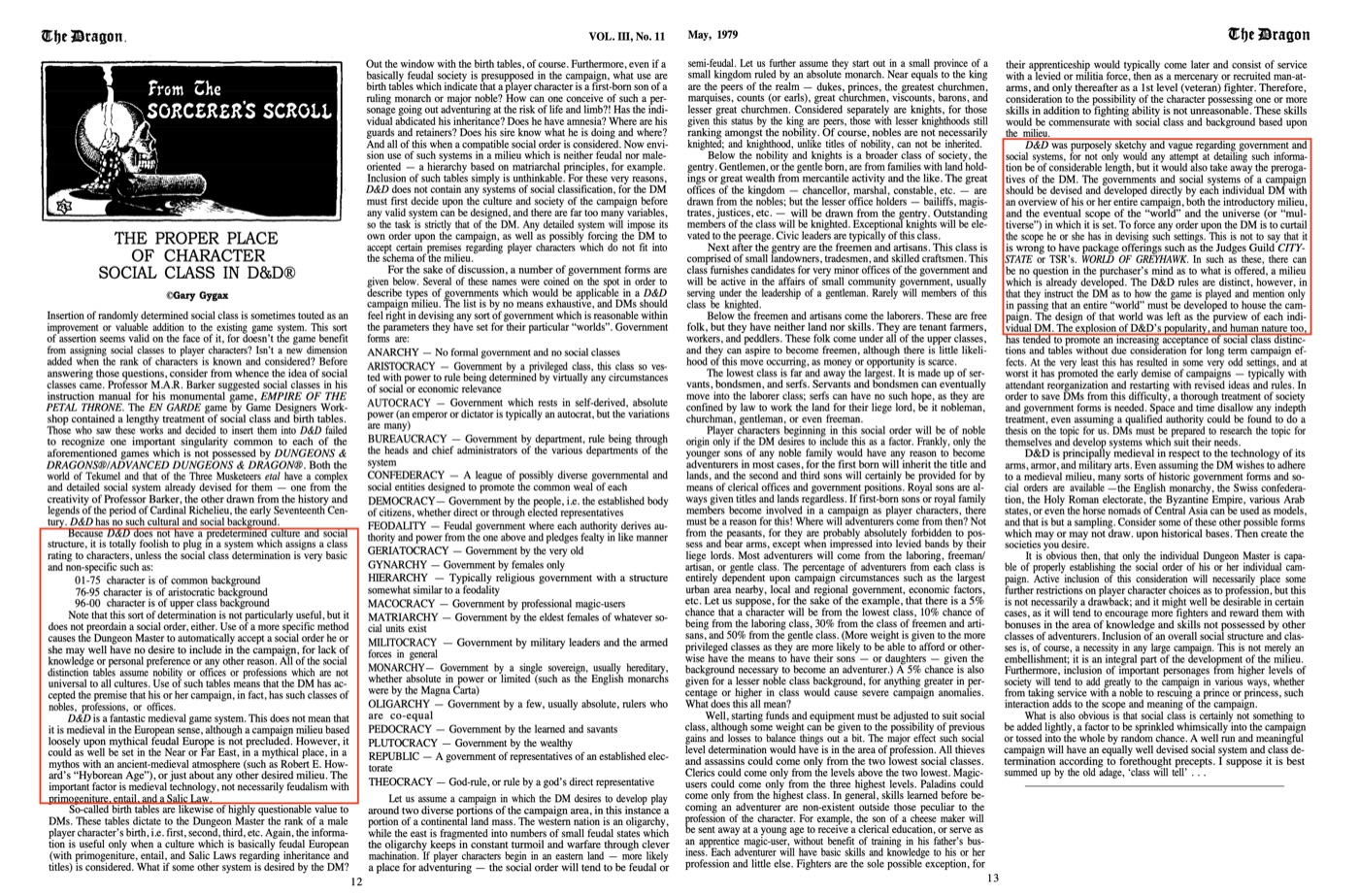
However, Gary did not emphasize that a lack of simulating social hierarchies and status within the hierarchy would open the game up to a great deal of criticism. One common criticism concerns the need to accumulate gold to acquire experience to move upward in the hierarchy. The second criticism is that the progression of character class skills is rather jarring compared to a skill-based system where individuals progress in the skills either by virtue of their continuous use in the game, or else by the direction of the player who has an aim in mind for how his character ought to individuate himself for success. The second criticism has merit. The first criticism does not.
On Heraldry & Social Class in Early D&D - Part 2
Is this the flavor that’s missing from your old school game?
When I first got my hands on a copy of Beyond This Point Be Dragons, it was world-changing. I felt like I had finally found the answers to so many questions. (Cf. D.H. Boggs, The Bufkin Copy of Beyond This Point be Dragons, January 11, 2018, available at https://www.patreon.com/HiddenInShadows). I have mentioned before that patron play was firmly embedded in these early rules. What’s more, the author(s)? of that 1973 play test draft had welded together Chainmail and familiar OD&D rules in a combat system that just begged to be played at the table. But, more importantly, this juxtaposition allowed me to see connections I had previously missed.
On Heraldry & Social Class in Early D&D - Part 1
Is this the flavor that’s missing from your old school game?
I can still remember it. I was sitting in my assigned seat in the front row of my junior high English class. On the table in front of me is one of those scholastic-style magazines with pulpy paper. There’s an advertisement that leaps off the page at me.
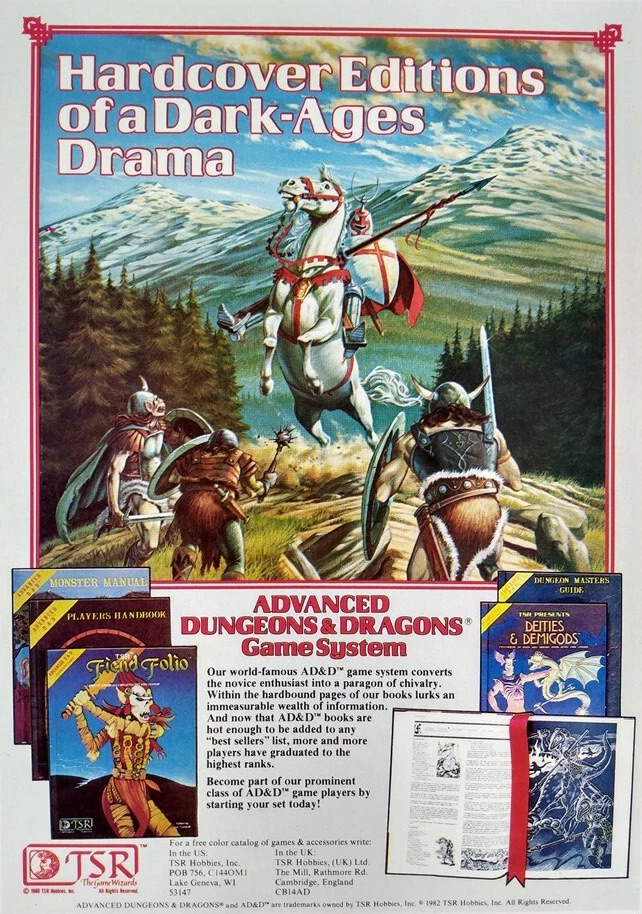
(This ad appeared in Dragon Magazine in March 1983 as well as many other publications. It was originally the artwork on the cover of Dragon #62 June 1982)
The horse and rider were striking. And, although the heraldry on the shield was simple (and the crest of the helm hardly notable) it did stick with me. This is exactly the point of heraldry and the color coordinated accoutrement. Together, they fingerprint an individual on the battlefield. If you knew the markings, you knew the man.
Accidental Discovery from First Fantasy Campaign
Exploring Alignment Systems from the Twin Cities gaming circle adds further evidence of Chainmail’s early influence
I’m not sure why people believe that “Dave never played that way” “Arneson never used Chainmail” etc. I think that myth is widely debunked. But thanks to some people questioning when alignments appeared in Blackmoor, we ended up with an accidental discovery.
Question on Discord: “Is it known who brought law, chaos, and neutrality and alignment into OD&D? Arneson’s games had good and evil, but not law and chaos, right? I know Gary convinced Professor Barker to change stability and change to law and chaos (which was thankfully quickly changed back later)”
The Richard Snider Variant is a Dead End
Midgard had no influence on the development of TSR’s D&D
Introduction
I have been putting off writing this for two days now. I have done additional research on 6 pages of material from the Twin Cities that were written by Richard Snider. Less than half of this material is in Arneson’s First Fantasy Campaign (FFC). Some of the rest of it is described by D.H. Boggs on his blog in enough detail that it can be mostly reconstructed. As you can imagine, for 6 pages to have an influence on the course of development of the official D&D published rules and supplements from the 1970s, that material would have to be pure gold. It is not. Let’s put it together.
Morale Checks in Early Blackmoor
Yes, characters checked morale too!
In Blackmoor, there was originally a stat known as Guts (or Courage). In Midwest Fantasy Wargame, “Guts are representative of courage, morale, or the ability to endure mental or physical stress.” Throughout the rules, I make it clear that Morale or Gut Checks may be required in some instances.
By the time the 1973 draft of OD&D (known as Beyond This Point Be Dragons) has come around, there is a different stat: Ego. In Dragons Beyond, I describe Ego as “the measure of loyalty and self-interest. It influences how well a player can give or take orders; the reaction to a real or perceived insult; and the likelihood that the player will risk his life for his liege, religious Order, Guild or Fellowship.” (A screenshot of BTPBD’s definition is below).
I did "Nuthin" Wrong
Creating pulp-y monsters for fun and profit
When I created Midwest Fantasy Wargame: The Primeval RPG, I wanted to get back to the Appendix N roots of the hobby. Even though Appendix N is a Gygax thing (allegedly), we know that Arneson consumed monster movies on TV and at least the Gor novels by John Norman. One thing that has always bothered me in D&D is the hyena-like Gnolls. Great monster concept, but completely disconnected from the Appendix N roots.