The Richard Snider Variant is a Dead End
Rodney Hampton
- 10 minutes read - 2080 wordsMidgard had no influence on the development of TSR’s D&D
Introduction
I have been putting off writing this for two days now. I have done additional research on 6 pages of material from the Twin Cities that were written by Richard Snider. Less than half of this material is in Arneson’s First Fantasy Campaign (FFC). Some of the rest of it is described by D.H. Boggs on his blog in enough detail that it can be mostly reconstructed. As you can imagine, for 6 pages to have an influence on the course of development of the official D&D published rules and supplements from the 1970s, that material would have to be pure gold. It is not. Let’s put it together.
Below are the headings Boggs provided. I’ll rearrange them in roughly the same order as the three little brown books (3LBBs) from original Dungeons & Dragons (OD&D), i.e. player facing rules, monsters & treasure, and Referee facing rules. Snider’s headings will be in UPPER CASE with the OD&D section following in parenthesis.
Book 1: Men & Magic
THINGS TO ROLL FOR IN MAKING HERO OR SUPERHERO (Determination of Abilities pp. 10-11).
- Per Boggs, “RSV expects rolls for Strength, Health, Intelligence, Leadership, Horsemanship, Sailing, Flying, normal (melee) combat skill, and archery skill.” These are rolled using 2d6. “Strength, Health, Intelligence, Leadership, Horsemanship, Sailing, Flying, normal (melee) combat skill, archery skill. Roll two dice for each.”
- “Weapon Specialization (Hero 3 die, Superhero 4 die).” Based on other context, this most likely means rolling 3d6 or 4d6 for the roll-under weapons proficiency score.
- “Life energy level: hero rolls one die. On a roll of 1-3, has the option to either keep his first roll or reroll with two dice. Super-hero rolls two dice, on a roll of 1-2 (on either die) has the option of either keeping the first roll or rolling over with three dice. Any time the option is taken, the first roll is thrown out (whether the second roll is higher or not).” “Life Energy Level/Points of RSV is both like and unlike the Life Energy Level of OD&D. Both Heroes and Wizards have Life Energy Level/points, but level advances much more quickly with Wizards. Like Levels in D&D, Life Energy Levels benefit some statistics, such as [Magical Power Ability] for wizards and bonuses for Superheroes,” per Boggs.
- “Magic resistance ability: hero rolls one die and on roll of one has option to keep first roll or roll over with two die. Superhero rolls three die.” Per Boggs, “Magic Resistance is not a reservoir spent in defense, but rather a fixed number that can be subtracted from the chance a spell has to effect a creature.”
THINGS TO ROLL IN MAKING WIZARD (FFC “The Original Blackmoor Magic System” p. 50).
- Life Energy Level and Magical Power Ability (MPA) show up here. MPA is “a range of points the wizard has available to ‘spend’ on casting spells,” per Boggs.

WIZARDRY APPRENTICESHIP (Characters—>Magic-Users p. 6; FFC “Richard Snider Additions”, p. 58)
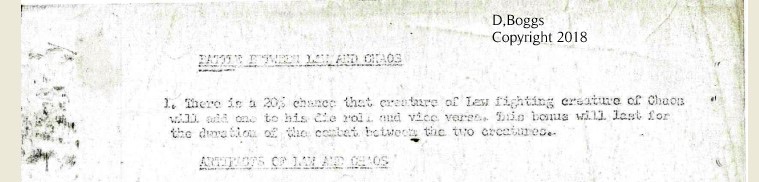
BATTLE BETWEEN LAW AND CHAOS (Character Alignment p. 9). This section is interesting because it gives combatants a potential +1 pip bonus to their attack rolls if facing the opposite alignment, however it only comes into play 1-in-5 times.
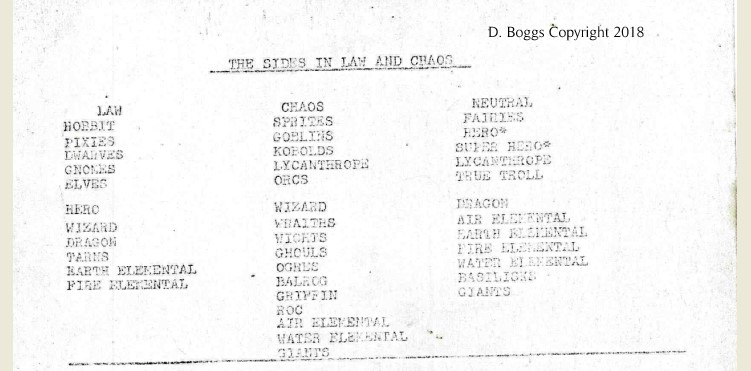
THE SIDES IN LAW AND CHAOS (corresponding chart on p. 9; also Cf. Chainmail 1st ed., p. 47 “General Line-Up”)
COST OF SPECIAL FLUNKIES (Non-player character pp. 12-13; Also Cf. LBB#3 “Specialists” and “Men-at-Arms,” pp. 22-23)
COST OF THINGS (Basic Equipment and Costs pp. 13-14)
MOVEMENT ([Weight, Encumbrance, and Movement], p. 15)
POINTS NEEDED TO RAISE LEVEL (Experience Points p. 18)
HOW TO FIGURE HOW MANY HITS A CHARACTER CAN TAKE (Dice for Accumulative Hits p. 18)
- “(Strength + Health + Intelligence + Combat Skill + Life Energy Level + Magic Resistance Ability + Highest Weapon Specialization) divided by five.” This is per Boggs’ blog.
SAVING THROWS (Saving Throw Matrix p. 20) “The RSV uses a single save”
- “A die roll of 1 indicates the following saving throws:
Wizard 7
Super-hero 8
A die roll of 2 or 3, indicates the following saving throws:
Wizard 5
Super-hero 7
Hero 9
All other creatures of appropriate type 8
To make a Saving Throw roll 2 dice; equal or above succeeds."
MAGIC SPELLS AND MINIMUM POINTS NEEDED TO USE THEM (Spells Table p. 20)
MAGICAL EXHAUSTION (FFC “The Original Blackmoor Magic System” p. 50)
EFFECT OF SPELLS (Explanation of Spells—>Magic-Users pp. 23-31)
THE PENTAGRAM (Conjure Elemental p. 28; also Cf. Chainmail 1st ed., p. 39, 44)
THE PLANES OF CONTACT (Contact Higher Plane p. 29)
Book 2: Monsters & Treasure
HERO, SUPER HERO CREATURES (Chainmail 1st ed., Appendix E “Fantasy Combat Table”)
CREATURE ATTACK VALUES (Attack Matrix II.: Monsters Attacking p. 20; Also Cf. Chainmail 1st ed., Appendices D “Fantasy Reference Table” and E)
MAGIC RESISTANCE OF CREATURES (LBB#1 Dwarves p. 7 and Halflings p. 8)
CREATURES (Monster Descriptions pp. 5 - 20) “there are a few unique new monsters in addition to the [CHAINMAIL] stock”
DIFFERENCES IN CREATURES FROM BLACKMOOR GAME (FFC “Richard Snider Additions”, p. 58)
POINT VALUE OF CREATURES (FFC, Magic Protection Points, p. 30)
ARTIFACTS OF LAW AND CHAOS (Artifacts, pp. 38-39)
Book 3: The Underworld & Wilderness Adventures
SECRET PASSAGE (The Move/Turn in the Underworld—>Secret passages, pp. 8-9). Per Griff at Secrets of Blackmoor, Snider’s rule is a single, short sentence.
ODDS OF CREATURE FRIENDSHIP (Random Actions by Monsters, p. 12)
KNOWN LEGENDS (Rumors, Information, and Legends, p. 23)
POPULATION OF KNOWN AREA (Baronies, p. 24)
RECOVERY OF DAMAGE (Healing Wounds, p. 35)
Argument
Even assuming all of Richard Snider’s contributions made it back from his sub-campaign to Blackmoor proper and thence to Gygax via Arneson, the influence is minimal at best. Minor mechanical changes in a few rules, monster descriptions, spells, experience points, saving throws are not going to change the character of the game we received. These are areas of perpetual home-brewing and tinkering anyway. Snider did not alter the exploration loops for the wilderness or underground, and did not seem to have been ambitious enough to change the combat system. Even looking forward in time to Adventures in Fantasy (jointly authored by Arneson and Snider), the combat system described is just nuance on top of what Arneson had already honed in his own Blackmoor campaign. Thus, when Boggs asserts “that the RSV is a published set of fantasy RPG rules older than D&D” he is most assuredly wrong. It is a grab bag of mechanics built on top of Arneson’s already established ruleset and nothing more. The RSV remains UN-published to this day.
Dating
We cannot properly date these materials firstly because only Boggs has them in toto. Perhaps looking at the snippets he has released or described might help, but they do not pre-date Blackmoor. And they do not seem to be as closely tied to Midgard. Looking at Snider’s dragon variants (Gold, Brown, and Green) these are inspired by Anne McCaffrey’s Dragonriders of Pern. Dragonflight was written and published in 1967-1968 so that does not help.
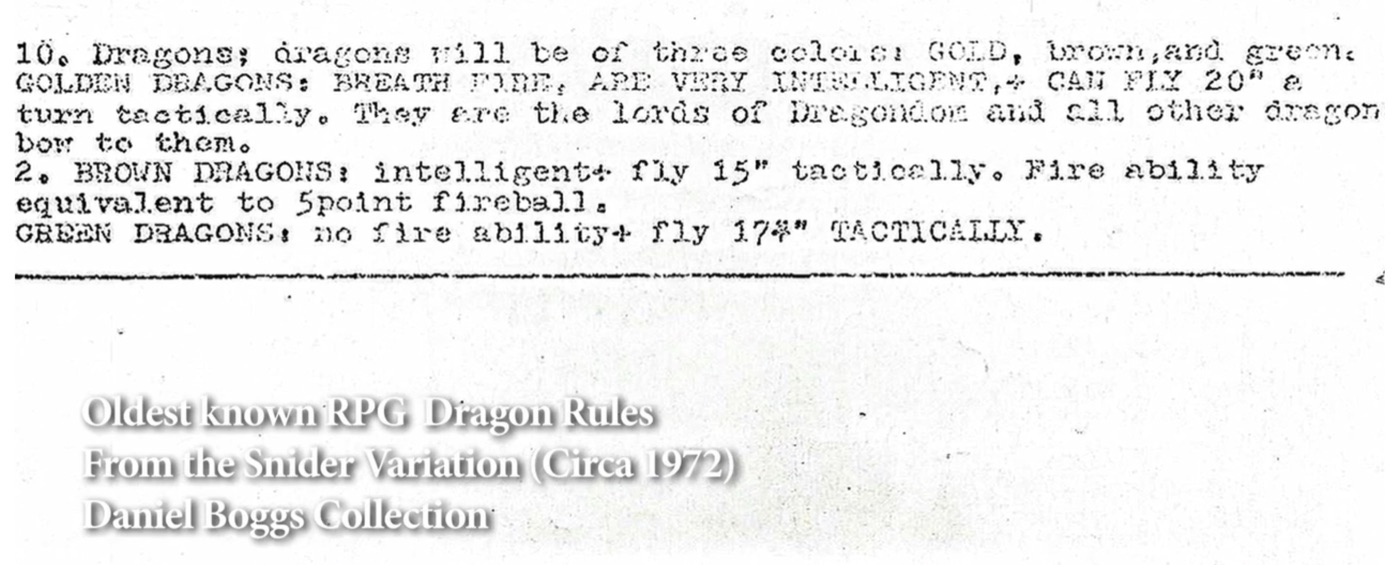
The CHAINMAIL-isms such as Hero and Super Hero are not much help either, especially if Arneson had a pre-publication version of the rules. The Minnesota Post, for example, says he got a copy in August 1969.
The reference to Tarns in the alignment table (THE SIDES IN LAW AND CHAOS) does not help either. John Norman’s Tarnsmen of Gor was published in 1968. In FFC, there are references to both “red silk” and “white silk” girls in the 5th book of the series, Assassins of Gor. In BTPBD there are references to the clan of assassins, but again this book was published in 1970. It is interesting that the Elementals are split into two different alignments instead of lumped under Neutral as in CHAINMAIL. Elementals don’t appear at all in Table 1: Opposing Forces from Beyond This Point Be Dragons from 1973.
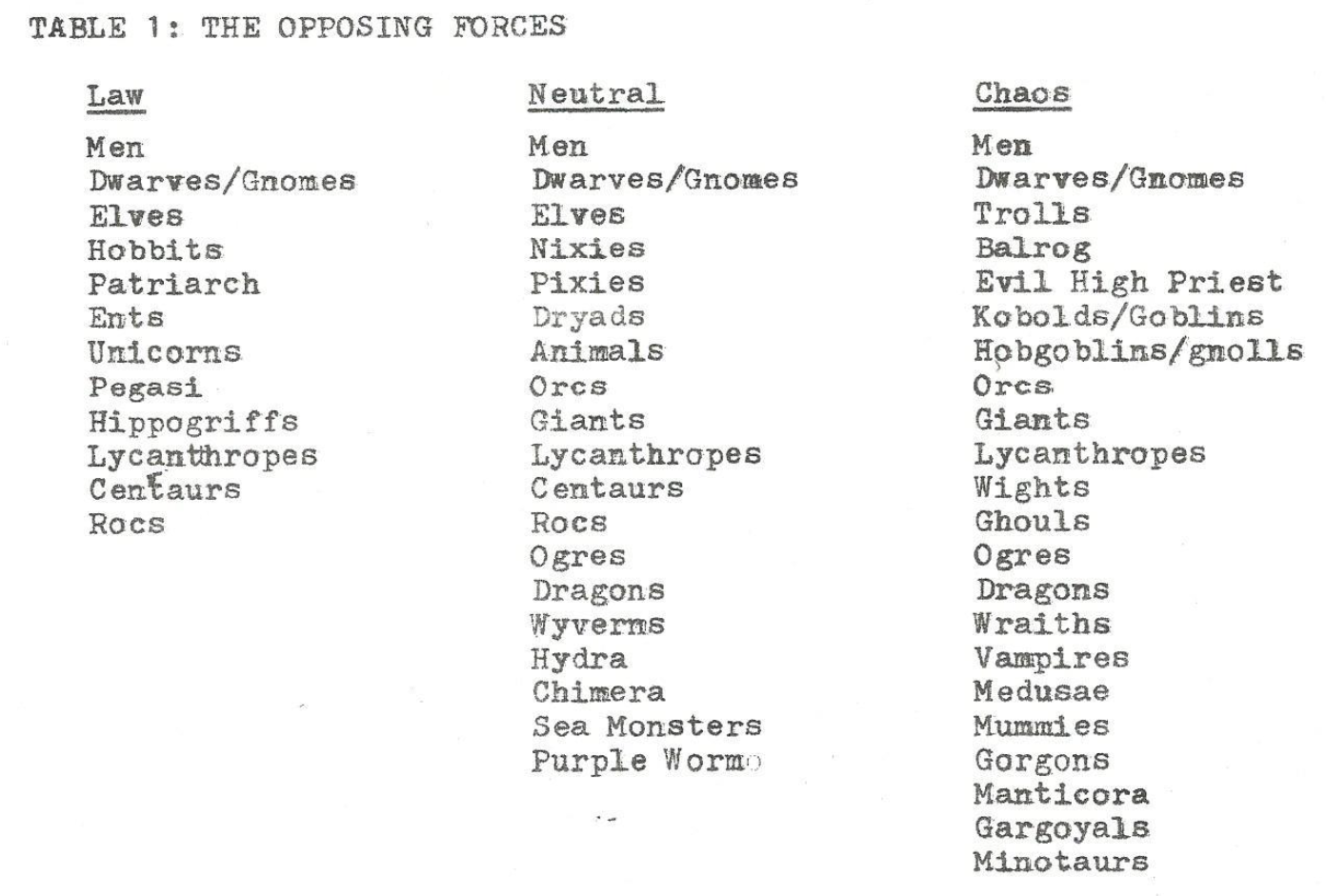
Nor do Elementals appear in the same table in the Arneson v. Gygax draft from 1973. I believe that this draft is the completion of what we once called The Mornard Fragments (compare the monster pages with hand edits if you like; they are the same). Per an interview with Mornard, some 20 pages were photocopied from Gary Gygax right before Mornard went to the University of Minnesota in October 1973. Listen at 2:35:00 - 2:39:21 on YouTube if you like.
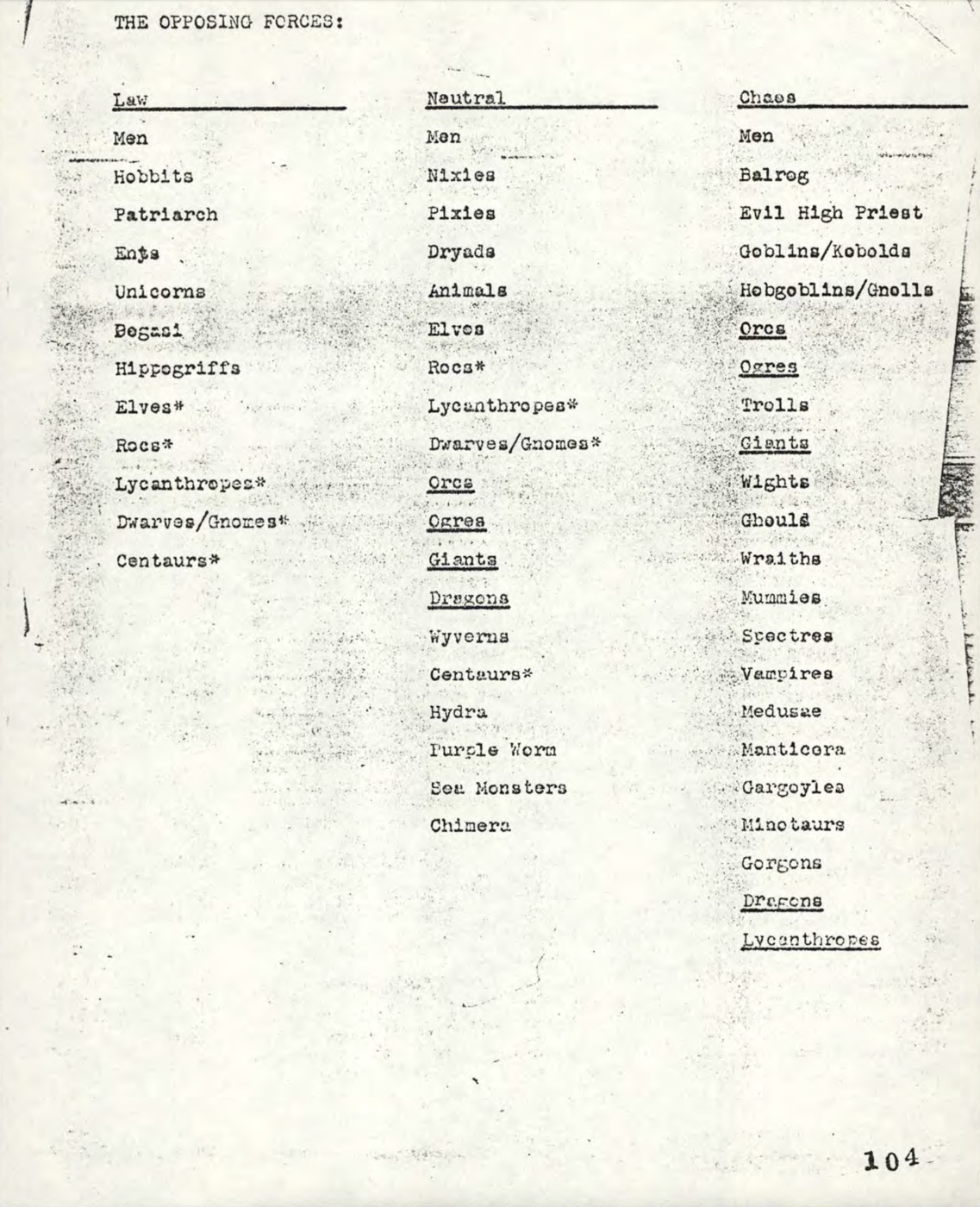
Boggs has already pointed out that Clerics are missing from the RSV pages. This would place it sometime before David Fant’s character Baron Fant had yet to become “Sir Fang” the vampire and well before Bishop Carr was introduced as a foil. Unfortunately, the interview Boggs conducted with Fant places the entire Blackmoor timeline well before the documentary evidence. I have not been able to find an interview with Mike Carr that can pin it down either. There are other documents that tell us that Fant became Baron of Blackmoor after the First Coot Invasion (possibly played mid-late August 1971 since the Blackmoor Gazette And Rumormonger #1 likely October 1971 relates some facts about the state of affairs).
Duane Jenkins did not do his first solo dungeon delve until Christmas Break 1971. Other members of the Blackmoor bunch began dungeon adventures the next day.
I don’t think RSV can be earlier than January 1972 and cannot be later than October 1973. I know that is a broad range. To narrow it down further, let’s accept Boggs’ assertion that the Midguard PBM game had an effect on it. Unlike Boggs’ blog post, I am not sure that Arneson had a trip to the UK in 1972. It is certain that he did make such a trip sometime in the late spring/early summer of 1971 due to a blurb in Corner of the Table (Vol. 3 #5 May 1971) as well as the return date stamp on Arneson’s passport. (Thanks Griff!)

In 1971, Midgard was publishing a set of draft rules one newsletter at a time. It wasn’t until September 1972 that these play by mail (PBM) rules were codified (See Hartley Patterson, Before the Flood, White Dwarf, Issue #2, August/September 1977, p. 11). I reached out to Patterson via email on 16 April 2026 and he wrote back, “I had no contact with Dave Arneson. The first I knew about D&D was when I was given a copy of the original game in around 1975. His background was in miniature wargaming, mine in Science Fiction fandom and postal games.”
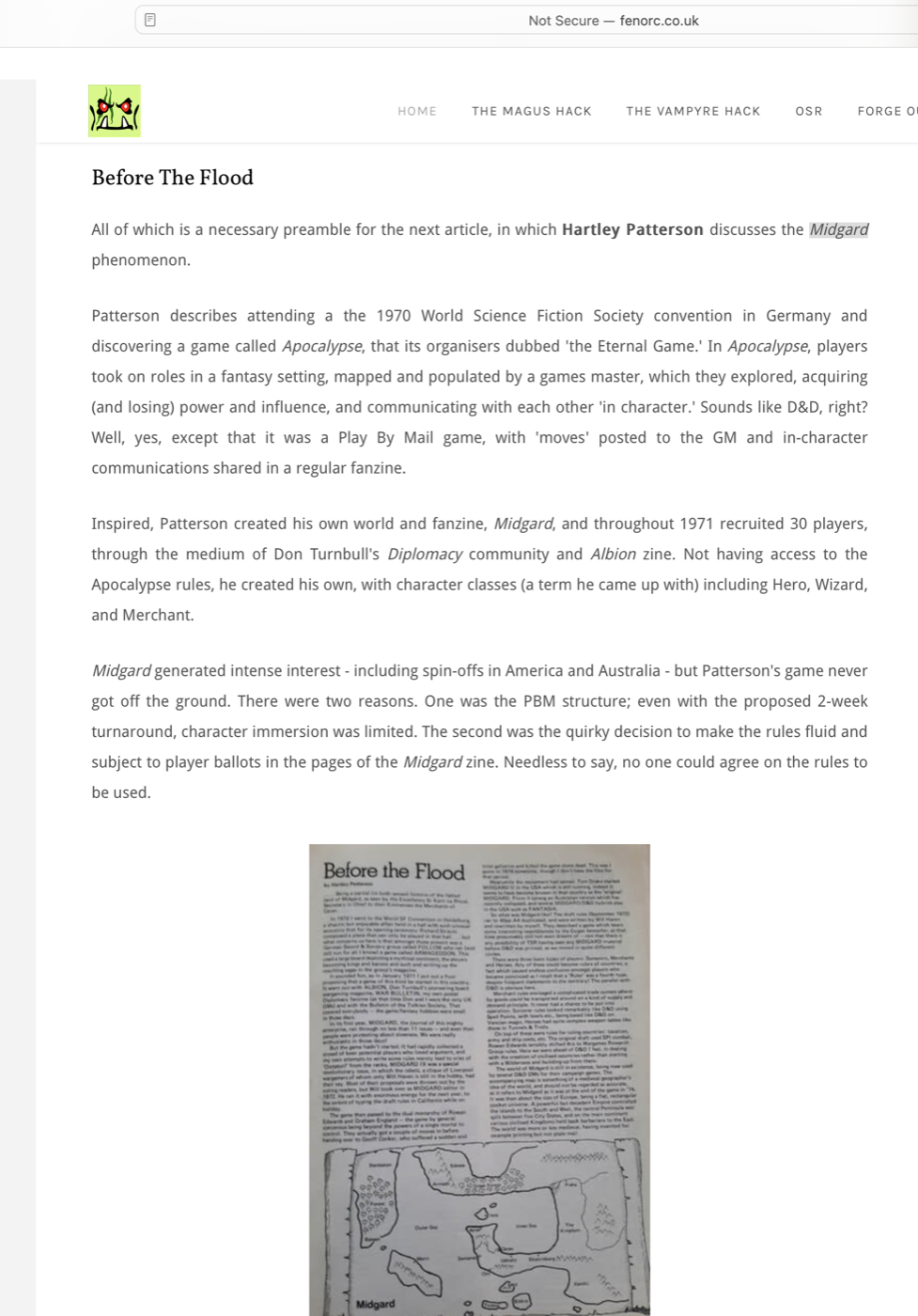
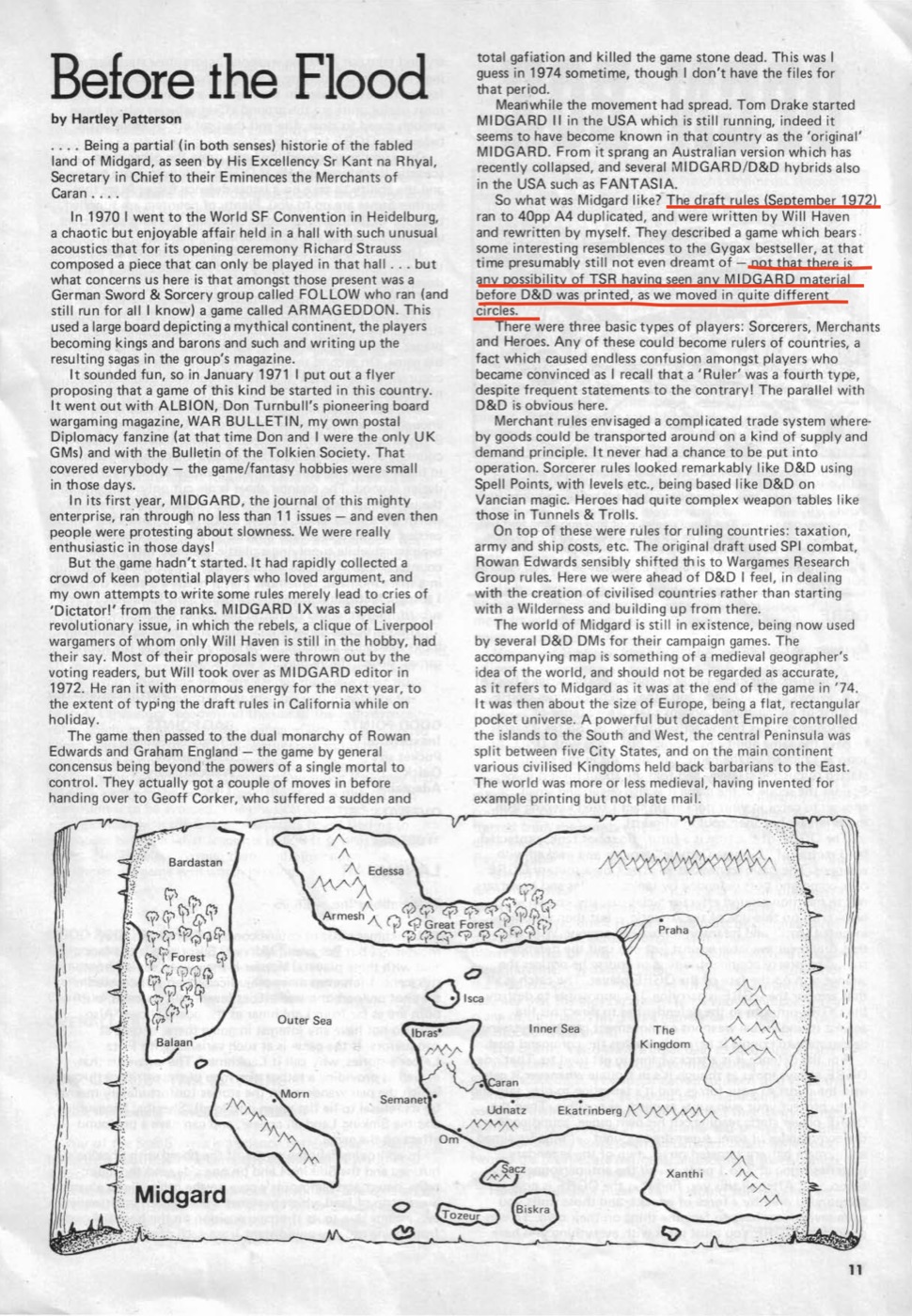
If we assume that Midgard was not an influence until September 1972, the date for RSV falls along the September 1972 - October 1973 time frame. This is still an entire year. But it is the best I can do, lacking the documents from the Arneson estate or better recollections from Fant. I suppose I should reach out to Carr, but I am not that invested in this research. (If anyone has access to this forum with an interview by Havard with Carr, please shoot me a copy. https://blackmoor.mystara.us/forums/showthread.php?pid=5238#pid5238) I find my interest with Richard Snider begins and ends with what was already published in FFC and in Adventures in Fantasy. Powers & Perils is inscrutable to me.
Conclusion
It is tedious to try to reconstruct these things without access to the documents, but enough information has been provided to rule out any long term knock on effects from the Richard Snider Variant rules. I am sure if the whole RSV was shared, it would be fun to play these out and see how things feel. Certainly going back to just flunkies, Super Heroes, Heroes, and Wizards would be eye opening . . . we could come much closer to the table experience in 1971-1972. Publish the documents! We want to be playing at the [Blackmoor] world too!
References Not Already Linked
- Paul Hughes, RPG History: Midgard, Blog of Holding, July 14, 2010, available at https://www.blogofholding.com/?p=265.
- Havard [Håvard Frosta], [Characters] Bishop Carr - First D&D Cleric, Havard’s Blackmoor Blog, January 22, 2011, available at http://blackmoormystara.blogspot.com/2011/01/bishop-carr-first-d-cleric.html#:~:text=Another%20famous%20example%20is%20Richard,%5B…%5D.
- Jon Peterson, Midgard II (1972), the Other Fantastic Medieval Wargames [Campaign], May 14, 2014, available at https://playingattheworld.blogspot.com/2014/05/midgard-ii-1972-other-fantastic.html?m=1.
- Jon Peterson, Spellcasting before D&D in Midgard, October 16, 2017, available at https://playingattheworld.blogspot.com/2017/10/spellcasting-before-d-in-midgard.html?m=1.
- D.H. Boggs, Meet the Baron of Blackmoor, October 2018, available at https://boggswood.blogspot.com/2018/10/meet-baron-of-blackmoor.html.
- Demos Sachlas, The First Fantasy Campaign: Richard Snider’s Additions, OSR Grimoire, November 28, 2020, available at https://osrgrimoire.blogspot.com/2020/11/the-first-fantasy-campaign-richard.html.
- Demos Sachlas, Richard Snider’s Additions: The Dragons, OSR Grimoire, November 29, 2020, available at https://osrgrimoire.blogspot.com/2020/11/richard-sniders-additions-dragons.html.
Originally published on Substack on April 18, 2026.