On Heraldry & Social Class in Early D&D - Part 3
Rodney Hampton
- 20 minutes read - 4208 wordsIs this the flavor that’s missing from your old school game?
Gary Gygax wrote, rather extensively, in both the 1st edition DMG (pp. 88-90) and in Dragon magazine (Issue 25, May 1979) about the perils of incorporating social class into the core rules of the game. In Gary’s mind, this was something that ought to be setting specific. I agree.
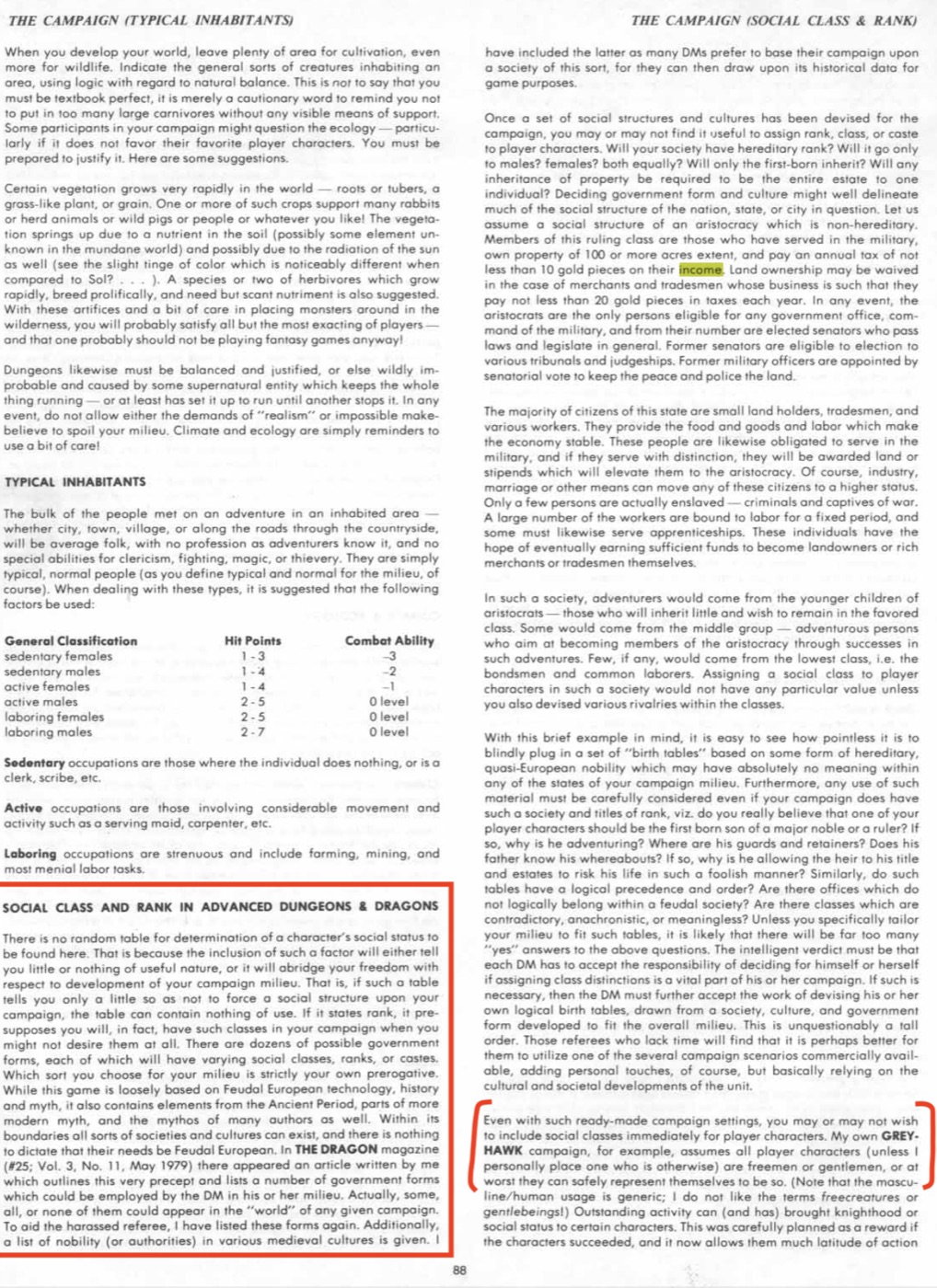
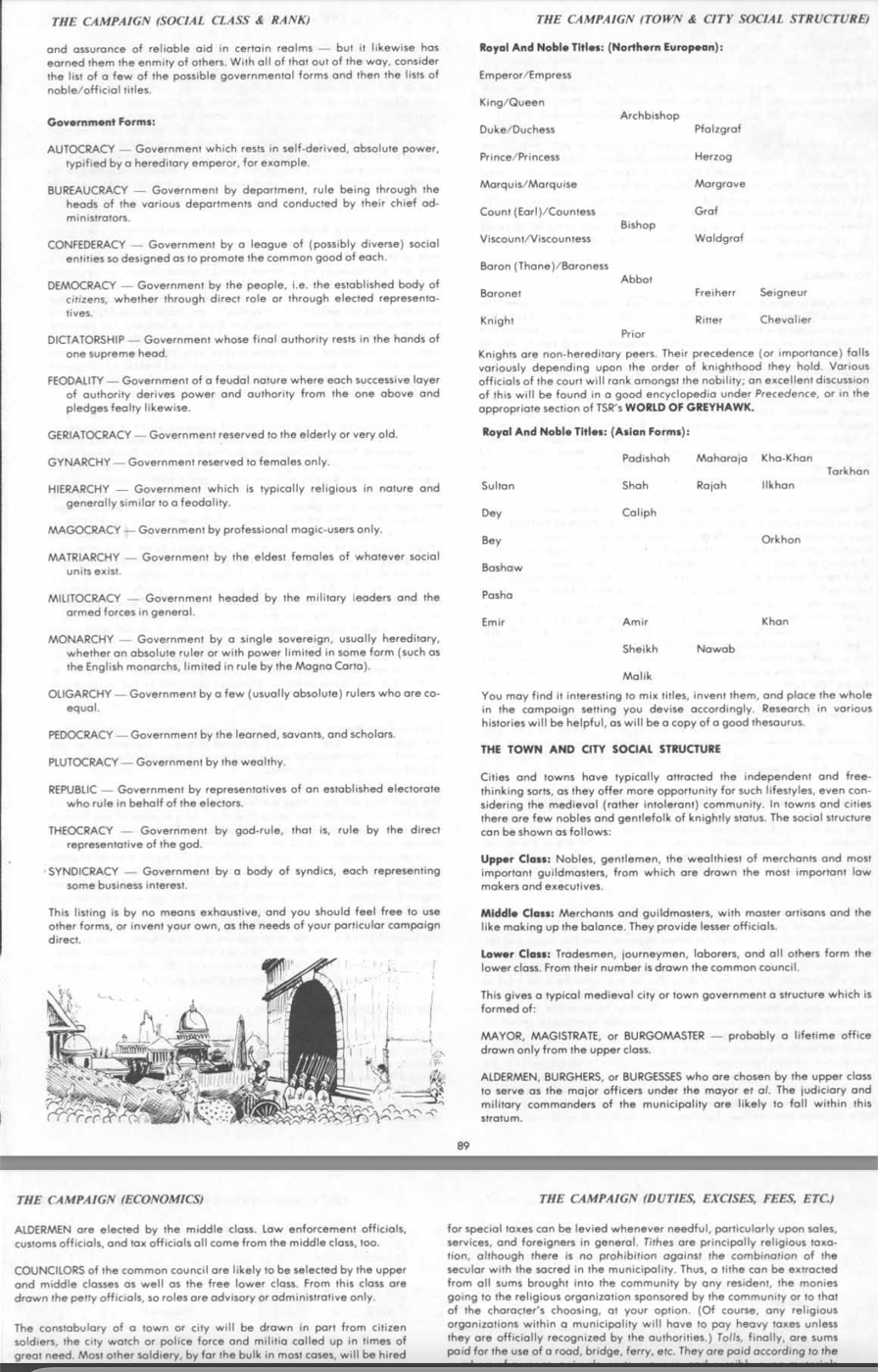
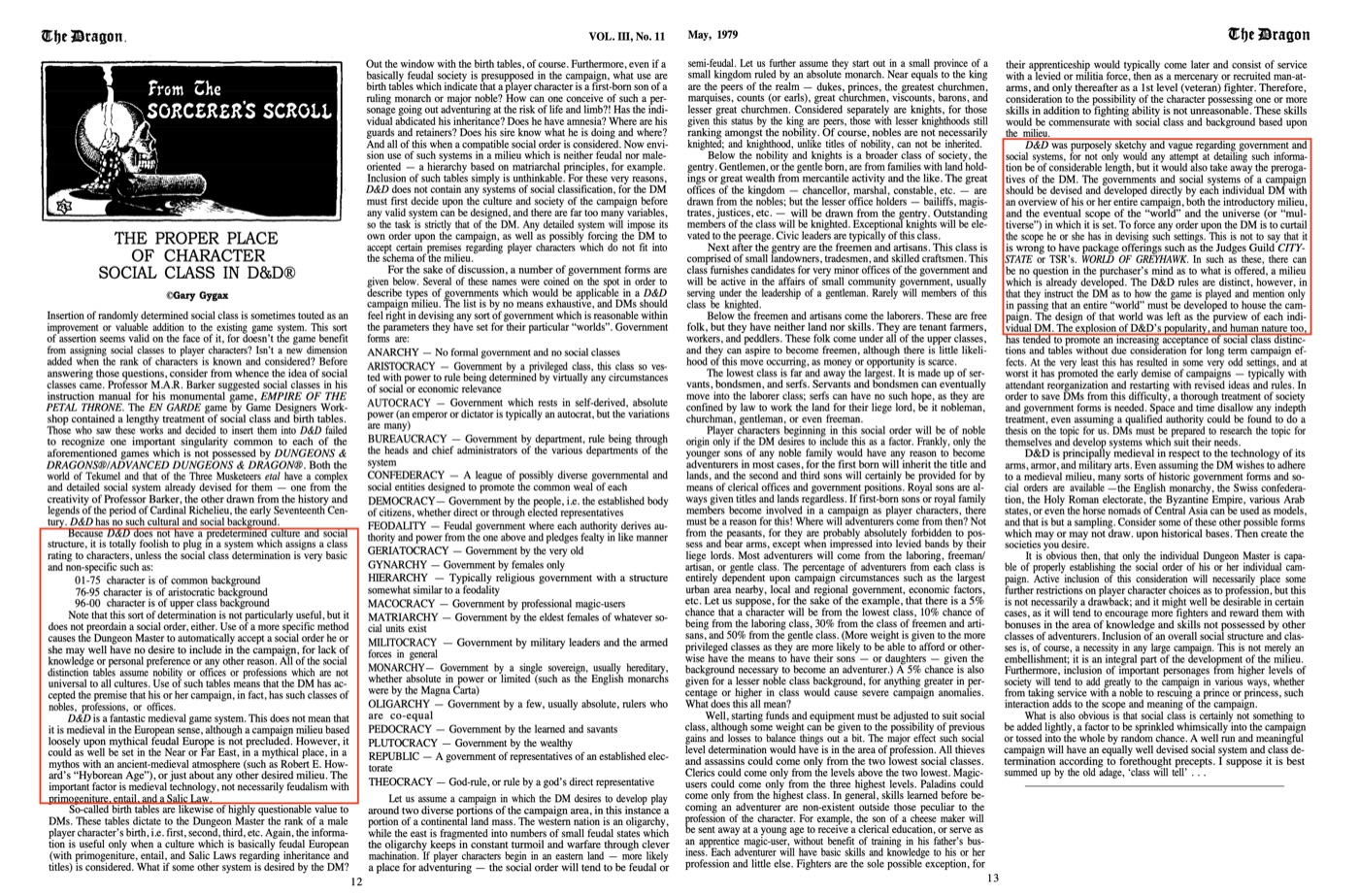
However, Gary did not emphasize that a lack of simulating social hierarchies and status within the hierarchy would open the game up to a great deal of criticism. One common criticism concerns the need to accumulate gold to acquire experience to move upward in the hierarchy. The second criticism is that the progression of character class skills is rather jarring compared to a skill-based system where individuals progress in the skills either by virtue of their continuous use in the game, or else by the direction of the player who has an aim in mind for how his character ought to individuate himself for success. The second criticism has merit. The first criticism does not.
Wealth is, absolutely, necessary to advance within one’s social hierarchy. In the fantasy milieu, wealth can be used to purchase goods (better arms and armor, strongholds, mounts, ships, etc.) as well as services (training, mercenaries, sages, etc.). Wealth is used to buy information and loyalty. And wealth is used to influence, to carouse, to invest in one’s domain, and to advertise one’s own deeds and accomplishments.
Level Titles
As early as Chainmail 1st edition (March 1971), a distinction was made between normal men (“flunkies” as they were called in the Twin Cities) and the Heroes and Super Heroes who could dominate the battlefield. Wizards might have alternate titles like Sorcerer or Warlock but no mechanics were included to differentiate these figures.
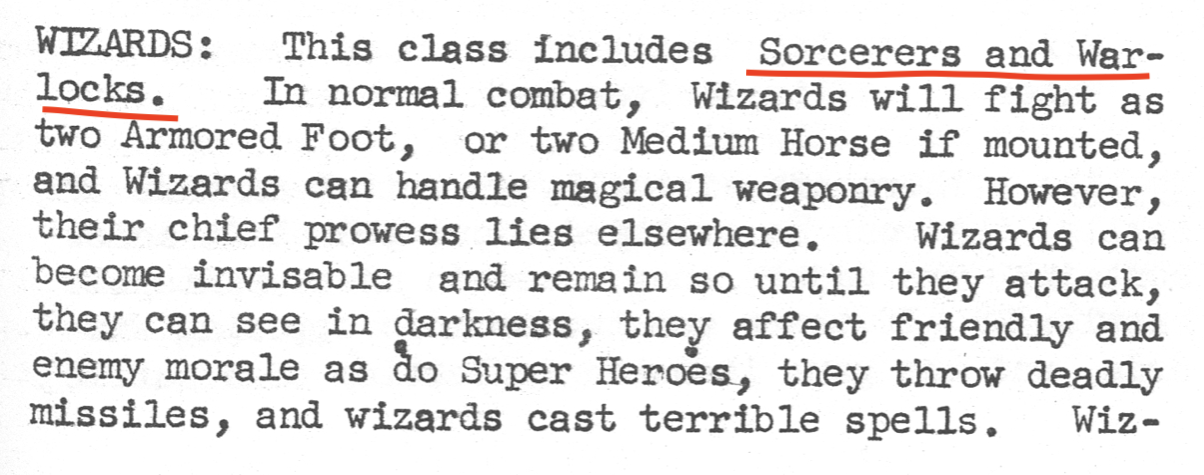
By Chainmail 2nd edition (1972), Wizards (proper) were distinguished from “Sorcerers at -1, Warlocks at -2, and Magicians at -3” where the dice rolls for lower levels were penalized in fantasy combat.
When original Dungeons & Dragons (OD&D) was published in 1974, each of the three core classes had its own set of titles, allowing a character to proclaim who he was. A Magic-User could call himself “Tim, the Enchanter” and people might understand the potential capabilities such a title implied. Likewise, a Fighting-Man calling himself “Goliath, Champion of the Philistines” or “Menesthius, Myrmidon in Achilles’ company” and have a measure of the man.
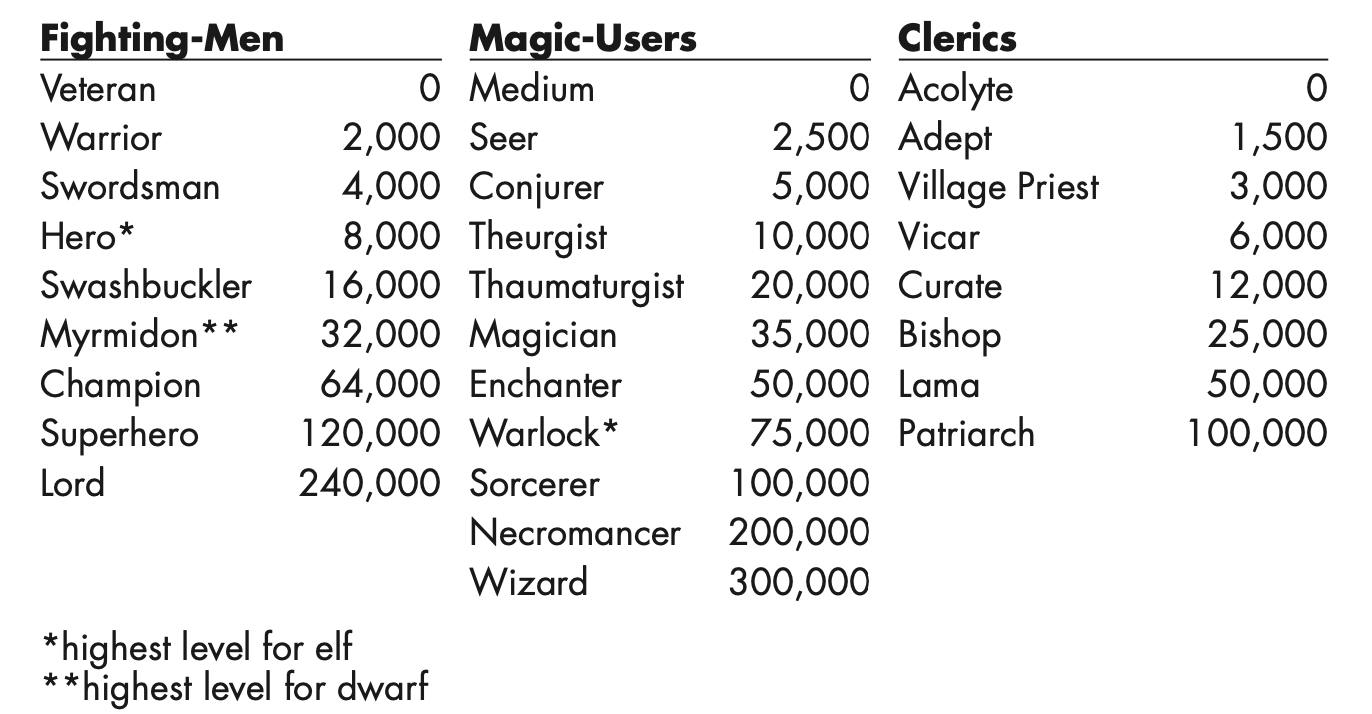
In Arneson v. Gygax (a 1973 draft of OD&D), we see scratched out a set of clerical titles (Vicar, Curé/Curate, Abbé/Abbot) that would have been more flavorful and avoided the “Lama.” Bah! In the other 1973, Beyond This Point Be Dragons (BTPBD) the progression looks like OD&D (this is one clue that this portion of BTPBD was developed later than the same section of the Arneson v. Gygax draft).
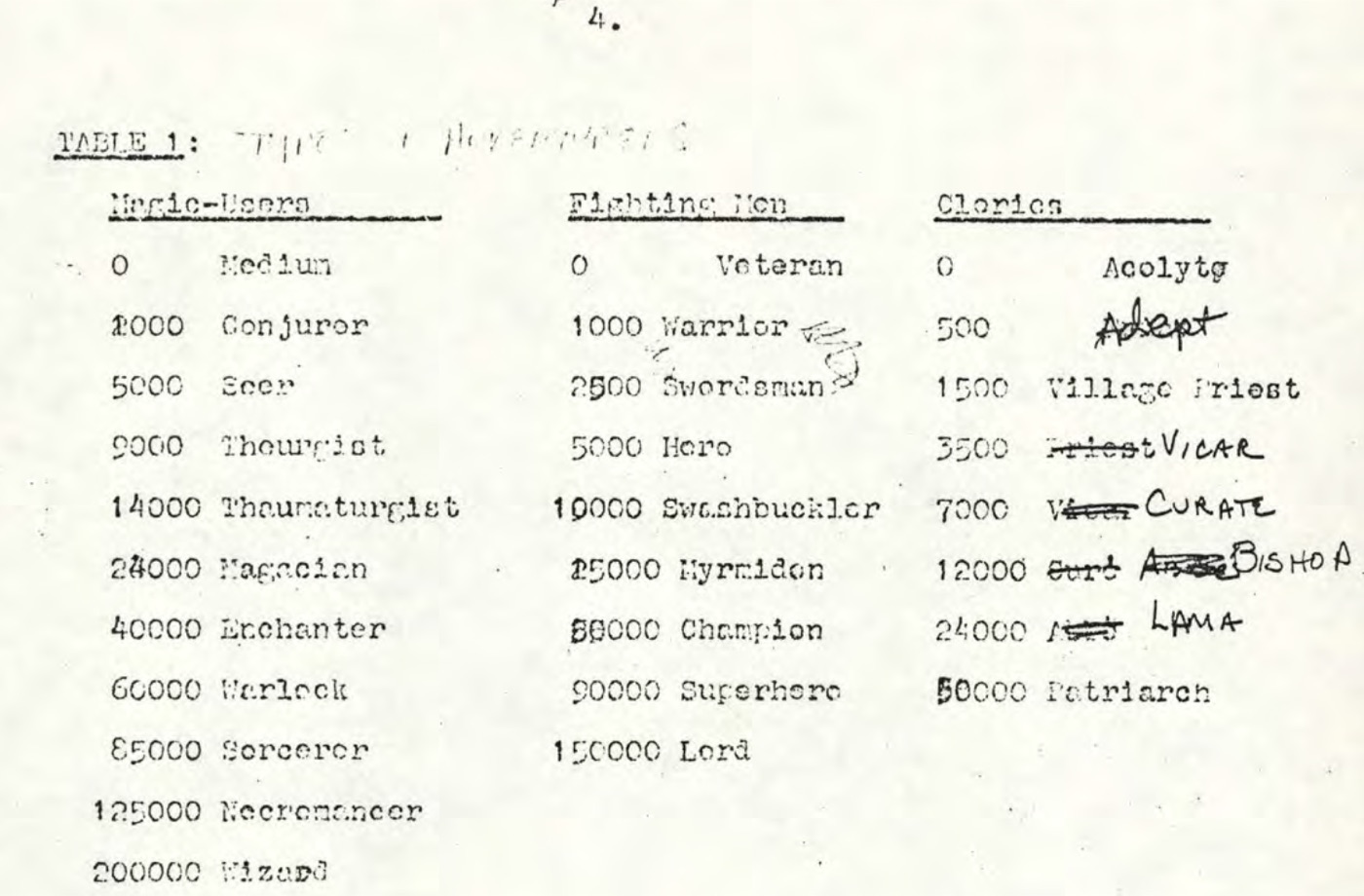
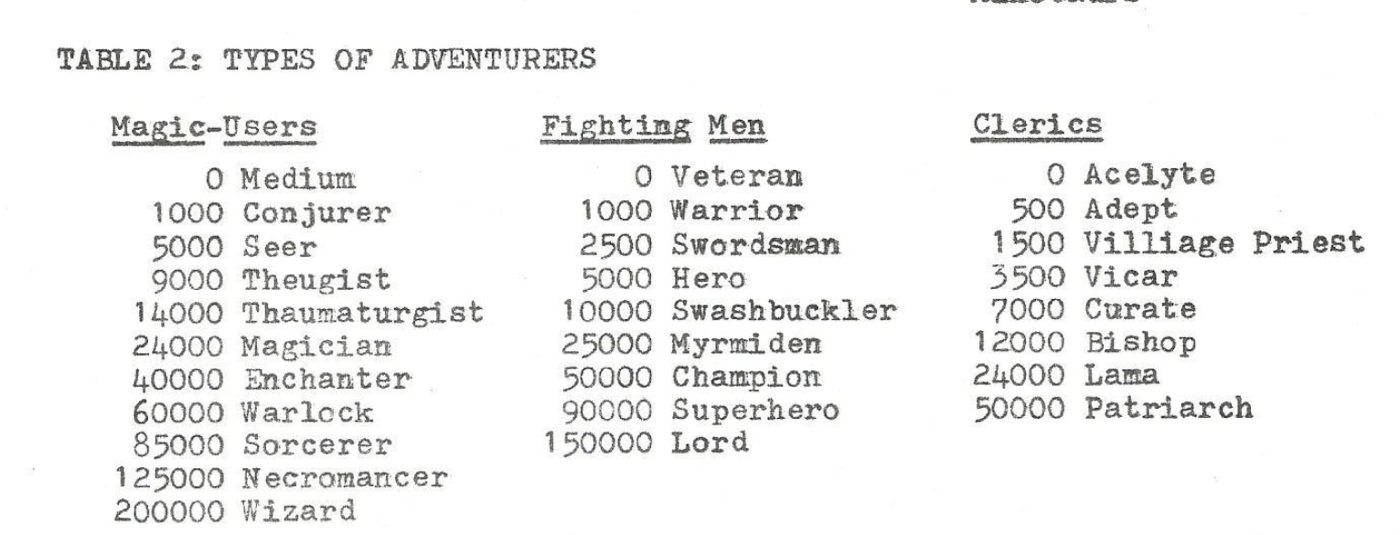
Incidentally, when Chainmail 3rd edition arrived in 1975, the Seer was added. This can only mean that Chainmail was meant to accommodate low level Magic-Users joining a mass combat with all that this entails: “WIZARDS (including Sorcerers at -1, Warlocks at -2, Magicians at -3, Seers at -4).” Spell complexity was also added with an interface to these level titles. Fascinating!
Nobility
As we saw in part 2 of this series, in early editions of Dungeons & Dragons there is a loose coupling between the Fighting-Man’s 9th level title “Lord” and the ability to receive the title “Baron.” This loose coupling of nobility and experience level is directionally sound. Although a man may, through feats of arms, be considered a “Lord” among men (and probably has followers and hangers-on), nobility is associated with feudal rights and obligations and tied to a patch of land.
Greyhawk
As Gary explains on p. 88 of the 1e DMG, “My own GREYHAWK campaign . . . assumes all player characters . . . are freemen or gentlemen.” Gygax, of course, has some exceptions to this general rule. Looking at p. 80 of the 1983 version of the World of Greyhawk, Appendix II, we see that Gary has created ten social classes with sub-categories within those classes. Freemen are in class 9, while Gentlemen are in class 8.
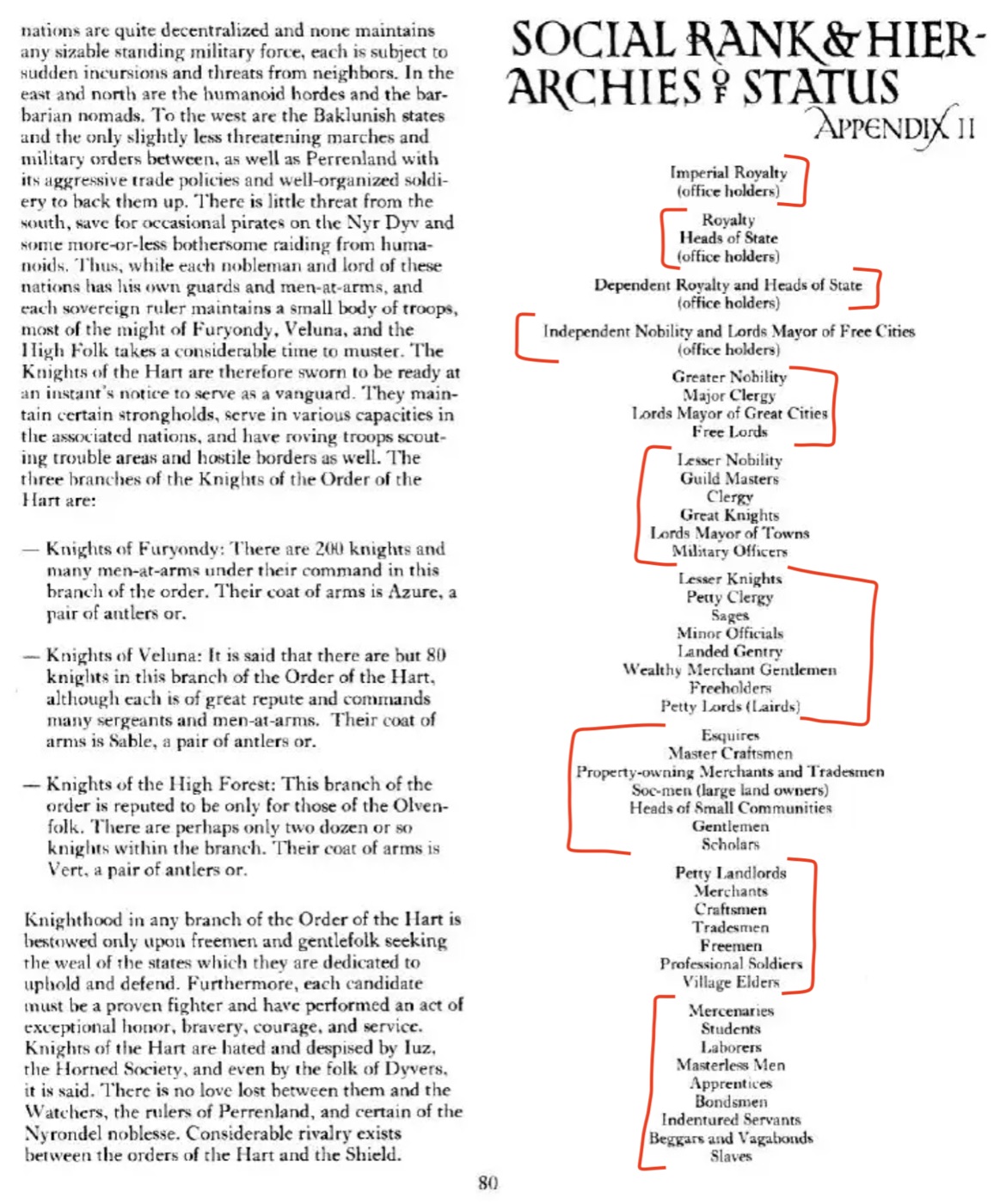
At the bottom of the left column of the page, Gary provides rules for any freeman or gentleman to achieve a Knighthood and improve their condition to class 7 (assuming the Order of the Hart is a set of Lesser Knights. I believe, due to white space on this page and the separate categories of Lesser and Great Knights that there is a distinction of class within the overall category of “Lesser Nobility.” But I could be wrong.
Judges Guild
Independent publisher Judges Guild was initially given carte blanche to produce modules and settings compatible with Dungeons & Dragons. Judges Guild published the massive City State of the Invincible Overlord in 1976. The somewhat overlapping Ready Ref Sheets were produced first as a set of loose-leaf sheets in 1976, and subsequently as a booklet in 1977. These tables, oracles, and rules provide a bolt-on system that pairs nicely with both OD&D and AD&D 1st edition. There are up to twenty Social Levels (including a “god” tier at SL20). There are also six different Hierarchies: Noble, Gentlemen, Military, Guildsman, Merchant, and General. A Freeman is SL4 within the General hierarchy, while a member of the Gentry is SL6 within the Gentlemen hierarchy.
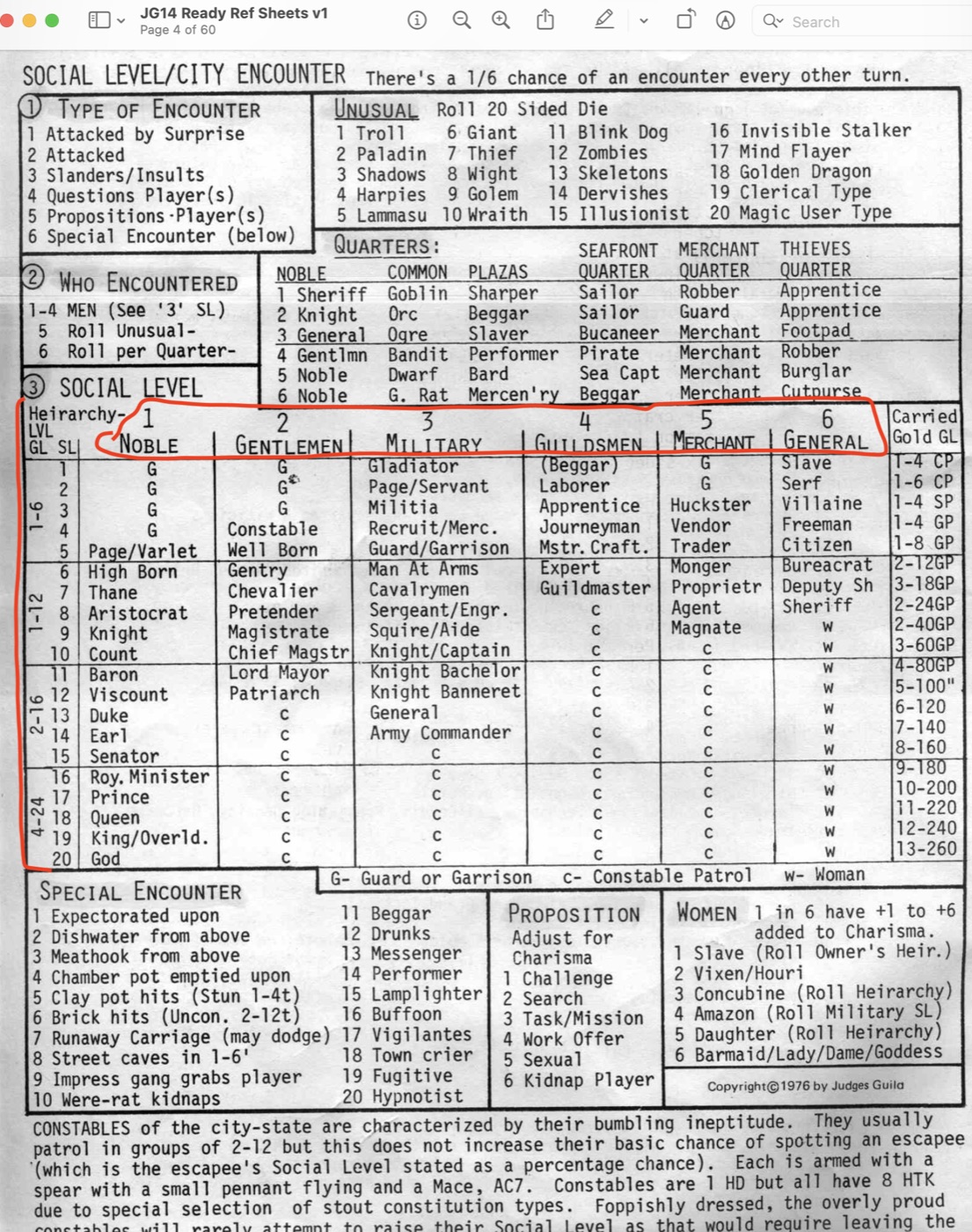
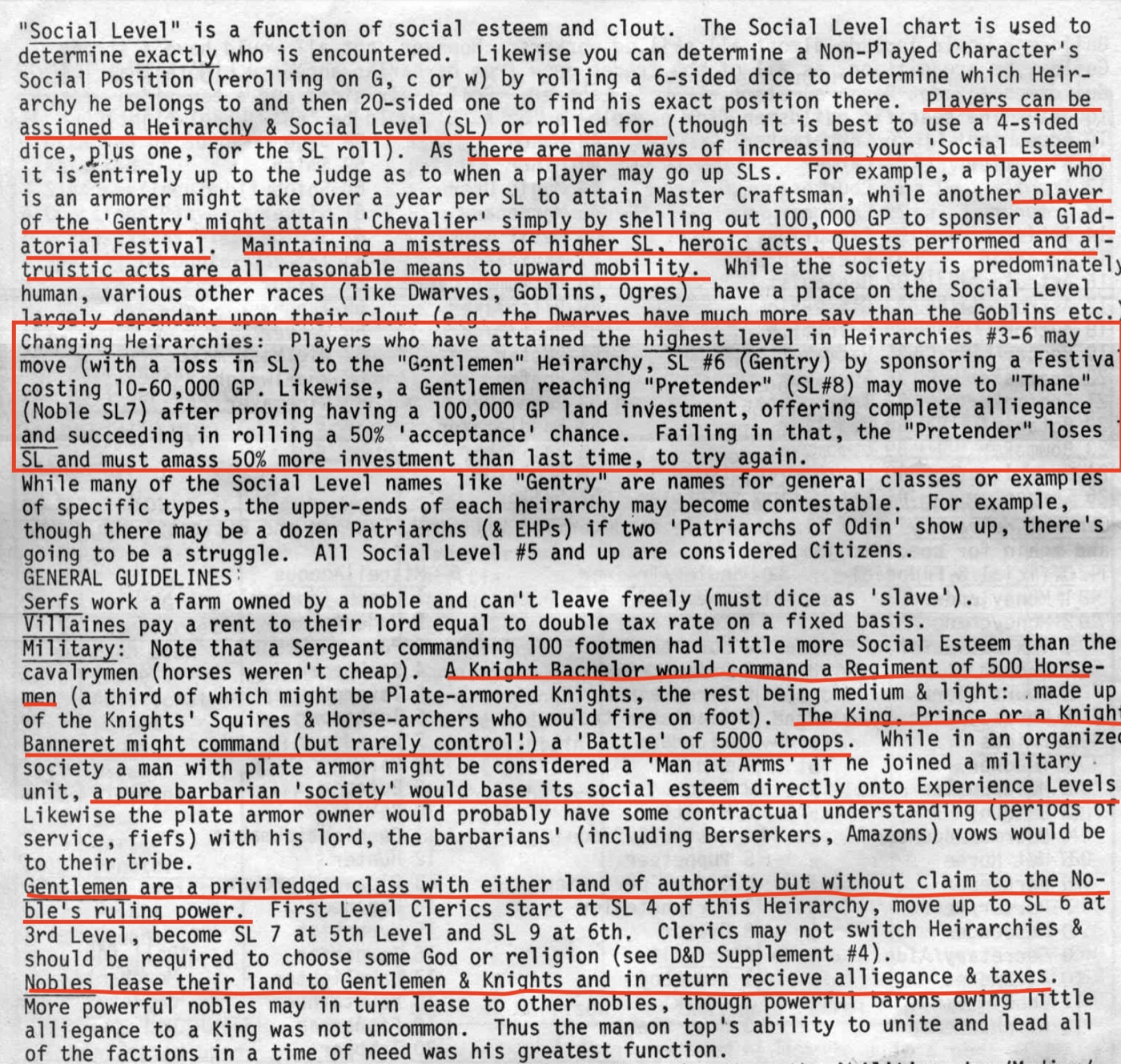
The Referee is given guidelines for initial Social Level, how a character can move up in Social Level within a hierarchy, and even how a character can hop over the wall into another hierarchy. This pattern, again, makes it clear that wealth, property, and deeds on the battlefield and homefront are all necessary components to simulate human society.
Empire of the Petal Throne
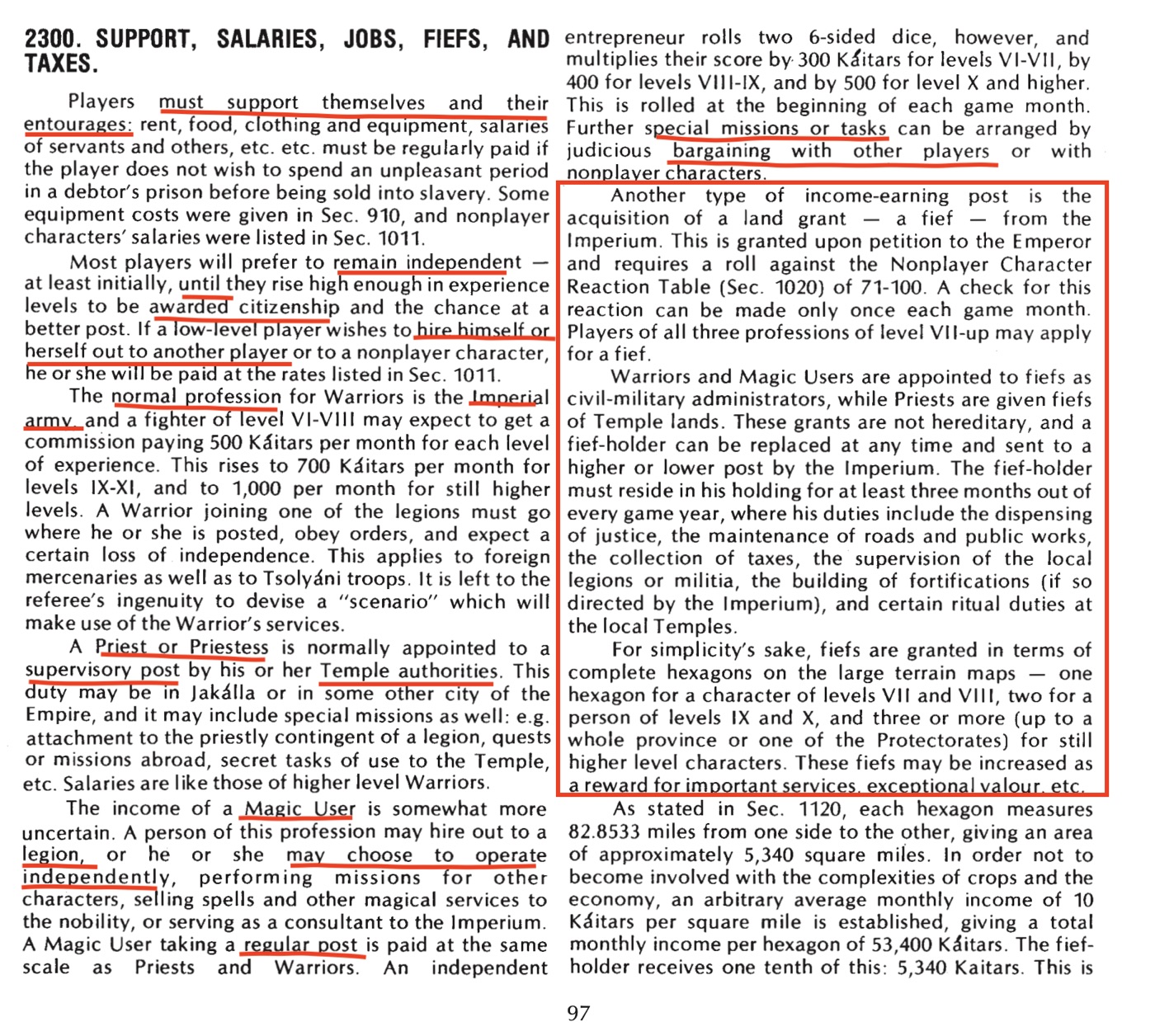
TSR published Professor M.A.R. (Phil) Barker’s Empire of the Petal Throne (EPT) as a boxed set in 1975. Barker had previously self-published these materials in 1974. This manuscript is actually available via DriveThruRPG. I have not yet purchased it to see what design secrets it holds. Barker had begun working on his fantasy world many years earlier when he was an undergrad. He was in the Twin Cities and Dave Arneson actually played in Barker’s Tekumel campaign (and vice versa IIRC). EPT is a combination of rules and setting. The rules diverge from OD&D in several ways, but have a great deal of compatibility. They are well organized. Within EPT, each adventuring class is treated as a “profession” with titles for each level of experience (p. 15). Other professions fall into three larger social classes: Plebeians, Skilled [Workers], and Nobles (p. 27). There are career paths unique to each adventuring “profession” that tie in with the level progression (p. 97). Domain play is covered as well, giving different types of fiefdoms to Warriors, Magic-Users, and Priests.
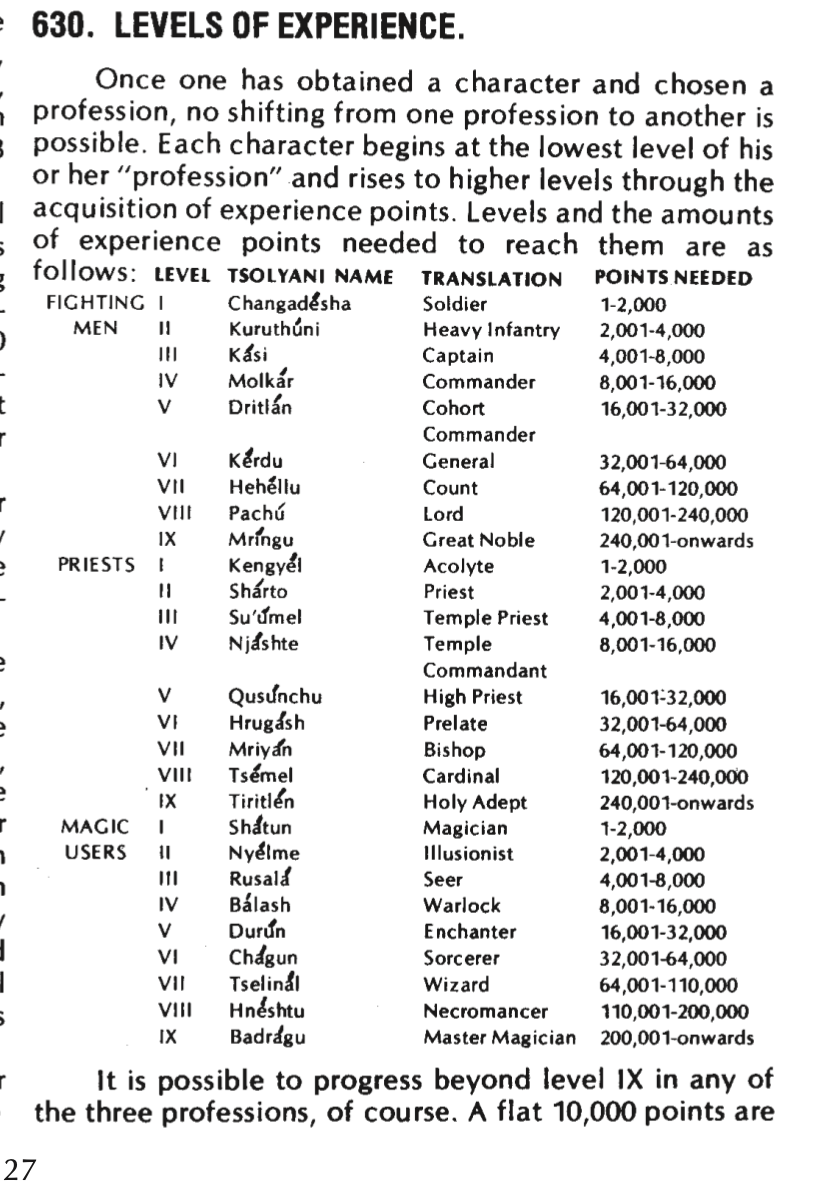
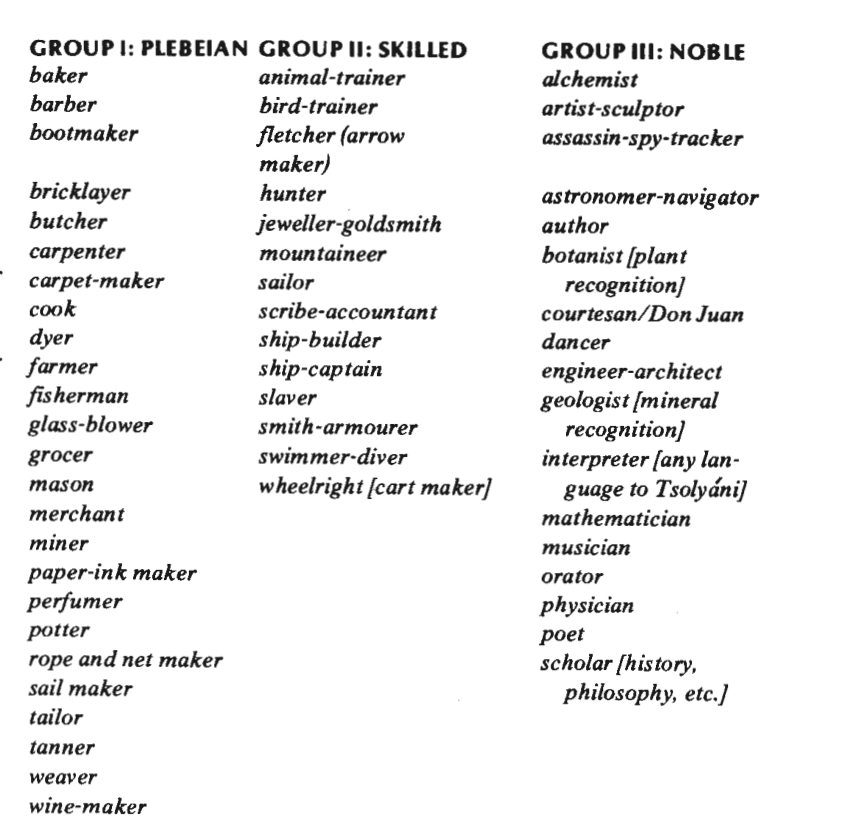
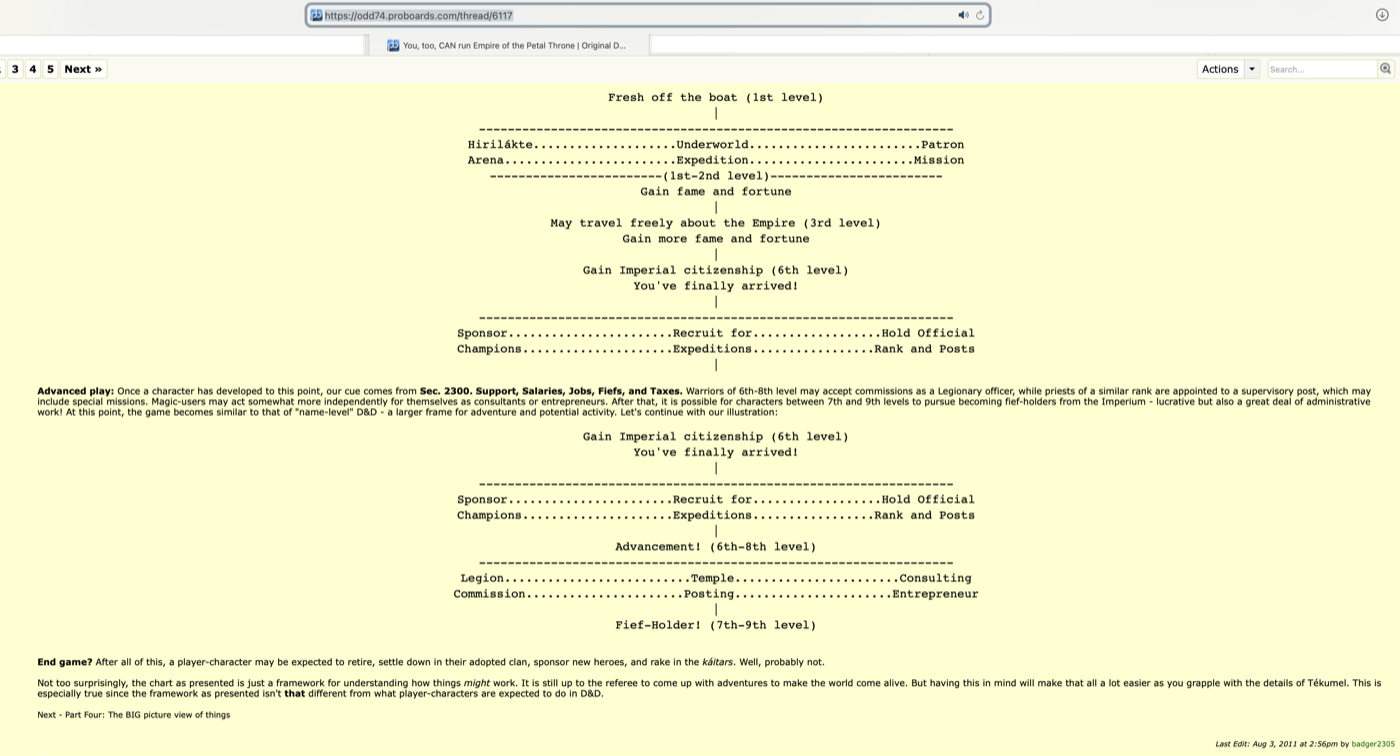
Although this system seems simple enough, there is one blog post that captures how players should expect things to play out for a character who survives a long-running campaign in the world of Tekumel (Cf. badger2305, You, too, CAN run Empire of the Petal Throne, August 3, 2011 available at https://odd74.proboards.com/thread/6117).
FFC
David Arneson’s notes from his Blackmoor campaign were accumulated and published in 1977 by Judges Guild as The First Fantasy Campaign Playing Aid (FFC). Within FFC there are a lot more titles of nobility than people probably realize. Apologies if the page number referenced or summaries are off-base. This was produced by having Claude (Opus 4.6) re-analyze the FFC text.
King
- King of Vestfold — Title held by Ra-All after his promotion; the castle then fell to “the Weasel” [David Wesely]. p. 21
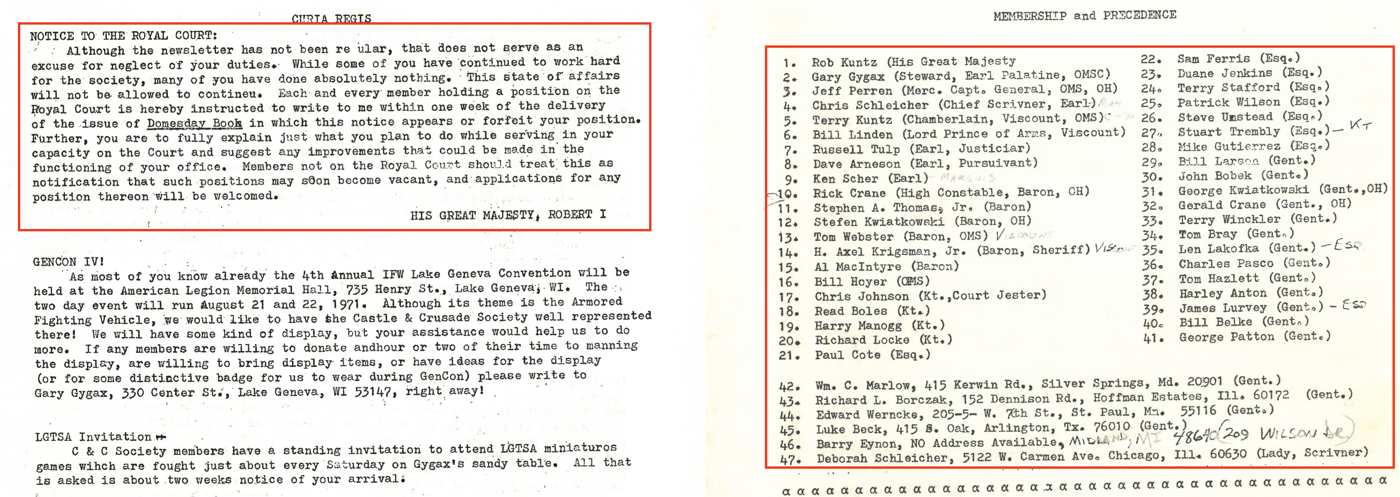
- Robert I, King of all Geneva — Historical king during whose reign Blackmoor Castle was built. p. 21 [This is a reference to Robert Kutz who was made head of the Castles & Crusades Society. See Domesday 9 image below.]
- Funk I, King of All the Orcs — Named on the bronze tablet at the entrance to the Orcian Way in the Dungeon. p. 28 [This refers to player Fred Funk]
Duke / Duchy
- Duke of the Peaks (also “Lord Whitehead, the Abominable Snowfreak”) — Infamous side-switching character; originally sided with the Ran of Ah Fooh. p. 16 (Infamous Characters)
- High Duke — Title of the Ran of Ah Fooh, who is listed in the Table of Contents as “High Duke of the Duchy of Ten.” p. 13 (ToC listing); p. 14 (character description)
- Duchy of Ten — Player-controlled faction with a budget of 100,000 GP. pp. 4, 7, 9
Earl
- Earl of Vestfold — Major Good faction army commander; 12,000 army points, 351 Men, 10 Heroes; rules Tonisborg (15 Villages = 30,000 people). pp. 4, 6, 8
Baron
- Baron Fant — Commander of Blackmoor Castle after the first Coot invasion. pp. 13, 17
- Baron Jenkins — Rules the northernmost march of the Great Kingdom on the frontier with the Egg of Coot. p. 13 (military manpower table); p. 17 (Facts about Blackmoor)
- Baron Ra-All (Ra-All the Wise) — Former holder of Blackmoor Castle, later promoted to King of Vestfold; the Castle passed to “the Weasel” [David Wesely] after him. p. 21 (Castle History)
- Balfred the Bald — Referenced as a former Baron of Blackmoor who kept a Jungle Beast in “The Lair” haunted room. p. 23 (Haunted Rooms)
- Baron Alveraz — Headless ghost in the Tower, killed in a Barbarian attack. p. 21
- “The Bloody Duke” / “the Dog Duke” — A sadistic former Baron/Duke who used the dungeon as a torture chamber. Spirit said to haunt the Catacombs. p. 21
- Eight Baronies at Start listed in Richard Snider’s section: Barony of Patursia, Barony of Kusan, Barony of Koda, Barony of Rizzo, Barony of Chulan, Barony of Kankiang, Barony of Monkai, Barony of Relaco. p. 58 (doc 3568, p. 26)
Knight or Paladin
-
Sir Jenkins — The same Baron Jenkins above is also referred to as “Sir Jenkins.” p. 17
-
Sir Fang — “Originally a 9th level Fighter (Dave Fant) that fell prey to a Vampire and didn’t get away.” Now a Vampire haunting the dungeon, appearing as a wandering monster on Level 1, Quadrant A. p. 29 (Blackmoor Dungeons section); also referenced in the Wandering Monster Area note on p. 30 (”Players rolling a wandering monster in Quadrant ‘A’ will have encountered ‘Sir Fang’!”) and the Level 1 Wandering Monster table p. 30.
-
The Great Svenny — “Long time pal of the King and First Paladin of the Kingdom.” p. 17 (doc 134 image p. 19)
Other Titled Rulers
- Regent of the Mines (Dwarves) — Neutral faction; 6,000 army points. pp. 4, 9
- Lord Calvin — Referenced in the Gray Room haunted room account. p. 23
- Lord Alfred — Referenced in the Secret Room haunted room account. p. 23
Land Holdings
Aside from the town overlooked by Blackmoor Castle, there were several additional land holdings held by the players. Again, hat tip to Claude for teasing out this list.
Svenson’s Freehold — A small keep built in the early days of the campaign, destroyed in the second fall of Blackmoor and then rebuilt. This belonged to player Greg Svenson.
Svenny’s Freehold (distinct from above) — Greg Svenson “built Svenny’s Freehold with the help of the Blue Rider, Mello, and the Bishop to stand guard over the road through Wolf’s Head Pass." Described as being razed during the Siege of Blackmoor and recently rebuilt. p. 17, image on p. 19
Player John Snider held an area on the Outdoor Survival board that “was covered in a deadly yellow mist (no one knows what happened inside John’s area and no one has come out!)" after being wiped out. p. 11
Richard Snider held a separate area on the Outdoor Survival board; “The expedition to the home of Father Dragon that took out both Sniders, although an offspring took over Richard’s holding." p. 11
Players Dale Nelson and Pete Gaylord lost their holdings “going evil” following the expedition to the City of the Gods (located in the Desert south of [Chuck] Munson’s old place). p. 11. Pete Gaylord played the famous Wizard of the Wood whose Hut was on the campaign map, east of Blackmoor, surrounded by mist-filled woods. “Pete got wiped out after about two years when he went to The City of the Gods," and each new Magic User gets a chance to take over Pete’s old position. p. 19
These titles and territories probably were created by Arneson on the fly, though there is some precedent within the old Castles & Crusades society for more active members to receive higher honors (Cf. Domesday 9, Castles & Crusades Society, [c. Jan - Mar, 1971], pp. 20-21).
Adventures in Fantasy
David Arneson and Richard Snider teamed up to write their own role playing game in 1979. Adventures in Fantasy (AIF) received lukewarm reviews and is a bit of a monster to wrap your head around. But, there are clearly elements from the early Blackmoor campaign that both men wanted to highlight or expand upon. Every player begins with a starting number of status (S) points and an associated position (p. 15). For example, a Knight has 10 status points. One’s position in society also alters the amount of starting wealth and also may provide a guaranteed income. A player’s starting age further adjusts these numbers (p. 16). The players in the game self-sort into a social hierarchy where those in higher positions, such as a Baron, can send others on Quests or missions. As these are completed, status points are accrued until one rises in position. However, the subordinate player may not rise to the same level (or greater) than the patron under which he performs. There is just enough meat on the bones here to set the system in motion, but not much explanation of how this would work in play. Presumably players could switch patrons when status and ambition dictate.
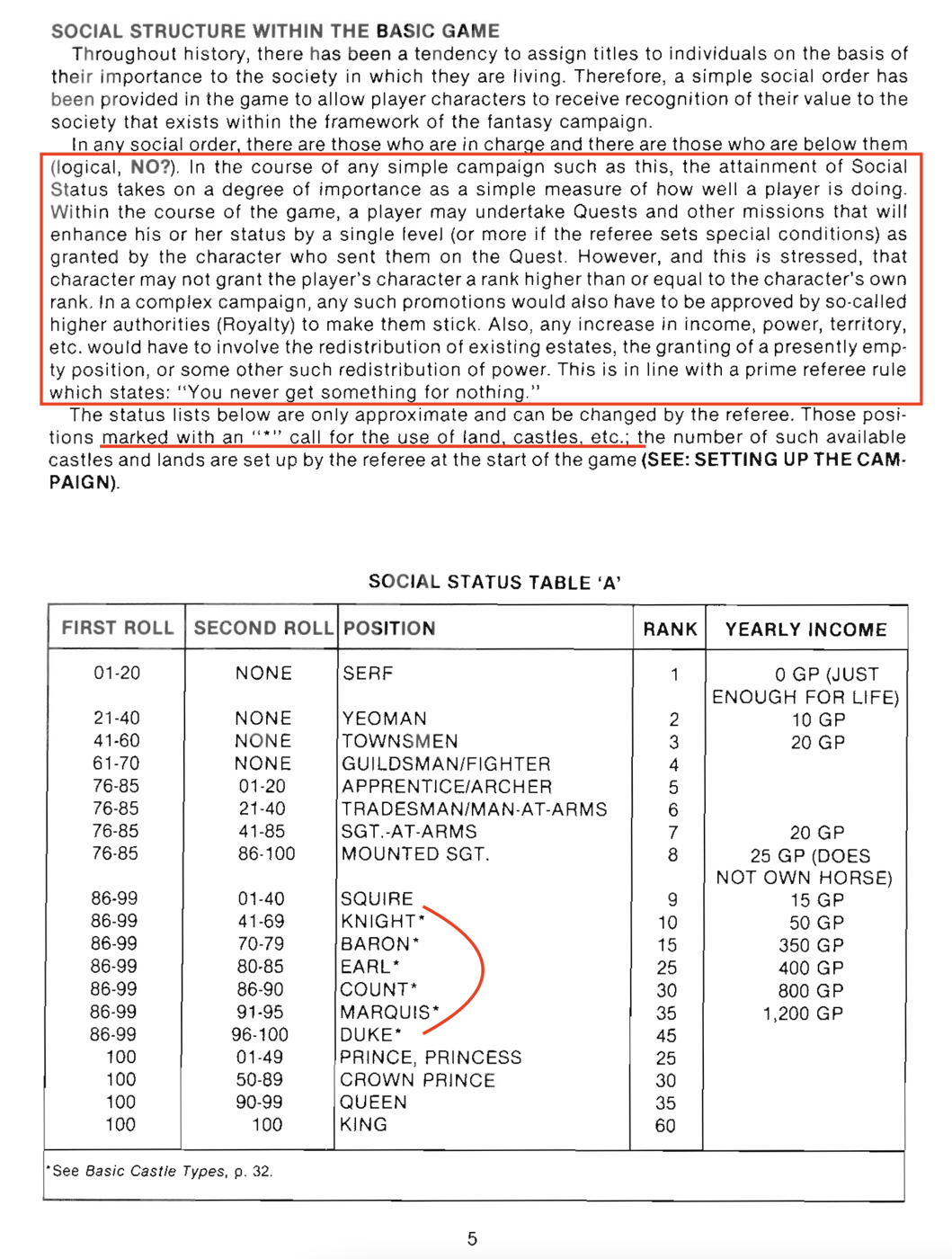
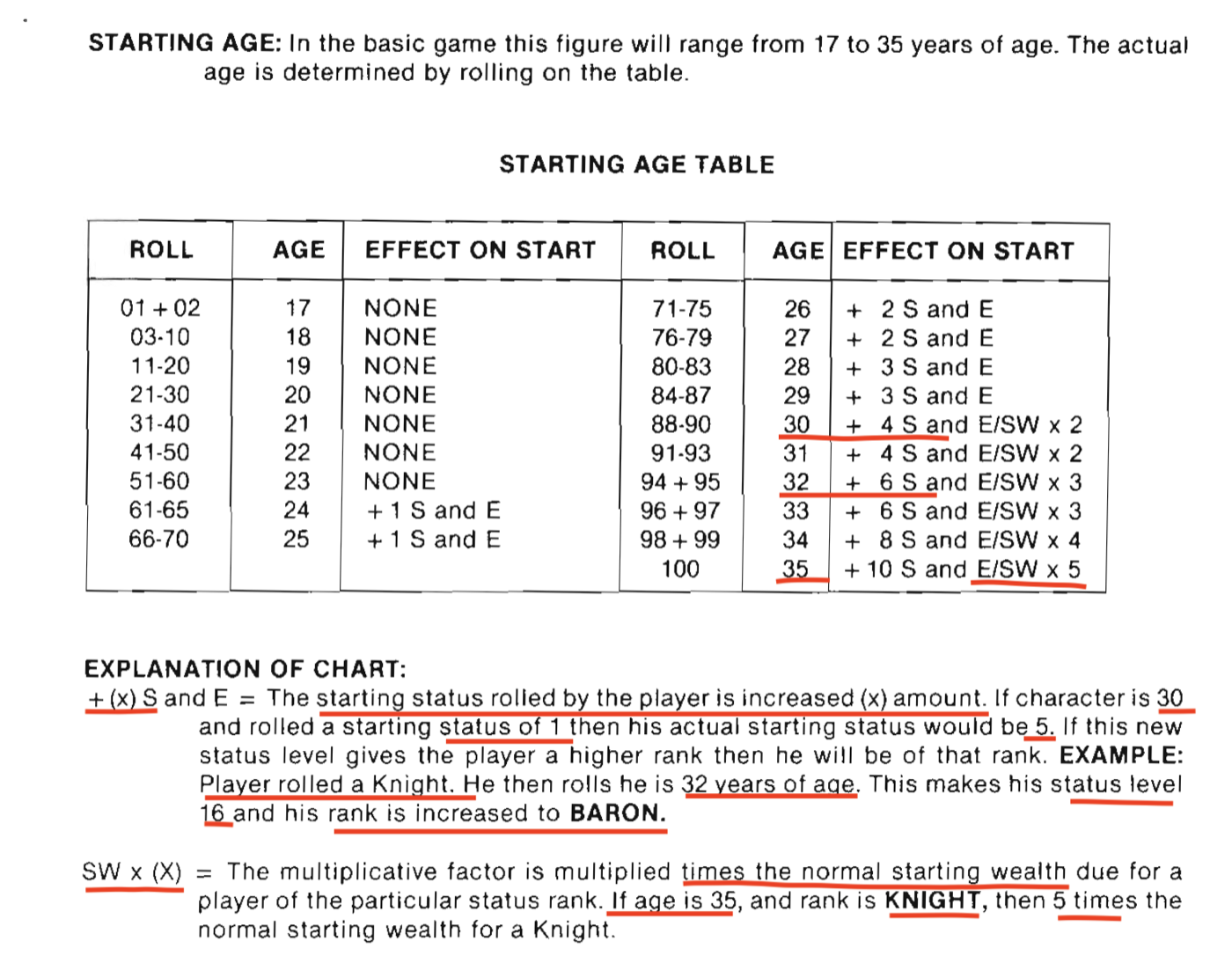
Neither the “Setting Up the Campaign” section, nor the “Bleakwood” example referenced by it describe how the Referee should set up holdings or strongholds as promised on p. 5 shown above.
Hackmaster 4th edition Players Handbook
Through a series of fortunate accidents, in 2001 the founders of Kenzer & Company were able to create a parody of the 1st edition AD&D rules and several famous modules from TSR’s early days. Although this is the first edition they published, they called it 4th edition. There is a related tie in with Jolly Blackburn’s Knights of the Dinner Table comics (poking fun at RPGs and gaming culture). The fictional head of the gaming company that allegedly produces Hackmaster is none other than Gary Jackson (a combination of Gary Gygax and Steve Jackson). But, the best part is that Hackmaster 4th edition has an analogue for the core 1e books including a Player’s Handbook (PHB), GameMaster’s Guide, a multi-volume bestiary (the Hacklopedia of Beasts), along with numerous expansions including one on the pantheons of “Gawds,” and even a book on fortifications. Kenzer & Company went beyond a simple comedic bit and created an homage to 1e with a degree of seriousness that might astound you. Underneath some of the ridiculousness (such as a set of instructions on how to roll dice and a d-1000 critical hit table), there is a playable core game here.
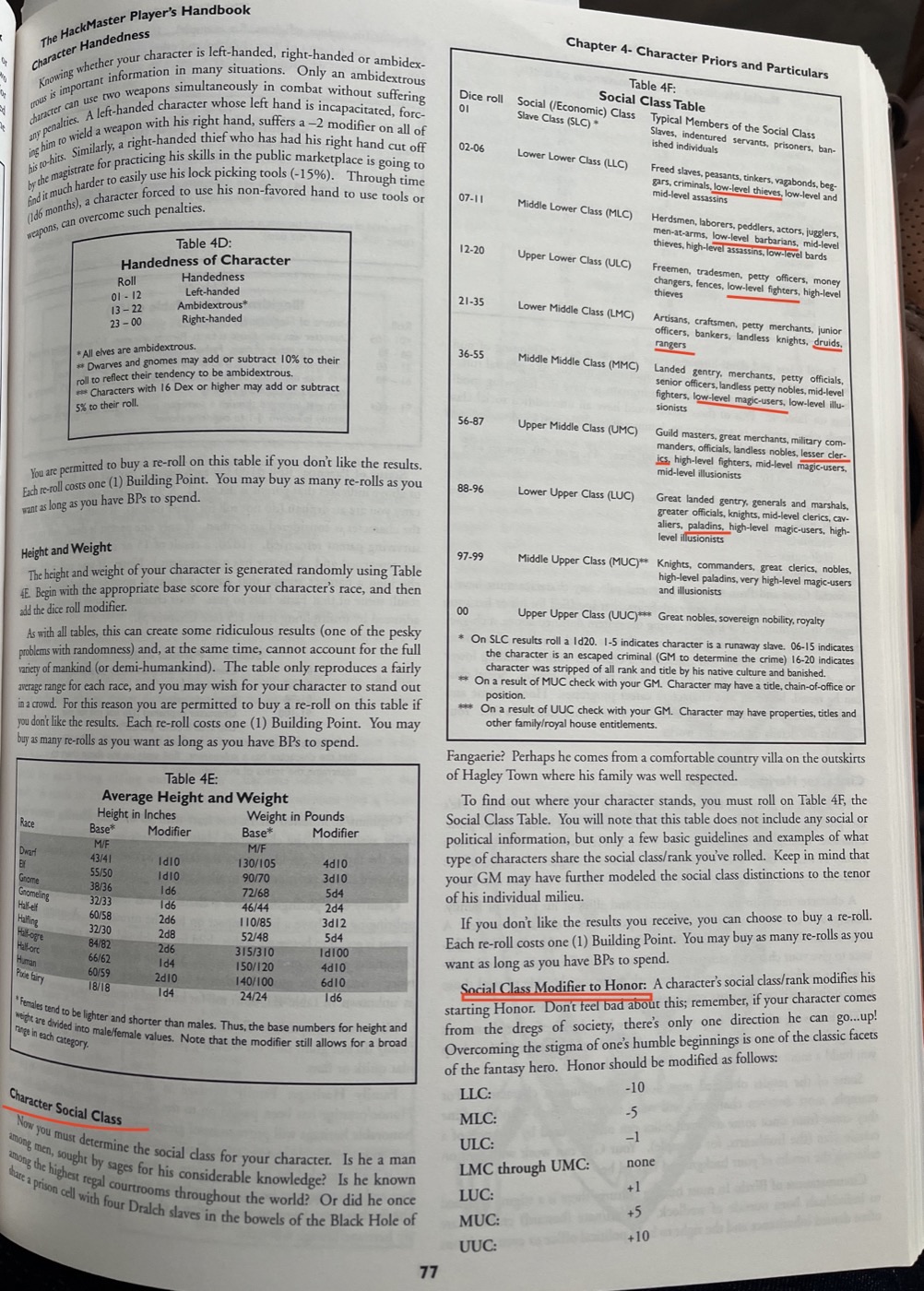
Social Class
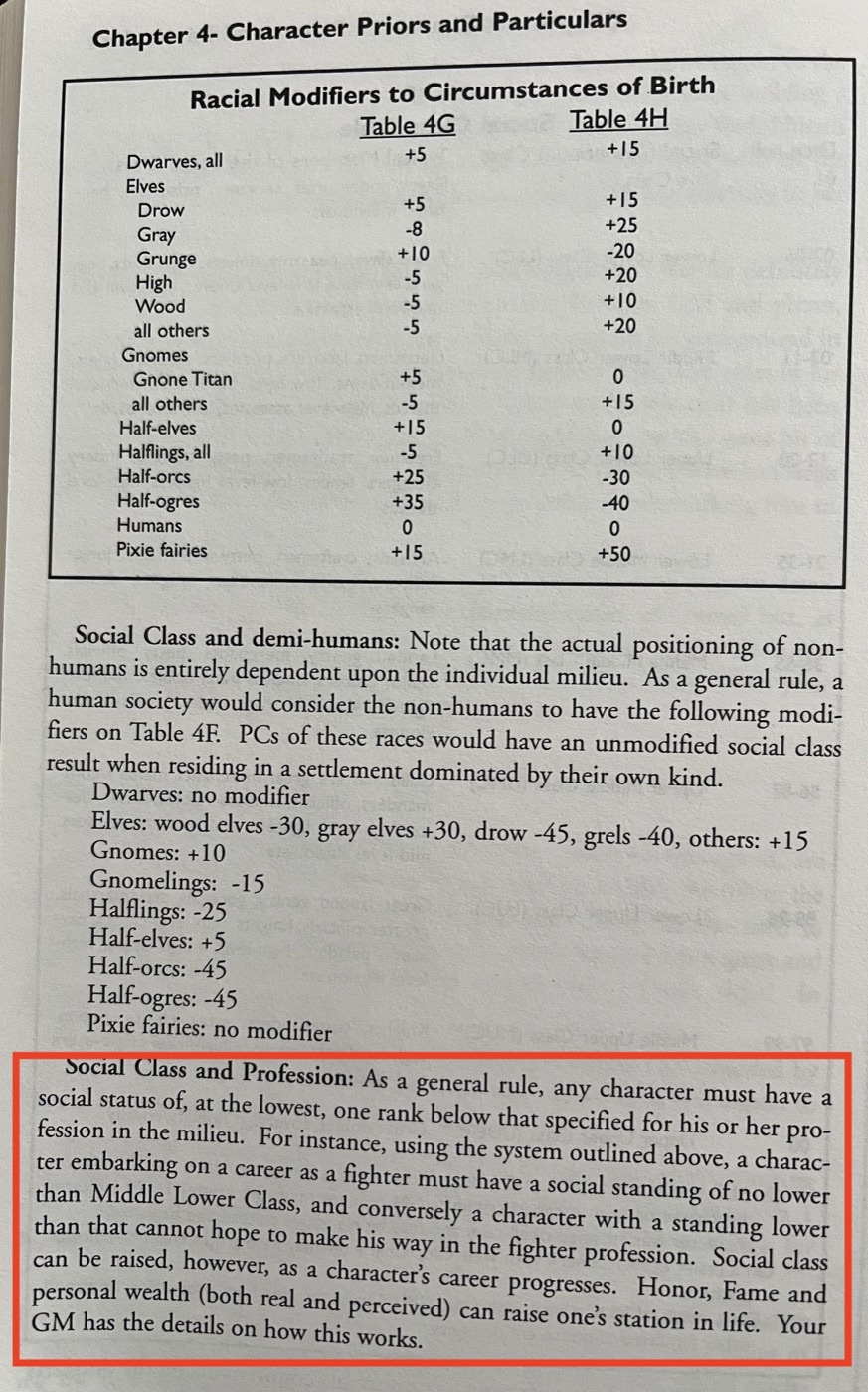
Hackmaster (Cf. PHB pp. 77-79) has ten social classes with the lowest consisting of indentured servants, slaves, prisoners, and exiles to Upper Upper Class consisting of greater nobles, sovereigns, and other royalty. Social Class modifies a character’s initial Honor. Fame and social class are interrelated as well (see below). Social Class is a gateway to being able to play a particular class at a particular level of experience. While you might be able to get away with playing a lower-level thief as a member of the second-lowest social class, you could not play a fighter. Experience levels are broken out into low-level/lesser level, mid-level, high-level, and very high-level.
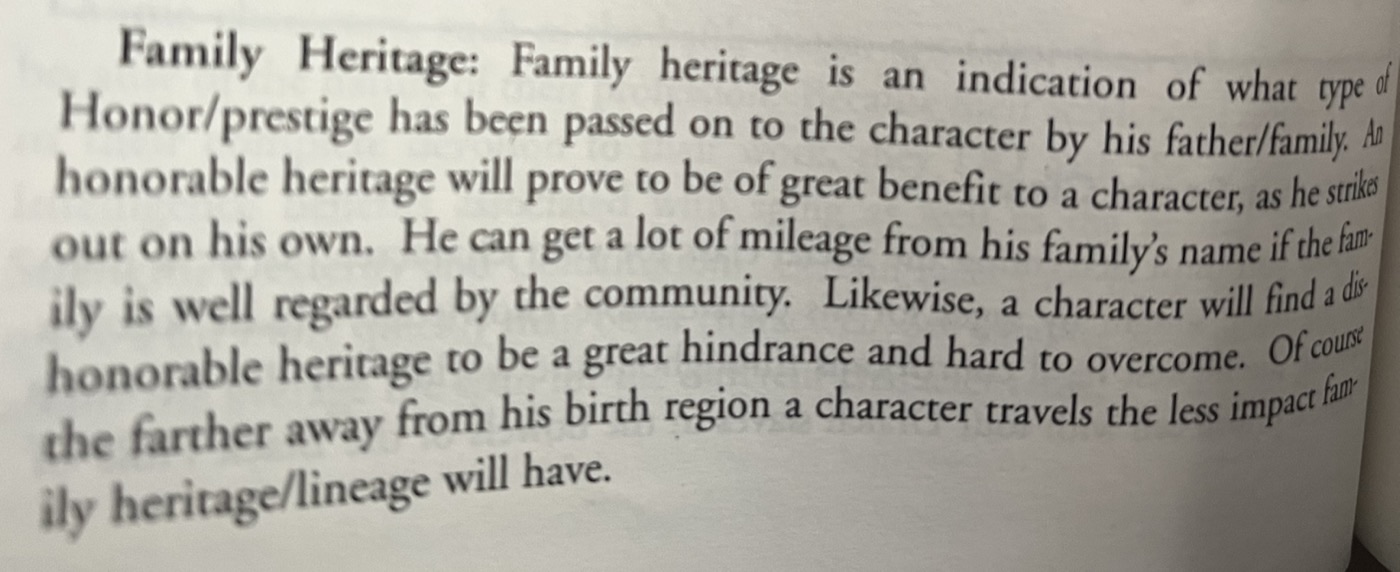
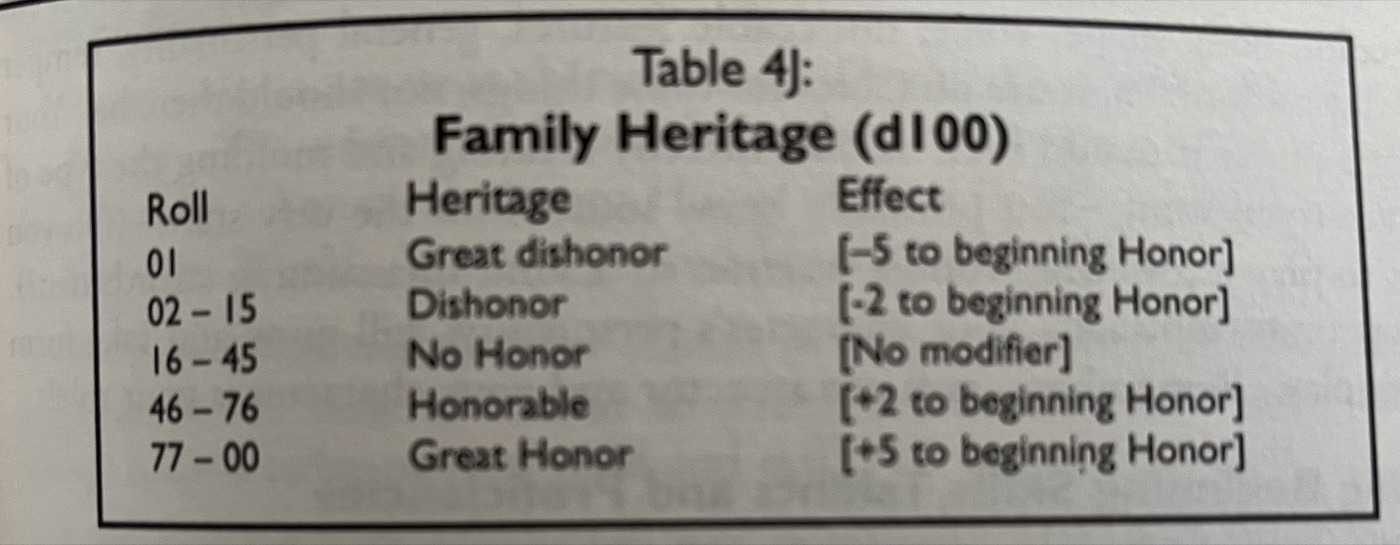
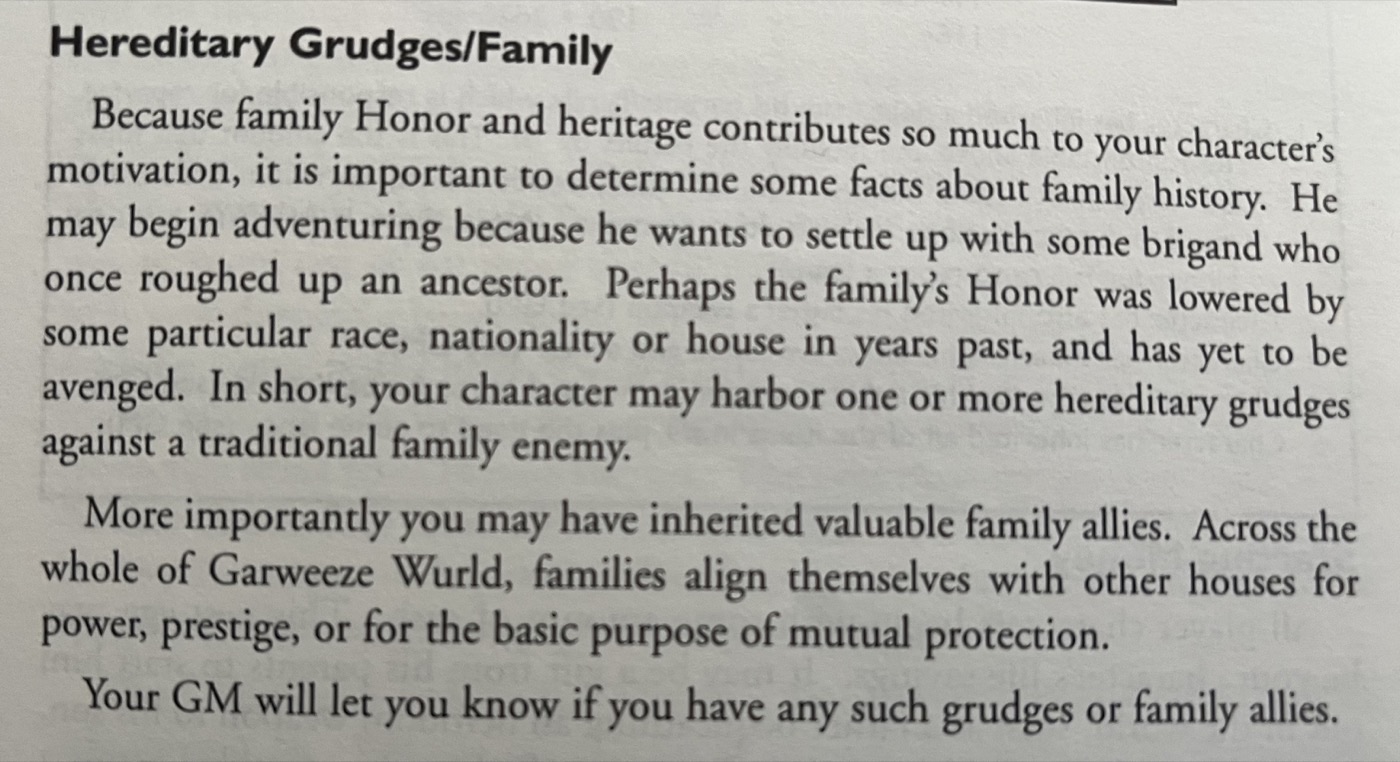
Social Class is modified by (fantasy) racial heritage and family. Furthermore, the family’s own honor and backstory can add further complications.
Honor and Fame
Within the PHB there are seven pages (pp. 81-87) devoted to Honor and Fame. Characters begin, rightly or wrongly, with differing levels of Honor. The character’s initial social class modifies this score. An illegitimate peasant begins with much lower Honor than the legitimate son of a merchant, for example. For a character to increase to the next level of experience, he must have accumulated a certain degree of Honor. The Referee can grant Honor or dock it at the end of a gaming session based on a number of factors. One example is that an adventurer returning to town after a delve might be down to a single hit point, but if the town drunk harangues him and he does not defend his honor, he will get docked.
An adventuring party can have its own Honor (reputation) as well. So insults to the group, or daring exploits, can affect the Honor of the individuals in a group as their individual honor is averaged and then each member is moved 1 point toward that average periodically.
A character might be capped on accumulating further Honor if he gets tagged with Bad Karma (a disconnect between his actions and his internal moral compass). Bad Karma requires an amends before Honor can again accrue to the character.
A character of lower Honor can “steal” honor from someone above them. One way to do this is via dueling.
A character with enough Honor (compared to his level) is given a +1 pip advantage on all rolls and a single “mulligan” (re-roll) during the session. On the other hand, a character whose Honor score has fallen too low is “dishonorable” and has a -1 pip penalty for all rolls.
A character with (10 x level of experience + 10) Honor points is operating at a level of hubris above his or her station. And if this is not brought into balance, the Gawds themselves might take an interest in taking the adventurer down a peg or two. A player could intentionally have his character perform dishonorable acts. However, the game gives players a mechanism to “burn” off 10 points of excess Honor by adding his Honor Dice (yes, there is a table for this) to some other dice roll like a saving-throw or combat roll. (The rules let a player burn Honor whether he has an excess or not). A character can also “purge” all of his honor to avoid a situation entirely such as when a dragon decides to blast him with fire.
There are rules for Infamy, Oaths, and Honor Checks too. And, presence is a combination of one’s Charisma attribute plus a roll of his Honor Dice. Presence can be combined with skills such as Oratory or Negotiation to sway crowds or individuals.
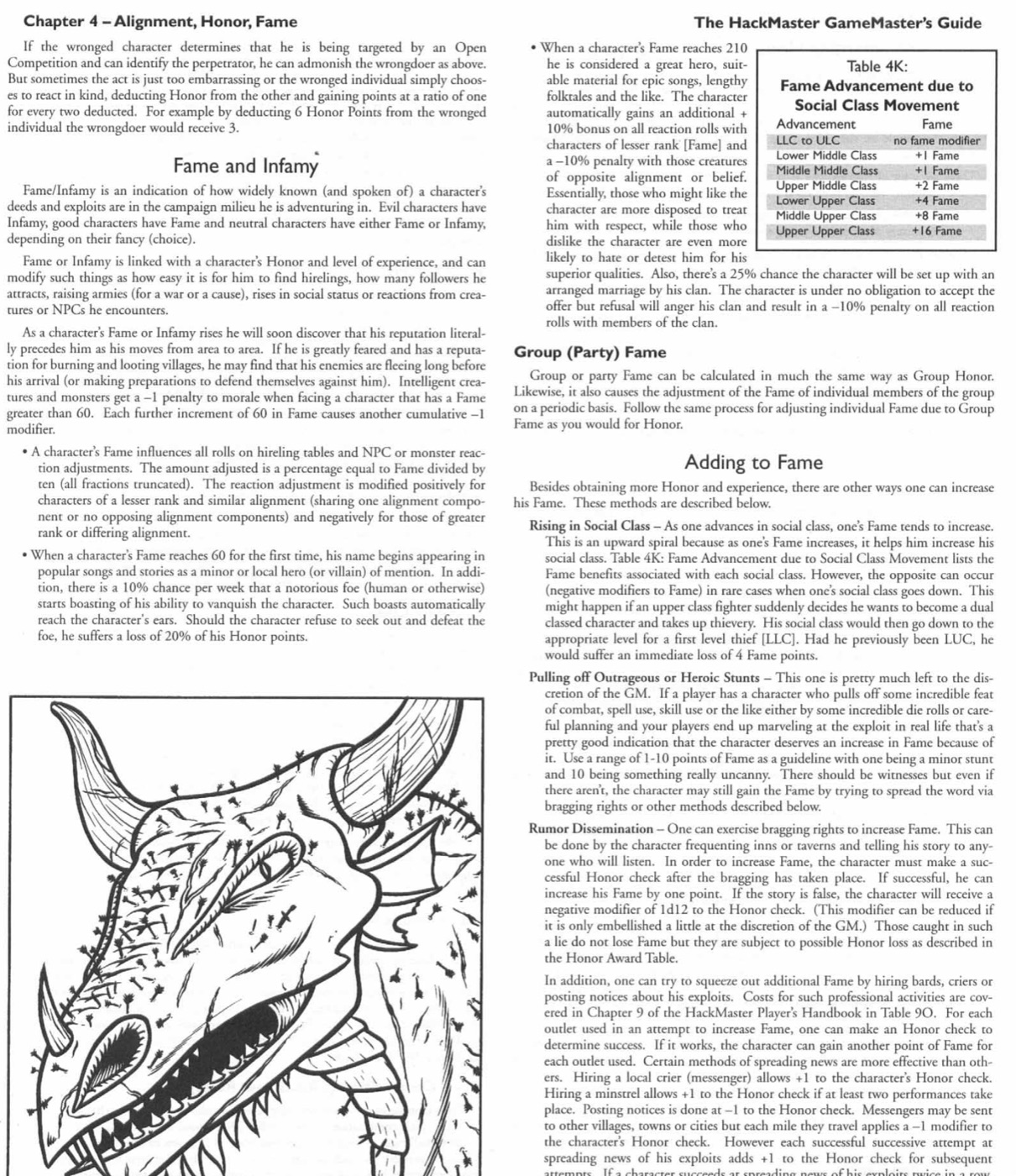
The Hackmaster GameMaster’s Guide (GMG) goes into further detail about all of the topics related to Honor (Cf. pp. 56-62). More importantly, Table K on p. 62 describes how Fame affects social class. Fame, per the PHB p. 86, is calculated using a simple formula: ( Honor x Level / 10 ).
Hackmaster has a lot of ideas, but the sheer number of things to track during a gaming session is already overwhelming. As with any seasoning, one should salt to taste. My own belief, without having played this game RAW, is that this subsystem would be jettisoned mid-session or only occasionally given the attention it deserves. I am showing this to you so that you might consider paths other game designers have taken. I won’t talk about Bushido, Chivalry & Sorcery, or other games not related to Dungeons & Dragons with the exception of En-Garde! below.
Oriental Adventures
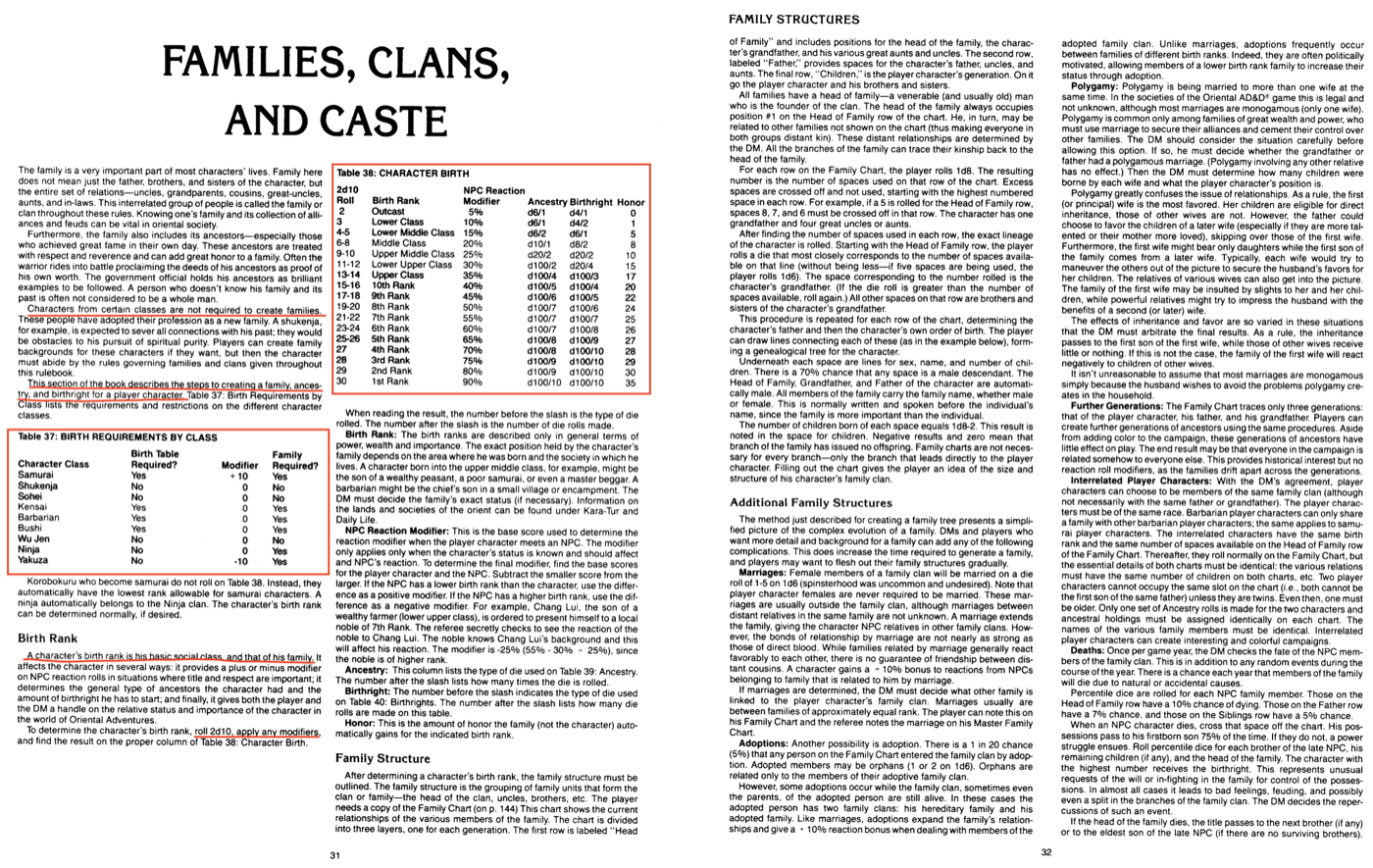
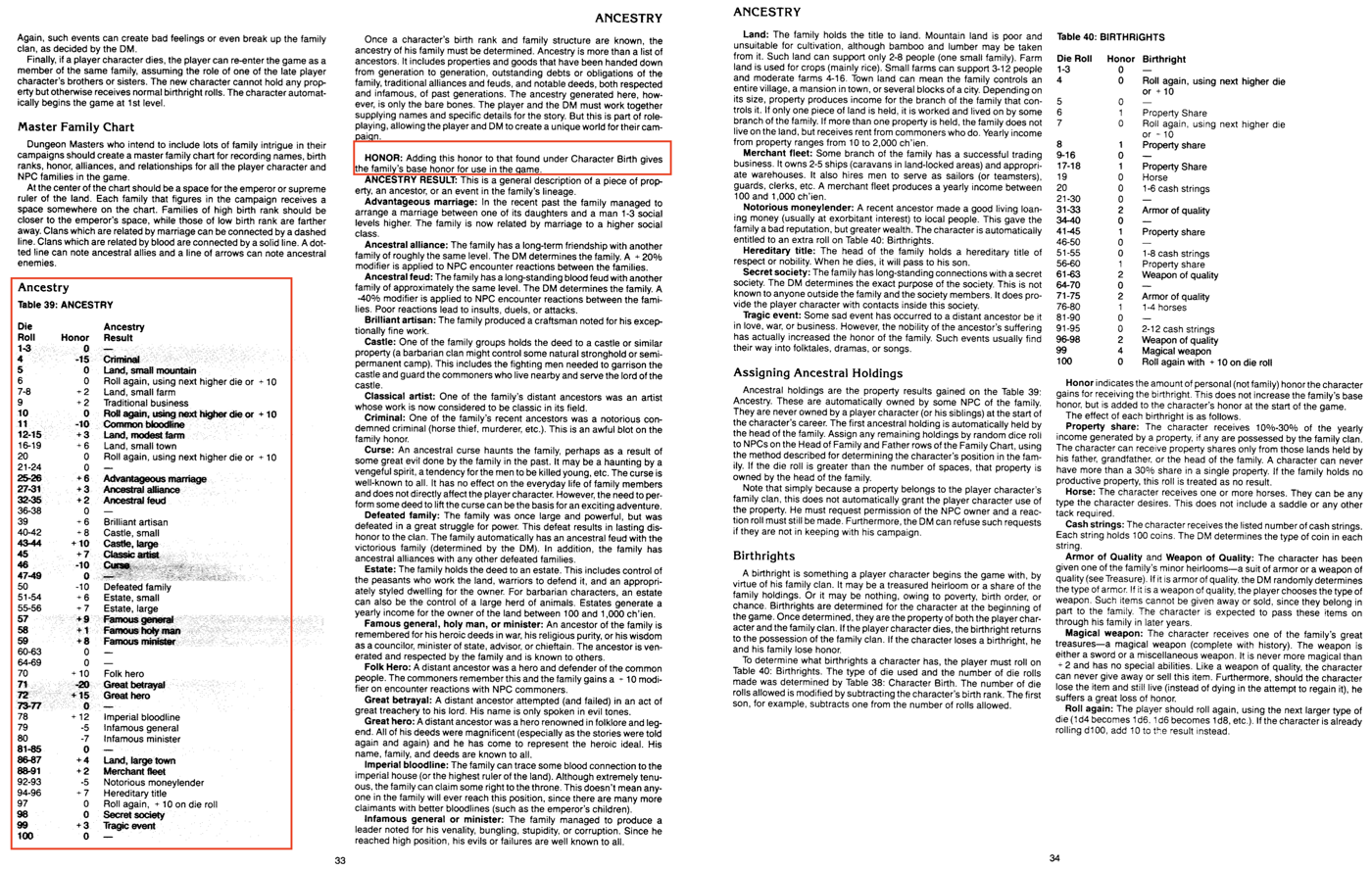
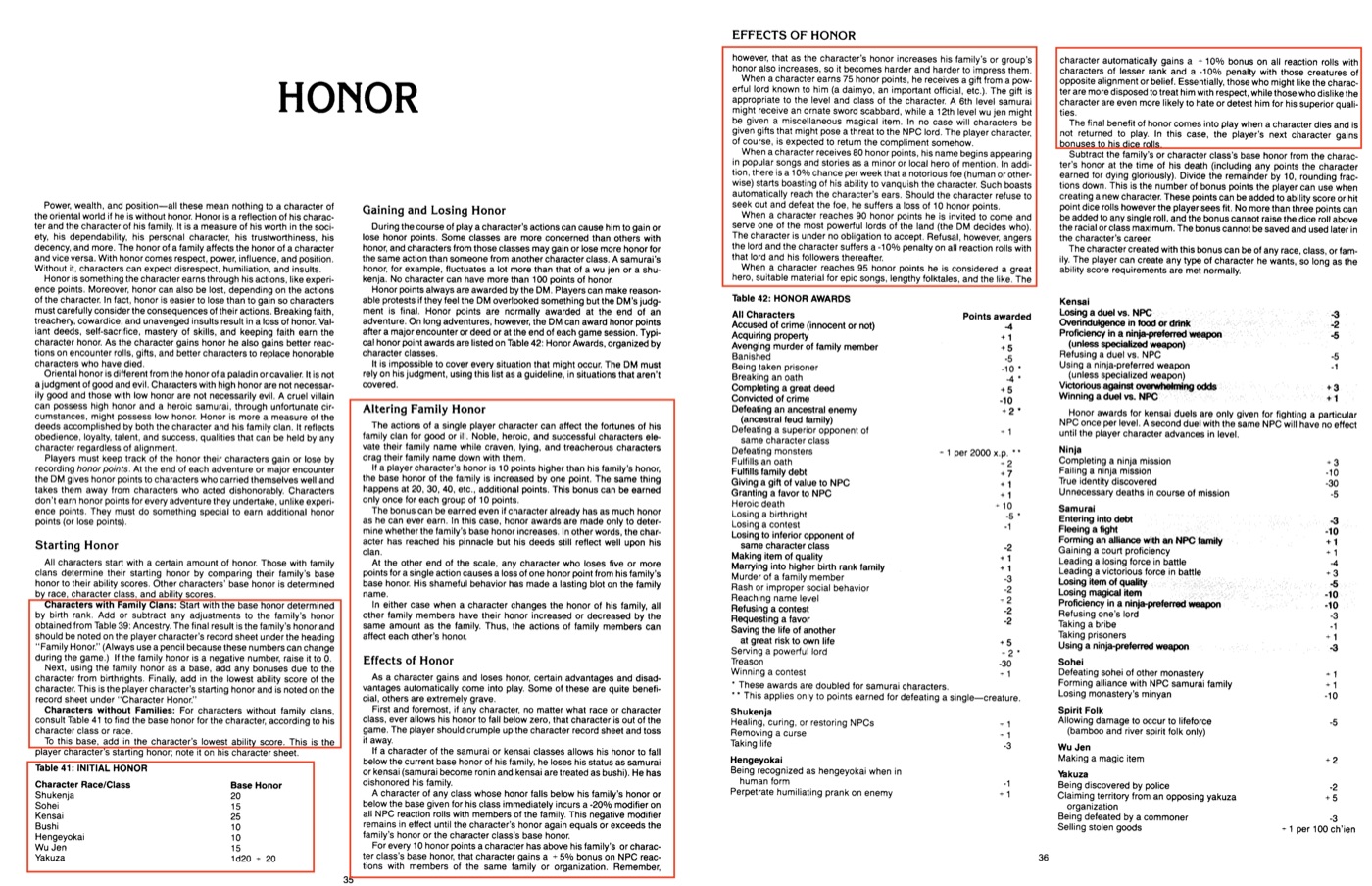
In 1985, TSR published Oriental Adventures. Although panned today by various detractors, there are a mix of character classes, economics, weapons, armor, ships, etc. that are drawn from several East-Asian cultures but predominantly the Japanese and Chinese. There is a generic system to create a family ancestry going back several generations, potential boons and birthrights, as well as social classes and an honor system with a definite effect on game mechanics. This system is not nearly as complex as Hackmaster’s. However, if you understood the elements I described from Hackmaster and how they might be viewed as distinct, but interrelated concepts, you will find Oriental Adventures checks many of these boxes and it does so with just six pages of text. I have highlighted the important bits. Once again, character class intersects with family/ancestry in a unique manner. I want to preserve what is left of your patience by moving on to our final game system and a call to action.
En-Garde!
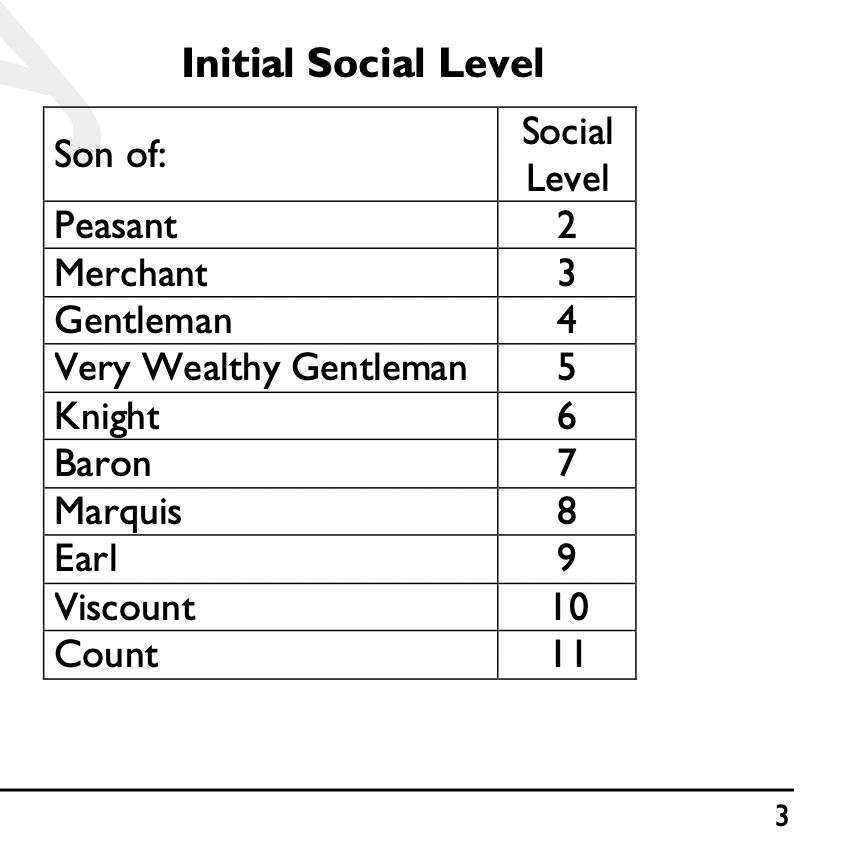
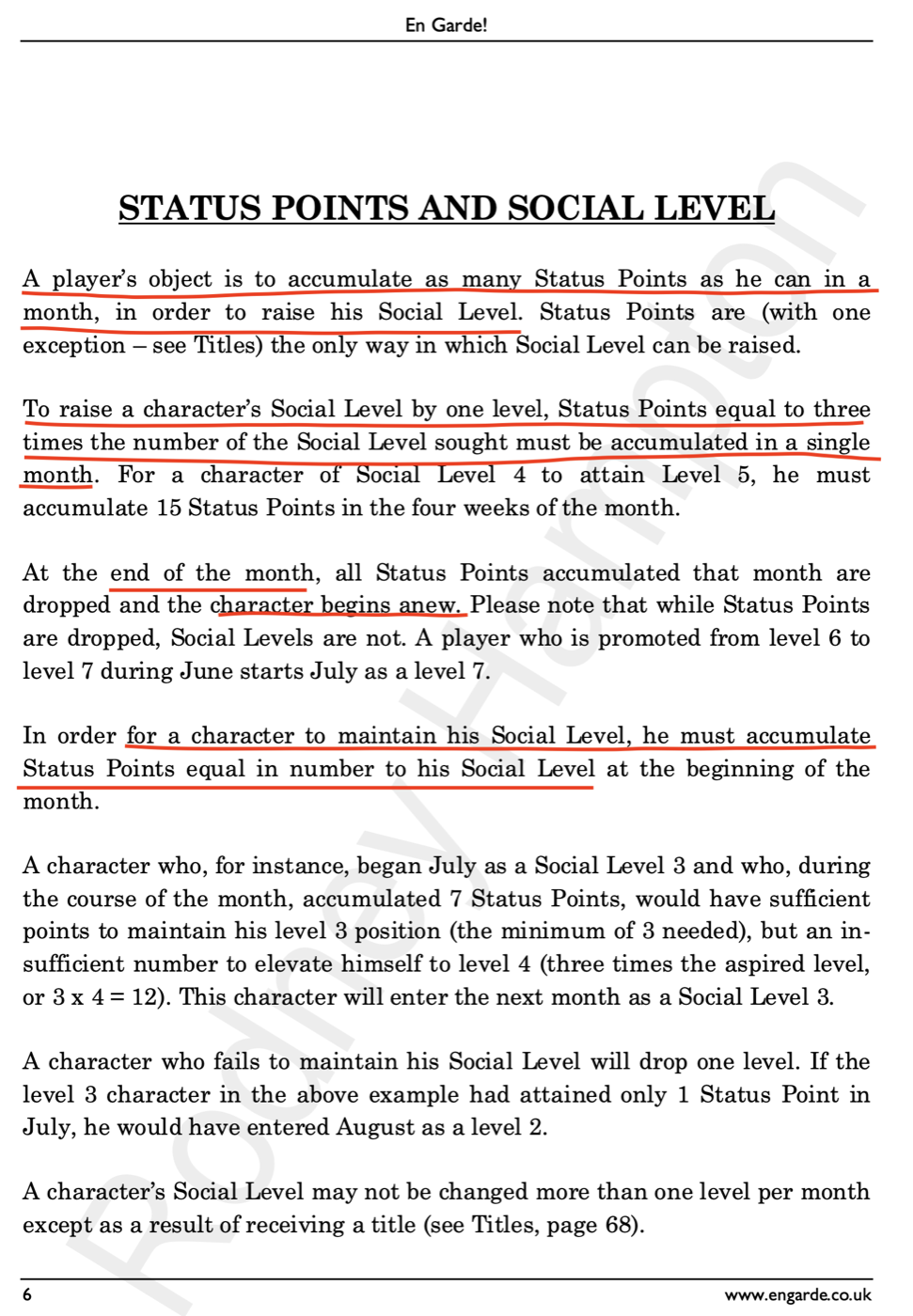
Perhaps the most succinct implementation of social level (social class), status points (honor), and titles of nobility can be found in Paul Evans, En-Garde! Being in the Main a Game of the Life and Times of a Gentleman Adventurer and his Several Companions, Margam Evans Limited, 4th edition, 2005, available at https://www.engarde.co.uk/buy.html. Players begin with an initial social level (p. 3). They then accumulate status points through their actions during the monthly turn cycle. Status points are gained through carousing, gambling, pursuing mistresses, and fighting duels. They are also awarded for various postings in the military or government hierarchy. To maintain one’s social level, requires earning as many status points as the social level score. To gain in social level requires triple the points of the current level (p. 6). The clock resets each month, so it is a bit of a “greasy pole” as our Referee describes it. (Yes, I am currently engaged in a play by post version of the game done in 1:1 time and administered via discord).
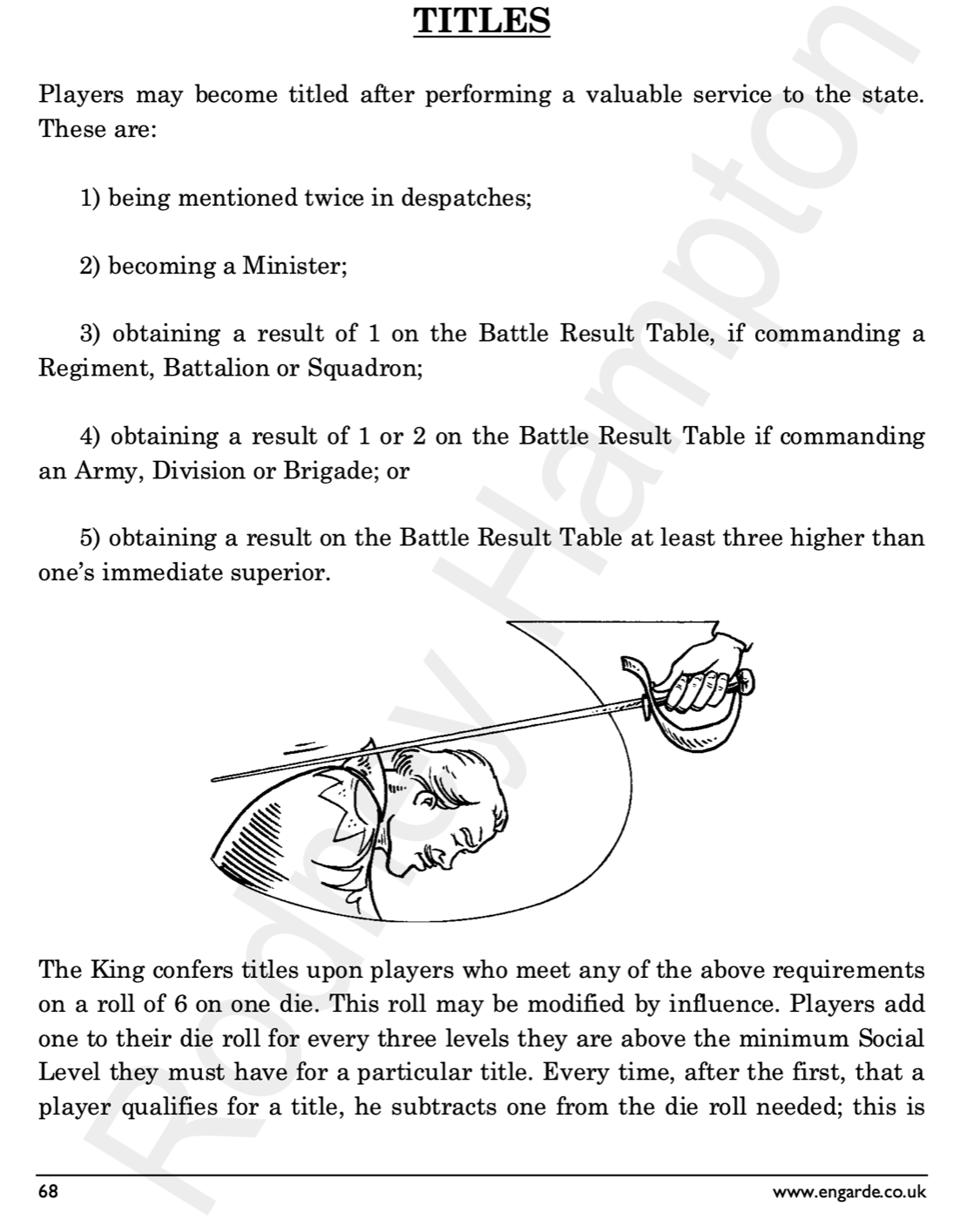
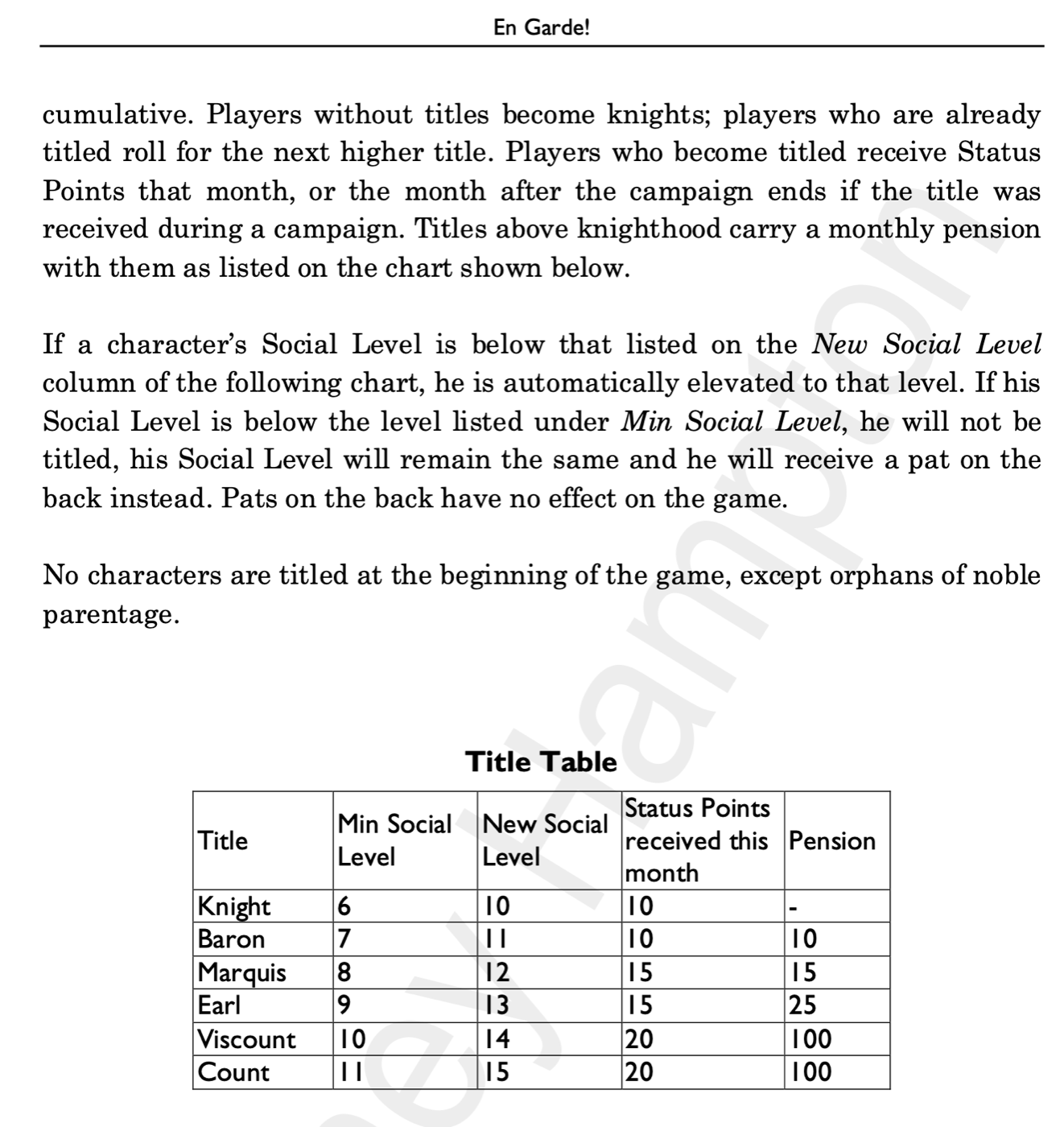
There are limited mechanisms to acquire a Knighthood and from there to begin climbing up the ranks of nobility. These are outlined on pp. 68-69. Because of the limited number of actions to acquire status points, and the limited number of posts, social clubs, money in circulation, and “macguffinettes” characters do tend to “converge” in their aims. Conflicts are resolved through swordplay, influence, and a bit of diplomacy and deception.
Interim Conclusion
En-Garde! can be used as a model for introducing social classes, status or honor within those classes, and the separate award of noble titles. Any Referee / Gamemaster can adapt the verbiage to match his or her campaign. For most, the groundwork has already been well trodden by Judges Guild, TSR, and others with regard to the medieval period in Europe.
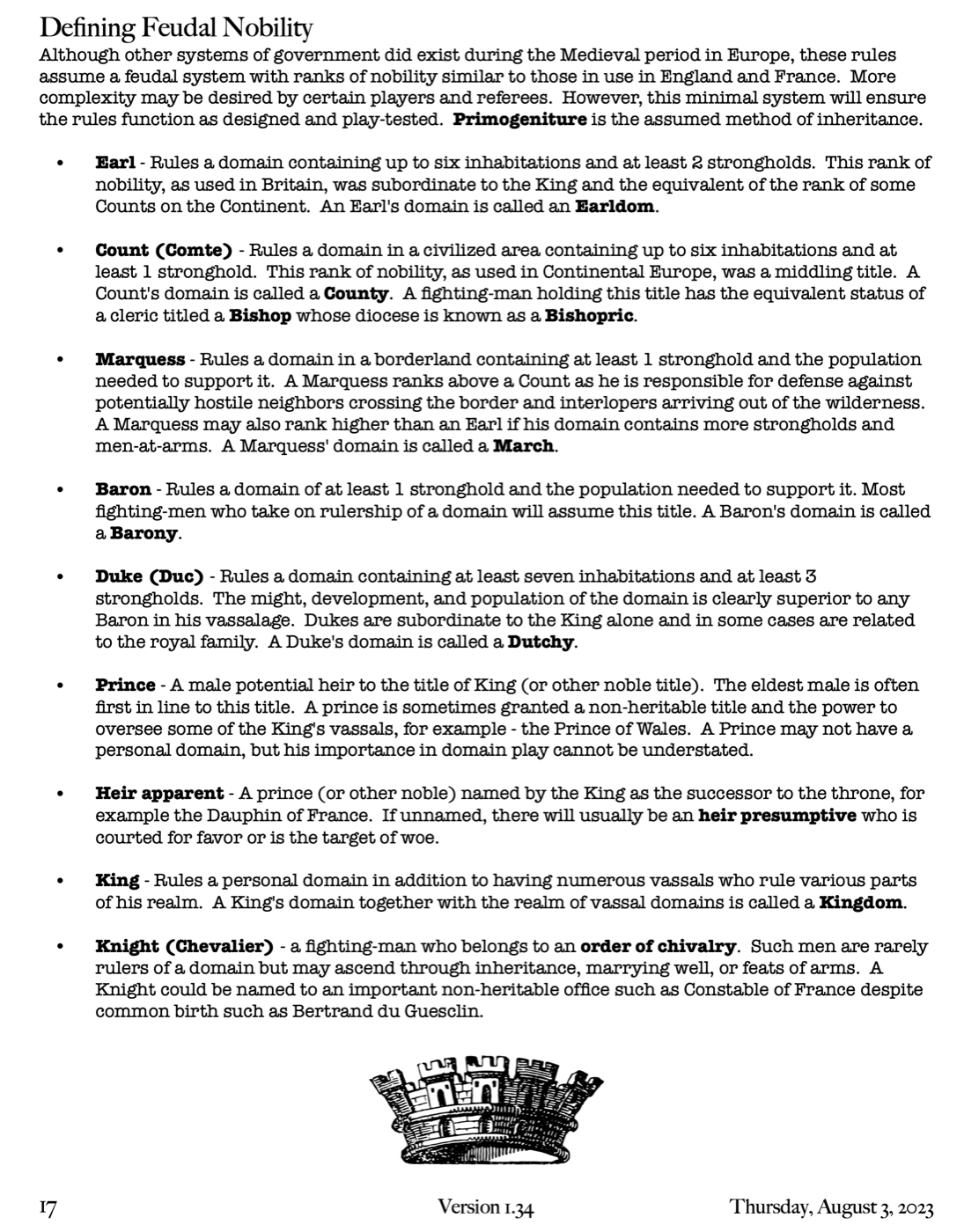
In 2022, my motivation for delving into gaming history was to re-connect lost linkages between wargaming and fantasy role playing games in the Old School Revival / Renaissance community. I began writing a supplement I named “Entitled Companion Rules for OSR and Wargaming Campaigns.” I knew at some point this work would come full circle. I never realized it would take four years of research and writing to come back to the work I initially roughed in. Allow me to share a page of Entitled that can help you on your way. This page provides you with a list of medieval European titles of nobility and links them to the the land (inhabitations) and strongholds that preserve civilization in the face of opposing powers. I hope to work on this supplement sometime soon.
Series Conclusion
In part 1, I began this series by looking at Heraldry going all the way back to Chainmail 1st edition. In part 2, I linked heraldry to Beyond This Point Be Dragons (a 1973 draft of original Dungeons & Dragons). We saw how the castles discovered in the wilderness might lead to jousting competitions, how OD&D’s equipment related to jousting, how fighting-men really had the greatest number of “career paths” open to them even though these ‘posts’ were not made explicit in the rules. We saw how the economic engine embedded in early D&D was tied to the fighting-man’s ability to clear the land, build a fortification, and receive the title of Baron. Finally, we saw how Baronies might be thrown into conflict or alliance based on their populations and the scramble to accumulate more resources (inhabitations, investments, and strongholds).
In this post, I outlined how social class is a larger framework in which nobility plays a role, how a character’s level of experience is coupled with achieving a noble title, and how other games and supplements within TSR’s orbit have tried to link hierarchical social classes with status (honor) as a means to climb that hierarchy, and the use of both personal titles and titles of nobility to further solidify a character’s place in a simulated medieval fantastic world.
I am not sure I have completely hit the mark with this series, but I hope that I have at least made a creditable essay. I firmly believe that adding social classes, status, and noble titles into your role playing campaign should be done. I also believe that this is best done as a supplement to the setting rather than as part of the core rules for the main gameplay loops. Let me know your thoughts in the comments.
On Heraldry & Social Class in Early D&D: Part 1 · Part 2 · Part 3
Originally published on Substack on May 17, 2026.