Hobbits™
Tolkien did not pull this name out of thin air. Did Michael Denham?
I am not your attorney, and no part of this article should be construed as legal advice.
Were you aware that the name Hobbit™ has been trademarked? It’s kind of crazy that both Middle Earth Enterprises and Warner Brothers might sue you for trademark infringement if you use the name Hobbit™ in some way they deem unacceptable. But property rights have always been a bundle of sticks, and when you unbundle them, you end up with multiple people who can beat you senseless.
CHAINMAIL's Origins - Part 1 - Weather
Exploring the mechanics and prose that show up in CHAINMAIL by Gary Gygax and Jeff Perren
Consider Chainmail (and the OD&D control weather spell) as giving no realistic guidance on how weather impacts the tactical situation. There are some older wargames that provide a slightly better system. For example, Wessencraft gives us a system in Wargamer’s Newsletter issue 109 from April 71. Notice how it affects more than just movement & fatigue.
Saturday Night Movie
If you love old school fantasy, you must watch Legend of the Eight Samurai
This English dubbed fantasy Samurai movie has it all. And it hooked me within the first 5 minutes and paid off every promise made along the way. You won’t regret watching this tonight as a Saturday night flick. I’d put it in the PG to PG-13 realm. Although there are a few decapitations and mature content along the way, if your (inner) kid plays D&D and is over 12 years old, give it a viewing.
Star Borg Solo: Session 1
A great little space opera game with lite rules, tight zine layout, and evocative artwork
Prologue
JP Coovert has written a wonderful little “Borg” game. It attempts to mimic the core trilogy of a certain space opera that many of you have seen in movie theaters or on streaming. Personally, I thought $30 was very reasonable for print and pdf copies of a game that I assume will be blasted out of existence by the lawyers of NYSE: DI$ as soon as they find it.
The Carrier Wave for Dungeons & Dragons
Our Hobby Owes a Lot to the Diplomacy Game
1954 - 1966
In 1961 and in 1971, Games Research, Inc. published Diplomacy. The creator, Allan B. Calhamer, had received his undergraduate degree from Harvard and was enrolled in Harvard Law when he designed the game. In 1954 he self published 500 copies that sold out. Then he licensed it to Games Research, Inc. Later, Avalon Hill acquired the company and, with it, the rights to Diplomacy. Although Calhamer never finished law school, his game is still actively played today.
Kinda Like Appendix N
The grognards told us where to find inspiration. We weren’t listening.
Everybody knows about Appendix N. But are you aware that in the final issue of Strategic Review, there are hints about what kind of music inspired the original players, and which movies they found worthwhile?
Before we go there, let me share a little bit about my own personal madness. In Dave Arenson’s First Fantasy Campaign (pg. 42, 1977) he tells us (perhaps unreliably) that the Blackmoor “dungeon was first established in the Winter and Spring of 1970-71 and it grew from there.” What inspired him?
More on Arneson's Combat System
Pulling together a few more bits of evidence and conjecture
Loving Chainmail
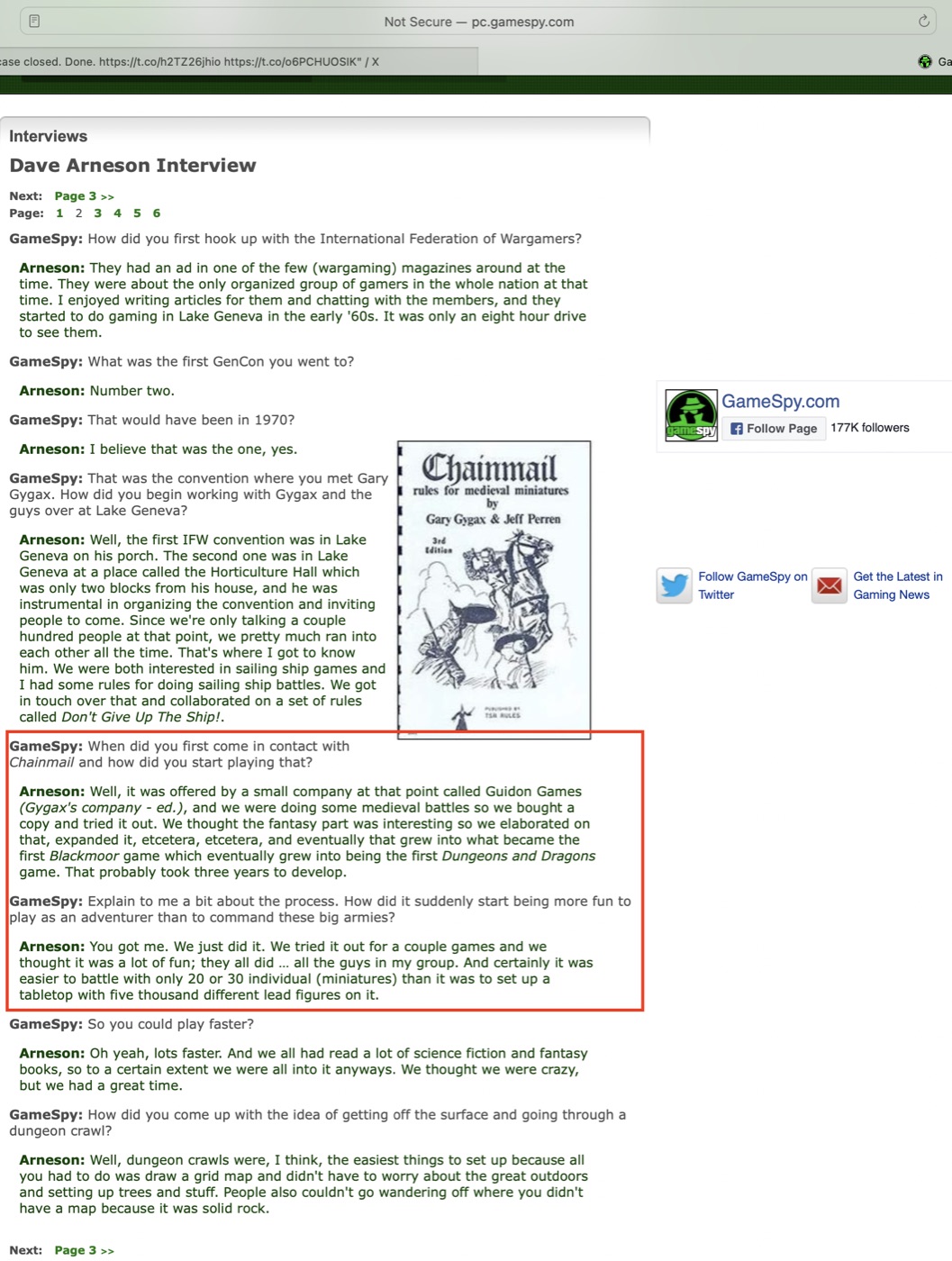
Dave Arneson, in an interview with GameSpy, describes getting his hands on Chainmail 1st edition (published March, 1971). His players loved it because it led to much faster combat resolution than Strategos-style wargaming. However, when applied in the dungeon context, it proved less satisfying. Read on.
Abandoning Chainmail
There is quite a bit on the Secrets of Blackmoor blog that validate my suspicions about the early combat system used by Arneson after he abandoned Chainmail’s Appendix E: Fantasy Combat Table. This happened after Bob Meyer’s infamous battle with the troll under the bridge (Saturday, April 17, 1971 per Corner of the Table Top Vol 3, Issue 4). Assuming Meyer was playing a Hero, he would have needed a 9 to drive it back and a 10 to kill it. The Troll, on the other hand, only needed an 8 to drive the Hero back and a 9 or better to kill him which is what happened.
Review of Sign of the Labrys
Spoiler: Not worth the trouble
So I mostly skimmed Margaret St. Clair’s novel Sign of the Labrys. As others have noted, the idea of levels, sub-levels, secret passages, weird guardians, and tricks/traps are all found within. This is a apocalyptic world with a pandemic on the brink of the restoration of some government order. I never got the impression that the protagonist (a man) was actually a man. In some ways it seemed like a dream-like novel written by lesbians for lesbians (if you know the history of the symbology of the Labrys you can understand why this interpretation makes more sense than the tenuous link with the ancient Greeks). There was, however, one bright spot for me. That was the confirmation that idea of a Casino in a dungeon probably originated here and made its way to Gygax who then referenced this work in Appendix N.
Reconstructed Techniques for Combat
Discerning Dave Arneson’s Blackmoor Combat System - Part 4
Introduction
After decomposing David Arneson and Richard Snider’s Adventures in Fantasy (AIF), it’s easier to understand what parts of combat Arneson wanted to see modeled in a fantasy role playing game. Figuring out which of these mechanics may have been present from the start is a bit of a challenge, but the two 1973 drafts (Beyond This Point Be Dragons and Arneson v. Gygax) provide neat bookends. Arneson’s First Fantasy Campaign (FFC) also fills in many gaps in our knowledge.
Additional Complexities
Discerning Dave Arneson’s Blackmoor Combat System - Part 3
Decomposing AIF
We begin today by looking at Adventures in Fantasy (AIF) by David Arneson and Richard Snider (one of the fellows in the Twin Cities gaming crowd). Snider is well known for adding complexity (see reviews of Powers & Perils by Avalon Hill) though I do find Star Empires to be readable and hope to get in some play next year. Arneson had complained that OD&D differed from the material he sent to Gygax. By looking at the combat system in AIF (published in 1979), I am hoping we will garner some insight into the elements of combat that Arneson found most essential to early Blackmoor’s combat system.