Reconstructed Techniques for Combat
Rodney Hampton
- 23 minutes read - 4720 wordsDiscerning Dave Arneson’s Blackmoor Combat System - Part 4
Introduction
After decomposing David Arneson and Richard Snider’s Adventures in Fantasy (AIF), it’s easier to understand what parts of combat Arneson wanted to see modeled in a fantasy role playing game. Figuring out which of these mechanics may have been present from the start is a bit of a challenge, but the two 1973 drafts (Beyond This Point Be Dragons and Arneson v. Gygax) provide neat bookends. Arneson’s First Fantasy Campaign (FFC) also fills in many gaps in our knowledge.
Character Stats
The original characters in Blackmoor had several key attributes. Looks, Sex, Health, and Strength are on both the HW Dumbo (David R Megarry) and Wizard of the Wood (Pete Gaylord) character sheets (see Part 2 of this series). Looks, Sex, and Health are also on the Spanish Royals Character sheet which is probably the earliest document from the Twin Cities wargaming campaigns where individual attributes are listed. The following image is provided under “Fair Use” for further scholarship.
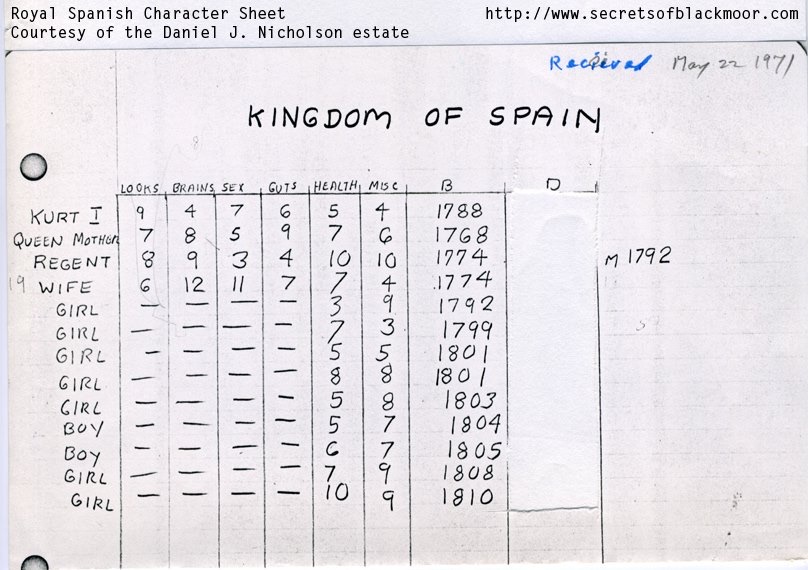
All of these stats are on a 2d6 system. A key attribute of 6, 7, or 8 is average while 9 or more is above average and 5 or less is below average. Health is a stand in for constitution or stamina. Strength is early enough that we can safely include it as an important component as well. By 1973, Health was being used to put a floor on hit points in Beyond This Point Be Dragons (see Table 3). Strength was used to provide a bonus to earning experience points as well since the Prime Requisite system had been developed. But in the system that pre-dated these OD&D drafts, should we use these stats in the combat system? Looking at AIF, I think the answer is yes.
Encumbrance
A character can normally carry 150 pounds (1500 coins).
A character with an above average Strength can carry 15 pounds more equipment (150 coins) before becoming encumbered. A character with a below average Strength carries 15 pounds less than the average man before becoming encumbered.
A an encumbered character travels 3” less per movement segment than an unencumbered character.
Fatigue
A character in melee uses a tremendous amount of energy. Every round of melee requires the expenditure of 2 points of Health. A character that runs out of Health is fatigued. Fatigue halves a character’s effectiveness in combat; there is a 1-in-2 chance that he cannot deliver a blow with a melee weapon. A character can regain 1 point of Health each round of melee when he only moves (i.e. does not deliver or receive a blow from a melee weapon). A character regains 2 points of Health if he neither moves nor exchanges blows. Likewise, characters not in melee regain 2 points of Health each combat turn.
Hits to Kill
For each level of experience, a character gains an additional “hit die” of points that represents his increasing skill in combat, luck, nimbleness, etc.
- Warriors get a +1 pip bonus to this 1d6 roll. Characters that use magic do not.
- Characters with above average Health get a +1 pip bonus while those with below average Health take a -1 pip penalty. However, a character will always gain 1 HTK when increasing in level.
Damage Bonus (Optional)
A character with an above average Strength does +1 point of damage when he strikes with a melee weapon. A character with a below average Strength does -1 point of damage when he strikes.
Weapon Proficiency / Base Chance “To Hit”
Every character is assumed to have some proficiency with every melee weapon, missile weapon, and artillery piece. Thus every character must record a 2d6 score for each weapon in the campaign world. These stats are rolled at time of character creation before the player equips the character. A character’s proficiency determines the character’s base chance “to hit” an opponent with the weapon. There is no distinction in how the “to hit” roll is made between weapon types.
Training (Optional)
A Referee may optionally allow for more proficient characters and non-player characters (NPCs) to train those who are less proficient. This requires the character to expend both time and money. There is no guarantee of success. Progress should be on a point by point basis per weapon. The details are left to the Referee.
Movement Rates
The problem with looking at AIF for movement rates is it is just so far removed from everything that came before that it is impossible to reconcile. There are movement rates in Arneson & Hoffa’s Strategos A, however, those also differ from the unbroken Tony Bath→ LGTSA→Chainmail→OD&D line. It seems best to default to Chainmail 2nd edition here (since 1st edition is unavailable). This returns us to the familiar scales and 3” bands that we almost all fantasy RPGs spawned from D&D have standardized.
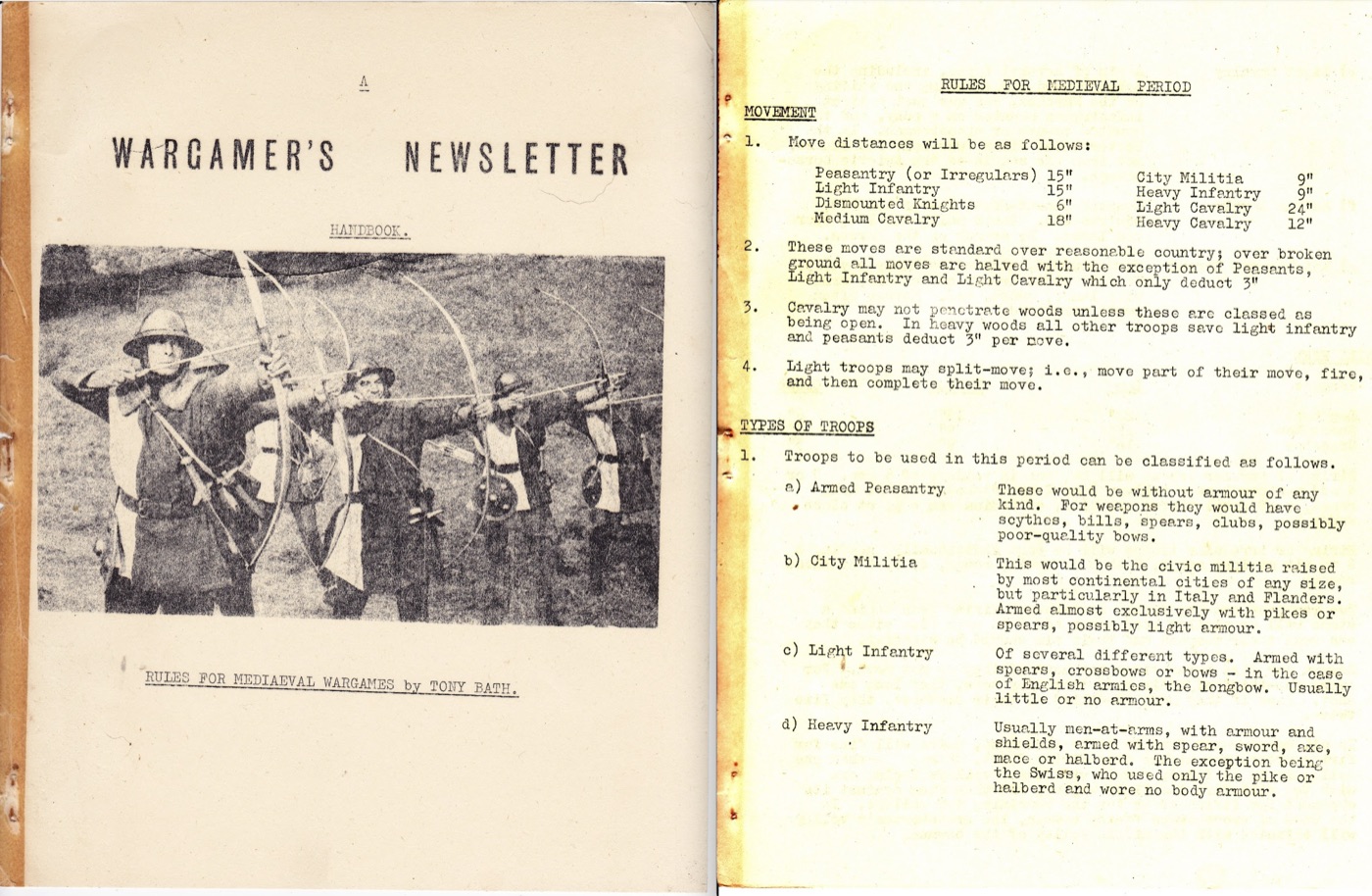
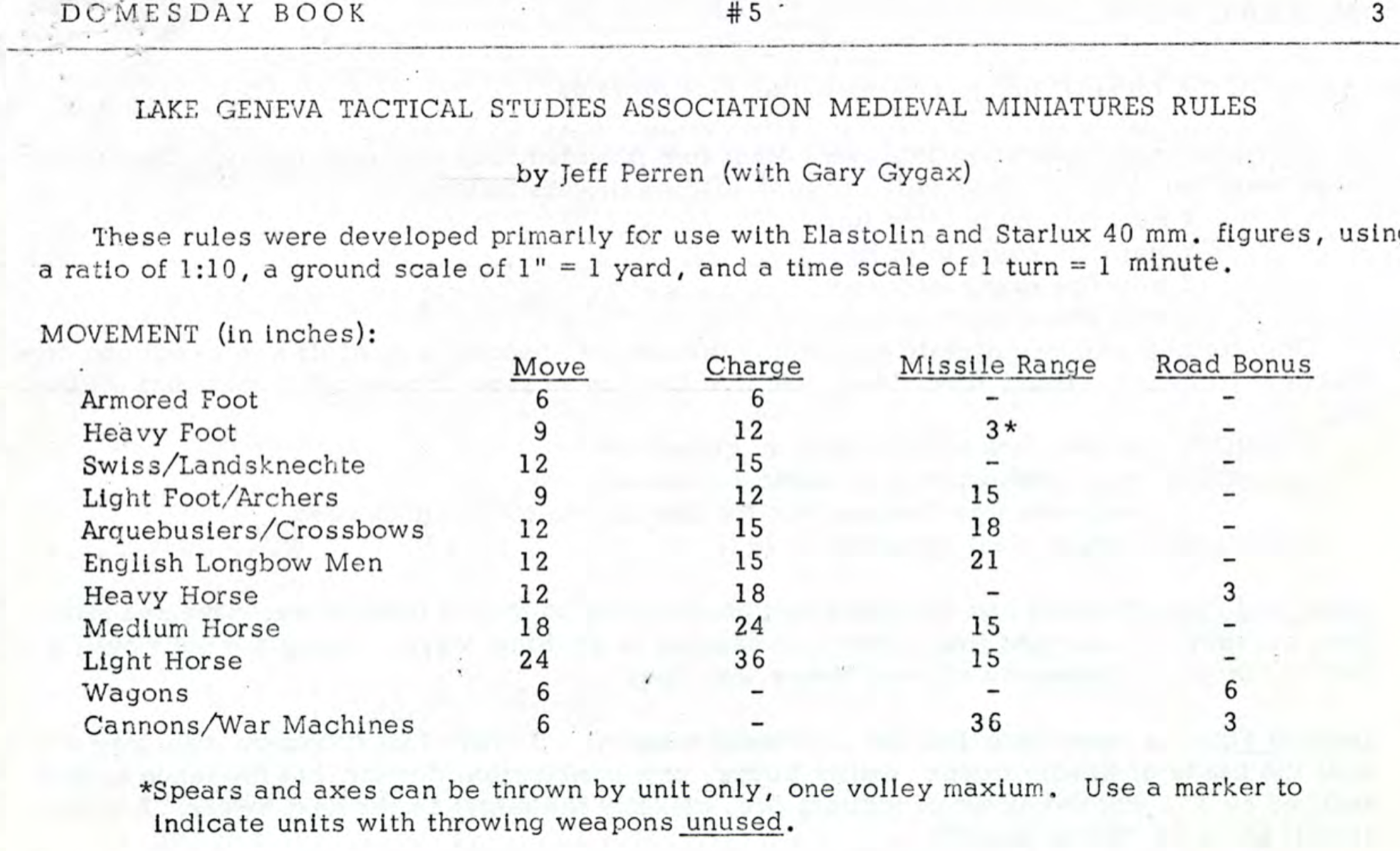
Tying this back to Arneson’s simple armor class system (first class 1 to worst class 8), the maximum distance a figure may move during a turn of combat is limited by armor and modified by encumbrance (-3”) or a charge (+3”).
- Plate + shield = 6”
- Plate = 6”
- Chain + shield = 6”
- Chainmail = 9”
- Leather + shield = 9”
- Leather = 9”
- Shield only = 12”
- Unarmored = 12”
Macro Terrain Effect on Movement
Woods - Prevents mounted movement but dismounted figures may lead their mounts through the terrain at the dismounted figures’ rate. If a figure is encumbered, his rate of movement through woods is halved. On the tabletop, trees are placed no more than 3” apart. A creature with 10 or more Hit Dice are not hindered moving through the woods and any tree in its path is removed from the tabletop.
Hills - Reduce movement by 1/3 when climbing. Movement downhill at normal rate, however a charge into melee is permissible. The charge increases the movement rate of men by 3” and mounts by 1/3.
Swamp - All movement is at 1/3 the normal movement rate. Mounted movement is impossible within a Swamp (thus mounts must be led by dismounted figures at their rate). Wagons or other wheeled vehicles cannot traverse a swamp.
Rivers / Streams - The Referee will advise the players as to fordability and the cost to enter and/or leave the water depending on the condition of the banks, depth of water, bed condition, and current strength.
Macro Terrain Effect on Combat
A Woods prevents missile fire within its boundaries. Missile fire into or out of a woods is generally ineffective. Figures using an erect or fallen tree for cover reduces the chance of a melee attack striking in half (i.e. 1-in-2 chance the blow is ineffective). A figure that has climbed a tree is hard to detect (1-in-4 chance at 25’ height; 2-in-4 at 20’; and, 3-in-4 at 15’).
Combatants on opposite sides of a Hill are unable to strike one another with missile fire.
Combat effectiveness for both melee and missile fire is halved within a Swamp. Thus there is only a 1-in-2 chance that a blow can be delivered, a missile launched, or artillery put into action each combat turn.
Micro Terrain Effect on Movement and Combat
Rocks, bushes, tables, and chairs normally prevent movement. Some of these are moveable by a man of average strength. Two men may move a table at 1/3 their normal rate of movement. A chair can be used as an improvised weapon. The Referee will use his discretion for such obstacles.
Low walls, barricades, abatis, etc. require the entire combat turn to cross. The figure making the crossing must suffer any blows delivered without the ability to fight back. If exit on the far side is blocked, the figure may fight from within/atop the obstacle at half effectiveness (i.e. there is only a 1-in-2 chance that a blow can be delivered or a missile launched).
Ladders can be climbed 5” (i.e 50 feet) per combat turn. A figure on a ladder cannot make missile attacks but is obviously vulnerable to missiles shot at him/her.
Trees are assumed to be 25 feet tall and can be scaled only 5 feet per combat turn. A figure can leap from one tree to another by making a check against his Guts attribute. A fall from 10’ or more incurs 1 HTK of damage plus an additional 1 HTK of damage for each additional 5’ fallen. A fall from the 5’ level incurs 0 HTK of damage, but there is a 2-in-6 chance that the figure will incur a sprain which halves his / her movement.
Gates and doors prevent combat until they are opened or broken down. These obstacles create bottlenecks where only one or two combatants may pass through at a time. Likewise, depending on the size of figures involved, only one or two figures on either side of a portal may fight those on the other side.
Arrow Slits allow for a cat and mouse game between combatants. Both the figure on the inside of the fortification and the one outside must make a missile attack directed at each other. The figure on the outside must be adjacent to an arrow slit and he fires with a 1-in-4 chance that his attack comes off. Simultaneously, the figure inside the arrow slit fires with a 1-in-2 chance that his attack comes off. Resolve any successful fire as as normal (“to hit” and damage) during the missile phase.
Laying Terrain onto the Table
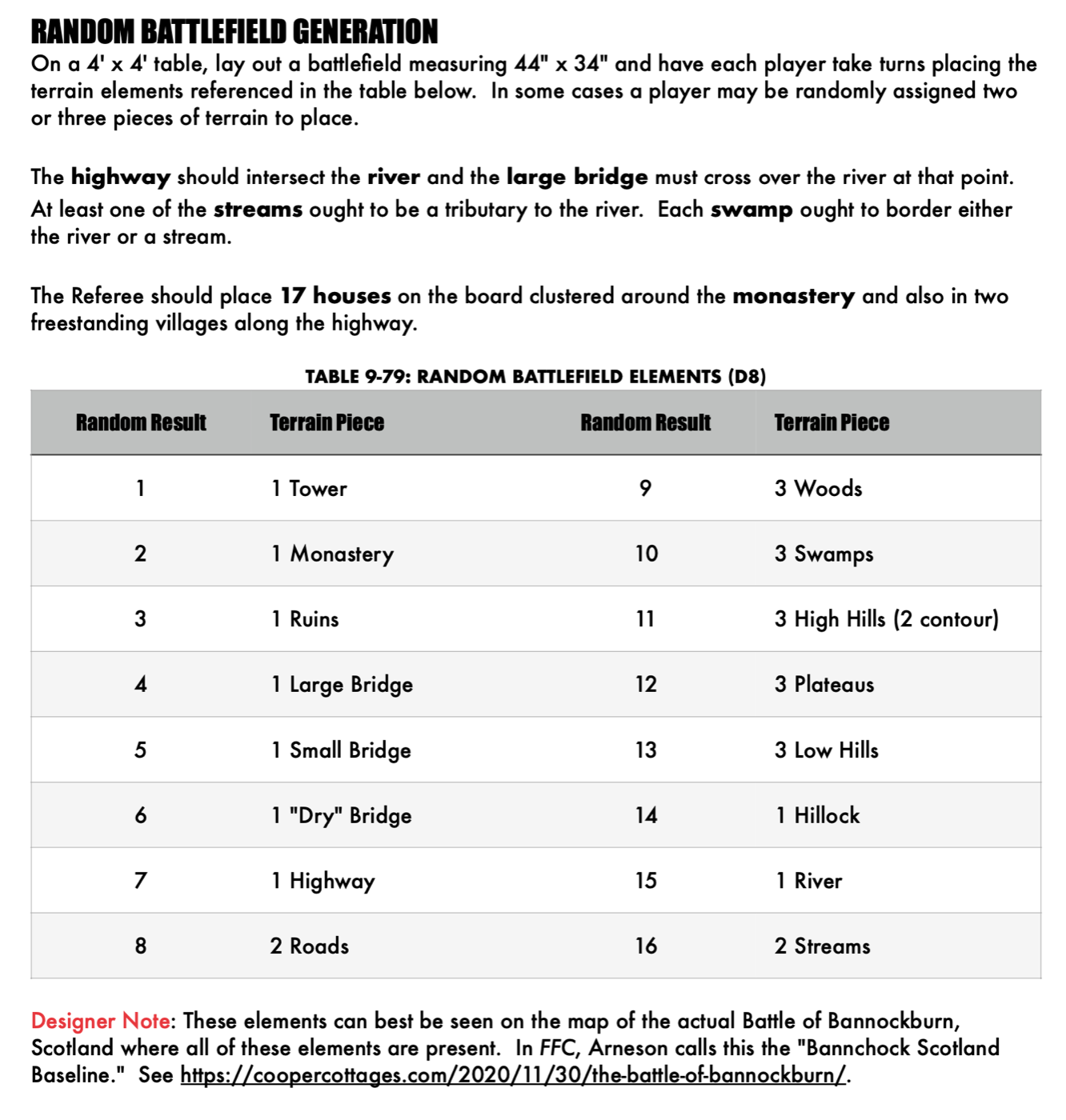
For underground encounters, the Referee can refer to his/her dungeon map. For outdoor encounters, however, terrain should be picked and placed onto the table. For each 6” x 6” space, select one of the following types of terrain. A table of at least 36” x 36” is recommended. And here I will simply reproduce my work from Midwest Fantasy Wargame: The Primeval RPG where I already expanded Arneson’s rules from FFC into a workable solution. I might alter the wording slightly based on the table and terrain piece sizes from AIF. Also I used the word “elements” twice in the footnote. I’ve gotta clean that up!
Combat Sequence
The combat turn is divided into seven phases. The melee phase consists of pairs of combatants exchanging blows. This is referred to as a round of melee. Movement takes place during 2 of these phases.
Players (including the Referee) on opposing sides move one figure at a time, alternating turns. If there is a dispute about who first occupies a space on the table, the figure with the faster movement rate (including charge bonus and considering encumbrance and magical effects) goes first. If figures are tied, roll a dice and the highest score wins the space. It is best to use the die with the most sides possible as this reduces the chance of a tie.
A) Declaration Phase - Magic-Users declare their spells.
B) Split Move and Fire Phase - Elves and some mounted archers are permitted to fire their missile weapons first. If they remain stationary, they may also fire during the Missile Fire Phase.
C) Movement Phase - Figures may move up to half of their movement. When a figure comes within 1/2” of an enemy combatant, the figure must stop as it is locked in melee. Once an enemy combatant is removed, the figure is no longer locked in melee and may move during phase G.
D) Missile Fire Phase - All ranged attacks take place during this phase including hand-hurled and slung missiles and artillery. The exchange is simultaneous and so are the effects. Thus two opposing figures may fire bows and kill each other. Optionally, the combatants compare ranged weapon modifiers and the one with the highest modifier gets the first strike.
E) Magic Phase - Magic-Users cast their spells. The exchange is simultaneous but the effects depend upon which figures make their saving throws. See below.
F) Melee Phase - Blows, counter-blows, and additional attacks (see below) are resolved in order. A figure that is killed by the initial blow does not get a counter-blow. Figures within 1/2” of one another are considered to be in melee with one another. The Referee resolves melees for each pair of combatants.
G) Second Movement Phase - Figures may move up to half of their movement unless they are already locked in melee or until they come within 1/2” of an enemy figure.
Missiles fired into a melee have an equal chance of hitting friend or foe. Magic usually strikes its intended target(s) unless it has an area of effect that overlaps a friendly figure.
“To Hit” Modifiers for Ranged Attacks
Considering the almost innumerable modifiers I’ve seen over the years, I can’t help but pare this section of AIF done to its roots. As a recent video by Chubby Funster pointed out, cognitive load is important to manage. A designer that tries to account for every situation, overloads the Referee and players and breaks immersion.
Weapons have three range bands: short, medium, and long. At short range, targets are hit with a +2 modifier. At long range, targets are hit with a -1 modifier. This modifier is applied to the weapon proficiency score.
If the target is smaller than a man, apply a -1 modifier. If the target is larger than a man, apply a +1 or +2 modifier.
The Referee may apply a -1 modifier for especially unfavorable conditions such as wind, rain, firing from horseback (unless a Horsemanship check is successful), shooting at a long range target down a corridor, or attempting to shoot through a narrow portal (i.e. at a partially covered target).
Missile Weapon Ranges
Again, I would revert these to Chainmail for these since Arneson used Chainmail 1st edition to crib his monster lists, monster point values, weapon and armor lists, etc. Still, let’s look to AIF for these ranged weapons that are explicitly named. The range bands are in yards. Thus in most indoor or dungeon encounters, the target will be at short range. Movement, scale, and weapon ranges are all interrelated. Use these AIF values and weapon limitations understanding that they may not mesh well.
- Short Bow (30/75/150) - can only penetrate plate at short range; cannot penetrate chainmail at long range
- Crossbow (50/100/170) - must use 1 combat turn to reload after firing; can penetrate plate armor at medium range but not long range
- Composite Bow (50/100/200) - can only penetrate plate at short range
- Longbow (50/100/200) - can penetrate plate armor at medium range but not long range
Treat helms as if made of plate for purposes of penetration
Magic and Saving Throws
A magic-user must remain stationary, have view of the target(s) for his spell, and concentrate at least up until the spell is cast. If the caster is interrupted by a successful attack upon his person, the spell is lost.
Each target of the spell may make a saving throw.
- A missed saving throw means the spell has an immediate effect.
- A saving throw in excess of the number required negates the spell entirely.
- A saving throw that is exactly on the nose means that the spell will still take effect, however, it will be delayed until the next turn’s Magic Phase. If the spell’s effect is delayed, the caster must maintain concentration throughout the delay. He may also choose to abandon the spell (the spell still counts as being cast).
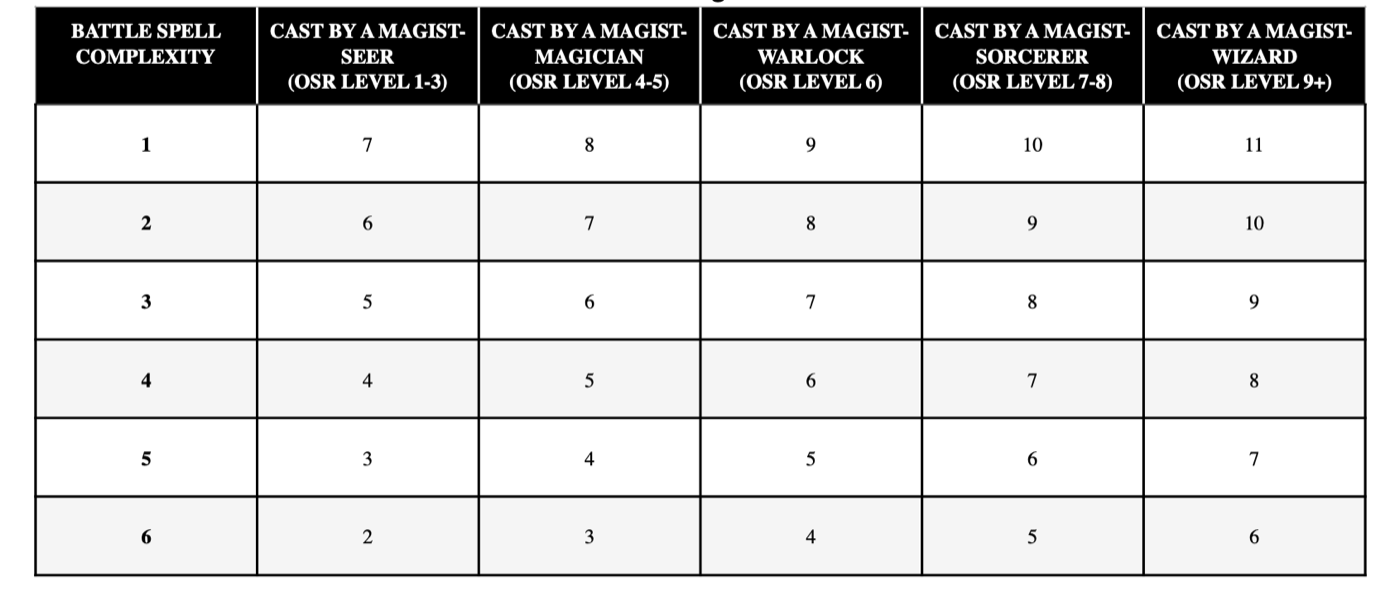
Here I will simply substitute in a table I already devised for The Mage’s Companion since it uses a 2d6 mechanic. Complexity = spell level. Note that this save depends on the caster’s level, not the target’s.
Who Strikes First in Melee
One shortcoming of AIF is the lack of an initiative system. Since a round of melee is resolved by pairs of combatants, we are always dealing with two figures. In the Dungeon! board game, a real player will always go first versus a monster. In Beyond This Point Be Dragons, a player (versus an NPC or monster) will always have the upper hand unless the opponent is on higher ground or has surprised him. Contrawise, in The Rules to the Game of Dungeon “The baddies draw first blood, as they always attack first.” These rules from the Twin Cities point to the need for simplicity.
It seems best to give the first “chop” to a real player if pitted against an NPC or monster run by the Referee. If two players are at odds, simply dice off using d6 until there is no tie. Players can re-roll or alternate getting the first chop each turn of combat.
Interposing a Shield
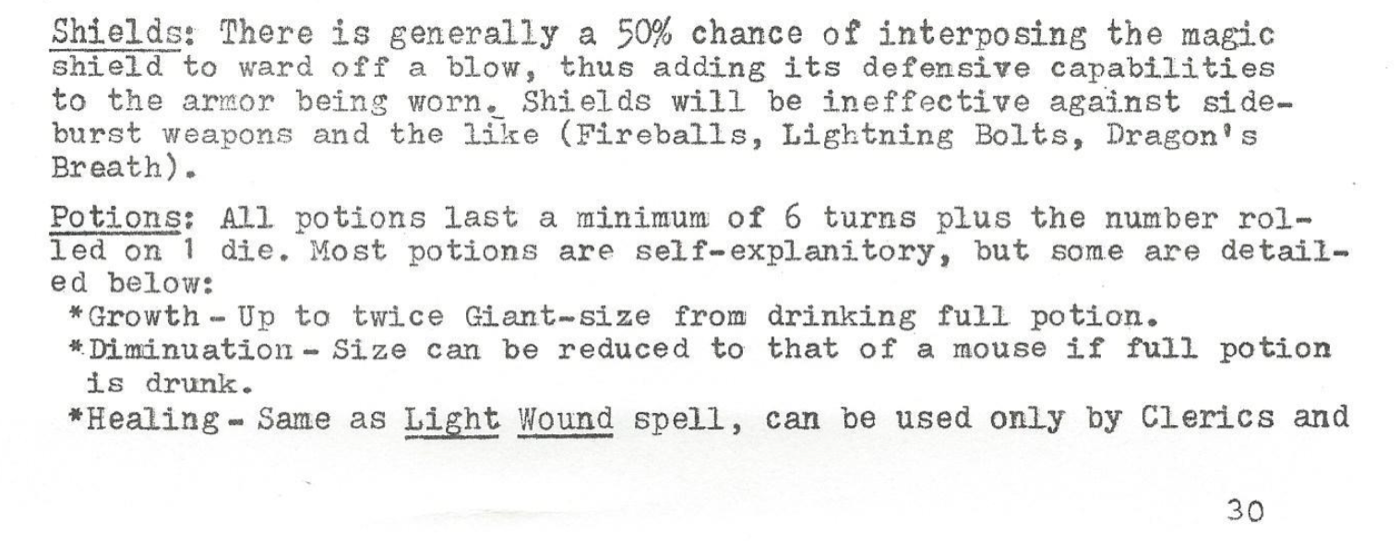
AIF’s rules on armor saves tells us that a shield is useful for “frontal [attacks] only.” Standing alone I would not give this much weight, but Beyond This Point Be Dragons also has commentary to the same effect on p. 30.
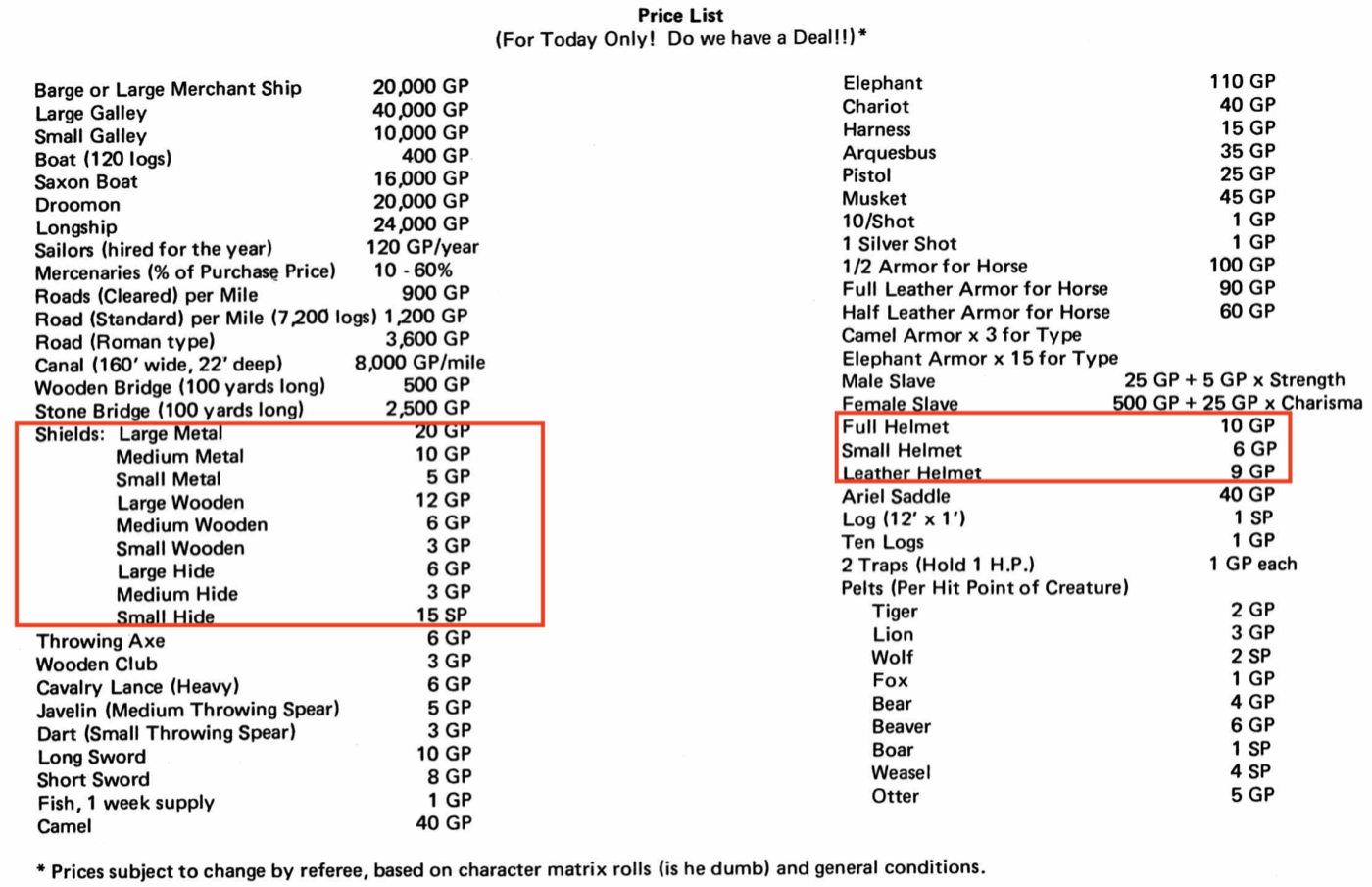
AIF has both large and small shields. Arneson’s First Fantasy Campaign p. 11 also has varying types of shields (and helms).
As with all design choices, I prefer simplicity. Perhaps a rule like this makes the most sense: A shield can be used to ward off blows from the front only (i.e. the attacker must be beyond the front edge of the defender’s figure).
Small shields are easier to interpose yet provide less protection. Large shields are unwieldy yet provide more cover. On average, these differences can be ignored. A defender has a 1-in-2 chance to interpose his shield to stop a blow. Example: a human figure with plate and shield is attacked from the front by an Orc. The Orc has succeeded on his “to hit” roll. The human must see if he can interpose his shield in which case he will make his defensive saving throw using AC1. If he cannot interpose his shield, his defensive saving throw uses AC2.
Multiple Foes
Each combatant in a melee has at least one opponent. If he is pitted against multiple opponents, treat each pair as a separate melee (i.e. decide who gets the first blow and who gets the counterblow). Resolve pairings starting with the overmatched figure combating any foe to his rear, then on his left flank, on his right flank, and finally his front.
Damage and Body Type (Optional)
Here we turn to First Fantasy Campaign p. 3 which outlines, in a general fashion, how the early Blackmoor combat system operated.

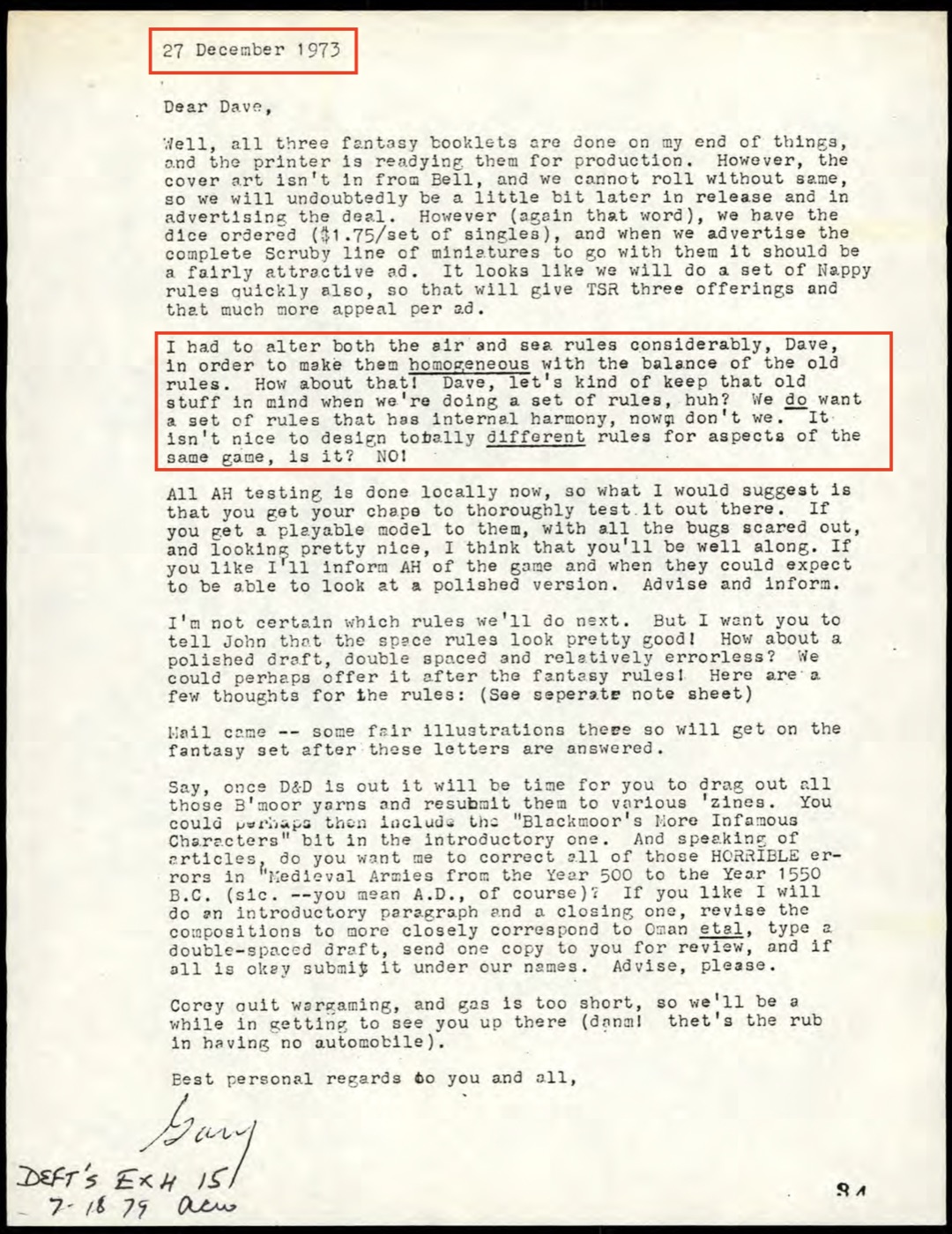
As we know, having HTK vary from 0 - 100 was abandoned fairly early. We also know that although OD&D’s LBBs have a hit location table in LBB#3 p. 27 for aerial combat, it has zero to do with Arneson. This letter from Gygax to Arneson from the law suit tells us this much. Mike Carr’s Fight In the Skies (published in 1972 as a revamp to the 1966 Dawn Patrol) is likely the inspiration for the aerial hit location tables in OD&D, though Gygax and Blume also have aerial hit locations in Warriors of Mars (also published in 1974).
The next time we see hit locations show up is in Supplement 2: Blackmoor (published 1975). These run on to multiple pages and cover hit locations from the front, side, rear, and sometimes top and below for Humanoids, Avians, Reptiles, Insectoids, Fish, and Snakes. I have heard that Tim Kask may have exercised considerable editorial discretion with the exception of the Temple of the Frog section. I believe it.
The line that rings most true with what Arneson wrote in FFC is on p. 7 of Blackmoor: “ [I]f a humanoid with a total of 100 possible hit points is attacked, the head can withstand up to 15 points of damage, the chest 80, the abdomen 60. each arm 20, and so on; however, if the head receives 15 points of damage (100% of the possible total) death occurs immediately.”
Looking at AIF’s hit location table - it really boils down to an alteration of the damage dice imposed. Perhaps it would be best to use a simple d6 roll as follows:
- Extremity (hand, foot, tail, mandible, etc.) - 1d4 HTK
- Appendage (arm, leg, wing, antenna, etc.) - 1d6 HTK
- Guts (abdomen) - 1d8 HTK
- Vitals (chest or thorax) - 1d10 HTK
- Brains (head, spine, etc.) - 1d12 HTK
- Special - 1 attribute such as Strength or Health is impaired 1d6 points. Re-roll. If six again appears, reduce mobility in half.
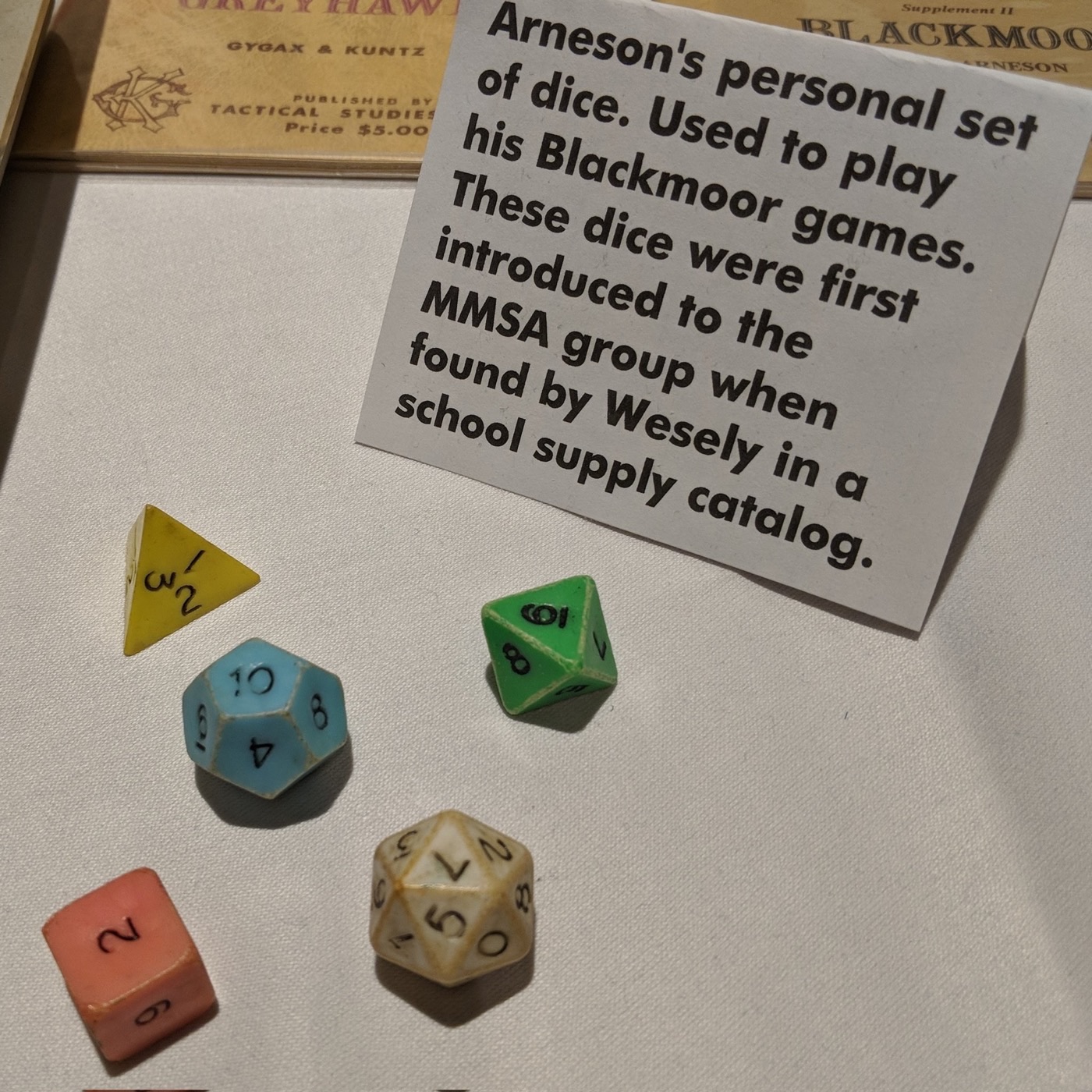
This does honor to AIF’s table, the idea of hit locations, and Dave’s polyhedral dice. The presence of a helm could optionally be used once to absorb a blow to the Brains.
Size Differential (Optional)
As noted above, a creature’s size can provide a bonus or penalty to missile attacks. This rule, however, applies to melee between foes of differing sizes. We first see this concept appear in Chainmail (2nd edition p. 26). When Dwarves and Giants fight one another their effectiveness is halved.
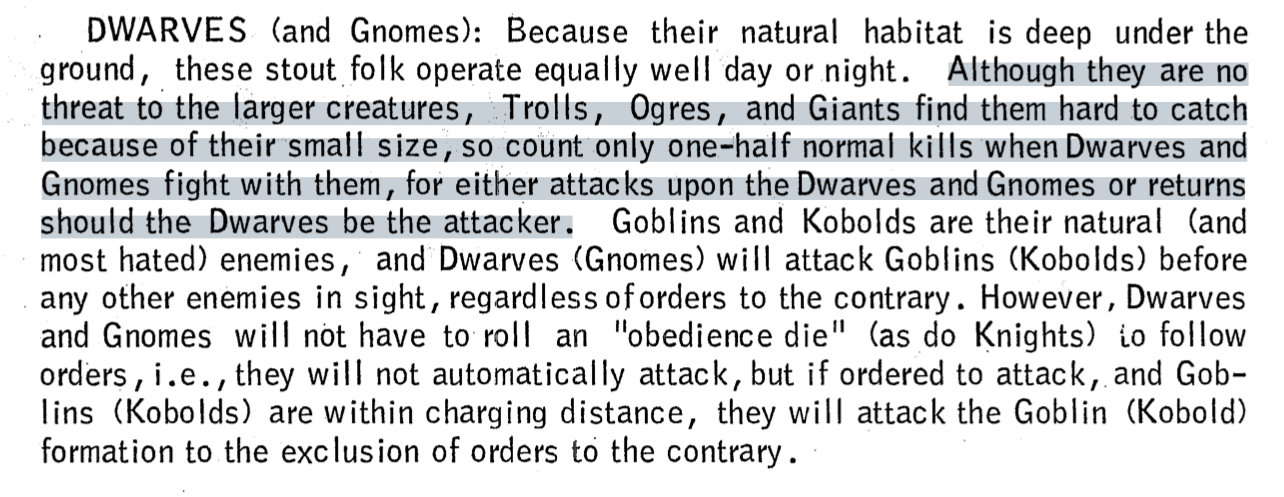
Again, referring back to FFC p. 3, Arneson repeats this saying “height differentiation [was used] so that the little guys could run around more and the big ones could kill more.” On AIF p. 53, the Strength Bonus to damage says that “creatures with more than 3 hit dice will inflict double the normal damage. Take the normal damage roll and multiply it by two (2).” Supplement 2: Blackmoor has a very complicated table that I attribute to Kask absent evidence to the contrary. Here’s why —v
Looking at the 1973 draft Beyond This Point Be Dragons tells us in two places to simply double the damage doled out by creatures like giants. It seems like a size differential such as a human versus a pixie or a Giant versus a human would simply be entitled to double damage (i.e. multiply the damage x 2, not roll a second time). Another way to look at it, a pixie versus a human or a Dwarf versus a Giant might need to halve the damage inflicted.
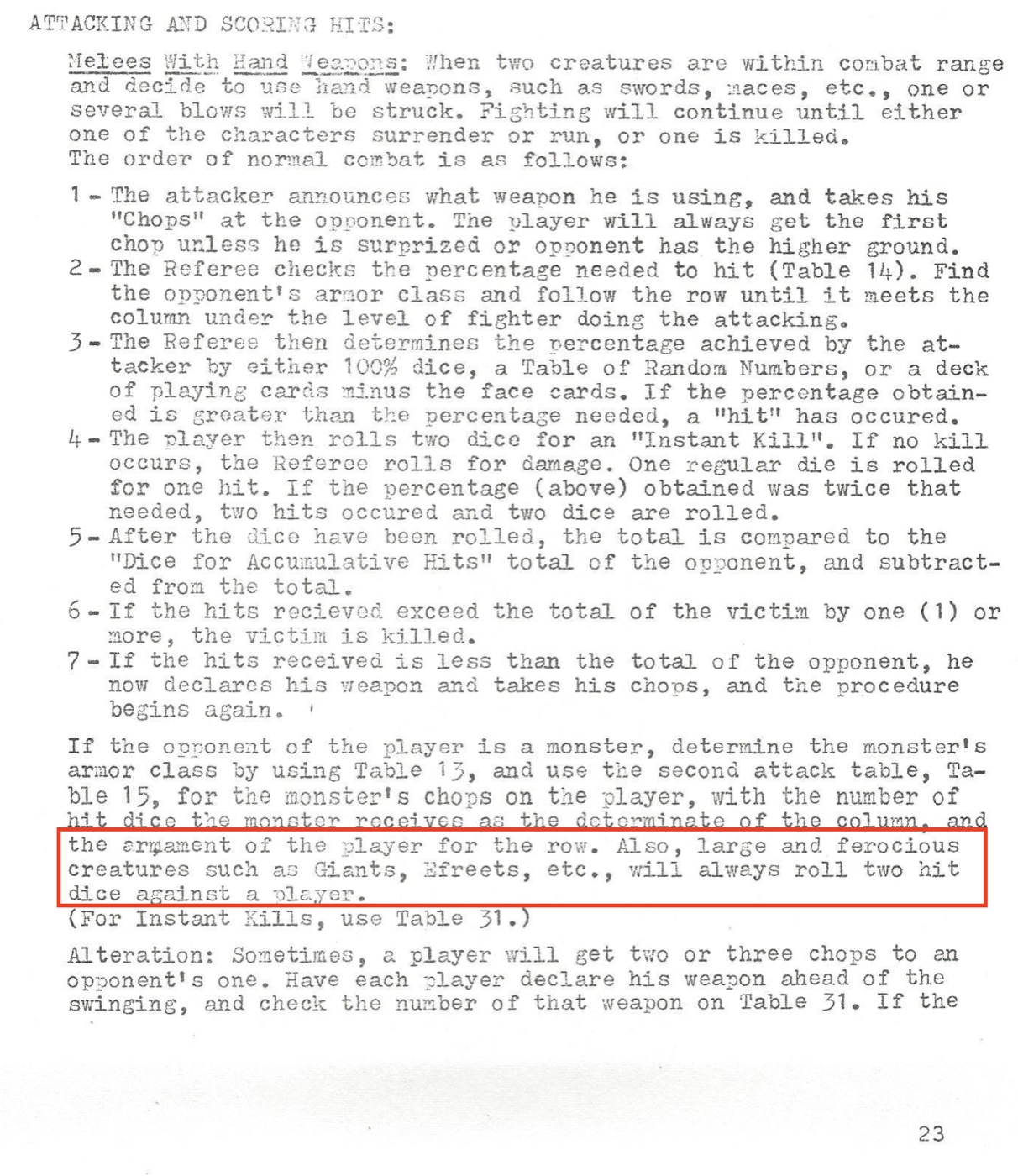
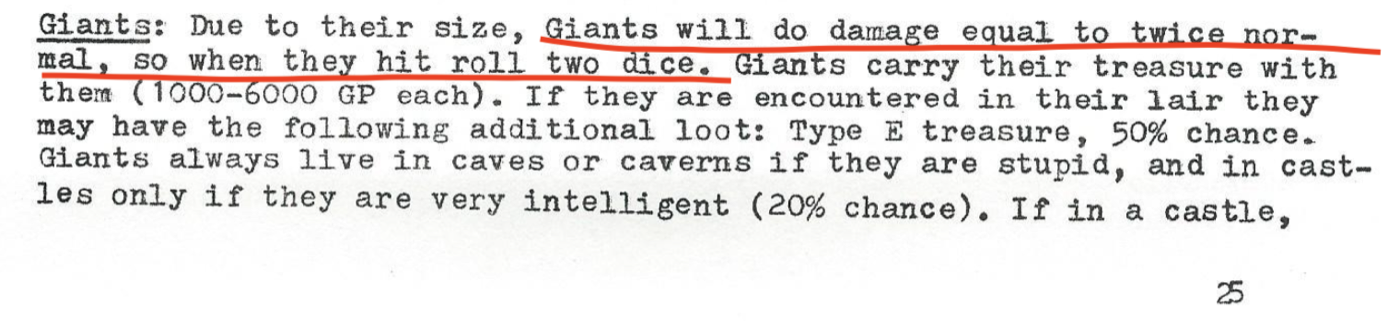
Since FFC, AIF, and BTPBD all seem to agree, let’s not overcomplicate things in our reconstructed combat system.
Additional Attacks
Due to magic, dual-wielding, multiple limbs, etc. a figure may have the ability to make an additional attack. This may only be done once per figure per combat turn. These additional attacks are resolved after all pairings have had their rounds of blows and counter-blows. In case of a conflict about who strikes first the advantage goes to any monster or NPC. Otherwise, dice to resolve which additional attack lands first.
Enchanted Weapons
Because the “to hit” roll is on a 2d6, any modifiers would be potentially outsized much like in Chainmail. To quote Gygax here: “Excaliber [sic] and other ‘Super Swords’ would give a plus two or three!” Essentially, since the “to hit” roll in our reconstructed system is a roll under system on 2d6, each plus essentially adds to the character’s proficiency in that weapon. A magic arrow and a magic bow can be combined to stack the bonus. Note, a roll of 12 (double sixes) will still always miss. This is consistent with the Luck of the Irish rule from AIF.
Enchanted Armor
Half of all enchanted armor is +1, of the remaining, three fourths are +2, thus only one in eight pieces of enchanted armor are +3.
If multiple enchanted pieces are borne, only one may have an effect on the figure’s Armor Class. For each plus, reduce the figure’s Armor Class by 1 point. Note that the lowest possible score is AC0. A defender’s armor saving throw will still fail if zero is rolled on 1d10. Again, the Luck of the Irish is at play.
Dual Wielding (Optional)
A dagger may be used for an additional attack when paired with a sword, hand axe, or club. However, there is only a 1-in-2 chance that the dagger can be brought to bear. The dagger attack is resolved after the original exchange of blows.
Dagger and Shield (Optional)
When a combatant’s sole weapon is the dagger, it may make two attacks. As above, the second attack is resolved after the original exchange of blows and only has a 1-in-2 chance of coming off. However, if the combatant has used his shield to deflect a blow during the current melee round, he does not get the second attack.
Death Saves (Optional)
FFC tells us that Warriors were entitled to a melee save roll that originally Magic-Users (and later Clerics) did not have. In the 1973 draft from the Arneson v. Gygax law suit, this became a steadily improving buff to Armor Class.
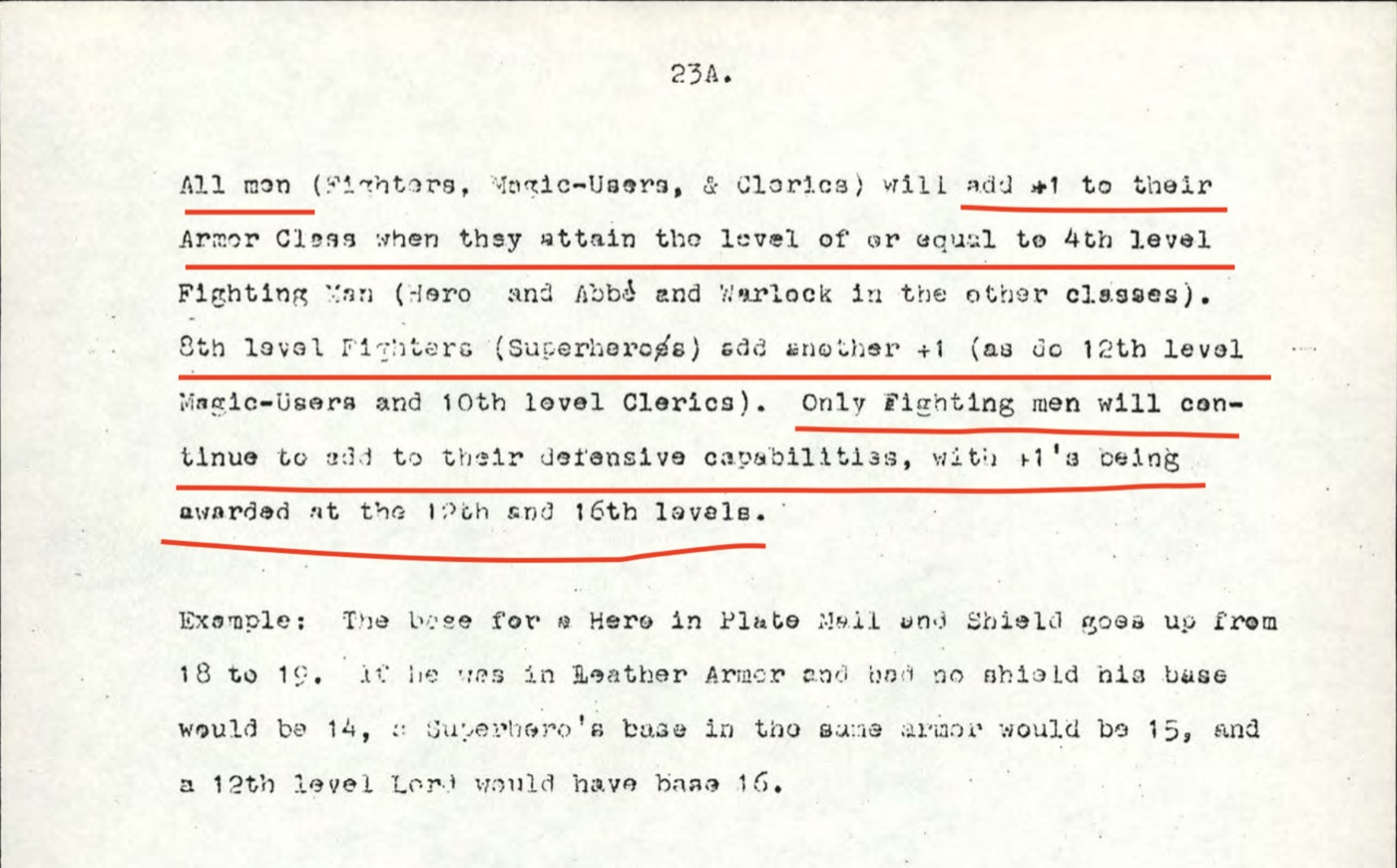
I’ve already addressed this in Midwest Fantasy Wargame, granting this saving throw only if the damage from a melee blow would take a fighter below 0 HTK. I still think this is a solid way to thread the needle here.
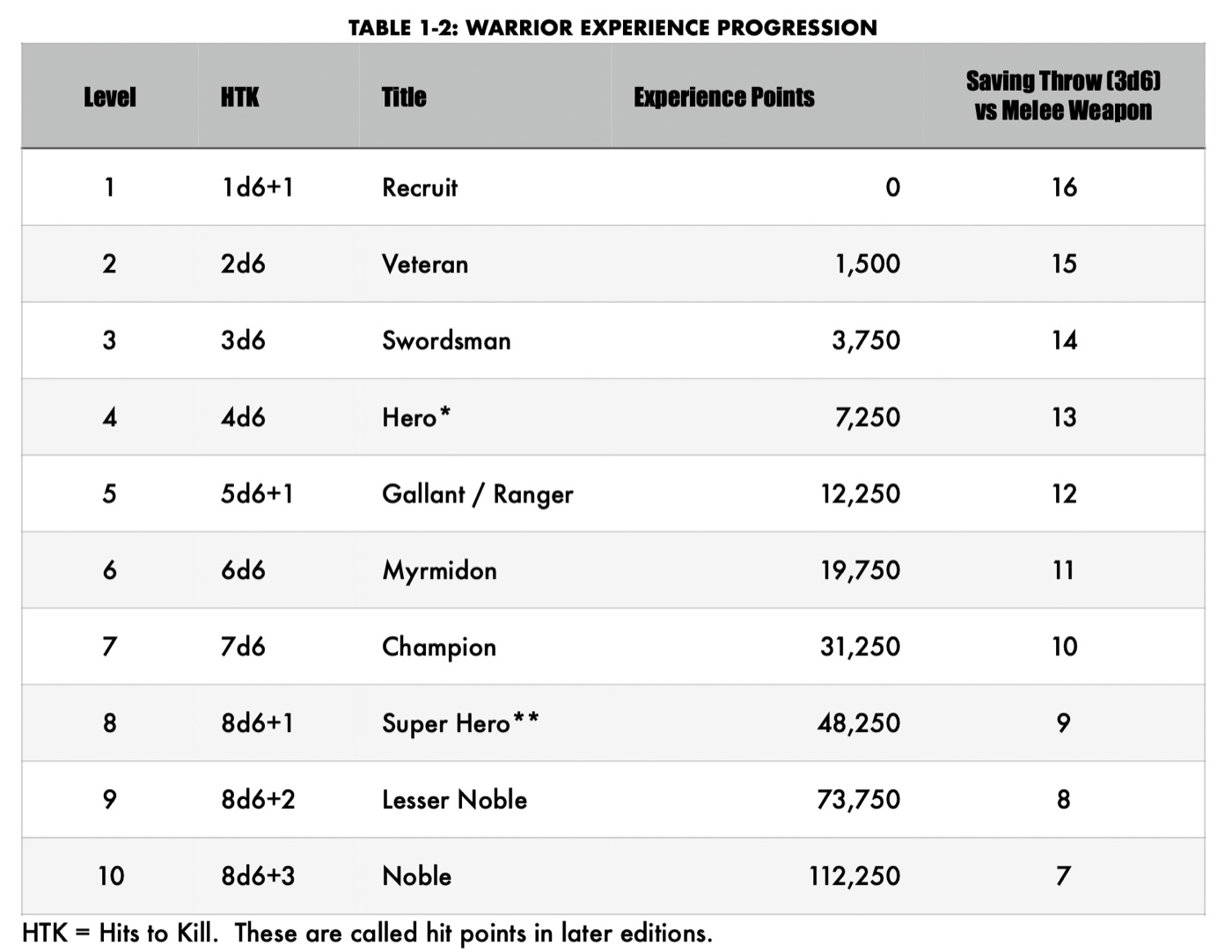
Just be aware, if you think death saves are a new thing they most assuredly are not. They are Arnesonian from the start.
Keeping the Main Thing the Main Thing
Recalling part 1 and part 2 of this series, just understand that an attacker makes a 2d6 roll and must roll under a character’s weapons proficiency (as modified) to hit. Double sixes alway fail no matter how high the modified score. The defender rolls over the character’s armor class on 1d10 to defend against the blow. A zero is always a failure.
A Final Observation About 2d6
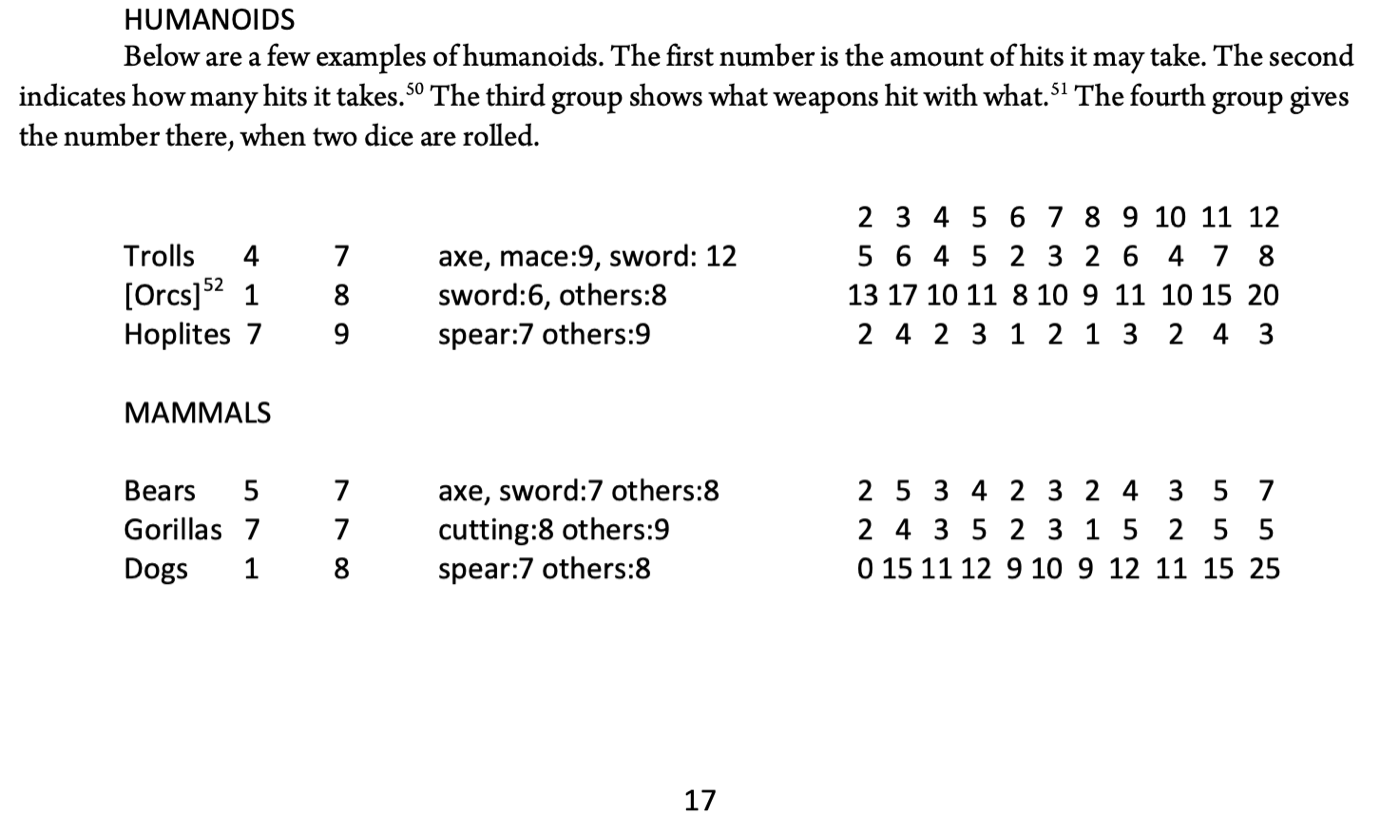
Not only does Beyond This Point Be Dragons use 2d6-based tables like Chainmail (Tables 30 and 31), we also may refer to two other dungeon-crawling systems from the Twin Cities near to the origin of D&D that used 2d6 to resolve attacks. The first is the Dungeon! board game by David Megarry. The second is The Rules to the Game of Dungeon which were once made available (and annotated) by Jon Peterson. Now the link is dead. Fortunately I have a copy.
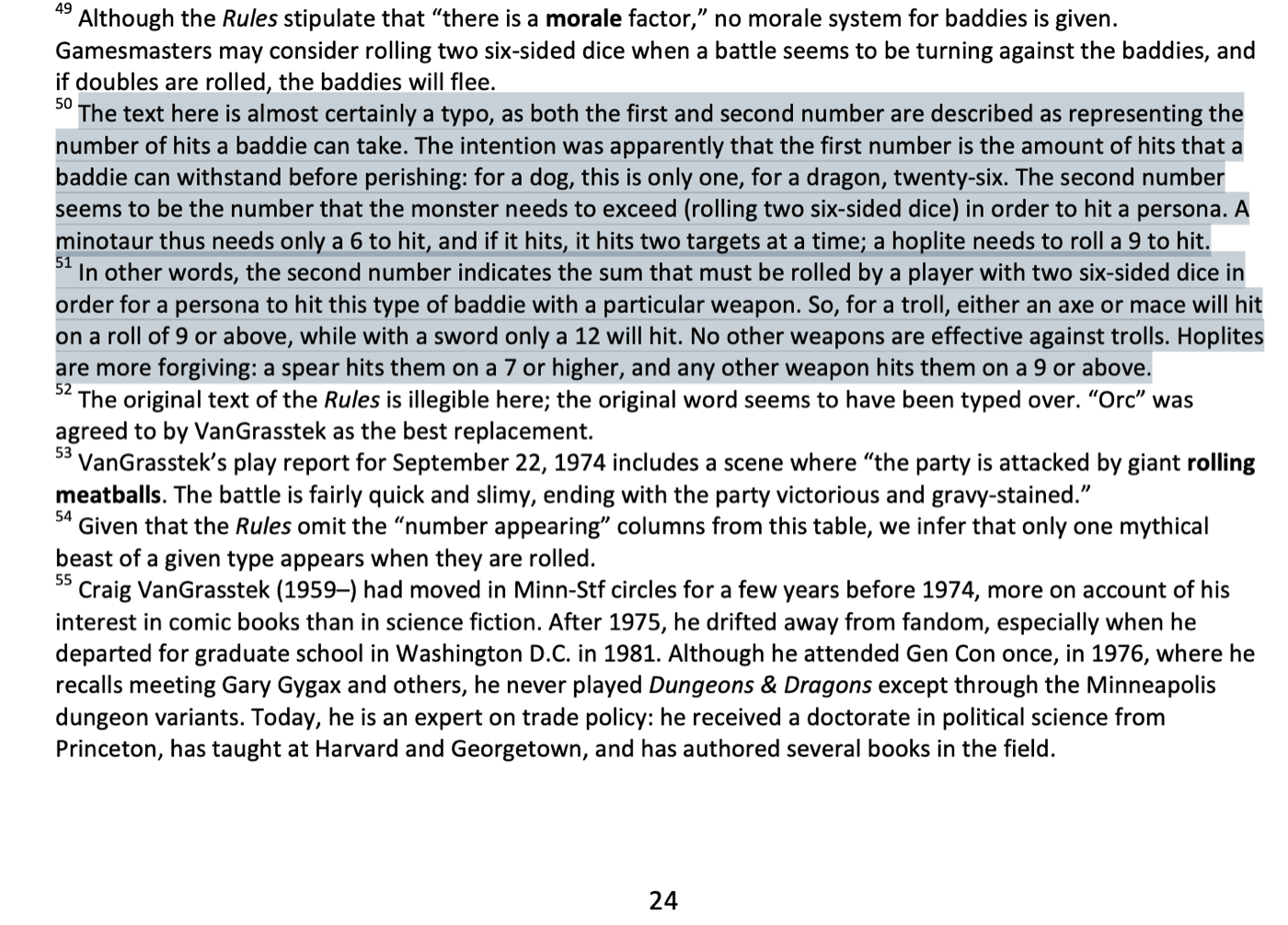
Craig VanGrasstek created Rules to the Game of Dungeon in 1974. Although he did not play with Arneson’s group, he was on the distant periphery. Interestingly, to strike a monster a player would roll 2d6. The target number for this roll varied from monster to monster by weapon employed. Does this sound familiar? Where did Craig get this idea? This is certainly not a Totten-based system. It is not a d20 system or d100 system. I find this incredibly interesting.
Morale Factor
As mentioned above, there must have been a morale factor that trickled into the Twin Cities community. The rule from Chainmail seems easiest to apply: once a set of allied figures has lost a third of their numbers (or a single figure has lost a third of its HTK), morale must be tested.
Here is the rule from Chainmail 2nd edition p. 23
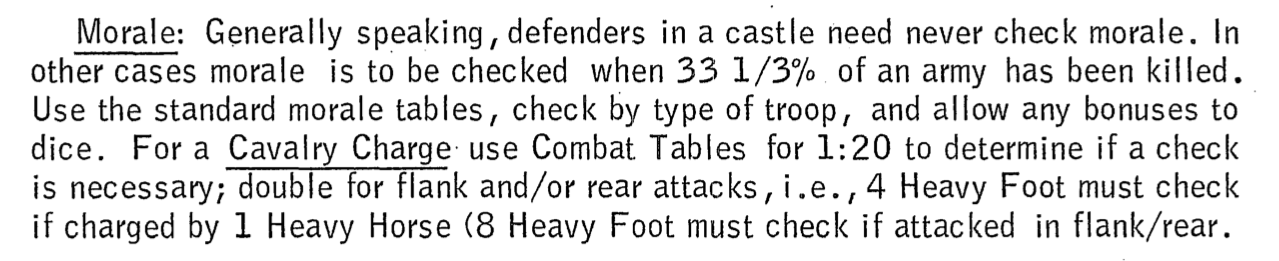
To keep this simple, roll 2d6 an on a 7 or better a figure passes its check. The Referee might apply a +/- 1 or 2 pip bonus or penalty depending on circumstances.
As to the consequences of a morale failure, it’s interesting to look at Megarry’s Dungeon! board game monster attack table. Essentially this boils down to dropping any treasure and running away; retreating one or two movement increments; and/or losing a turn of combat.
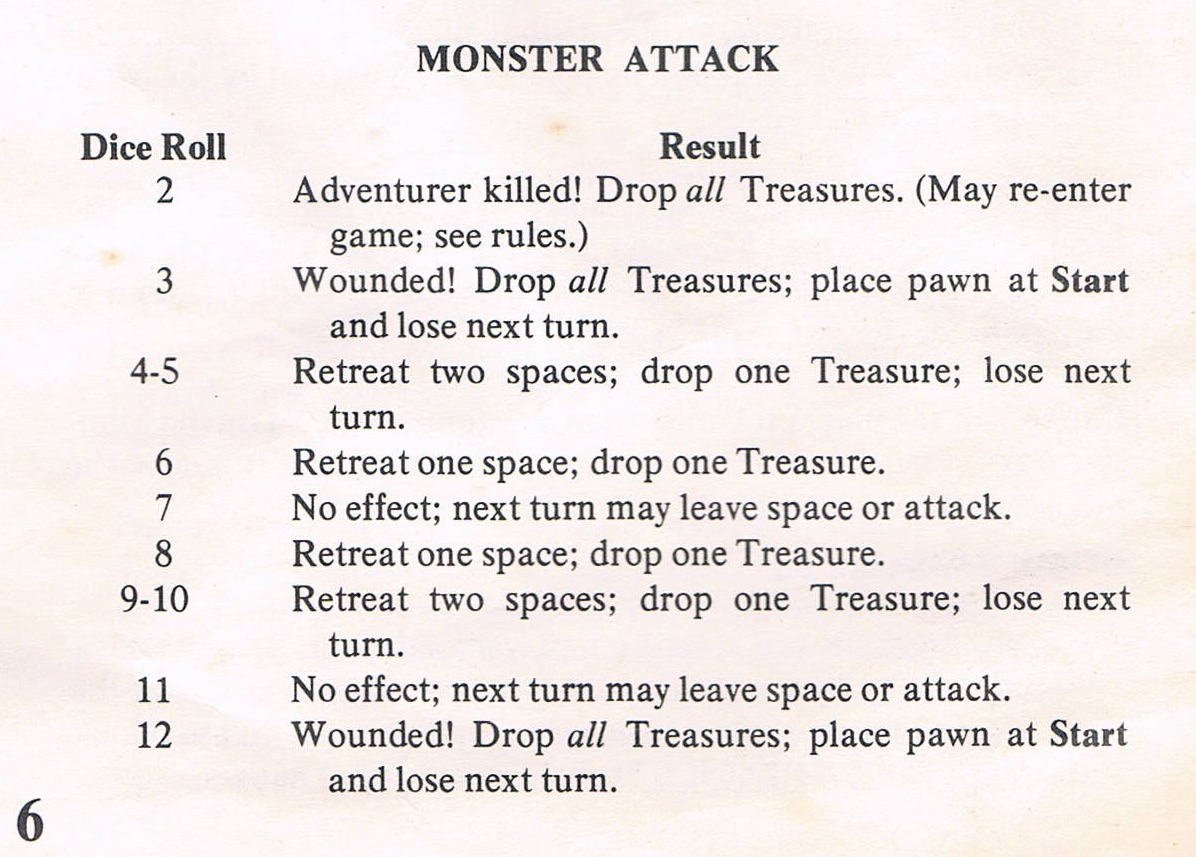
Again, Megarry’s consequences look a lot like the post-melee morale failures from Chainmail.
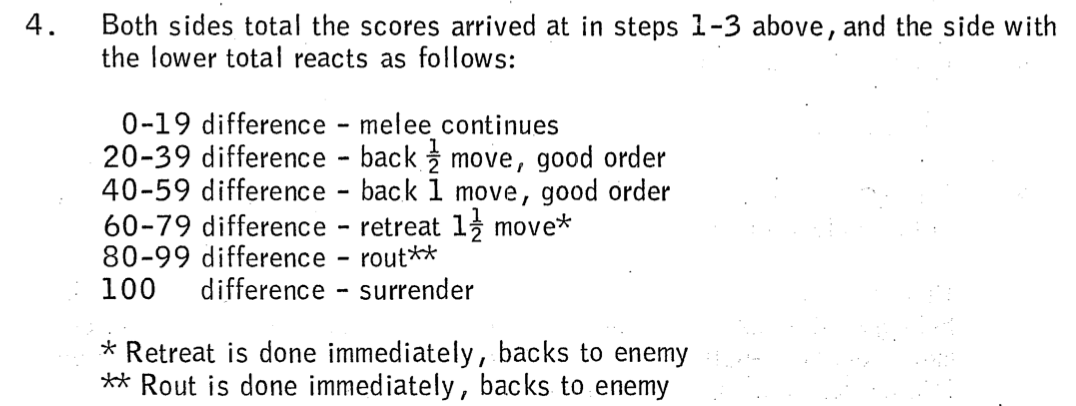
I leave this to the reader to construct his/her own table. Megarry looks nothing like Totten’s sliding morale scale with its complex effects on movement and reactions to battlefield conditions.
Conclusion
Although we cannot know which of the rules above would have been used by Arneson in the early days of Blackmoor, the system I have fleshed out is fully Arnesonian with some input from Richard Snider. It builds upon Chainmail 1st edition though there was a smidgen of influence from Charles Totten/Dave Wesely. I intend to revise Midwest Fantasy Wargame. The first edition will remain available, but the second edition will do away with all of complex rules and math that the Totten system required.
If you’ve enjoyed this reconstruction series, just know that this is how I approached the creation of Dragons Beyond, Men in Metal, Midwest Fantasy Wargame, etc. I continue to be fascinated by early wargaming rules associated with TSR in the US and Phil Barker’s Wargames Research Group in the UK. I look forward to continue to revive interest in these early games through reconstruction and retro-cloning.
Originally published on Substack on November 24, 2025.