Additional Complexities
Rodney Hampton
- 13 minutes read - 2636 wordsDiscerning Dave Arneson’s Blackmoor Combat System - Part 3
Decomposing AIF
We begin today by looking at Adventures in Fantasy (AIF) by David Arneson and Richard Snider (one of the fellows in the Twin Cities gaming crowd). Snider is well known for adding complexity (see reviews of Powers & Perils by Avalon Hill) though I do find Star Empires to be readable and hope to get in some play next year. Arneson had complained that OD&D differed from the material he sent to Gygax. By looking at the combat system in AIF (published in 1979), I am hoping we will garner some insight into the elements of combat that Arneson found most essential to early Blackmoor’s combat system.
Character Stats
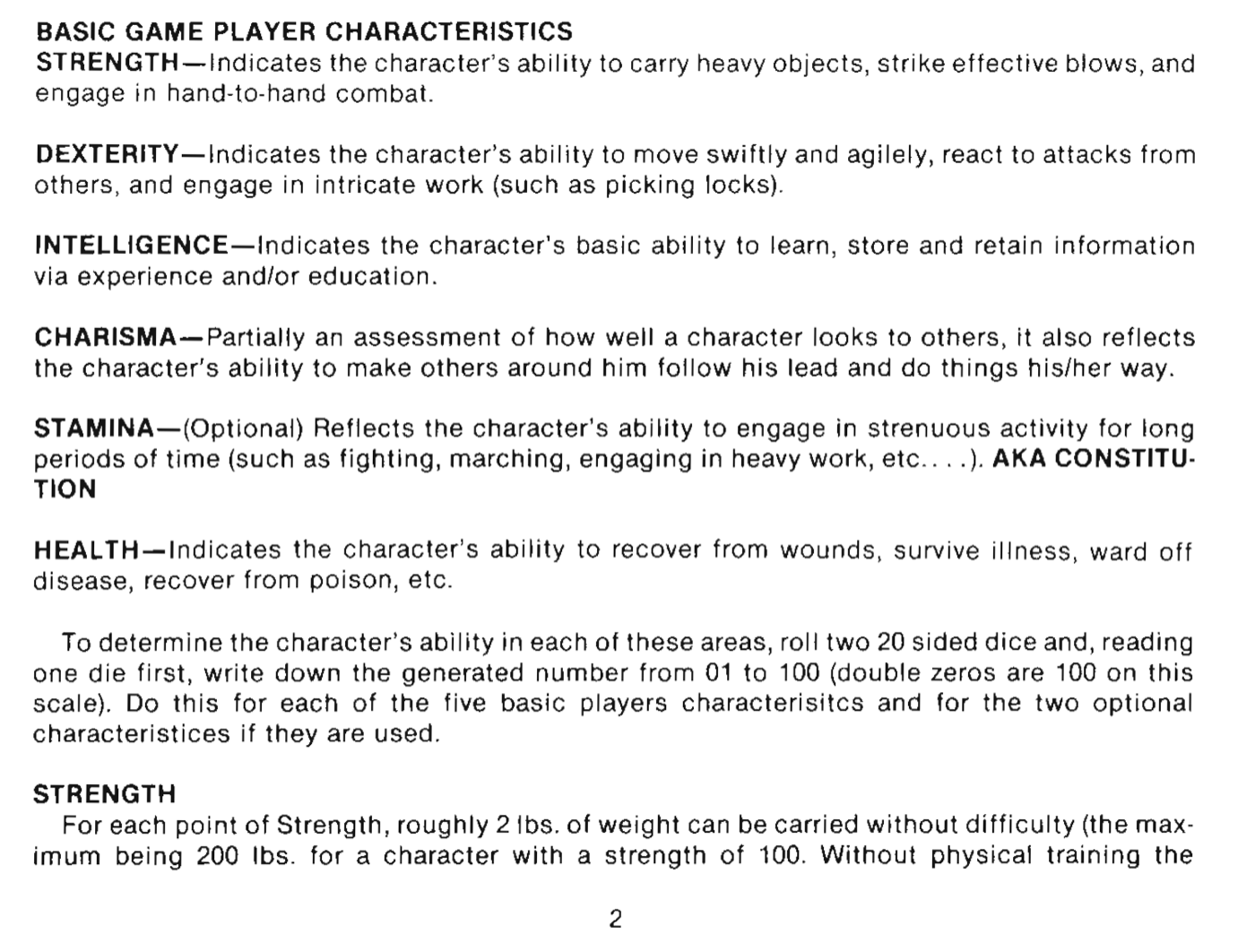
Characters start with 6 main stats. The three of most concern to combat are Strength, Dexterity, and Stamina. All of these are rolled using two twenty-sided dice (which are numbered 0 - 9 twice over). Thus these are all d100 rolls.
- Strength - For each point, the character can carry 2lbs. Also, while untrained a maximum of 75% of this score can be used. If the weight carried exceeds the maximum allowed based on these constraints, movement is NOT penalized. Instead, the rate of incurring fatigue is doubled or tripled. The maximum that can be carried is 300lbs (assuming 100% in this stat and fully trained).
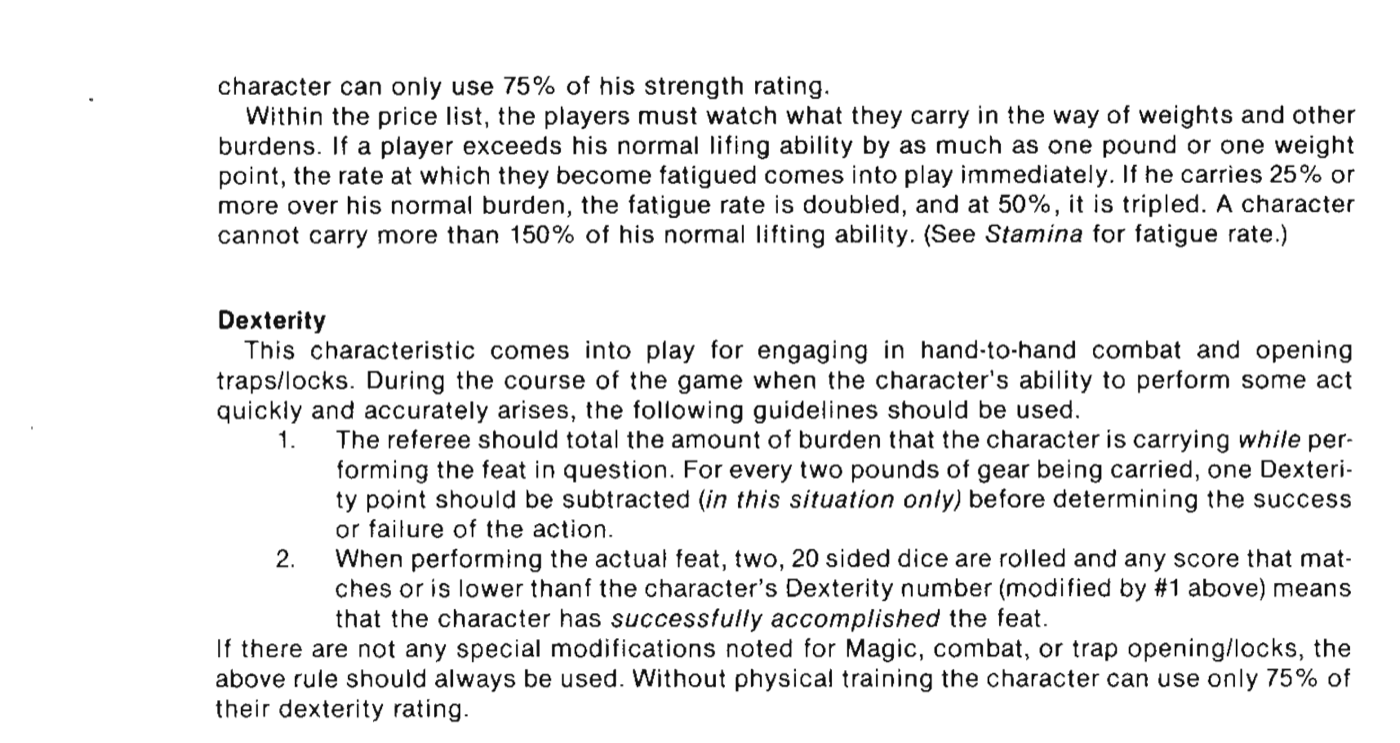
- Dexterity - this modifies the chances to hit a target (see below). Interestingly, when attempting a feat, Dexterity (modified down based on weight carried) is tested with another d100 roll. Rolling higher than the modified stat is a failure.
- Stamina - A character can fight in melee for a number of rounds (also called segments) before becoming fatigued. Normally this is 1/5th the Stamina in rounds. Fatigue causes a character to halve his effectiveness in combat. I assume this means dividing the “to hit” number in half. Rounding in AIF is usually down to the nearest whole number.
A mathematical formula is used to determine a character’s hit points based on these three stats.
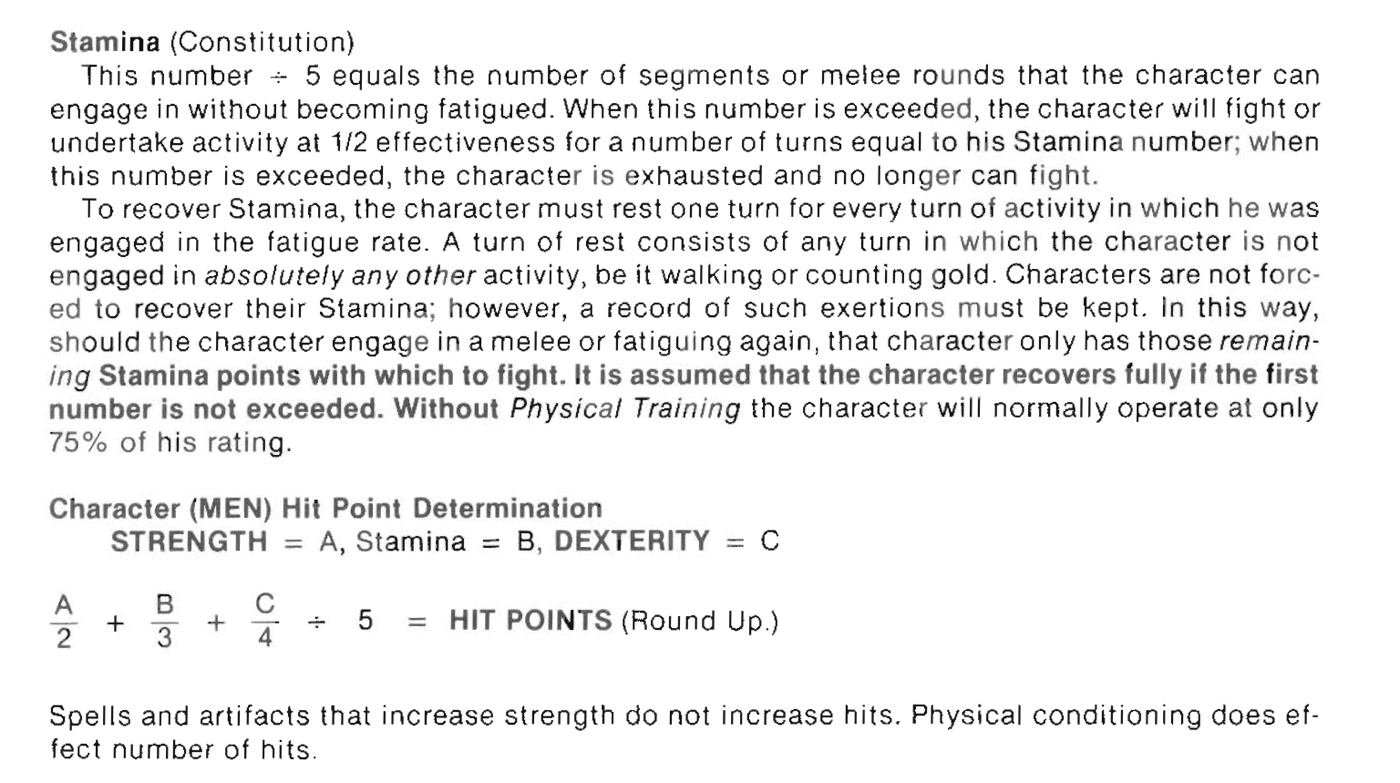
There is an explanation and example of how stamina is expended and regained on p. 52. This is a not complete break from Totten and Strategos N which used the distinction between fresh troops and non-fresh troops. Totten grants a 4:3 multiplier favoring the fresh troops. Wesely does the same thing on p. 15 of Strategos N and states that one turn of melee or 6 turns of marching without rest makes troops “not fresh” while 6 turns of rest + out of action re-establishes their fresh state. AIF’s mechanisms do, however, seem completely different. They look a lot more like fatigue in Chainmail than anything else.
Encumbrance
We will look at just a portion of Table C from p. 16 covering the encumbrance for weapons and armor. Bafflingly, the rule for encumbrance from p. 18 tells us to cross index weight carried with strength to get the movement rate. But as shown above, strength and stamina interact to produce fatigue, not reduced movement. There is no table in the scan that I consulted. Instead, there is a lot of white space on the page as though something were missing.

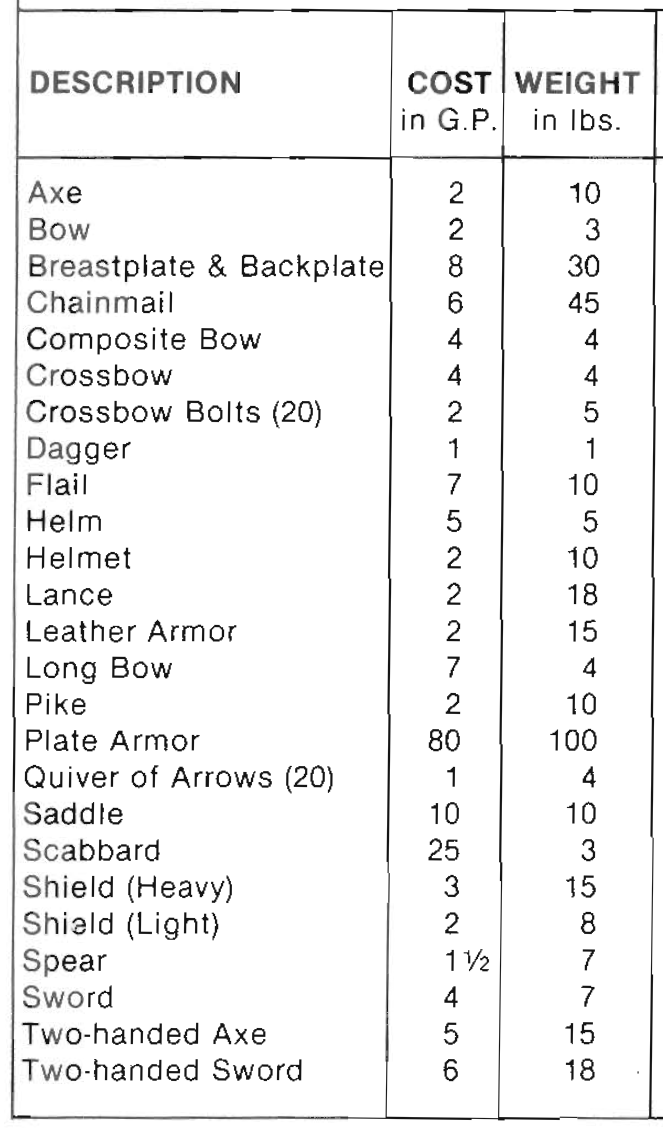
As a side note, Arneson & Snider have four categories of armor (leather, chainmail, plate, backplate and breastplate) , two categories of shields (heavy and light), and two types of head covering (helm and helmet).
Training
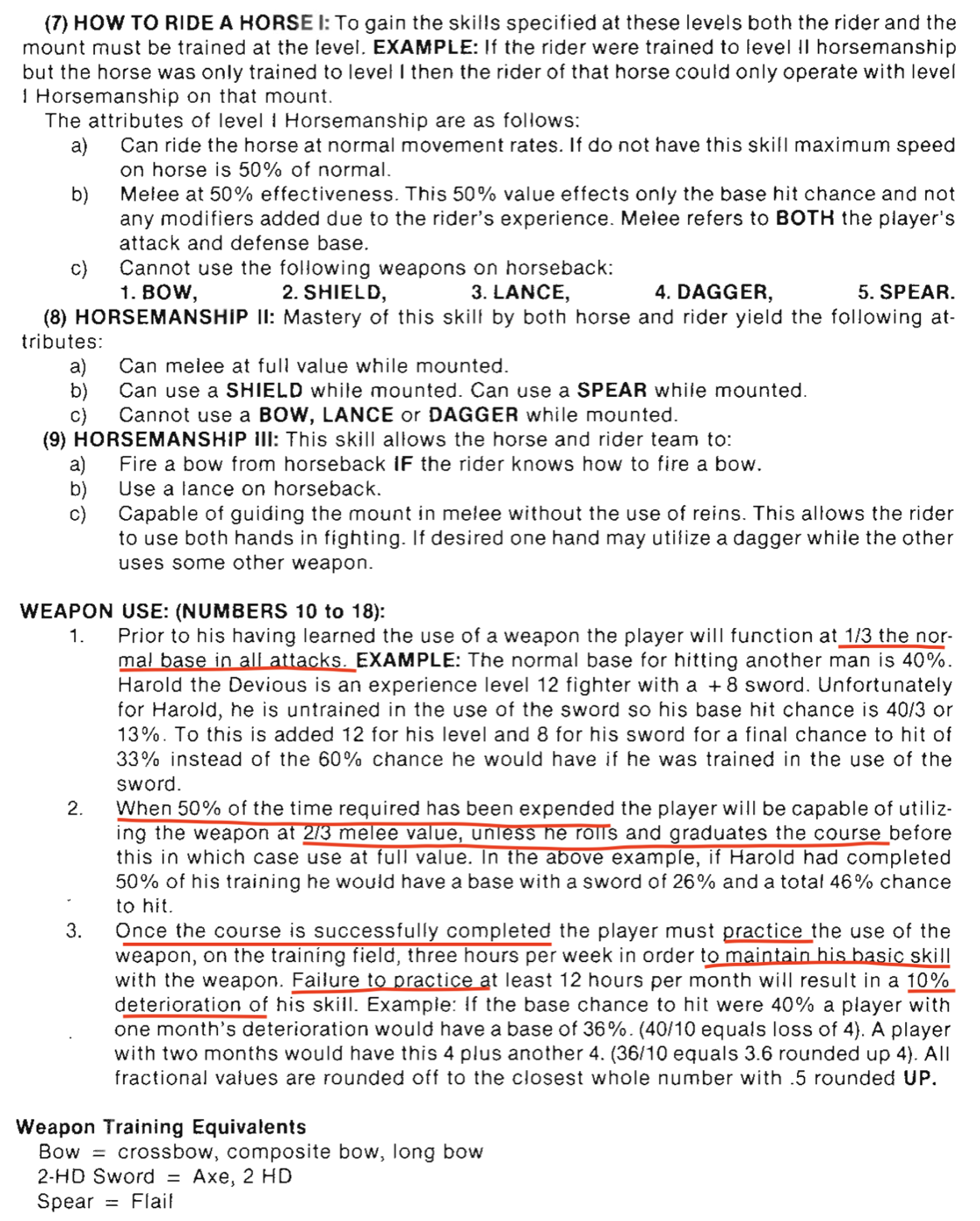
AIF expands upon the training concepts mentioned in Arneson’s First Fantasy Campaign. Without getting too side-tracked, horsemanship is no longer a simple 2d6 score with a roll under ability check. Now, there are graduated ranks in horsemanship which unlock martial capabilities. The training system in AIF is extensive. Also, complexity has been added to weapon proficiency. And there is a requirement for periodic training otherwise these proficiencies become impaired. In general, this system fits in with the annual campaign and social rank system to simulate life as a medieval warrior. However, these seem to be additions that post-date the original Blackmoor combat system. I will mention them no more.
Movement Rates
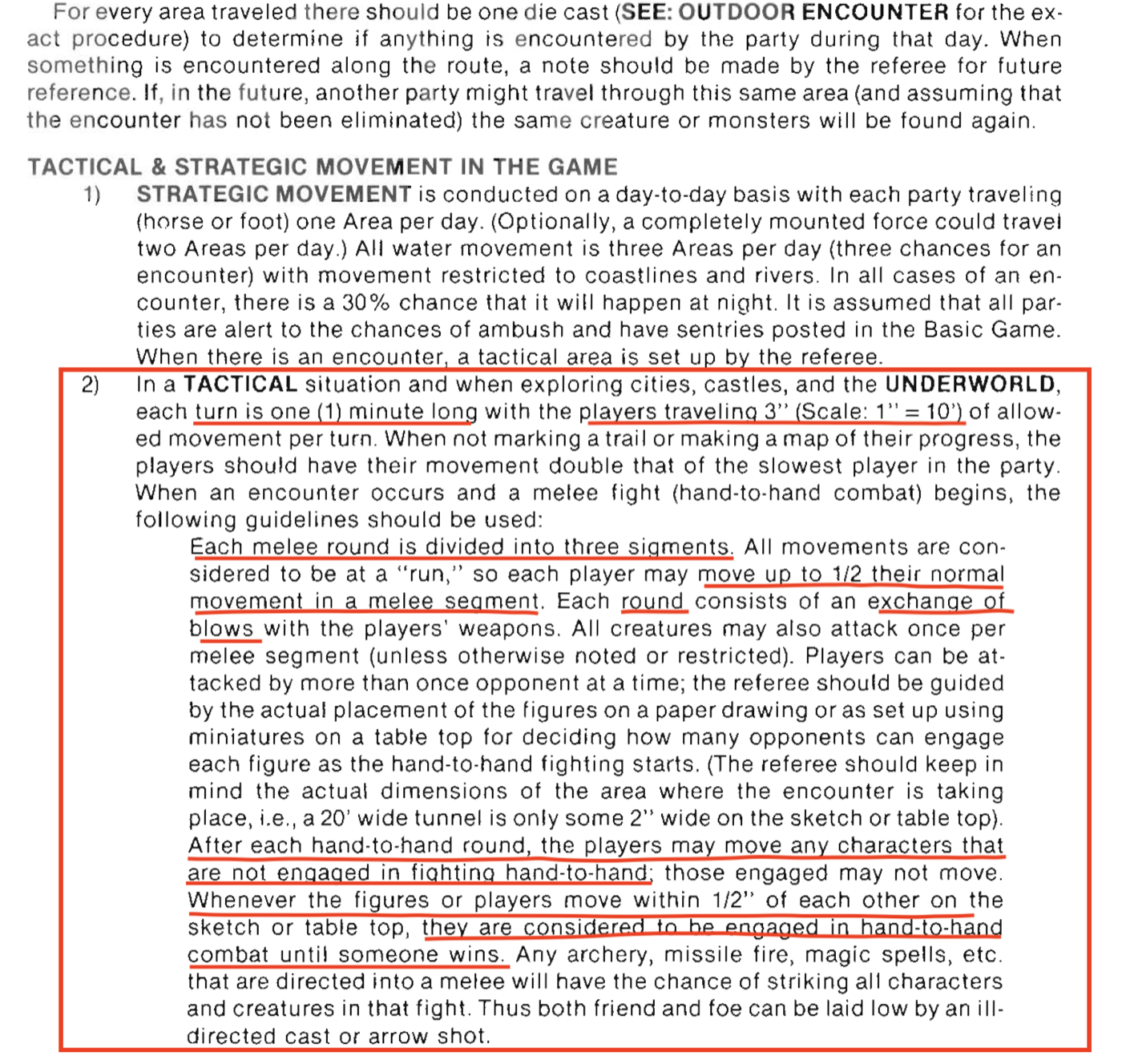
On p. 36 there is a section describing the transition from strategic movement to tactical movement when an encounter takes place. Many important combat rules are stacked into this block of text. The exploration turn in the dungeon sees players traveling at 30 feet per minute. Once in combat, the melee round is divided into 3 equal segments. For each segment, a player may move half of his exploration rate because he is considered to be running. Thus 1.5” + 1.5” + 1.5” = 4.5” However, once within 1/2” of an opponent, the figure is locked in melee until the opponent is eliminated. This describes a second movement phase following “normal combat” or melee combat wherein those who were not engaged / locked in melee get to spend their remaining movement. We will call this phase G. See below. Missiles may be fired into melee with equal chance to fall upon friend or foe.
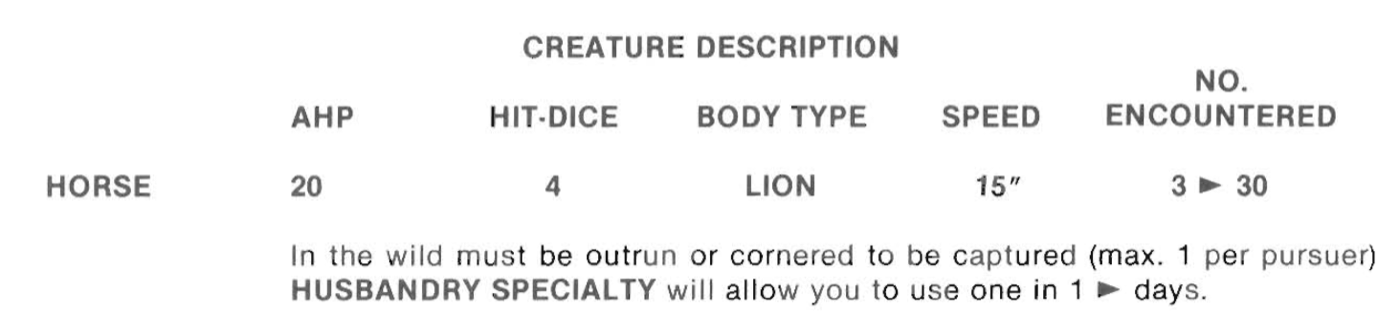
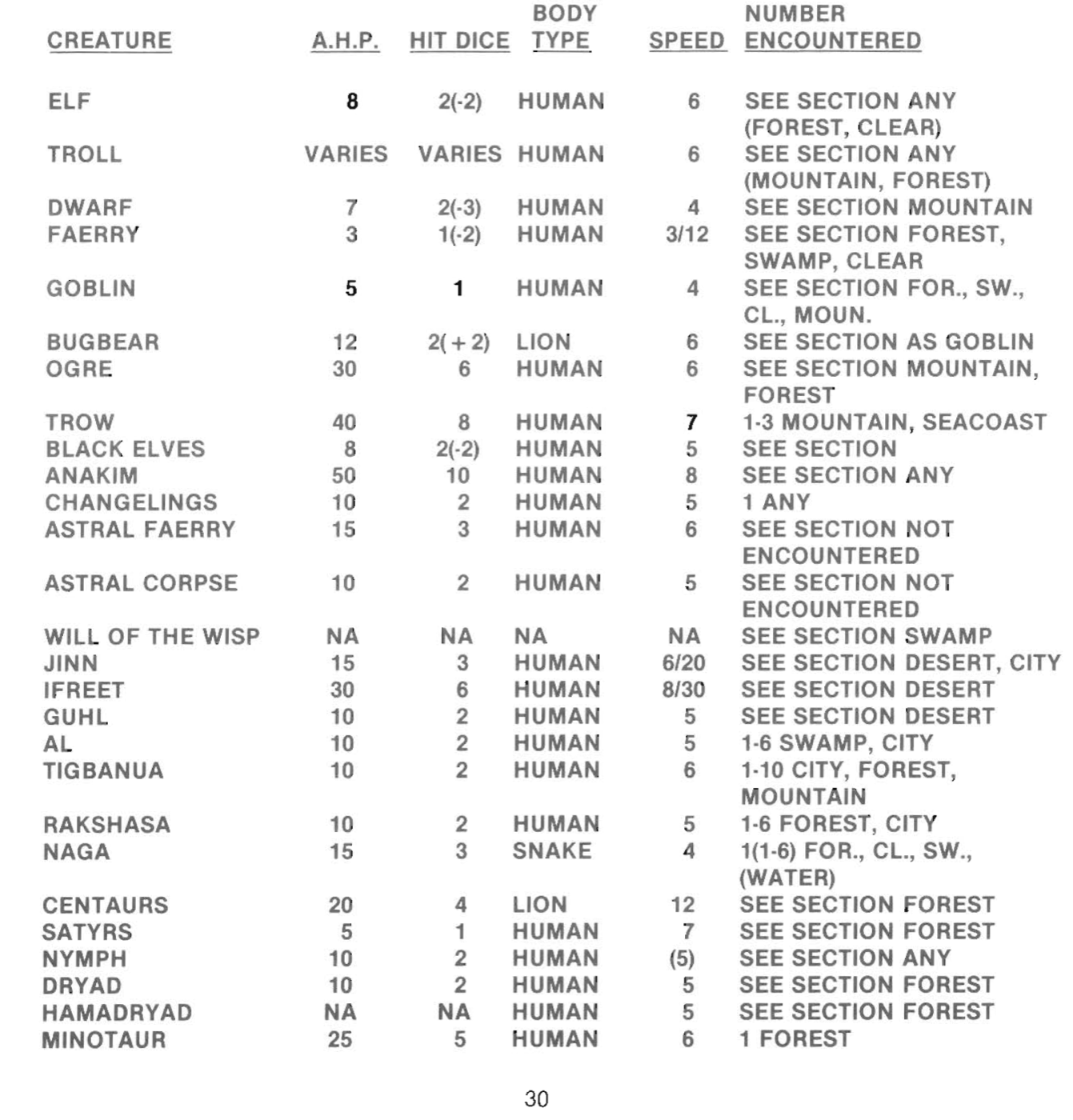
Compare this with the monster tables from pp. 29-30, however, and you see very different movement rates for Dwarves, Elves, etc. Again, it seems like an entire table for human movement rates is missing from AIF. It is interesting to note that Arneson and Snider have departed from OD&D’s movement bands in 3” increments though some traces still remain. A.H.P. below stands for Average Hit Points.
Encounters and Hostility
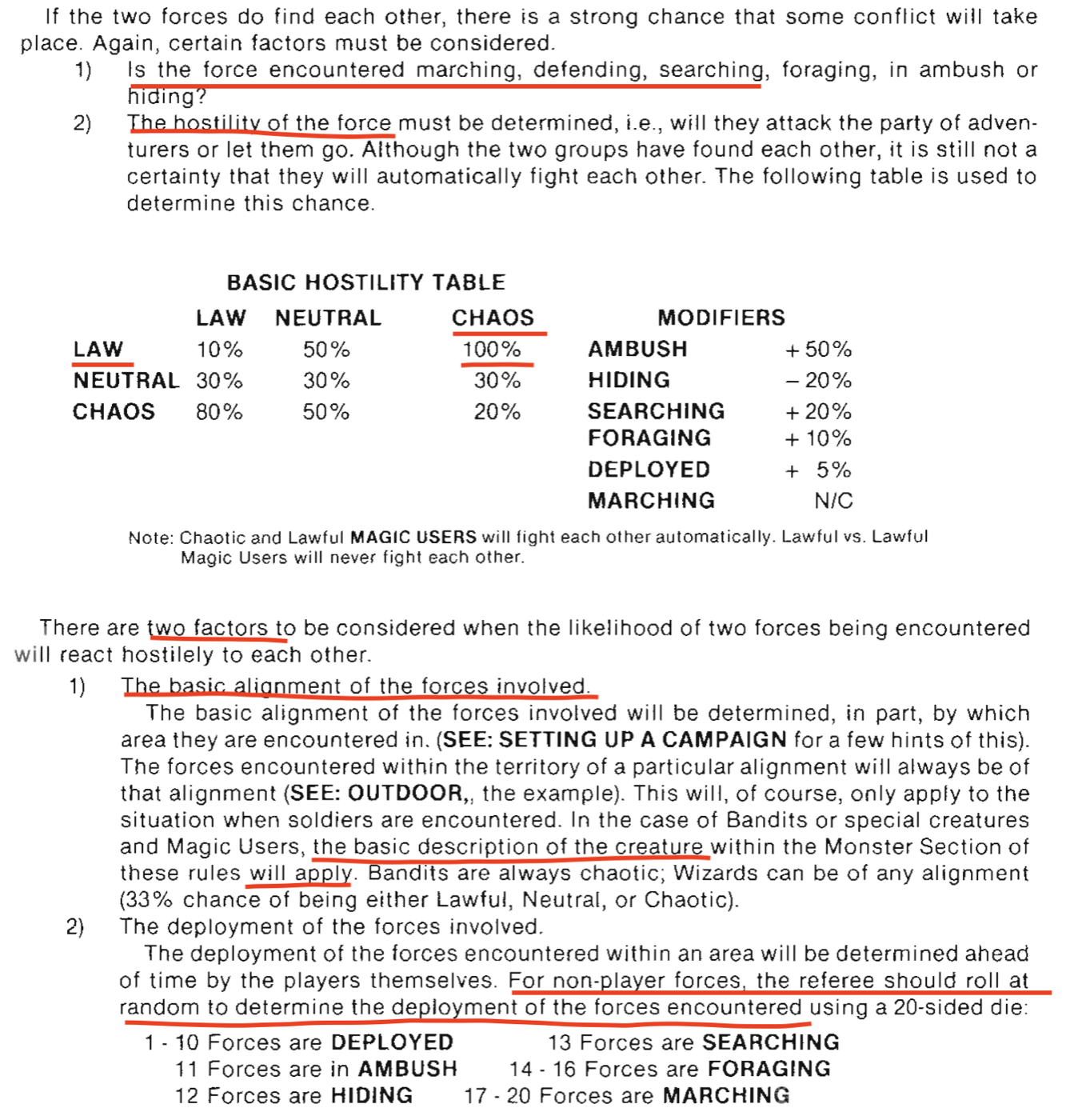
Encounters in the outdoors are described in great detail. The basic sequence is movement into an area, check for encounter, if an encounter is imminent the evasion table is consulted to see if the party is detected or not. If detected, the hostility table (p. 34) is consulted modified by the posture of the encountered creatures (ambushing, hiding, searching, marching, deployed). The underground has no defined exploration sequence, but the outdoor procedure could be truncated to accommodate, especially if the stocking of the dungeon is done on the fly. In situations of Law versus Chaos, hostility is assumed.
Laying Terrain onto the Table
For underground encounters, the Referee can refer to his/her dungeon map. For outdoor encounters, however, pp. 36-37 of AIF provides detailed rules about laying terrain down, scale, etc. This looks exactly like a wargame set to be played on a 36” x 36” table. Terrain effects on movement (discussed below) will further illustrate the wargame-y nature of combat in AIF. Interesting that both Arneson and Snider very much embrace this very tactical and tactile approach to resolving combat.
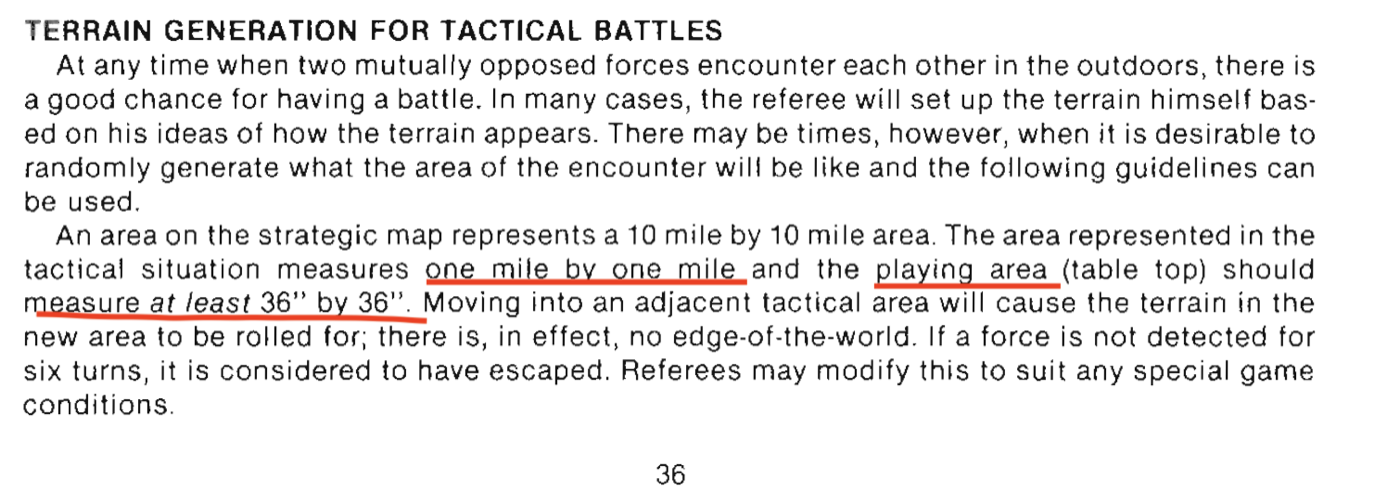
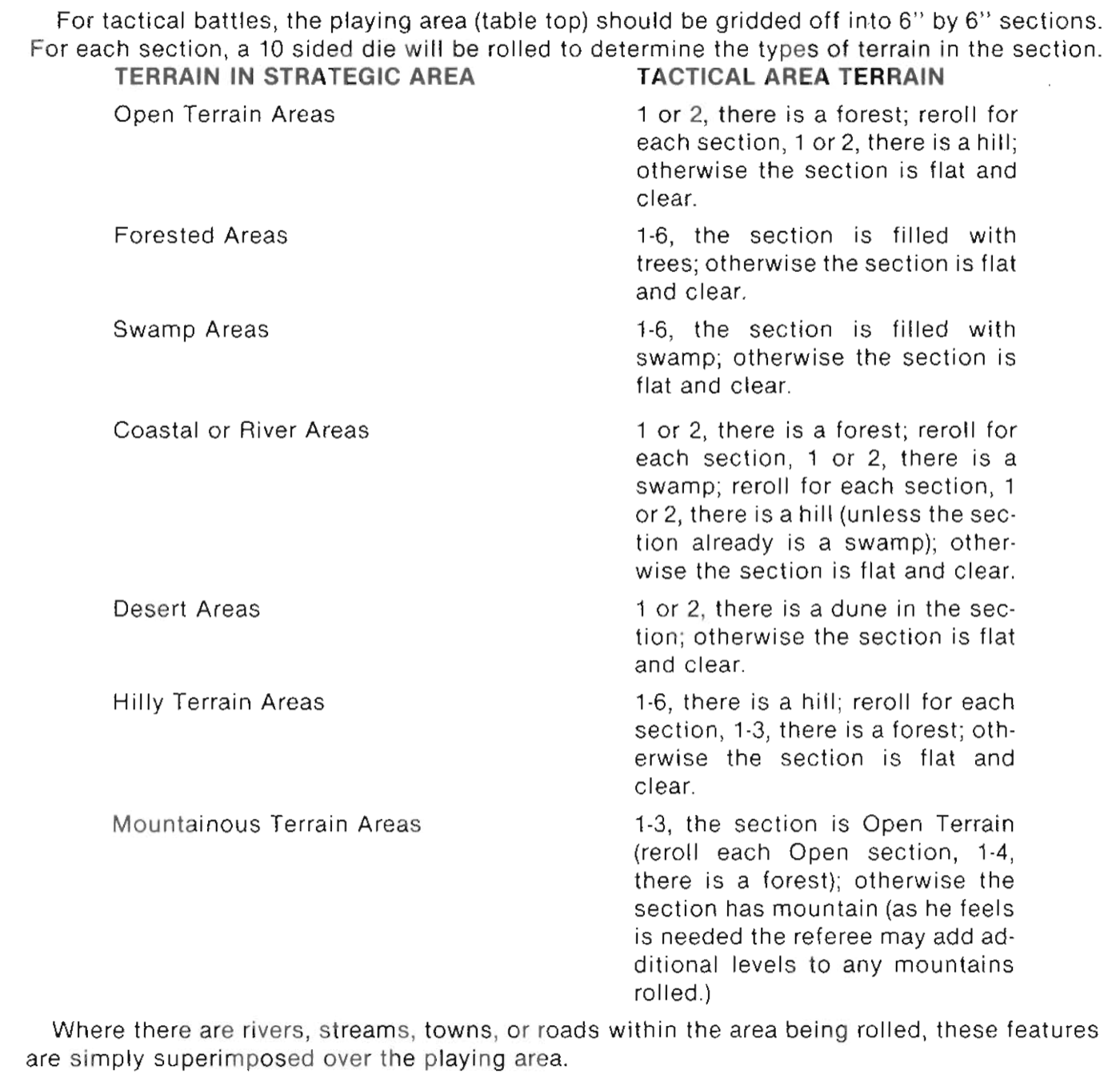
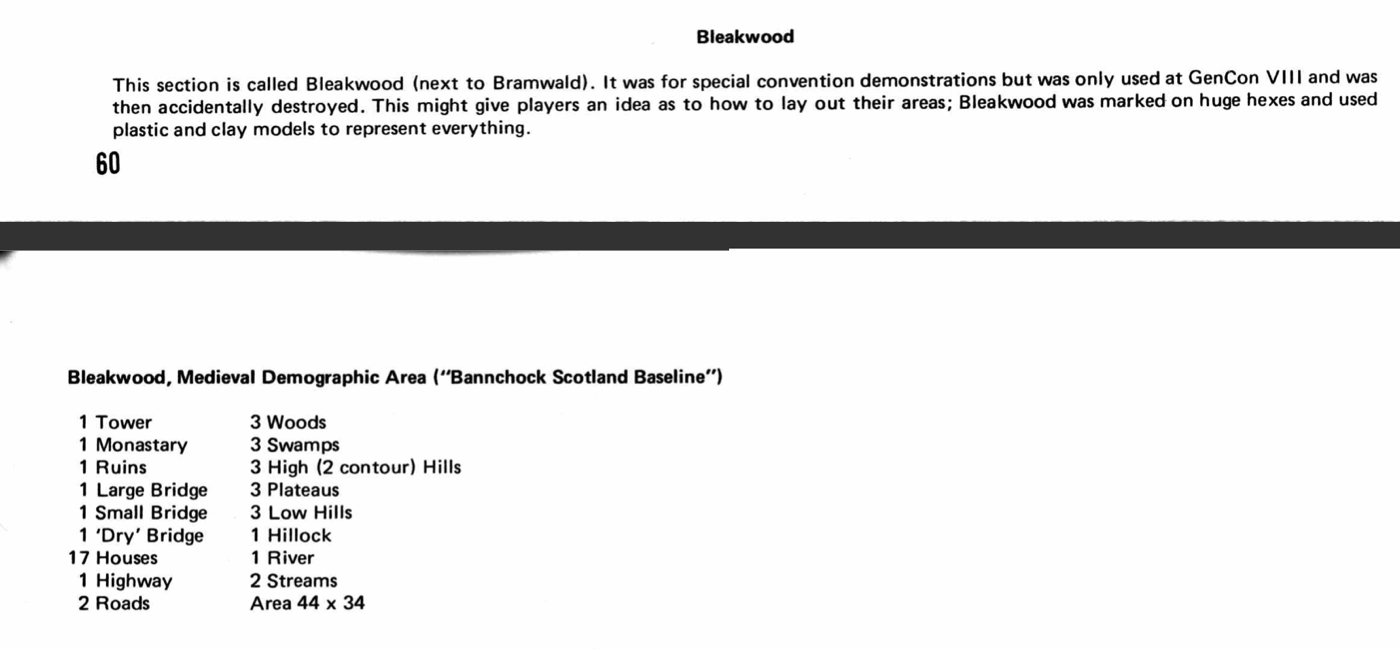
Notice that this is not the first time Arneson wrote down how he generated terrain for a gaming table. Compare AIF to Arneson’s technique for generating an area of interest from pp. 60-61 of First Fantasy Campaign. Arneson calls this the “Bannchock Scotland Baseline.” This terrain can best be seen on the map of the actual Battle of Bannockburn, Scotland where all of these elements are present. See https://coopercottages.com/2020/11/30/the-battle-of-bannockburn/. Note: Gen Con VIII was held from August 22–24, 1975.
Combat Sequence
The first two pages of the combat section (pp. 47 - 53) are devoted to the combat sequence, and constructing the “to hit” values for a pair of combatants.
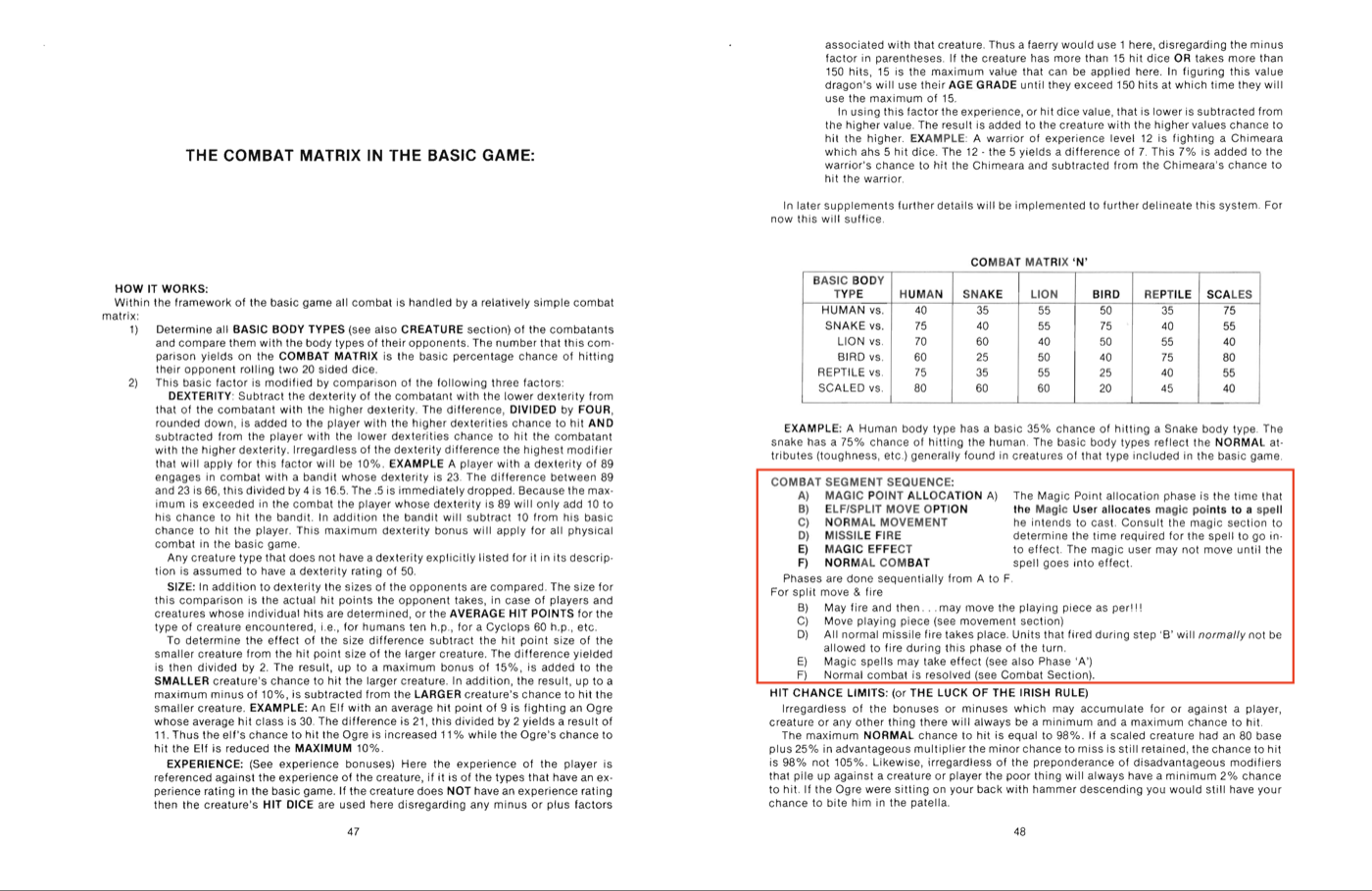
The combat sequence has 6 phases (A-F) but does not say who goes first.
A) Declaration phase for magic-users.
B) Split move and fire phase which presumably only applies to Elves. There is nothing about this in the description of Elves later in the book. Although it says “as per!!!) it does not refer to anywhere else. We know how split move and fire works in Chainmail, but AIF is different. AIF simply front-loads an Elf’s missile fire prior to the movement phase.
C) Movement phase. Various terrain types have an effect on movement.
D) Normal (mundane?) missile fire phase. Those who have split fired are generally prevented from shooting again.
E) Magic phase. We will omit the one on one wizard duel system from AIF’s book 2 (aka “ Sorcerous Combat”) which smacks of M.A.R. Barker’s Tekumel and TSR’s War of Wizards or psionic combat. See below for how standard spells work.
F) Normal combat phase (i.e. melee) a set of blows and counter-blows.
[G) Second movement phase. Those not locked in melee may move. See above.]
Calculating Melee “To Hit” Values
Back to pp. 47-48, the base “to hit” value is based on body type. For the same matchup (human v. human, snake v. snake, etc.) it is 40%. Dexterity, size modifiers, and experience differential (levels or HD comparisons) are applied to combatants on opposite sides. This would be tedious in a large scrum. Finally, there is always a 2% chance of success and a 2% chance of failure when trying to hit a target.
- I’ve talked about The Luck of the Irish in part 2 of this series and traced its roots back to Totten.
- Experience is an unnecessary extra variable. Hit points (HTK or “hits to kill” in early Blackmoor) already captures this variable as described in part 2 of this series.
- Dexterity is an attribute that did not exist in early Blackmoor. In Supplement I: Greyhawk (published 1975) p. 8 Dexterity is used to give Fighting Men an ability to react, parry, & dodge which basically boiled down to a penalty to an attacker’s “to hit” roll. It was used as a modifier to combatant order for the ACS in Book VI: Eldritch Wizardry (published May 1976) pp. 5-7. In Holmes’ Basic (published 1977) it was used to determine the order of attacks. I won’t say more about Dexterity in this series.
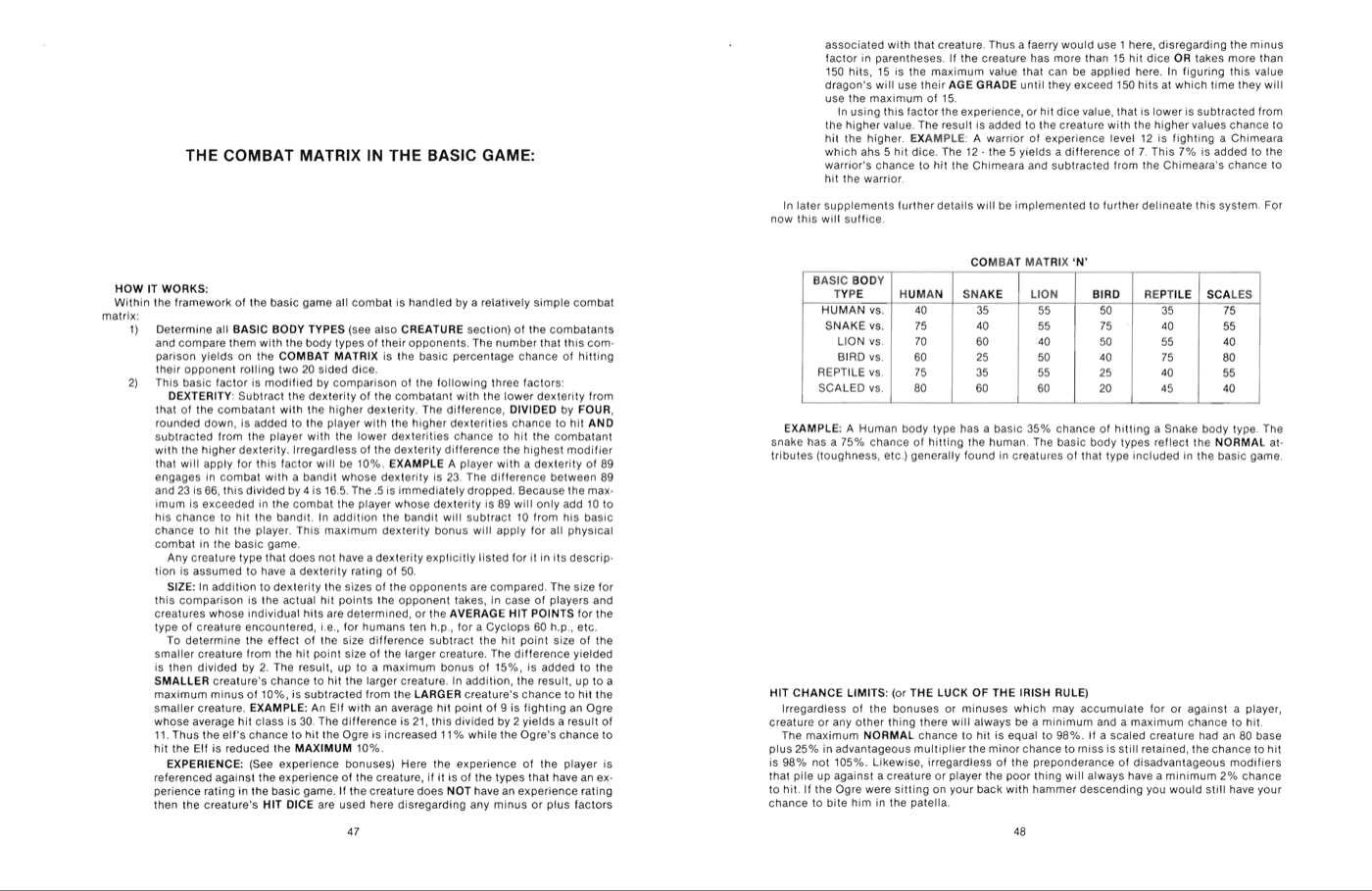
- Body Type and Body Size are worth further discussion. These were likely part of the early Blackmoor combat system.
Calculating Missile Fire “To Hit” Values
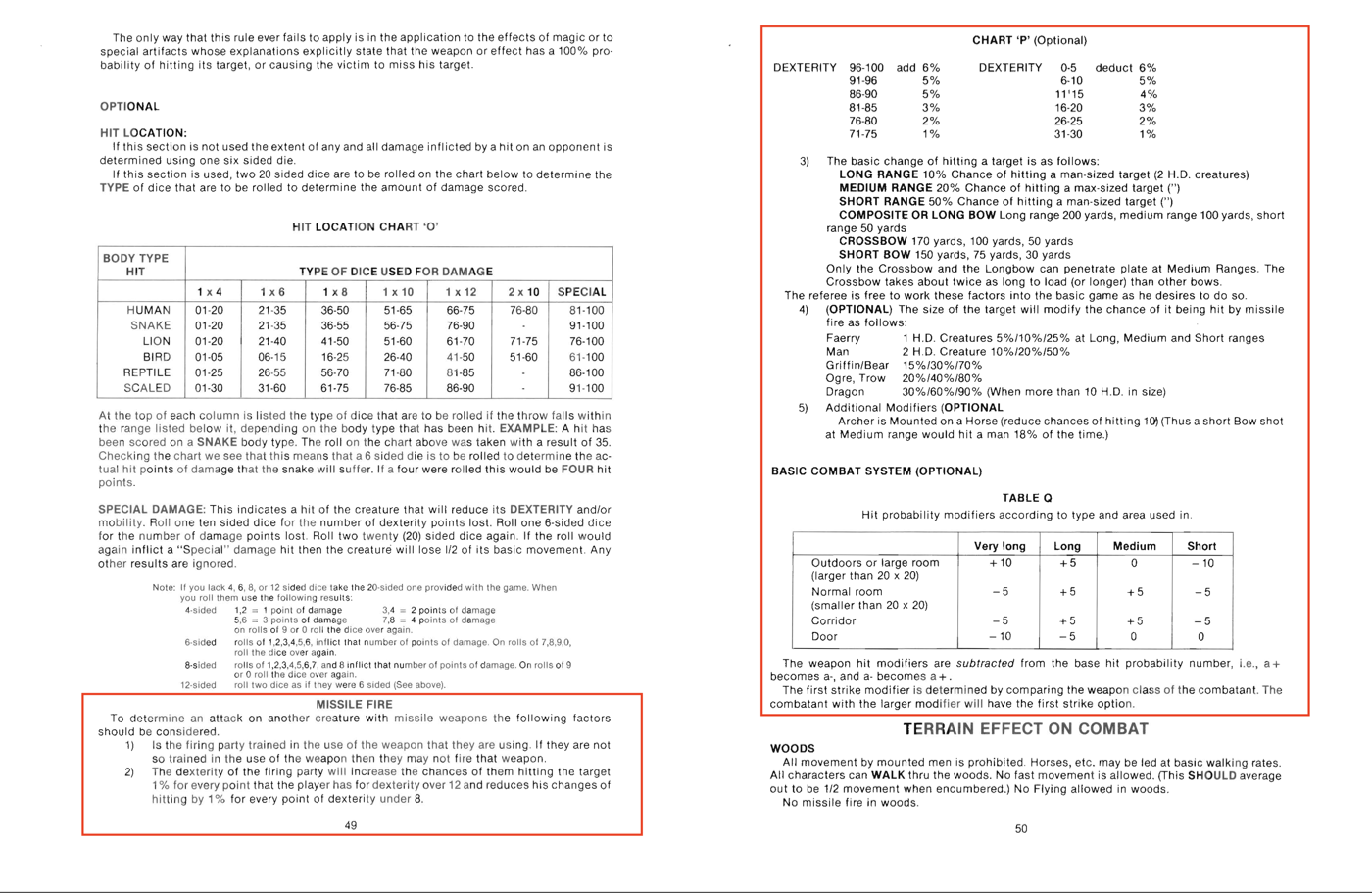
AIF describes missile fire on pp. 49 - 50. It isn’t clear until you read through the rules more than once that missile fire calculates the base “to hit” chance differently. Like Chainmail (and Tony Bath’s medieval rules) ranges for missile weapons are divided into three equal segments: short, medium, and long range. The base chance to hit a man-sized target at these ranges is 50%, 20%, and 10% respectively. Additional modifiers include the firer’s dexterity; the target size; and firing through corridors, through doors, at extreme range, etc.
This section also gives us the range bands for stringed weapons, limitations on the ability of crossbows and longbows re: plate armor, reload speed for crossbows, and (at the very bottom) a mention that the weapon class affects who gets the first strike. This is the only mention of who gets the first blow and is a notable shortcoming of AIF’s combat system.
Calculating Damage
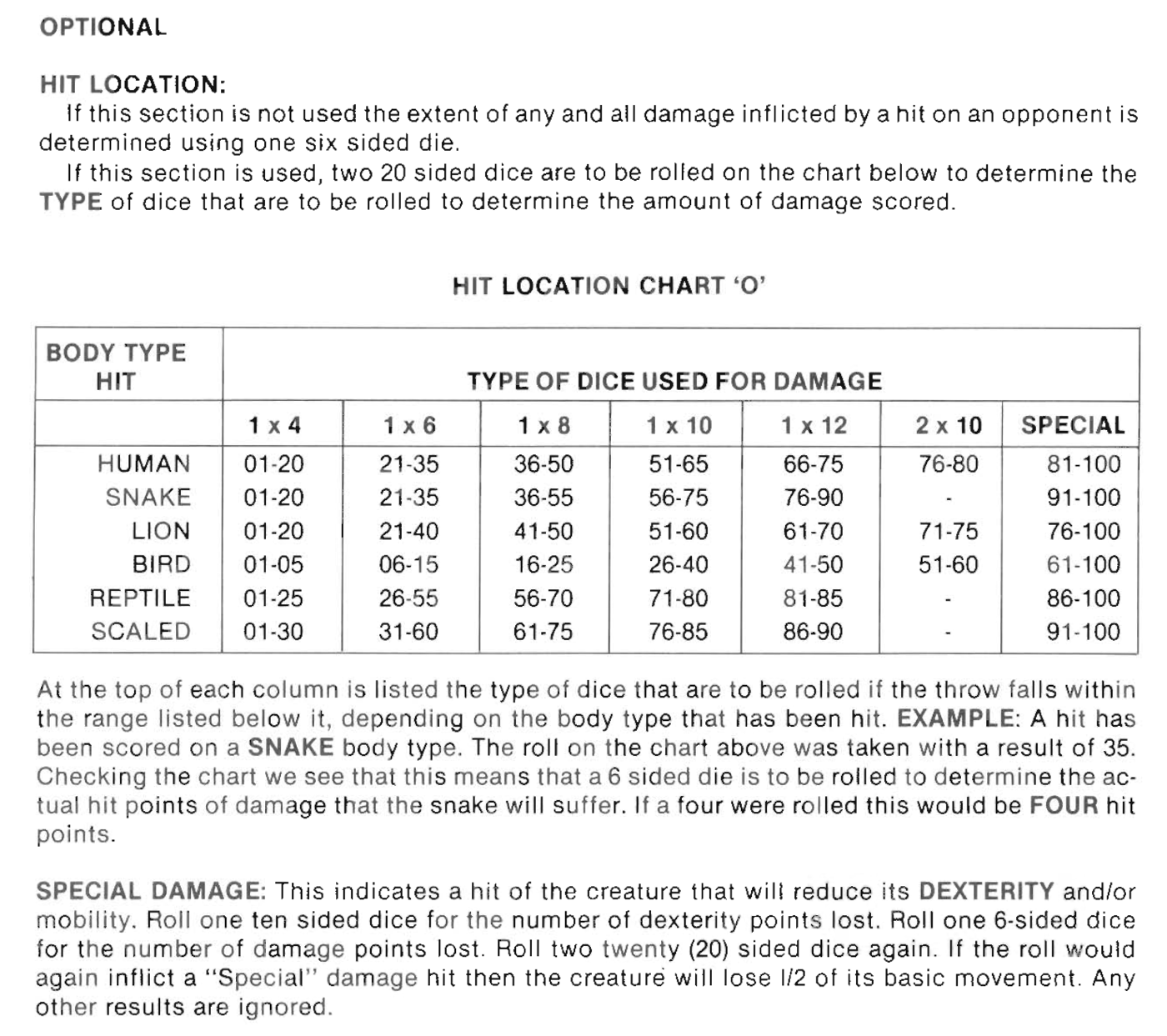
The default amount of damage is 1d6 hit points. However, there is an optional “hit location” table that determines whether to increase or decrease the size of the damage dice. Also there is (on average) a 2-in-10 possibility to impair the foe’s dexterity and (on average) a second 2-in-10 possibility of cutting his mobility in half as well.
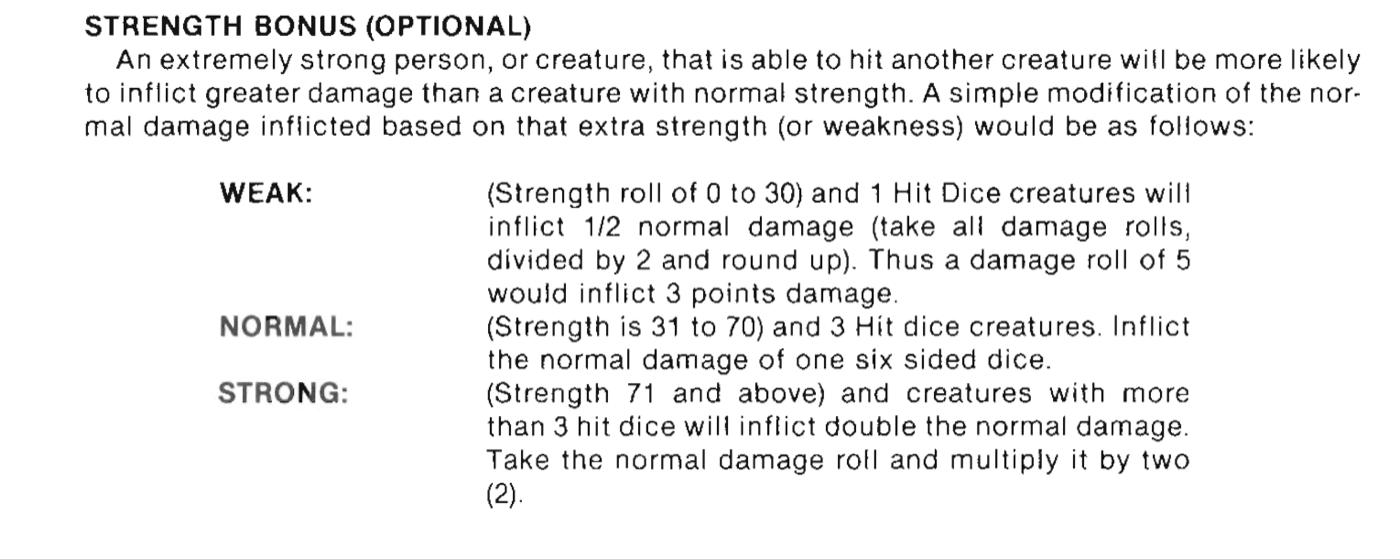
On p. 53 there is an optional Strength modifier to damage. Presumably this is for melee damage only.
Armor Saving Throw
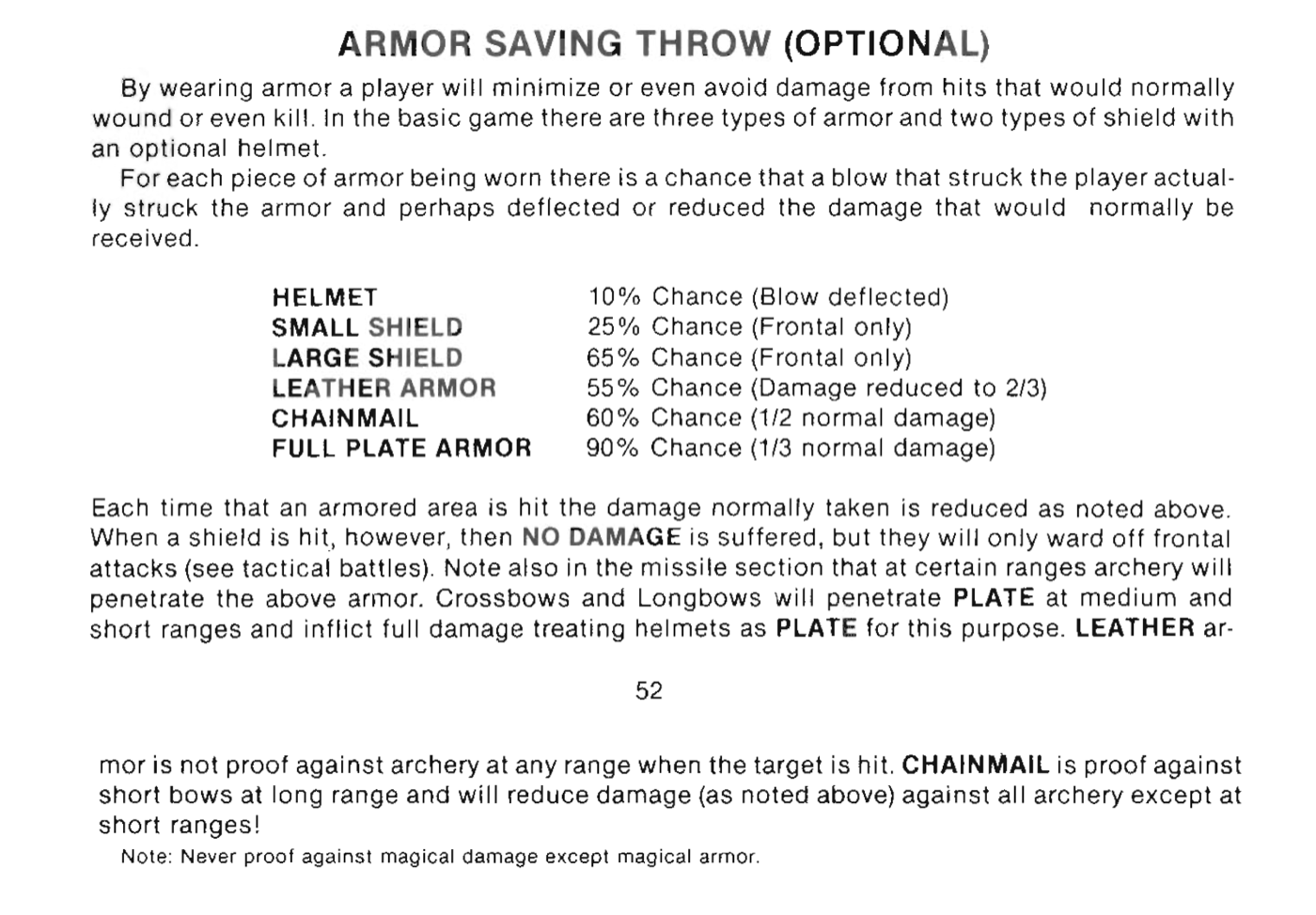
Optionally, Armor can be used to reduce damage per pp. 52-53. Interestingly we see here information about the two shield types, three standard armor types (but not the backplate/breastplate) and one head covering (helmet). There are additional rules regarding archery interacting with chainmail and plate mail. Unfortunately, there is no true “hit location” table so there is no way to know if a blow landed upon a shield, head, or body. AIF hints at an earlier system that was simpler and rewritten in a much more complex, yet muddled fashion.
Terrain Movement Modifiers and Cover
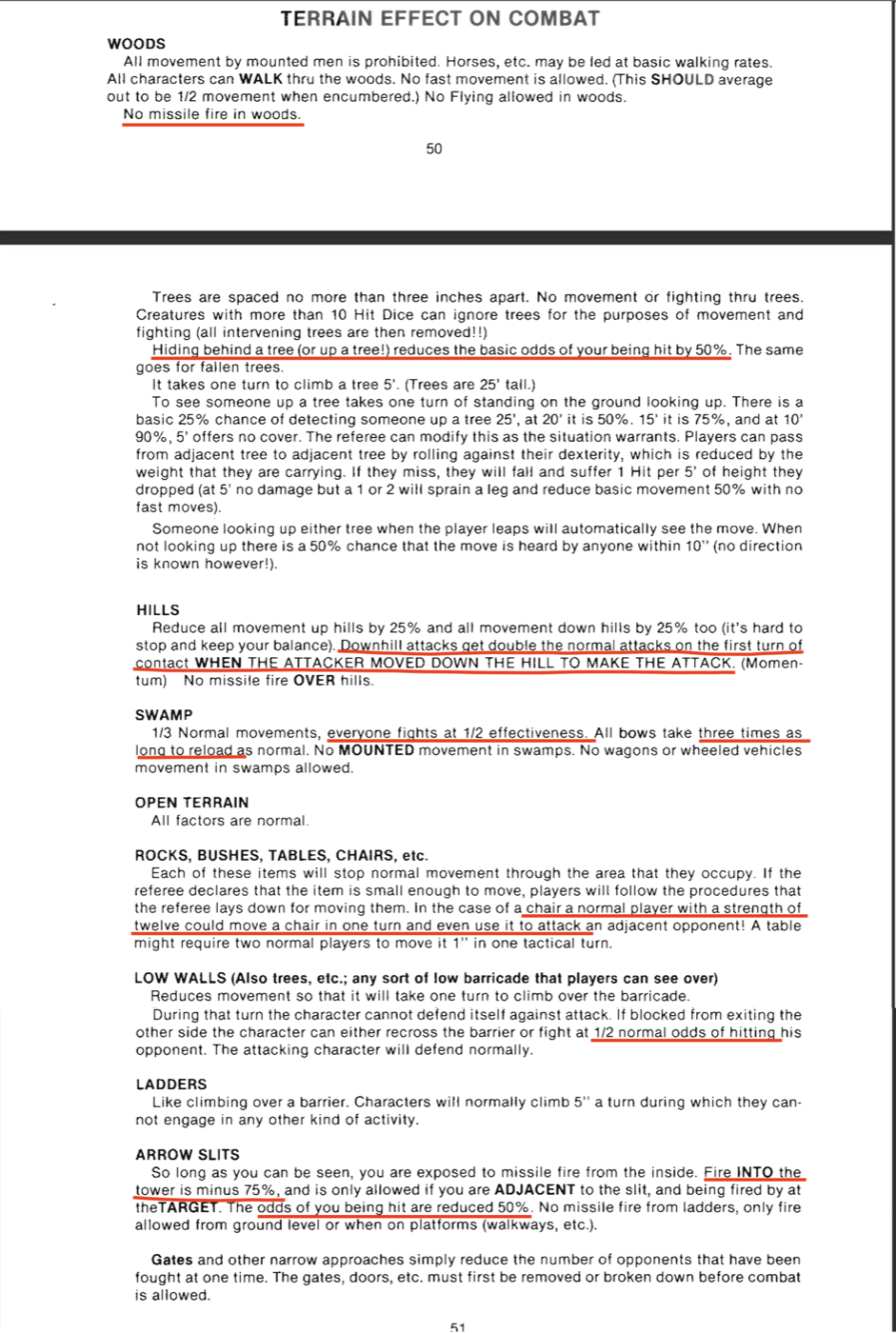
This section contains quite a few one-off rules especially when moving or leaping between trees, climbing obstacles, pushing tables and chairs around, etc. Cover of various types is a reduction of the “to hit” number. We do see that charging down a hill has an impetus bonus of sorts, however once again we are left to puzzle out how one becomes the “attacker” who presumably delivers the first blow in the exchange.
Magic Spells
Without getting sidetracked into the magic system, suffice to say that there are a limited number of magic points that can be expended each “turn” of combat. Targets often get a saving throw which is, again, a complicated affair to resolve. As a magic-user increases in levels, he can unleash more and more magic during a single combat turn. See pp. 2-3 of the second book of AIF (all previous pictures are from AIF’s first book).
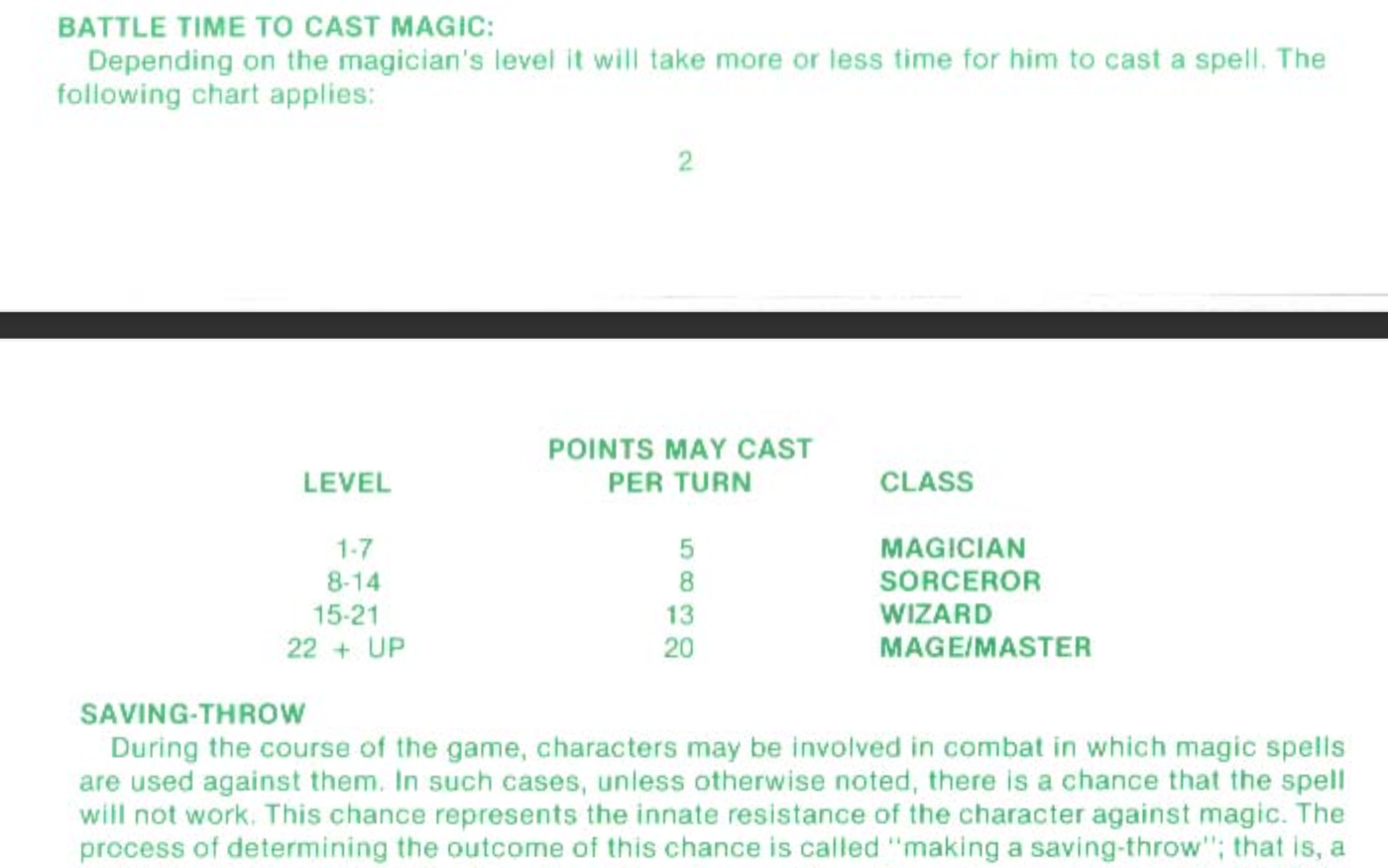
Looking at a single spell from p. 6, we can see that a “turn” is the equivalent of 3 melee rounds (6 turns = 18 melee rounds). This means that a 1st level lawful caster would require 6 melee rounds (10 points for this spell; 2 x 5 points per turn; 3 melee rounds per turn) to complete casting this spell and by default it only does 1d6 per melee round. However, it lasts for 6 turns (18 melee rounds) and each 3 melee rounds a separate saving throw is required. Interesting, but very complex.

Magic Weapons and Armor
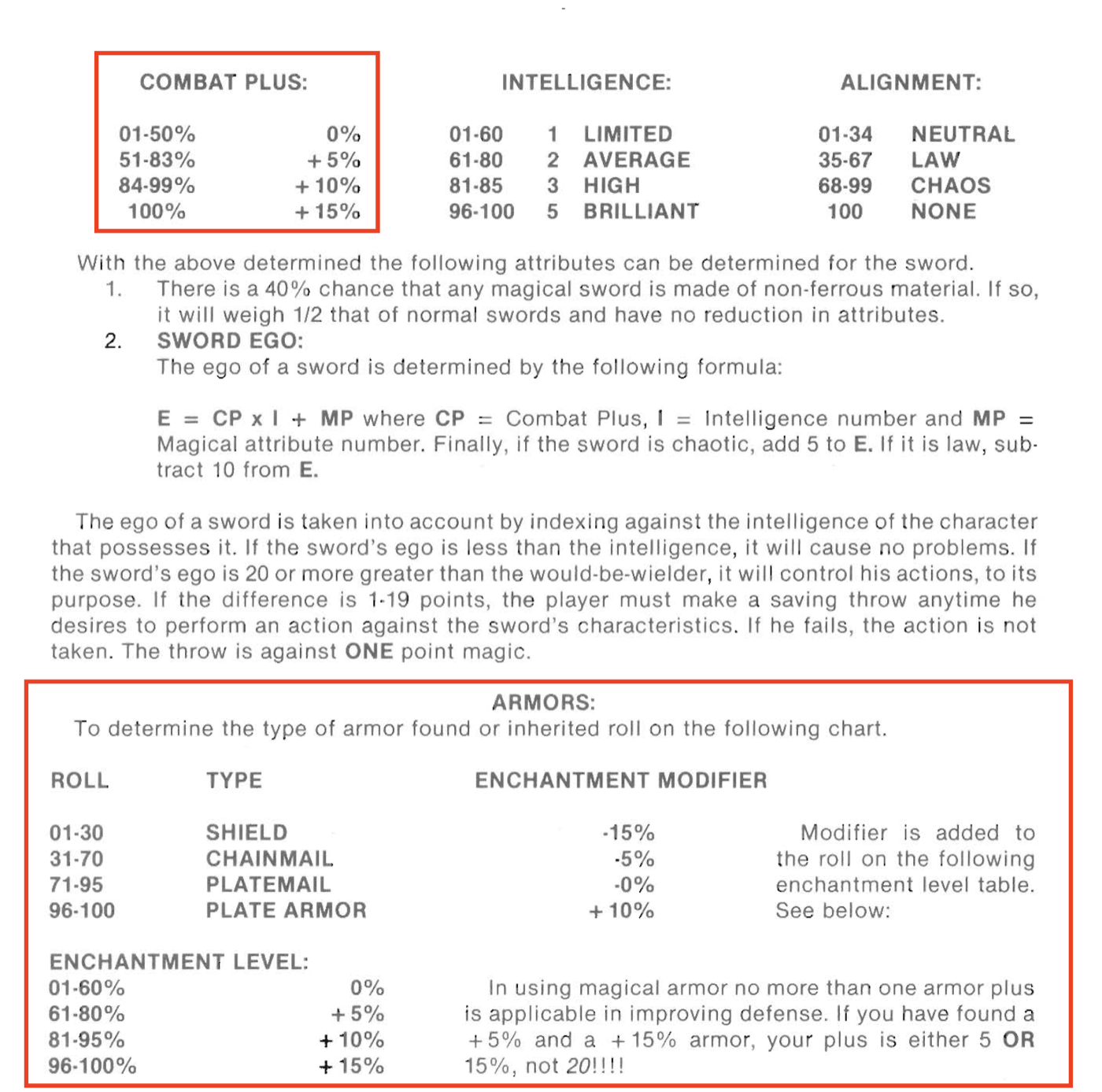
Magic swords take front and center in AIF. Since the “plus” is given as a percentage, this bonus seems to only apply to the “to hit” roll.
Likewise, magic armor applies a bonus that will, presumably, subtract off the opponent’s “to hit” roll. The bonus from an enchanted shield and enchanted armor does not stack. It is interesting to see the distinction between platemail (plate and mail) and plate armor which is presumably the latter full plate that we see in the late medieval period. Again, the backplate/breastplate combo is absent.
Dual Wielding instead of Parrying
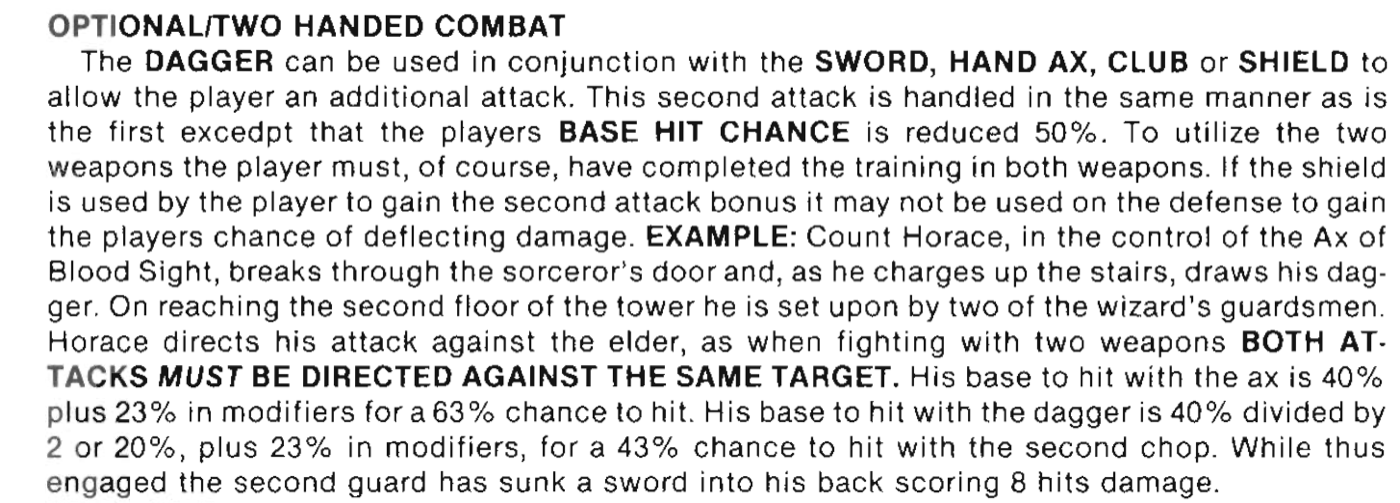
This is perhaps the best written rule in AIF’s entire combat section. It is self explanatory how it operates. We do not see the use of a parry as in Chainmail 2nd and 3rd editions and Holmes Basic, nor the ability to break the opponent’s weapon. Instead, we see that the dagger gets two attacks against a single opponent in a melee round. Of course, the second attack is at -50%. Still, this provides the player with an interesting tactical choice that may have been present in early Blackmoor.
Conclusions about AIF
There is, within the heart of AIF, a lot of very fun wargaming to be had. Characters advance in social status, encounter large bodies of troops and strange creatures, and generally resolve combat using a tight tactical wargame with a little bit of magic thrown in. With some re-organization and paring down, this could be a very playable game. A retroclone of this system would be very worthwhile.
List of Additional Complexities
Looking at the exhaustive deconstruction of AIF above, there are a number of complexities to be addressed to reconstruct the early Blackmoor combat system. Missile fire, movement, cover, terrain, and many other minor rules need to be documented to provide a seamless flow to the combat system. The order of combat phases seems workable and harken back to Chainmail. Certainly there is a firm foundation for body type and size differential to play a part in combat. Fatigue, strength modifiers to damage, dual wielding, and critical or catastrophic hits also may play a part. None of this looks like Totten. If anything, Dave Arneson and Richard Snider seem to have returned to a miniature wargaming approach to the hobby by 1979. It makes one wonder if they ever departed from it!
Post Script
In Part 1 of this series, I looked at Armor Class in Dave Arneson’s Blackmoor game.
In Part 2 - I tackled the attacker and circled back to the defender.
and in Part 4, I will conclude this series with a reconstructed technique for combat.
Originally published on Substack on November 22, 2025.
- Richard Snider
- Ttrpg
- Wargaming History
- Wargaming
- 1973
- 1974
- Roleplaying
- Rpg History
- Dave Arneson
- Adventures in Fantasy
- Fantasy Roleplaying
- Wargame
- 1972