Shoot 'Em Up: a 1st edition Boot Hill campaign
Rodney Hampton
- 17 minutes read - 3571 wordsOn the trail of Dave Arneson’s El Pauncho Brownstone character
Rules
- Boot Hill 1st edition
- Outdoor Survival - game board and Lost Scenario
- OD&D - surprise roll
- Bronco Busting - in modules BH2 p. 6, and BH4 p. 26
- Rattlesnake and Poison - BH2: Lost Conquistador Mine, p. 6
Supplements
- The Rules with No Name (TRWNN) Quick Play Weapon Selection Table [initial equipment]
- 100 Items in a Wild West Desperado’s Pocket by D10 Dimensions [initial equipment]
- Boot Hill 2nd Edition Referee’s Reference compiled by Kellri [character quirks, settlement generation, cost of goods and services where 1st edition is lacking]
- Tony Bath’s Ancient Wargaming: Including Setting up a Wargames Campaign and the Hyborian Campaign [personalities via playing card method]
Players and Characters
- Ambrose - L’de Ambrose (primary), un-named (secondary)
- Hatless Ash - Frank the Fast (primary) and “2 Left Hands” Larry (secondary)
- Forest - Deputy Taylor (primary)
- Diogenes - Go Long Wei (primary) and Sum Big Guy (secondary)
- Dr. Phil - Birdy (primary, female) and Big Red (secondary)
Pre-Game Setup
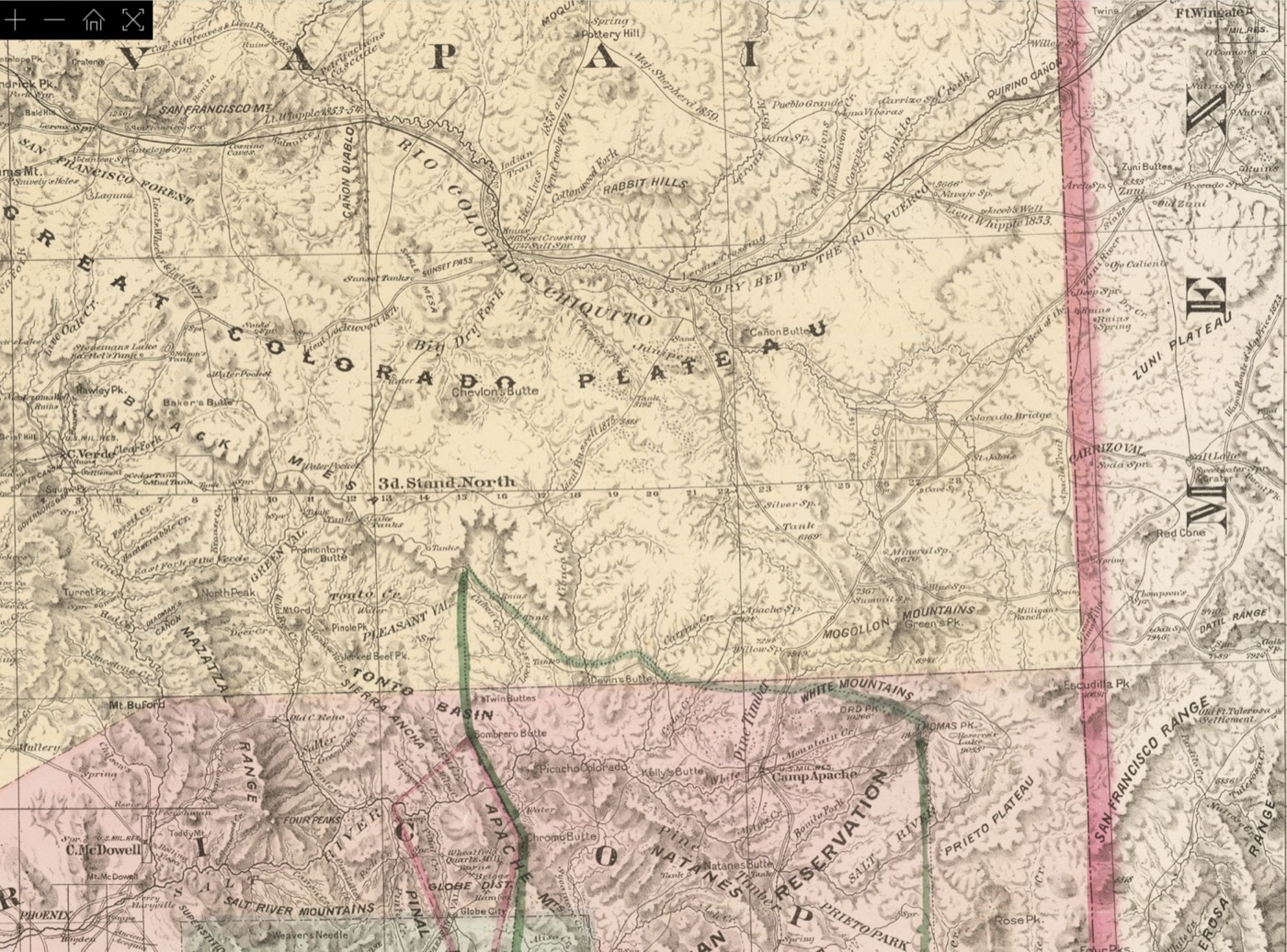
I ended up building an entire starter campaign. Yes, I uploaded a lot of stuff to Claude.ai and had it do the dirty work converting things to Boot Hill 1st edition statistics, drawing all the playing cards to build personalities using Tony Bath’s first system, creating all of the settlements (using the Boot Hill 2nd Edition Referee’s Reference), coming up with 20 rumors on various topics, building out NPC statistics on the fly, etc. It saved me a lot of grunt work. The important thing here is to have the #AI do things concisely. It tried to build out entire backstories for the important townsfolk and the settlements themselves. I threw almost all of that out and used my own interpretation of the cards as drawn and the personality quirks. I also uploaded an 1870s map of the real Arizona Territory in the same county and had it pull out names of springs, creeks, roads, etc. which I then placed onto the Outdoor Survival map I had printed out. I studied the real history of the county, especially the Indian (native American) tribes in the area along with the flora and fauna. After probably 8 hours of work, I think I have generated enough content to understand the political situation, major factions, economics, etc. likely to come up.
The 5 modules for Boot Hill have their own setting - the fictional El Dorado county. I did not want to use it and try to master someone else’s lore. I always feel that history is the best basis of a campaign and often the card draws and dice rolls end up painting an alternate history that is so compelling that it could very well be real. It’s real enough to me at least, and that helps me to sell it as the Referee.
Setting and Period
Events take place in July, 1875 in the Arizona Territory near the New Mexico border in Gila (pronounced “Heel-ah”) County. The county is still not fully “incorporated” and there is some dispute about where the county seat ought to be located.
Call to Adventure
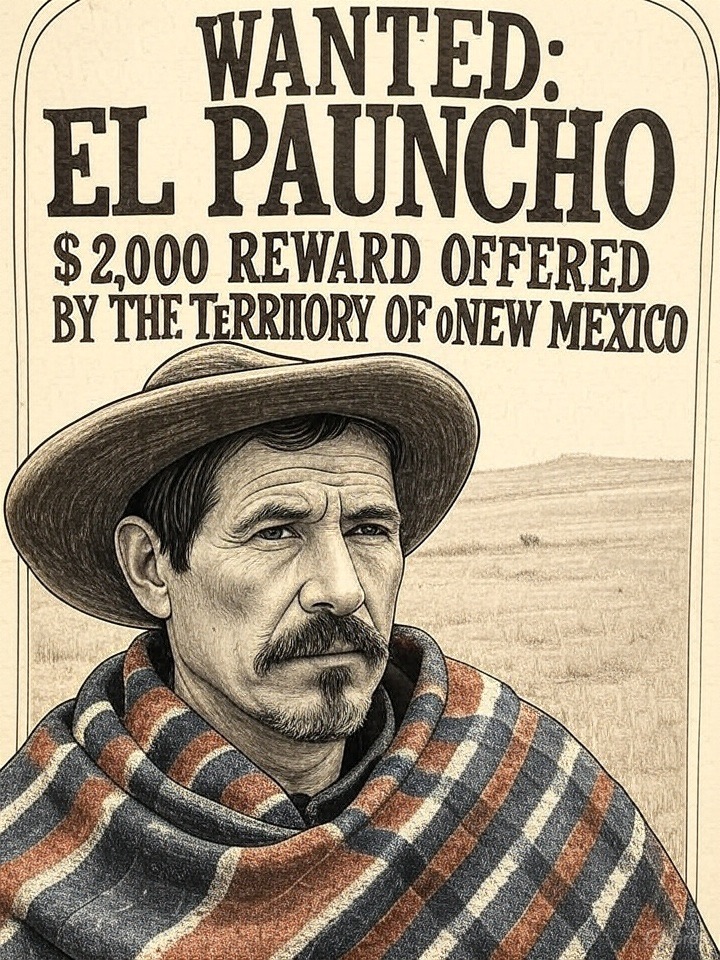
The characters were ranch hands near Flagstaff, but bored with that line of work. One of them, retired Deputy Taylor, has a newspaper obituary scrap of paper describing the deaths of 8 people in Dead End Junction. They were killed by the notorious bandit gang led by El Pauncho. Because the borders near Dead End Junction aren’t well surveyed, and due to some political shenanigans, it is not clear if the town is in New Mexico or the Arizona Territory. At any rate, there is a $2,000 price on El Pauncho’s head collectable whether he is brought in dead or alive. El Pauncho had previously been the scourge of Brownstone, Texas near Midland and apparently came west on the railroad, got off at Dead End Junction, and immediately resumed his old ways of sowing mayhem and committing murder.
Character Creation
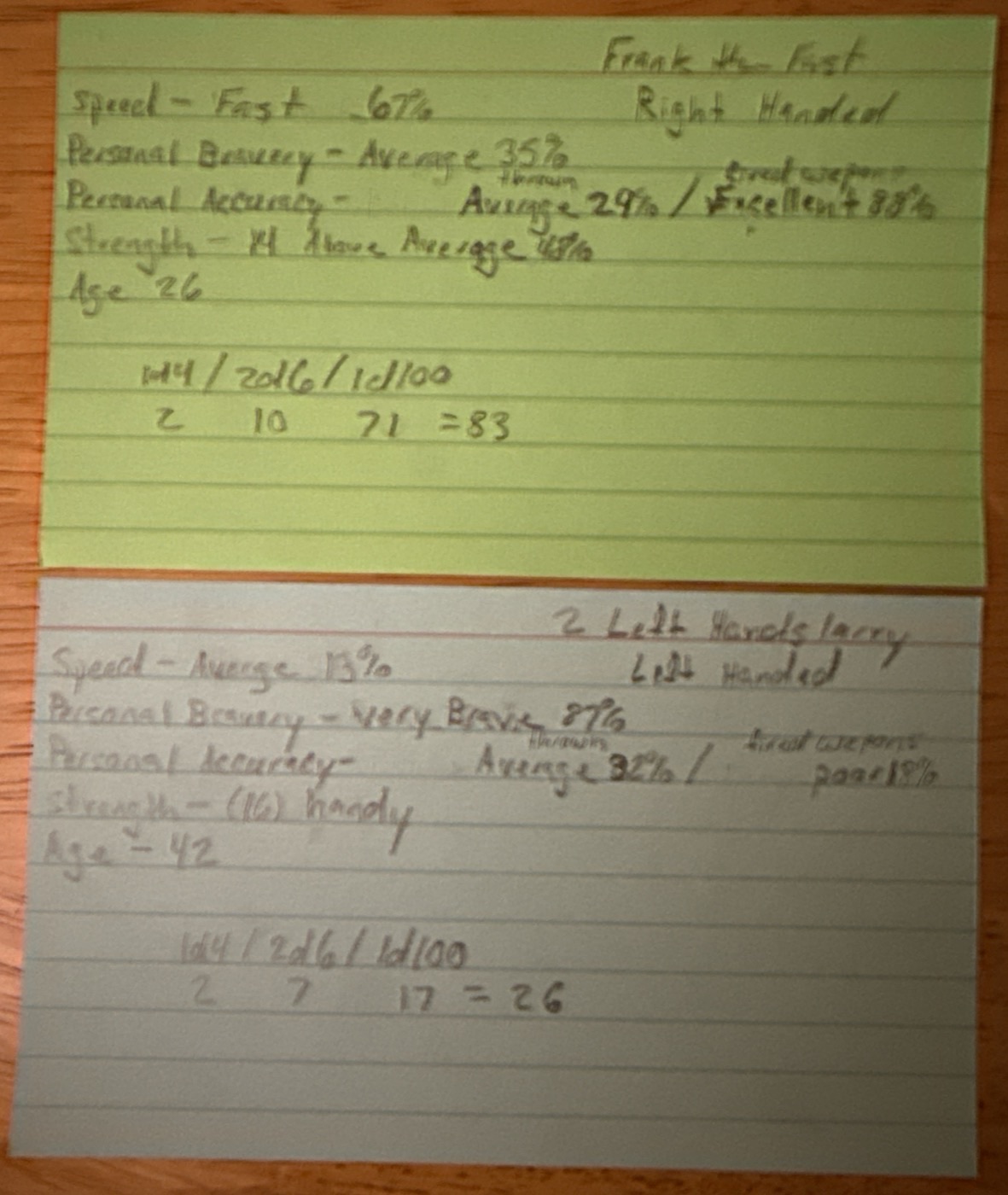
It’s easy to create a Boot Hill 1st edition character, there are only 5 statistics and a method for generating the character’s age. Dominant hand must be specified for the gunplay and brawling tables to function correctly. Initial cash is not listed in the rules. Each player rolled a primary and secondary character (Boot Hill is notoriously deadly). A sample is shown below.
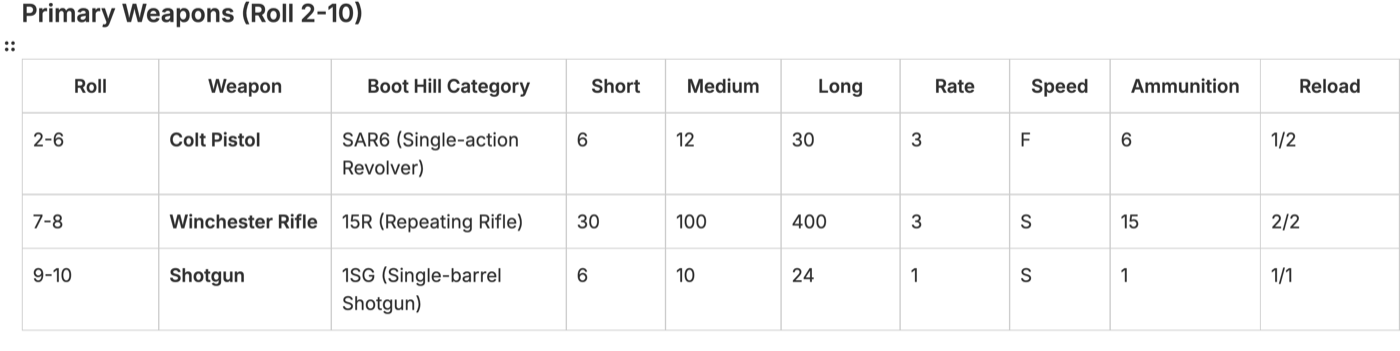
Instead of getting bogged down in equipment selection and tedious role play about “plugs of tobacco” etc., I took a page out of Diogenes’ book and took it mostly out of the hands of the players. Each player made a few rolls. The first was for a melee weapon, 1d4: Tomahawk, Knife, Club, or Sabre. The second for a gun (more on that), and the third for something unique that could be found on their person. For the last, I used 100 Items in a Wild West Desperado’s Pocket.
For the guns, I used a supplement from The Rules with No Name. I’ve got a hardback copy of these old west wargame rules. The supplement had a variety of weapons that were easy for Claude to map to Boot Hill 1st edition. I did a spot check and the Winchester Repeating Rifle rate had to be adjusted down to 3 from the ridiculous 15 that Claude spat out. Nobody rolled a Specialty Weapon.
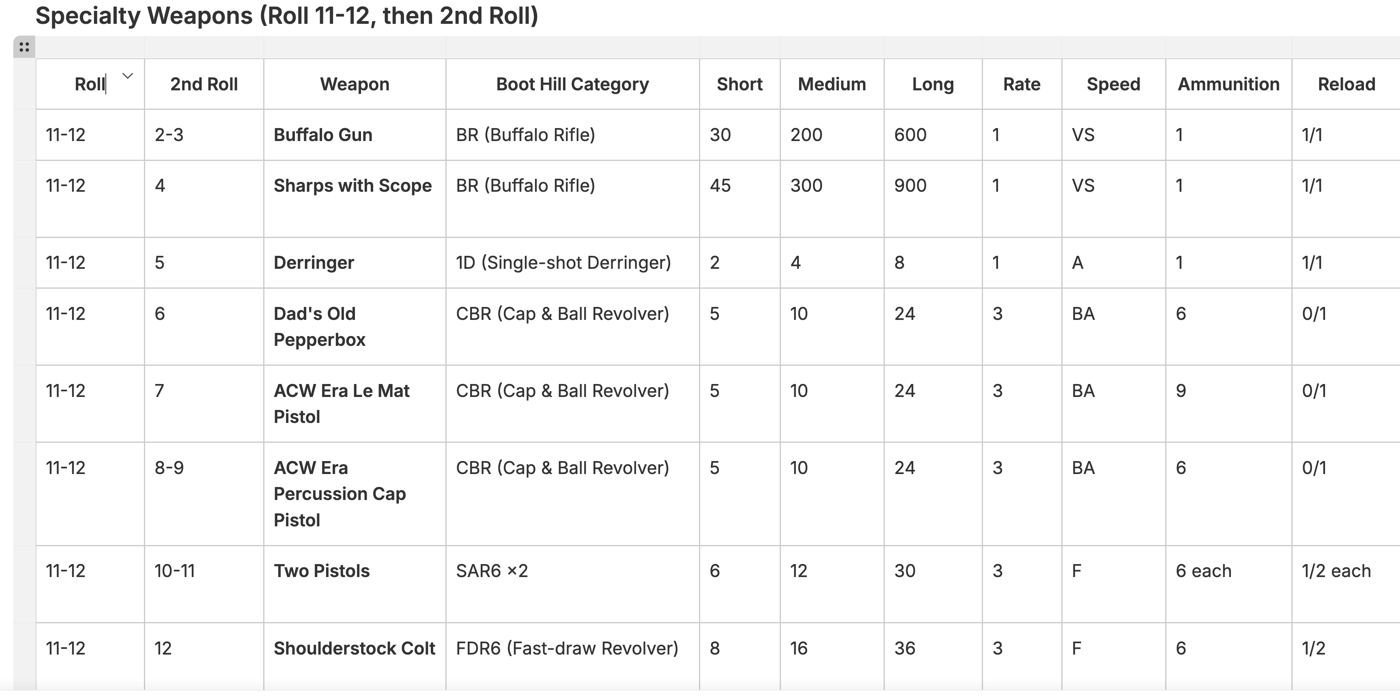
As for the miscellaneous items, Diogenes’ characters got a set of chopsticks and some firecrackers. He decided they were Chinese railway workers so when one of them rolled a Club as the melee weapon, I told him to just make it a set of nunchucks but he chose a sap instead. They are effectively the same, for now, when used in melee and only provide a bit of character differentiation.
Mustering Out
Leaving the ranch, I gave the characters the option to do some bronc busting as their mustering out pay. Depending on the quality of mount, I adjusted their last month’s pay of $30. Bronc busting lets the player choose whether to use a bridle / saddle (which has no real risk to the character if thrown) or else ride bareback. I was worried that this small mini-adventure would take a lot of dice rolling, so I told them that if they ended up with better mount for their primary character, their secondary would get a lesser mount and vice versa.
The players were split about evenly on whether to use the saddle or not. Number of rolls for each bronc: 2, 7 and 3, 2, 3, and 1. This went much faster than expected. As you can see one bronc got two riders. That’s what happens when the first one dies. Poor “2 Lef Hands” Larry was already a bit of a hopeless character. Well he met his match. The bronc sunfished. Larry sailed through the air, landed on his sunken chest, and suffered a mortal wound. Perhaps the horse stepped on him for good measure.
For characters that were thrown, I gave them a +1 on the 1d6 roll to determine the bronc type after the ride: 1 Poor; 2-3 Fair; 4-5 Good; 6 Exceptional. All of the horses handed out ended up being Good and Fair. This matters in a chase, or for selling the horse, but not much else. After the horses were distributed, I docked their $30 final month’s ranch pay. Characters with Fair horses ended up with $15 in their pockets and those with Good horses had $10.
Hitting the Trail
Boot Hill 1st edition has rules for posses and tracking. Per p. 22, “Turns should be weekly or monthly, until a situation such as a chase occurs. Then refer to the campaign map and use the movement procedures outlined below (this represents hourly turns).” There are wilderness encounters and city encounters in the 5 modules, but no consistent set of odds. There is also nothing about food or water, which is a huge miss for this set of rules as it is a major trope for many old west novels and movies.
Module BH2 has rules for movement across terrain and food and water consumption on pp. 5-6, but puts the Referee and players into the “beans and bullets” tracking mode that can burn up a lot of precious game time. The 2nd edition Boot Hill rules have “strategic movement” as an option and allow the Ref to pick any reasonable time interval for movement with a little math, however, there is nothing regarding food and water.
Gary Gygax was certainly aware of Outdoor Survival as the first edition of Boot Hill was published in 1975 which is after original Dungeons & Dragons (OD&D). It’s odd that he did not once again just point to Avalon Hill’s game as the solution here. At any rate, I needed a map, I needed rules for strategic movement, and I wanted rules for food and water that wouldn’t land us in role play hell at every outpost of civilization. Also, if players were lost, hunting for an animal, or chasing a party with a long lead time, Outdoor Survival has you covered.
Using OD&D as a guide, I made the hexes 5 miles across. The players were going to enter the map on the western edge in one of the 34 squares. The random number generator favored the players. I “rolled” a 17 which put them just north of outpost 7. Checking my campaign notes, that was Copper Creek - a mining town. Drat! The players got their first freebie thanks to the dice.
Day 1: Copper Creek
The players checked out Copper Creek. Despite the presence of a brothel, no one ventured inside. Pity, I was looking forward to repurposing another one of Gary Gygax’s legendary tables from the 1st edition AD&D DMG: the Harlot table.
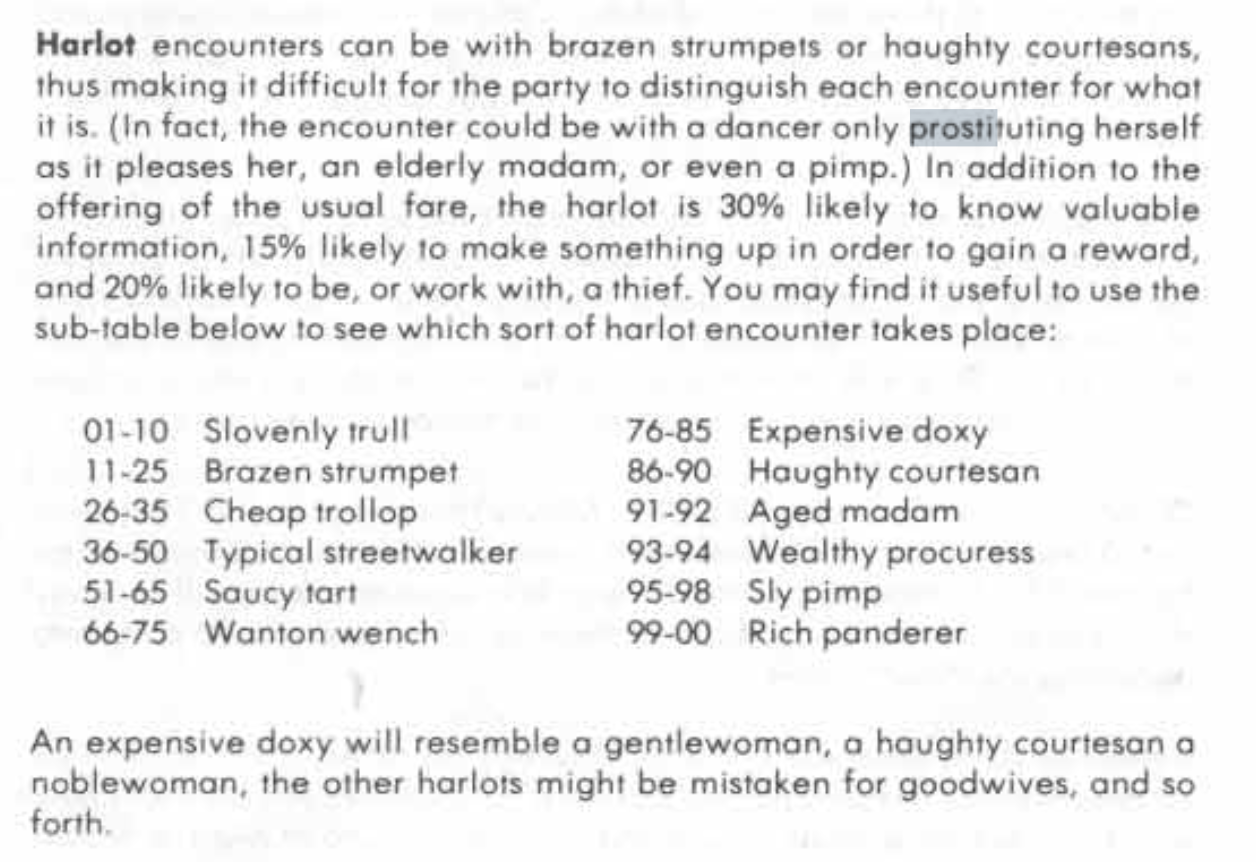
The players noted the lack of visible law enforcement and discovered that vigilante justice (organized by the mine foreman) kept things from boiling over. [I was fully prepared to pull in the rules for vigilantes from BH2 Conquistador Mine - p. 5 and BH3 Ballots & Bullets pp. 28-29 but the players were on their guard this early in the game.]
After picking up a few rumors the players got back on the trail with the goal of heading east “about a hundred miles” to Dead End Junction. Leaving town, their choices were to either take the game trail skirting the mountains to the northeast, or else the footpath skirting the mountains to the southeast. After finding the game trail ended up leading them into the mountains, they eventually landed on the foot path and started trekking east again.
Wilderness Encounters
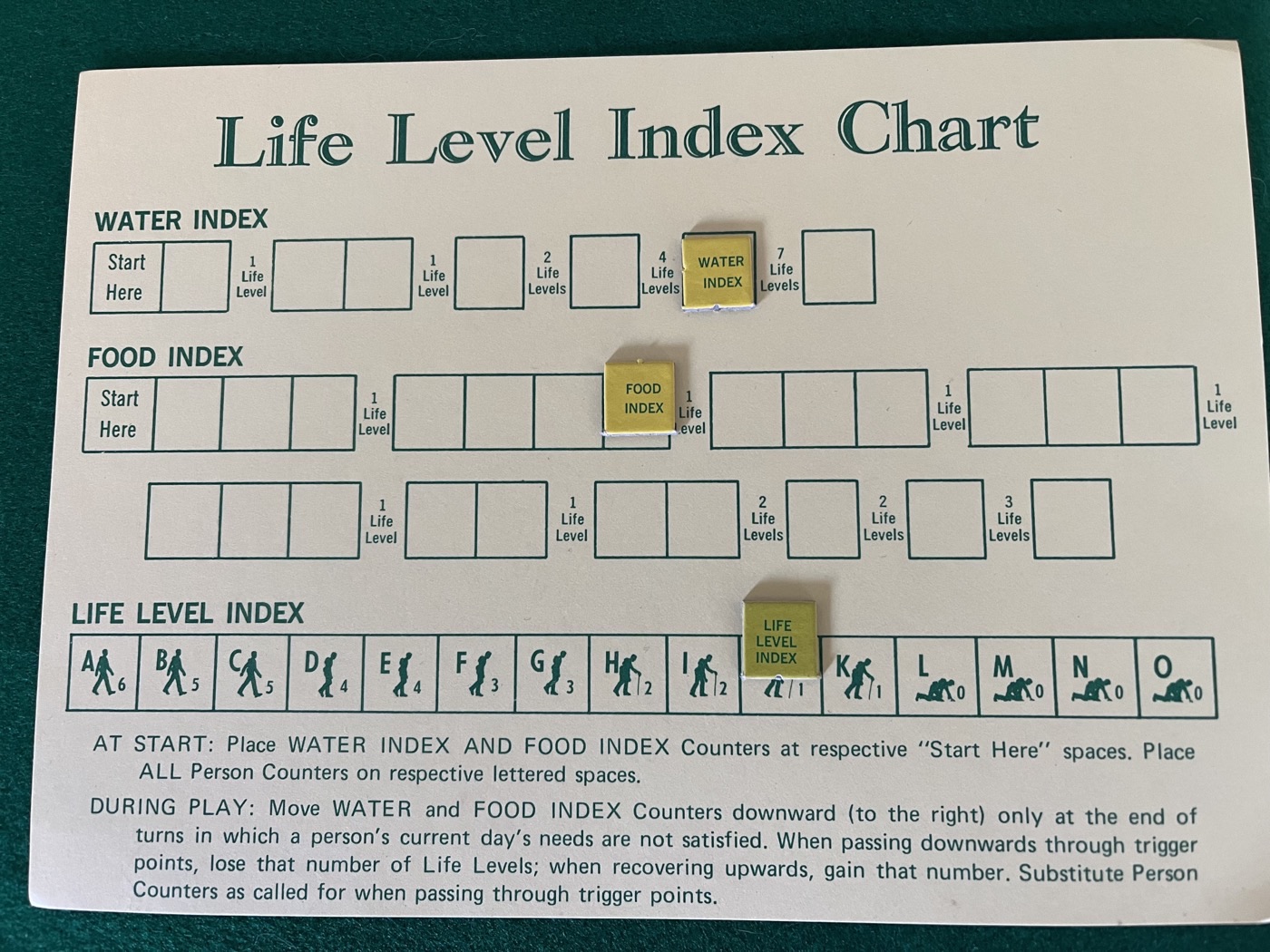
Since the players had no map of the county, we used Outdoor Survival’s “Lost Scenario” card for tracking food & water, rules for replenishing same, and selecting encounters at the end of the day. Tracking food and water was easily done. Life Levels presented a bit of a problem in conversion. For each Life Level lost, I penalized the players 1d2 strength points.
Encounters in Outdoor Survival are of three types and the rules do allow for randomly picking the type: “[I]n real life, travelers would not have this control over Wilderness Encounters. If you wish to simulate this aspect, substitute another die roll for the choice: a roll of 1 = Natural Hazards; 2 & 3 = Animal-Insect 4, 5 & 6 = Personal elements.”
These daily rolls were kept abstract to keep us from getting involved in skirmishes with wolverines, mountain lions, etc. or dealing with cliffs, confusing arroyos, food spoilage, etc. off yet another set of tables.
Day 6: Low Water
Water, in Outdoor Survival, is hard to keep topped off. The players found this out before the end of the first week and realized that their weakening condition and slowing progress was a significant problem. Fortunately, Diogenes decided to have his secondary character climb a very tall tree. Ponderosa Pine can reach up to 200 feet in the wild and there was a nearby lake only 5 or 6 miles away across mostly open terrain. I was charitable and gave them the option to double back a bit and head north to top their canteens off. I did, of course, require a roll to make sure Sum Big Guy did not fall out of the tree. He easily passed the roll.
Day 9: Agua Dulche
The characters camped outside Agua Dulce on Day 8 and entered it on Day 9. This is a trading post (outpost 3) and also a hub where numerous trails came together on the north side of the Gila River. After replenishing supplies and gathering a few more rumors, the party was anxious to get back on the road heading east but had to spend the night ($0.75 per person to flop). They also got a peek at a map in the trading post office before hitching a ferry ride to the other side ($0.20 toll per person).
Rumors gathered
- Gigachad Horses - The Pony Express has a new horse that can outrun any Apache pony - it’s a mustang-thoroughbred cross that came from Kentucky.
- Ghost Story - There are rumors of a haunted Conquistador Mine, some people mix this tale together with one about the ghost at the abandoned settlement of Widow’s Creek “about a hundred miles to the north.”
- El Pauncho - Some say he is the son of a wealthy Mexican Don - his banditry is for thrills, nothing more.
- Wargs! - The Apache have trained a pack of wolves to attack white settlements on command, using secret whistles passed down from their ancestors.
Day 10: The Mission
The group made slow progress through the thick forest on the east side of the river. The party was able to rely on the generosity of Fr. Santos at the Misión de San Miguel. Although they had to sleep outside, he provided food and water. The next morning, when asked about the Señoritas, Fr. Santos confirmed they would be at mass later in the morning for all of the locals, but since the sun was already well up he encouraged them to get on their way. Via con Dios!
Day 11: Rattlesnake Bend
Referee: An abandoned cattle station with a single-story house, partially-collapsed roof, and a shed, and trails going north and south.
Snarky player: “Sounds like my ex”
Another player decided to investigate the shed and was met by the unwelcome sound of a rattle. He beat a hasty retreat without suffering injury.
Days 12-Day 19
More wilderness travel resulted in the party pushing their luck. They did depart from the game trails and footpaths to try to break cross country to the east. They soon came to another major river with no ford in sight. Instead of risking their horses trying to swim a very deep river, they went about 5 miles north and found a ford leading to a mountain pass. As one player observed “short cuts make for long delays.”
Day 20: The Dice Are Against You
With water running out, everyone’s Strength depleted, and only 3 hexes to go across open terrain to get to Dead End Junction, it seemed a sure bet that the party would make it alright. Unfortunately, that’s when the luck ran out. The party got an encounter roll result that they had to stay in place for 3 turns due to a natural hazard. This was going to be certain death without creative thinking. The party mustered all of its resources to ensure that Go Long Wei would be able to get to town, collect water, and return by nightfall. They did not resort to slaughtering any of the horses, but this did cost $9 in town to pay for canteens.
Fortunately, there were plenty of other Chinamen in Dead End Junction as the railroad was gathering resources and making scouting trips to decide whether to expand toward Flagstaff or Phoenix. So Go Long Wei did not run into any 19th century prejudices on his solo trip into town.
Dead End Junction
The first order of business was whetting their whistles. We were already way over on time for the session. The desire for gunplay was palpable. I set a limit on rumor-gathering and made sure one rumor (selected at random) would trigger an altercation. Contrived? Sure, but it worked just great to round out the gaming session.
An old miner in search of a new lode to work was slaking his thirst. He pegged one of the party members, Deputy Taylor (retired), as a potential confidant and ally. Taking a risk, the miner started wagging his tongue about a dead prospector - now down the street the undertaker’s. Apparently, this dead prospector “drew a map to his secret gold mine on the inside of his boot before the Apaches got him - the self-same boot’s at the undertaker’s. Saw it with my own two eyes!”
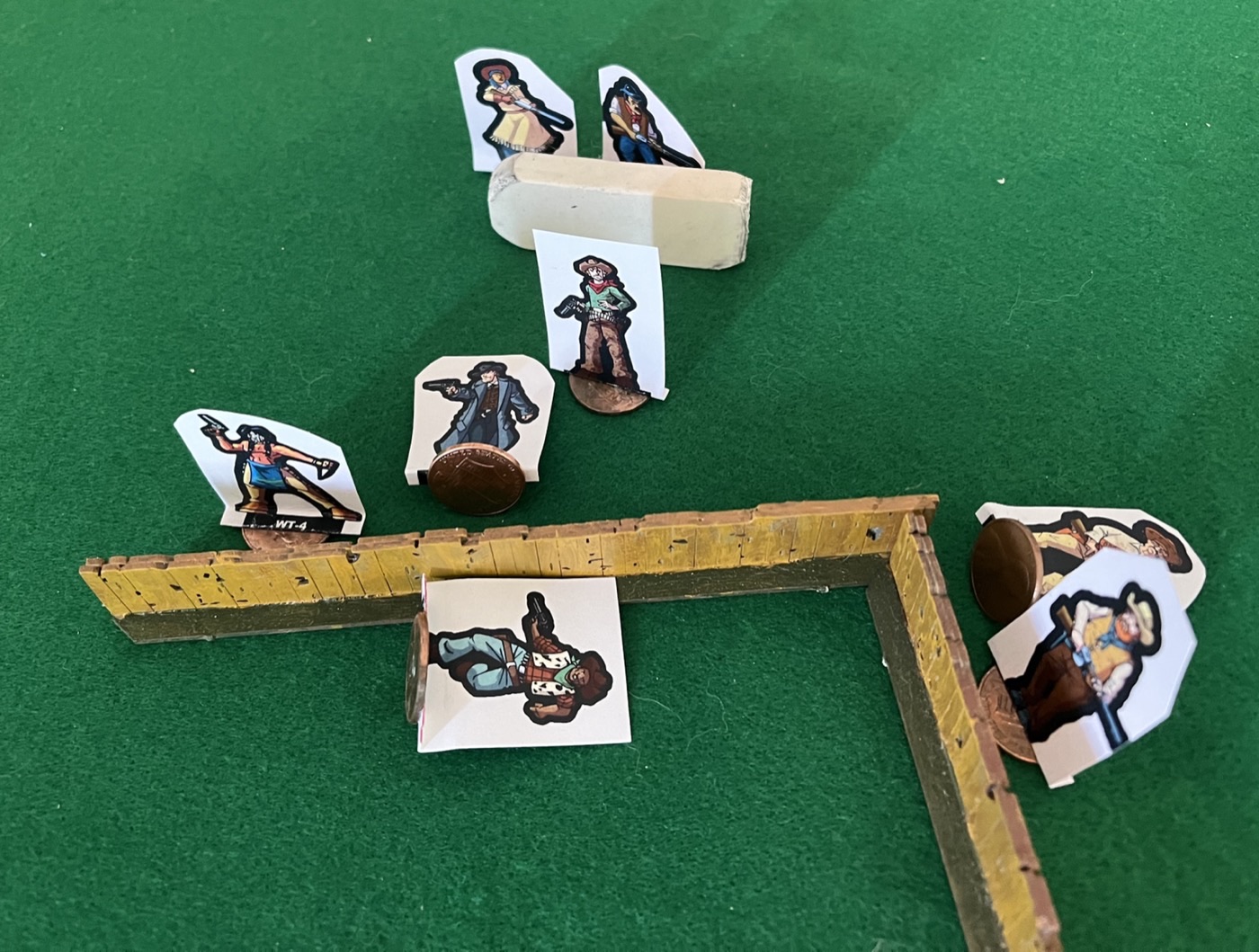
Overhearing this, the Bartender, one Big Mike O’Malley didn’t like what the miner had to say and shooed him out of the bar with shillelagh in hand. Deputy Taylor took offense at this rude treatment of a new acquaintance and called the bartender out on his behavior. The bartender made as if to grab Taylor’s collar. Taylor slapped his hand away. The bartender dropped the club and quickly reached beneath the bar. Deputy Taylor drew his pistol, but it was too late. A scattergun blast leveled at Taylor’s chest settled things up. Taylor dropped to the floor, unconscious, but not before his own bullet caught O’Malley in the shoulder.
At the end of the bar at the bend (the “el” so to speak), Go Long Wei already had his repeating rifle at his shoulder. Resting it on the bar, he took careful aim. But Big Mike must have caught the movement out of the corner of his eye. Just as quickly as he had dropped the club, he dropped the smoking scattergun and pulled out his Colt revolver. More shots rang out. O’Malley took another serious blast - but shrugged it off and plugged Go Long Wei in the chest. The Chinaman was dead before he hit the floor.
Meanwhile, Frank the Fast flipped a table over and he and Birdy crouched behind it, ready to act. Big Red, standing next to Go Long Wei, was tried to get a bead on Big Mike, but the bartender was already trying to duck behind the bar.
In the confusion it was hard for bystanders – even now being questioned – to relate what happened, some folks said Sum Big Guy jammed his pistol over the bar top and started blasting, doing in the Irishman. But that’s a damned lie. In reality, Birdy had shot Big Mike in the head with her Winchester (Dr. Phil rolled a spectacular 98% for severity).
With that, we wrapped up the session since we were one hour over time.
Self Evaluation
I grade myself an A when it comes to campaign Prep, role play (voices, interactions, etc.). I feel very natural in the Referee seat.
Wilderness Adventure: B-
Outdoor survival does not distinguish between mounted and dismounted movement. I probably need to speed up the movement next time. Certainly, when traversing areas of the map where the players have already been I can skip being “Lost” and instead shift to a more traditional travel and encounter mechanic from one of the Boot Hill Modules or even the 2nd edition Boot Hill strategic travel rules. But when venturing into unknown wilderness or initiating a pursuit, I will keep Outdoor Survival handy. It is just too useful to abandon. This was only my second time using Outdoor Survival RAW with players. It got easier as we played.
Gunfighting: C
I need to work on the basic mechanics of the gunfight and the full turn order. It works great in a one on one gun duel, but the 1st edition rules are missing a lot of things (even in the Advanced and Optional rules) to handle “all hell breaking loose.” We got through it together, but it was a struggle. I have good players and I trust them to do their own math and make their own rolls. They probably make as many errors as I do in that regard. I made mistakes about the use of First Shot, the base “to hit” chance is 50% not Gun Accuracy (fortunately my dice rolls made this a moot issue before I caught myself), and I was not confident about handling gun changes mid-combat instead of reloading. I had the tables printed out but not detached from the rulebook - too much flipping.
Overall Grade: B-
There are a few things I wanted to be able to handle in real time (such as the movement of two more factions on the map) that I could not do. Still, for my first time using Boot Hill for a gaming session, I think things went well.
Call for Participants
We are going to run this campaign using 1:1 time. If you’d like to take on being a faction leader in Gila County, let me know. Faction leaders require very relatively little time to run, and all of that can be done using Play by Post via discord. If you’d like to join a gaming session, find me on the Living Urf #BrOSR discord or hunt me down on one of several OD&D related discords.
Originally published on Substack on July 20, 2025.