Outdoor Survival Fails Us
Rodney Hampton
- 7 minutes read - 1464 wordsDeath in a remote corner of Gila County in the Summer of 1875
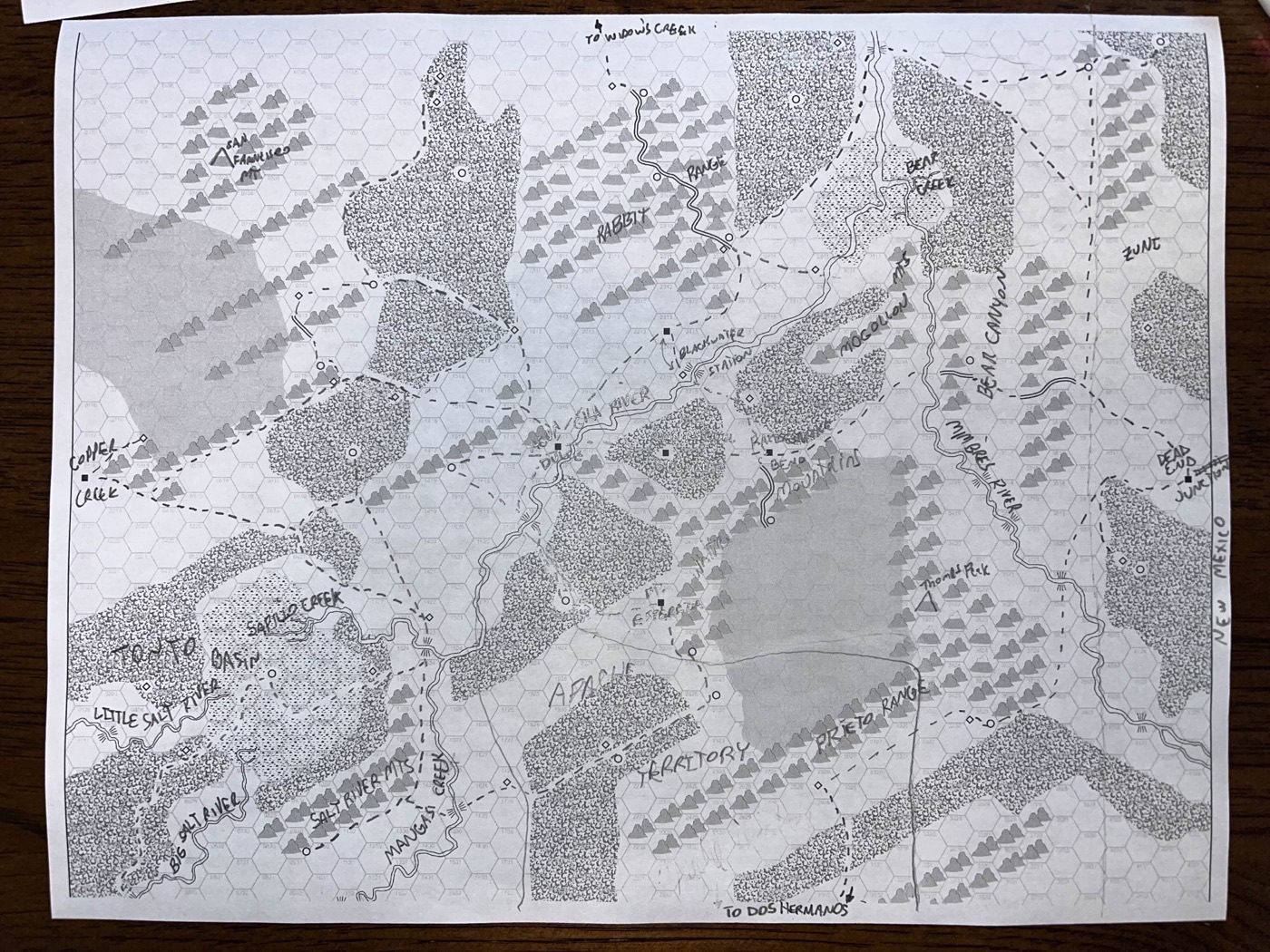
In a previous Boot Hill gaming session, I had hidden the map from the players as they made their way from Copper Creek (a mining town) on the western edge of the map to Dead End Junction, the railhead at the eastern edge of the map. The map for this Boot Hill campaign was simply Outdoor Survival with a couple of head nods to some terrain feature names in the border area between the Arizona and New Mexico Territories circa August 1875 (present day Gila County).
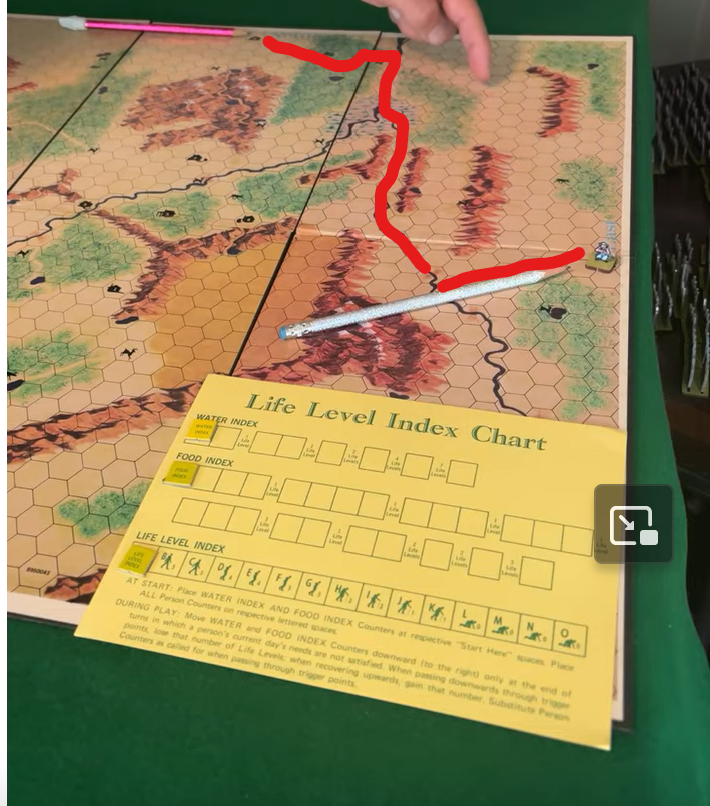
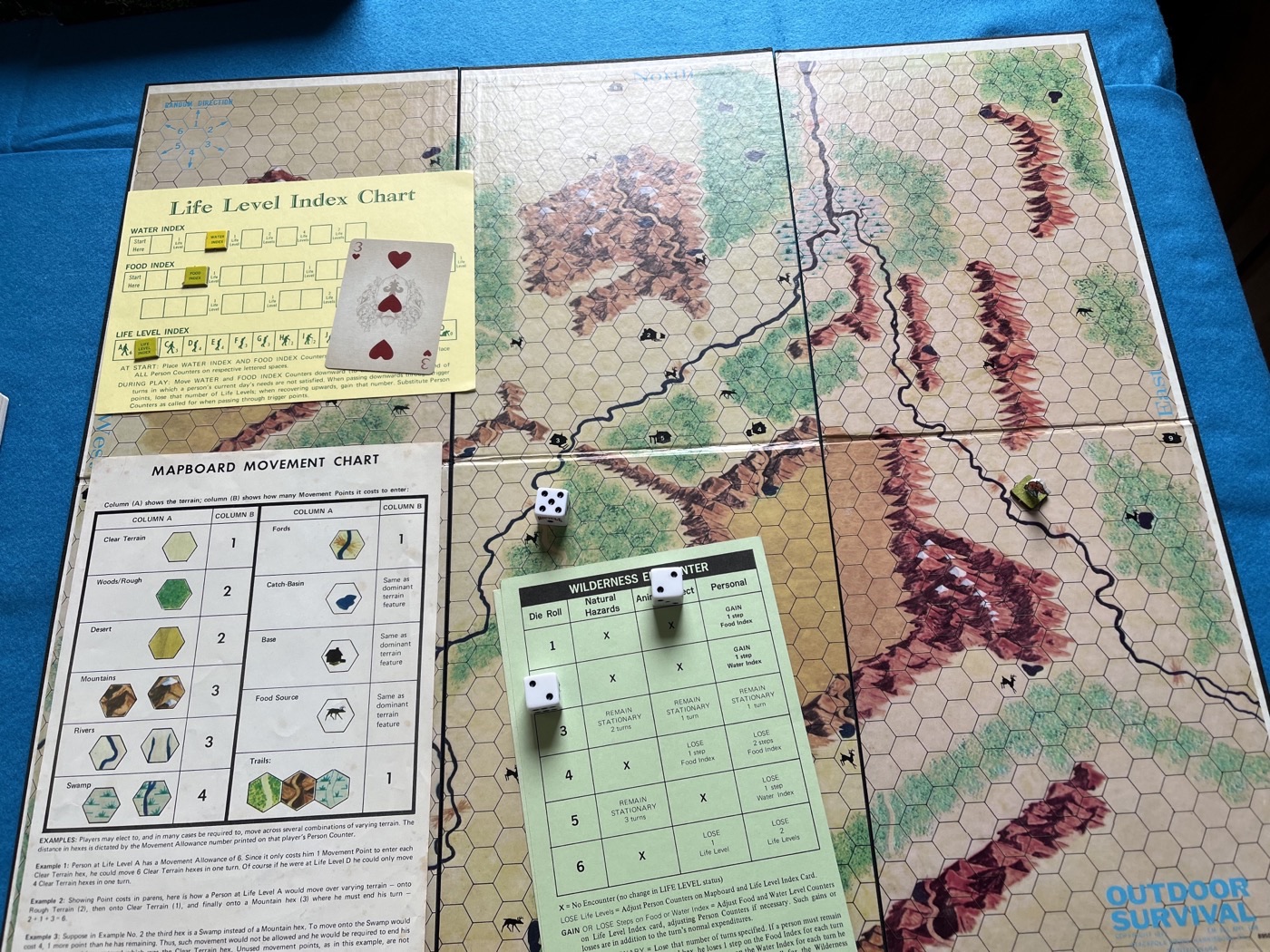
One of the players challenged me to run Outdoor Survival rules as written during the next session and let the players see the map. I proceeded with that plan. The players who showed up for the next session wanted to travel from Dead End Junction (outpost 9) to Widow’s Creek (outpost 8) in the north part of the county. The plan was to travel southwest to the Mimbres River, then skirt it upriver to a major confluence above Bear Creek. From there travel would be across country as straight as possible to Widow’s Creek while avoiding the Rabbit Range. On the actual Outdoor Survival map the intended course looked like this—v
I ruled that when traveling to and from the Mimbres River we would use the Lost scenario rules and while searching for the river and Widow’s Creek we would use the Survival scenario rules. These are on the green cards. The idea was that if the player could see the map, we could use Outdoor Survival to avoid the “beans and bullets” logistics and allow the game scenarios to abstract away all the concerns about getting lost, varying rates of overland travel, fatigue, weather, animal encounters, etc.
Unfortunately, the party got mired in the swamp and died. This result was unsatisfactory for me as the Referee and for the player. The feedback was that the rules in Outdoor Survival did not provide the same experience that a person who was accustomed to the outdoors would have (the PCs were cowboys after all). Personally, I thought it was a nonsensical result as well. I haven’t done a lot of back country backpacking as a civilian, but I did spend a couple of years in the infantry wandering around in woodlines, draws, hills, and arroyos. Given that these are ostensibly 5 mile hexes with a planned distance of 33 hexes (165 miles) for experienced cow pokes on horses . . . the result should not have been so extreme.
We discussed this online with the player who had recommended using OS raw. He reported having numerous successful excursions playing with the rules. As a matter of fact, he is currently running players through another hex-crawl game from Avalon Hill entitled Source of the Nile. (Dave Wesely, incidentally, has a design credit for that game).
This morning I re-ran the scenario with the same planned route. Again the result was death. I have documented every move. I challenge anyone to travel from outpost 9 to outpost 8 and report back if you can avoid death using the same planned route.
Turn 1
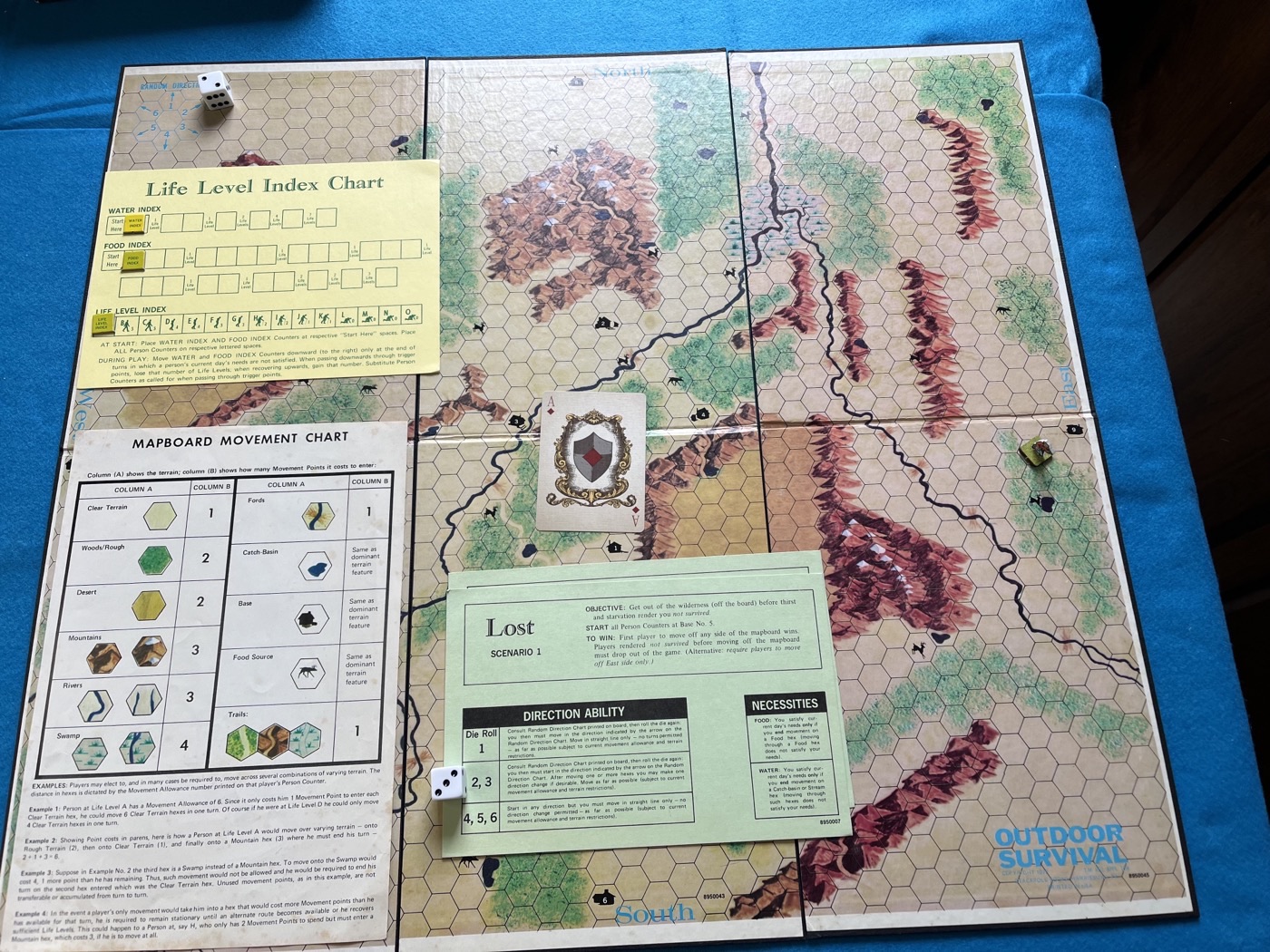
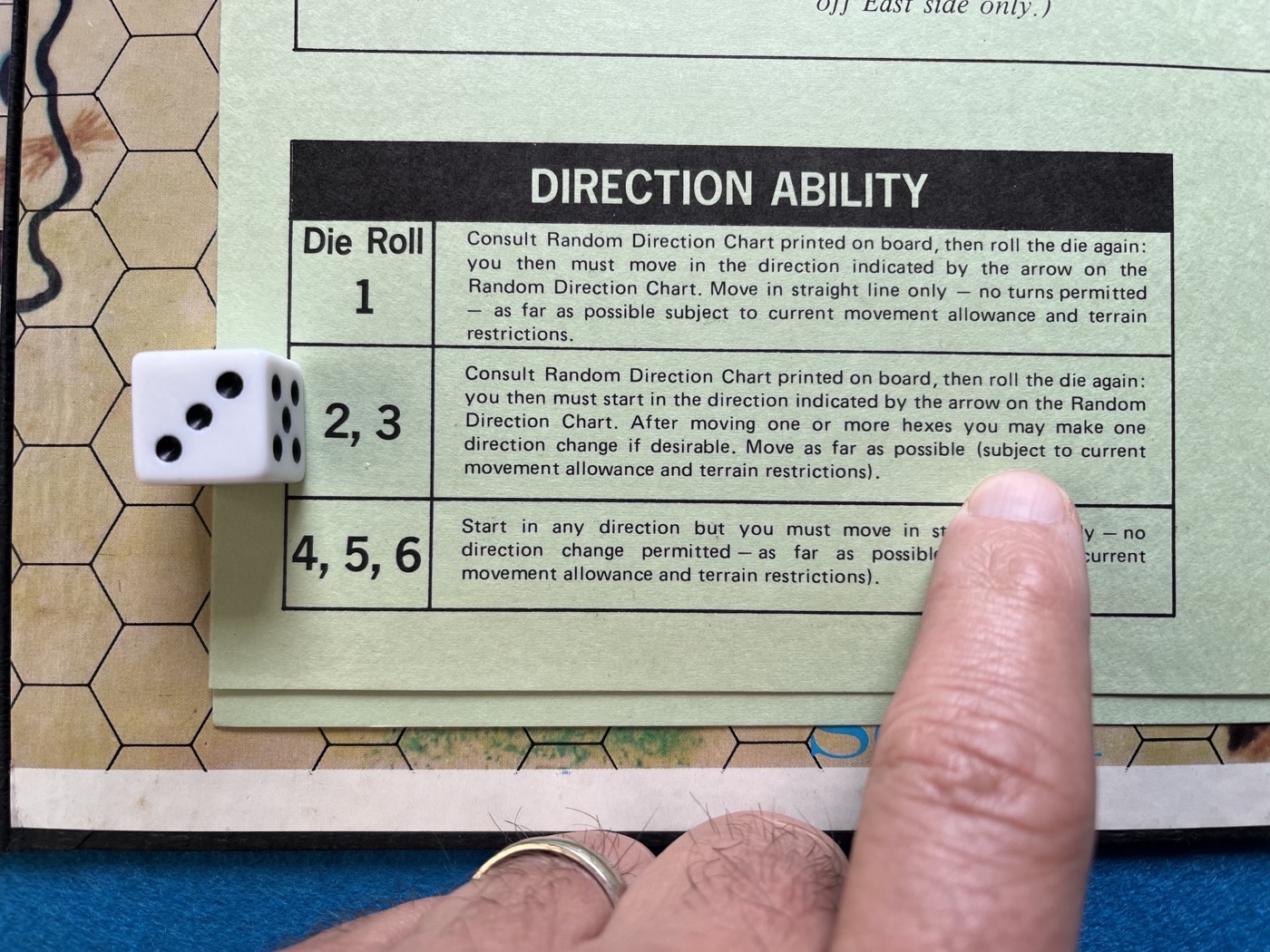
Lost scenario - roll 3 meaning initial direction must be done at random. Roll 2 move northeast. The player starts with a movement rate of 6 dictated by the Life Level Index. Moving north from Dead End Junction would go off map, but it looks like a clear hex (cost 1 to enter), then a return to the town, then moving southwest as planned. Only enough movement to enter one forest hex.
Turn 2
Another required move in a random direction takes us northwest to start. We do not end adjacent to the Mimbres River (though we are tantalizingly close), so I must still deduct water on the chart.
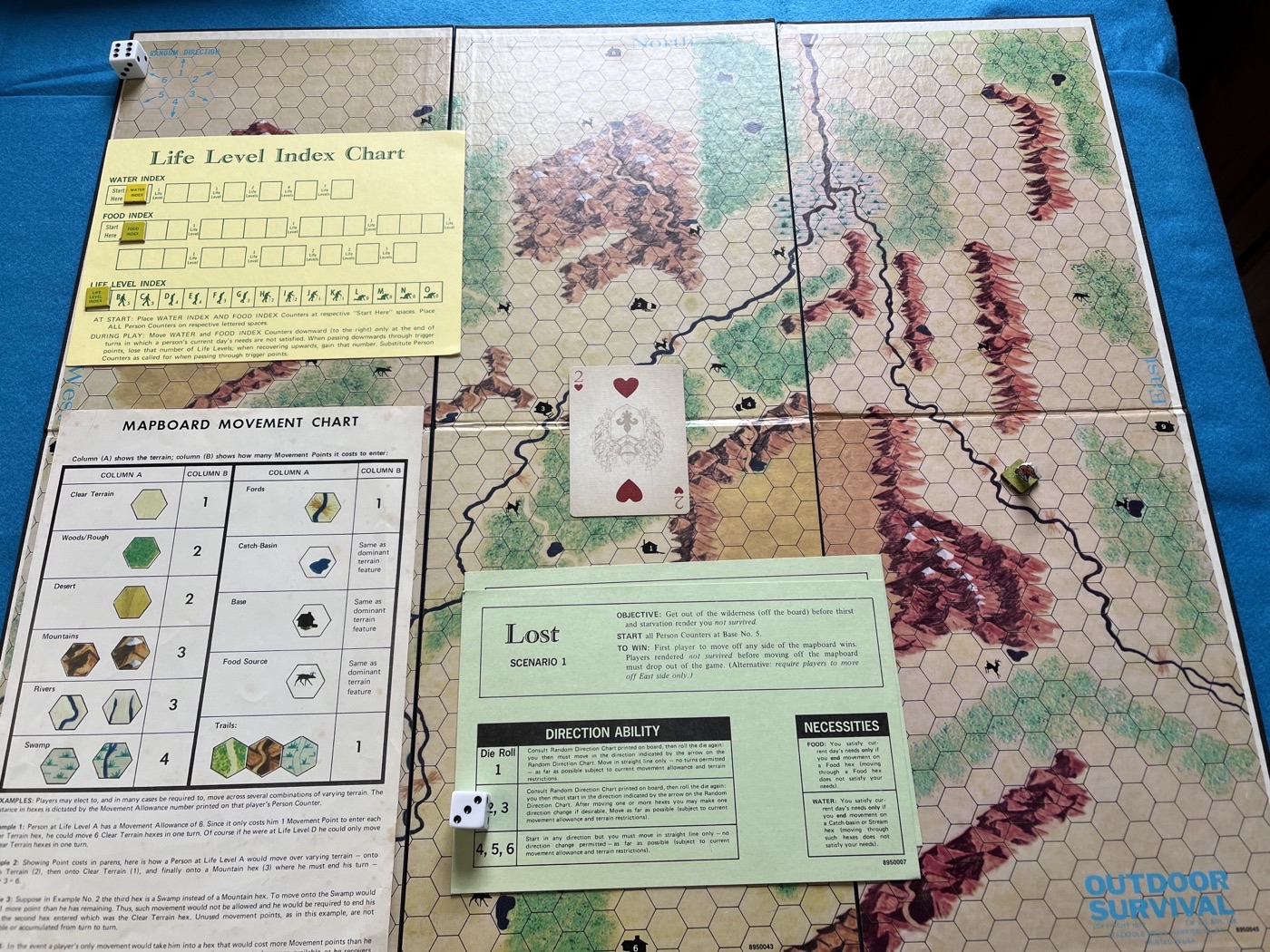
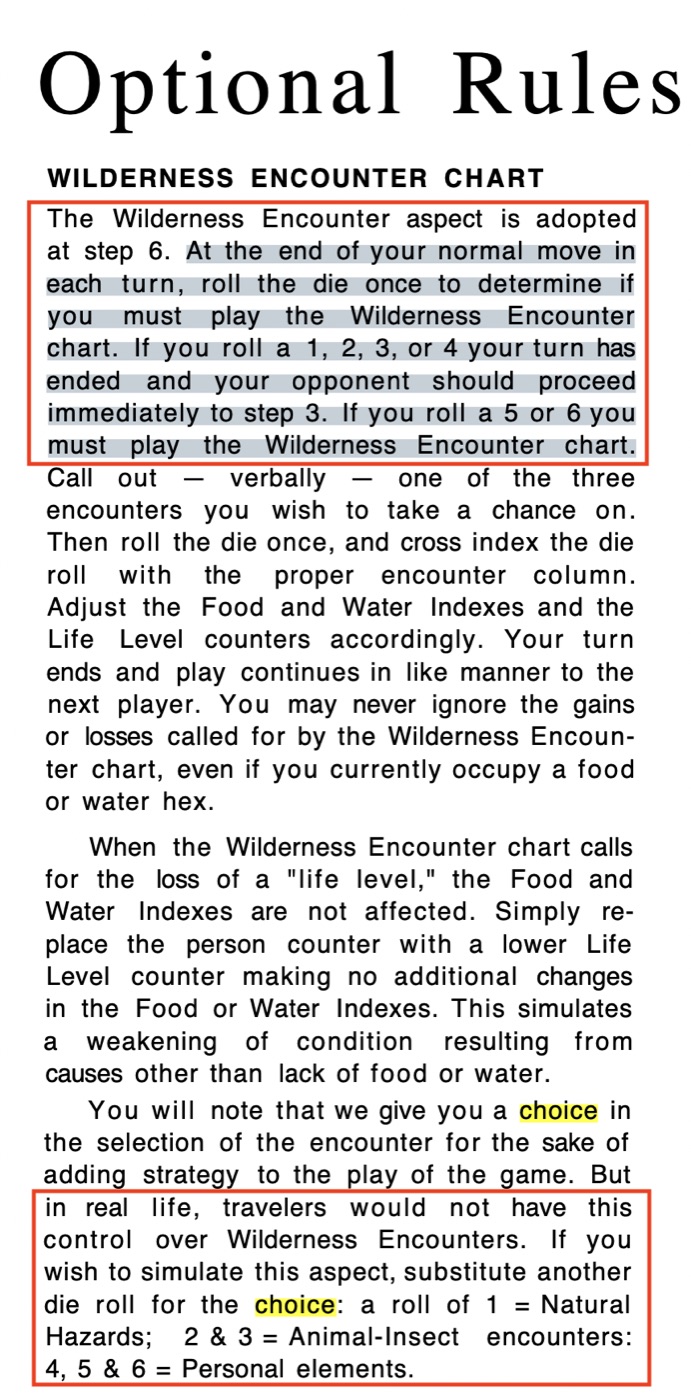
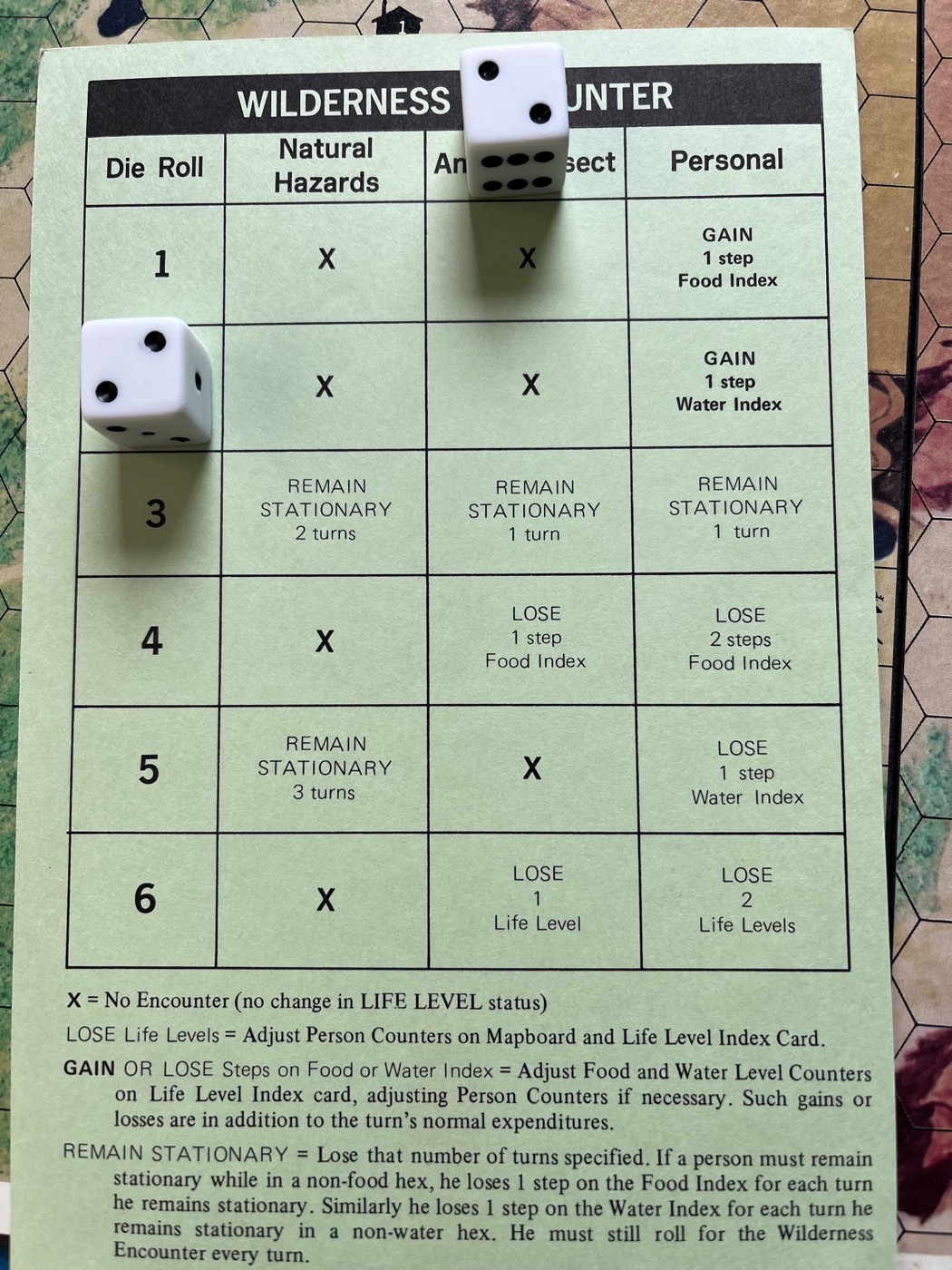
Unfortunately, I rolled a 6 at the end of the turn, and therefore we must roll a Wilderness Encounter. These are on the reverse side of each scenario card. In this case, the result was an animal encounter that will cost us a turn!
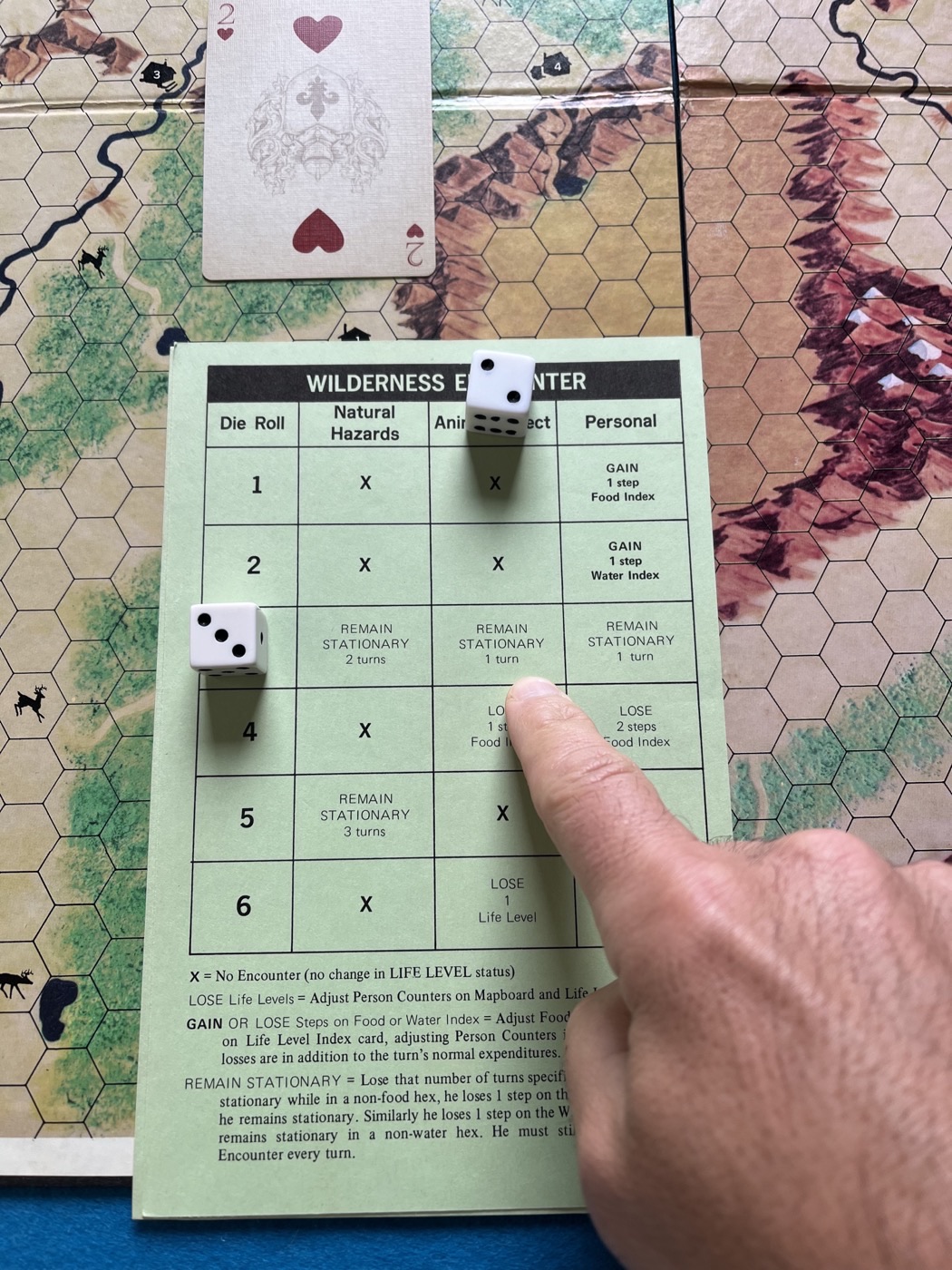
Turn 3
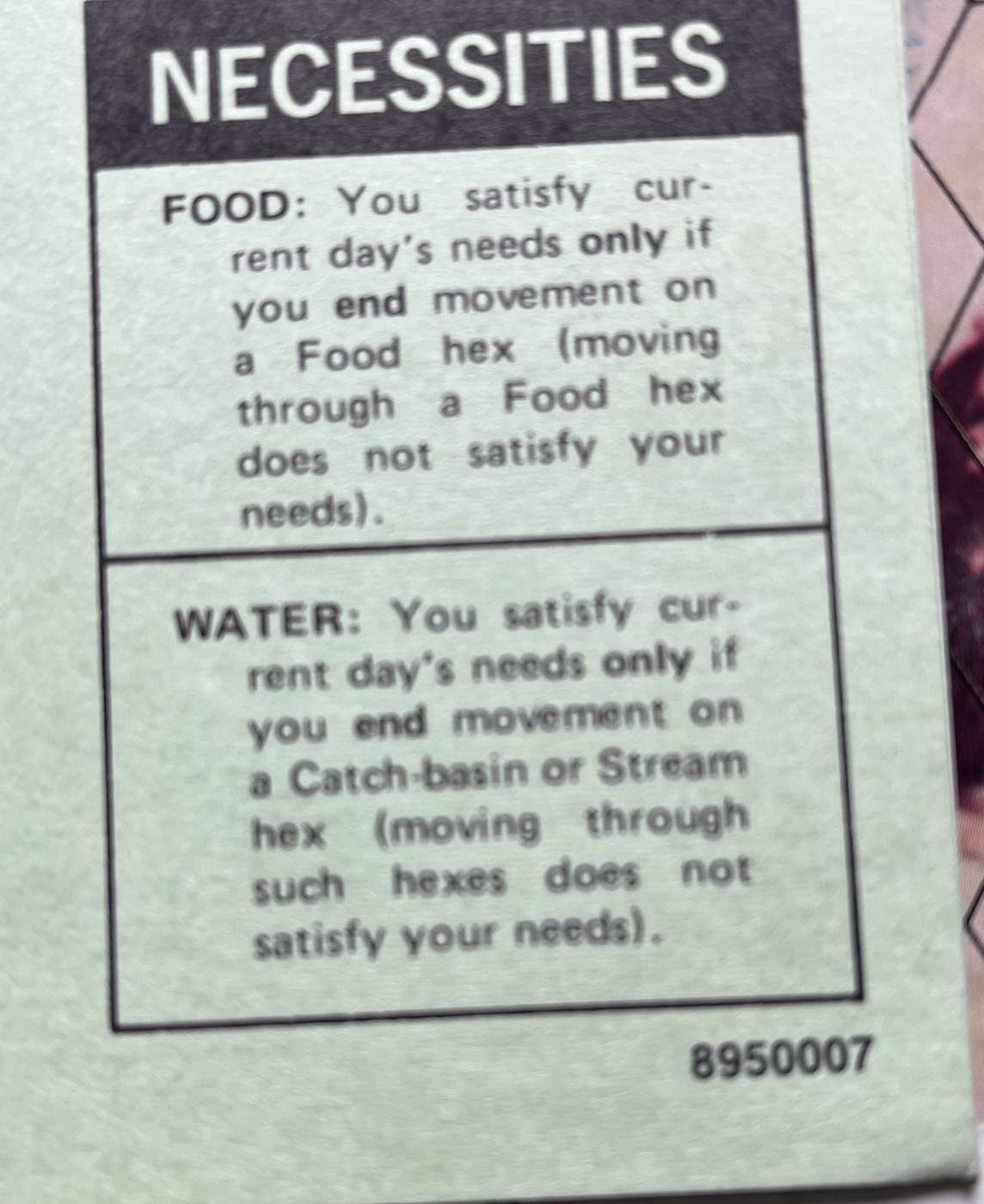
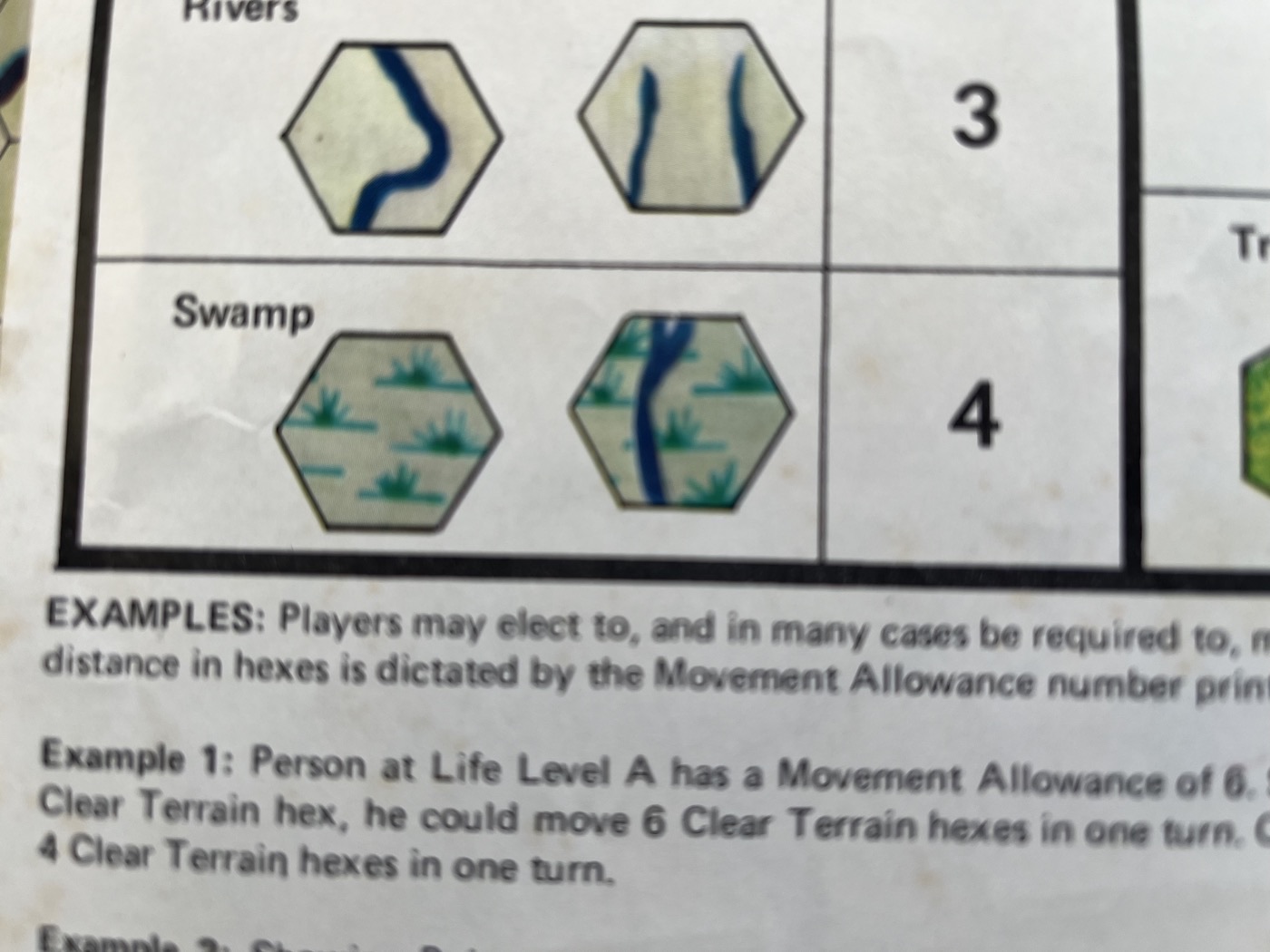
We remain stationary and again I roll a 5 at the end of the turn indicating yet another roll on the Wilderness Encounter table. This time, the result is X meaning no encounter. We are still losing water and food. This affects our Life Level and our movement rate is now 5. You must pay to enter a hex based on its terrain type. See the Mapboard Movement Chart lower left.
Turn 4
I went ahead and moved us to the Survival scenario card since we are within sighting distance of the river though technically not in a river hex. There are fords north and south of us and these would be well travelled by folks coming and going to Dead End Junction.
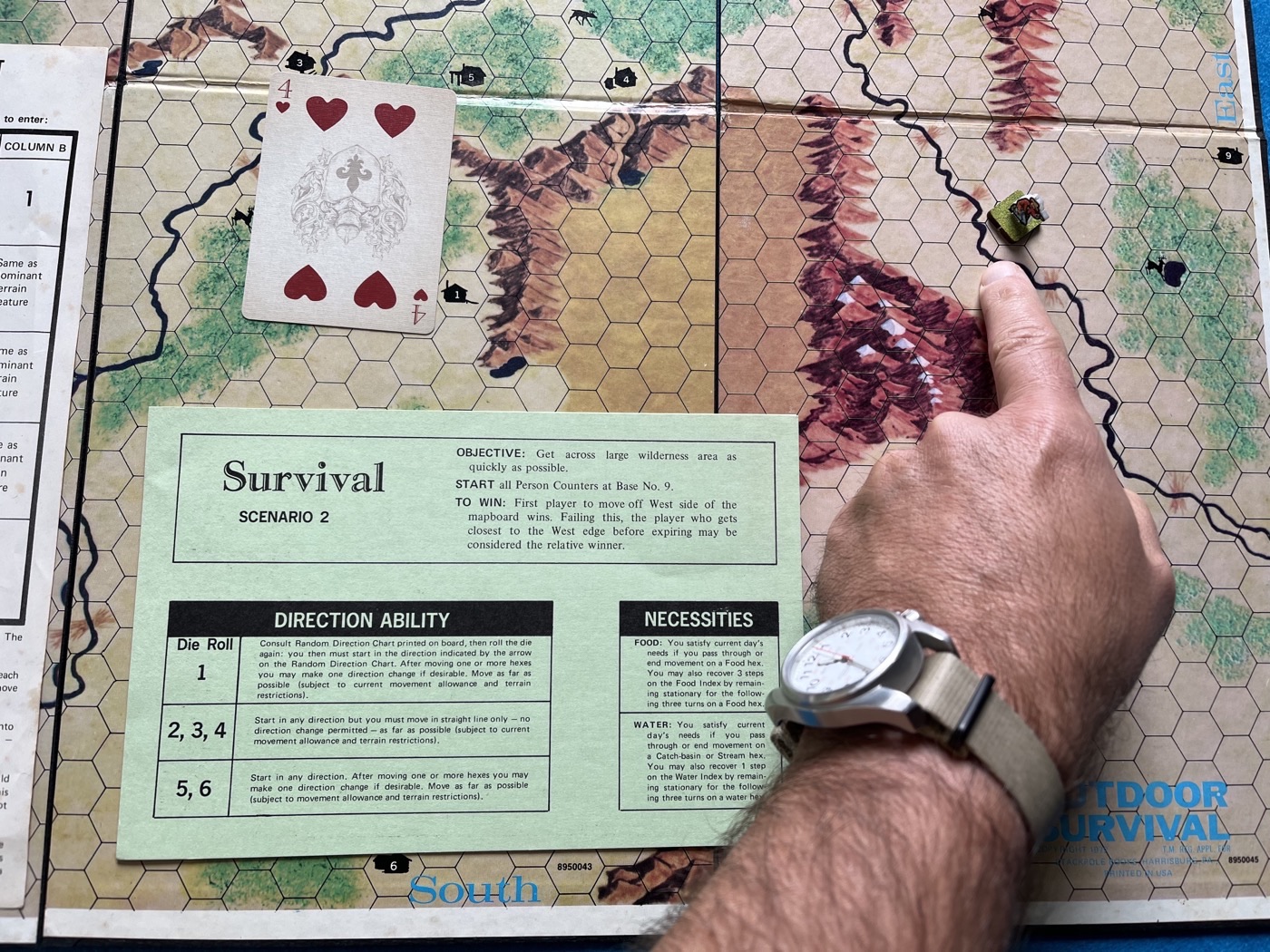
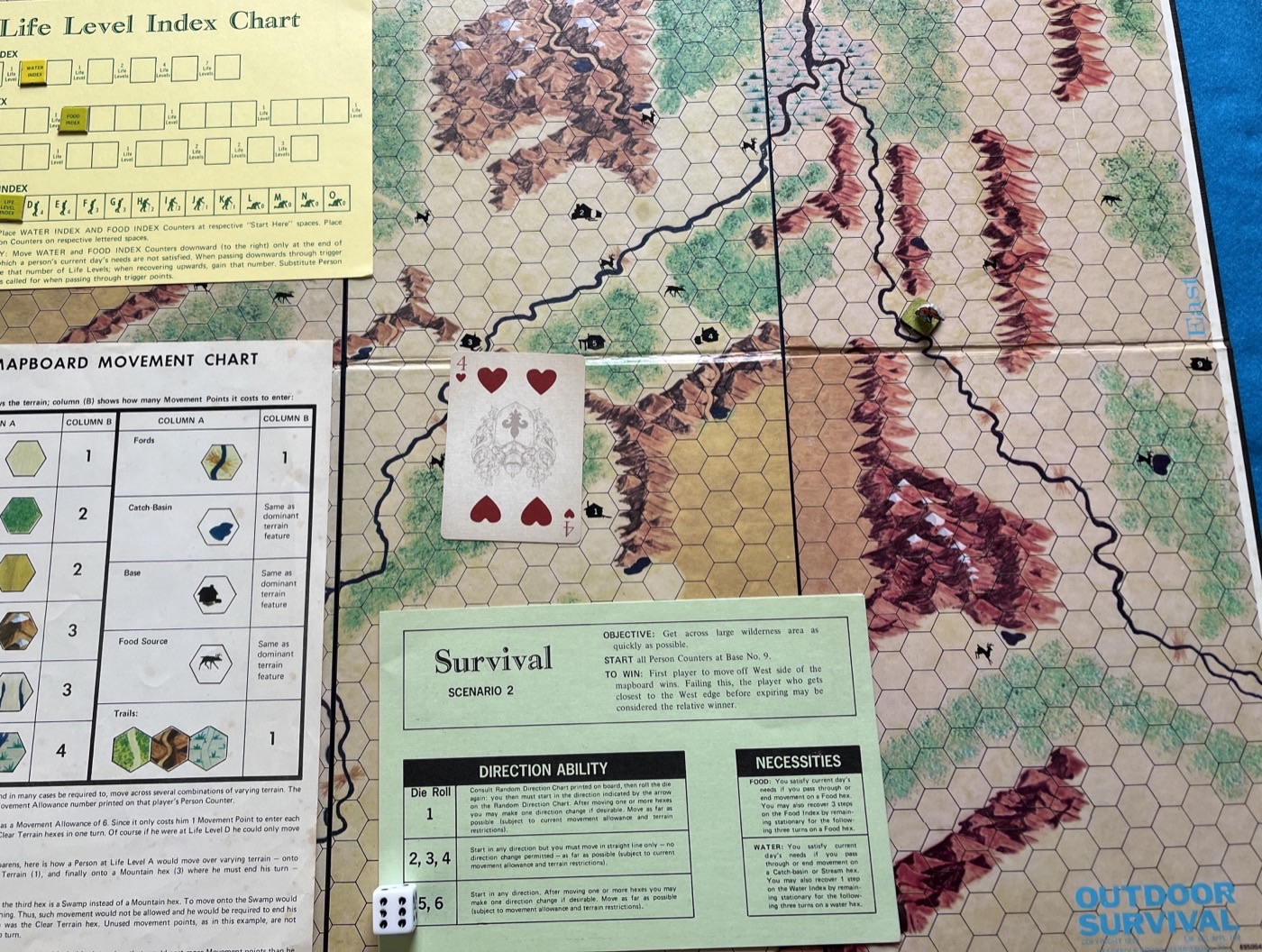
I was fortunate enough to roll a 6 giving us the ability to move much as we please. I begin to implement the plan which is to go upriver toward the major confluence. With only 5 movement, we make it to the south end of a range of mountains. We end in a river hex so no need to deduct water this turn.
Turn 5
We proceed north, skirting the Mimbres River on its east side which is considered clear terrain. Again, we end in a river hex which helps preserve our water. As one player pointed out during the gaming session, this kind of travel ought to top off the water supply, but the Outdoor Survival rules do not allow this.
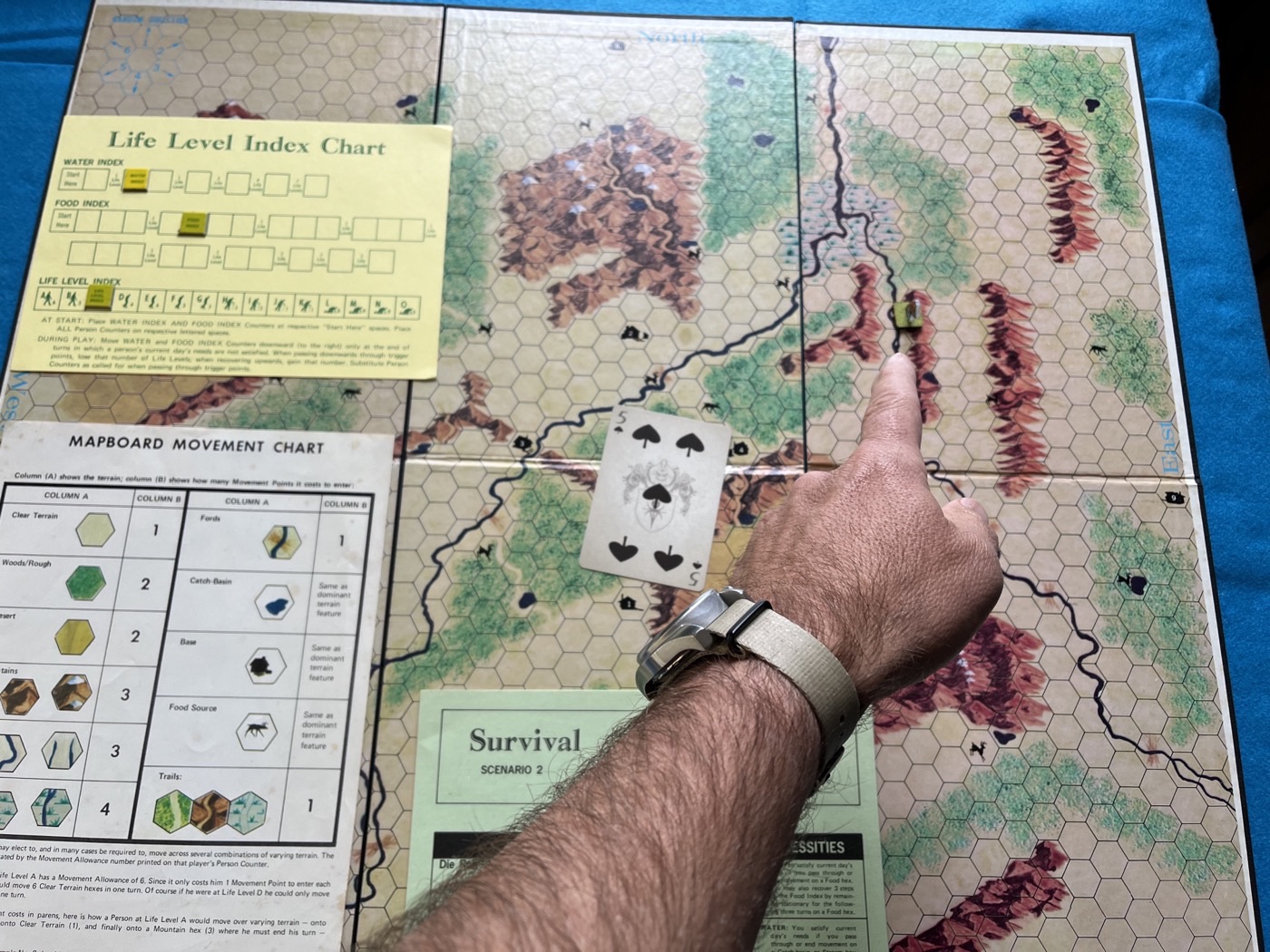
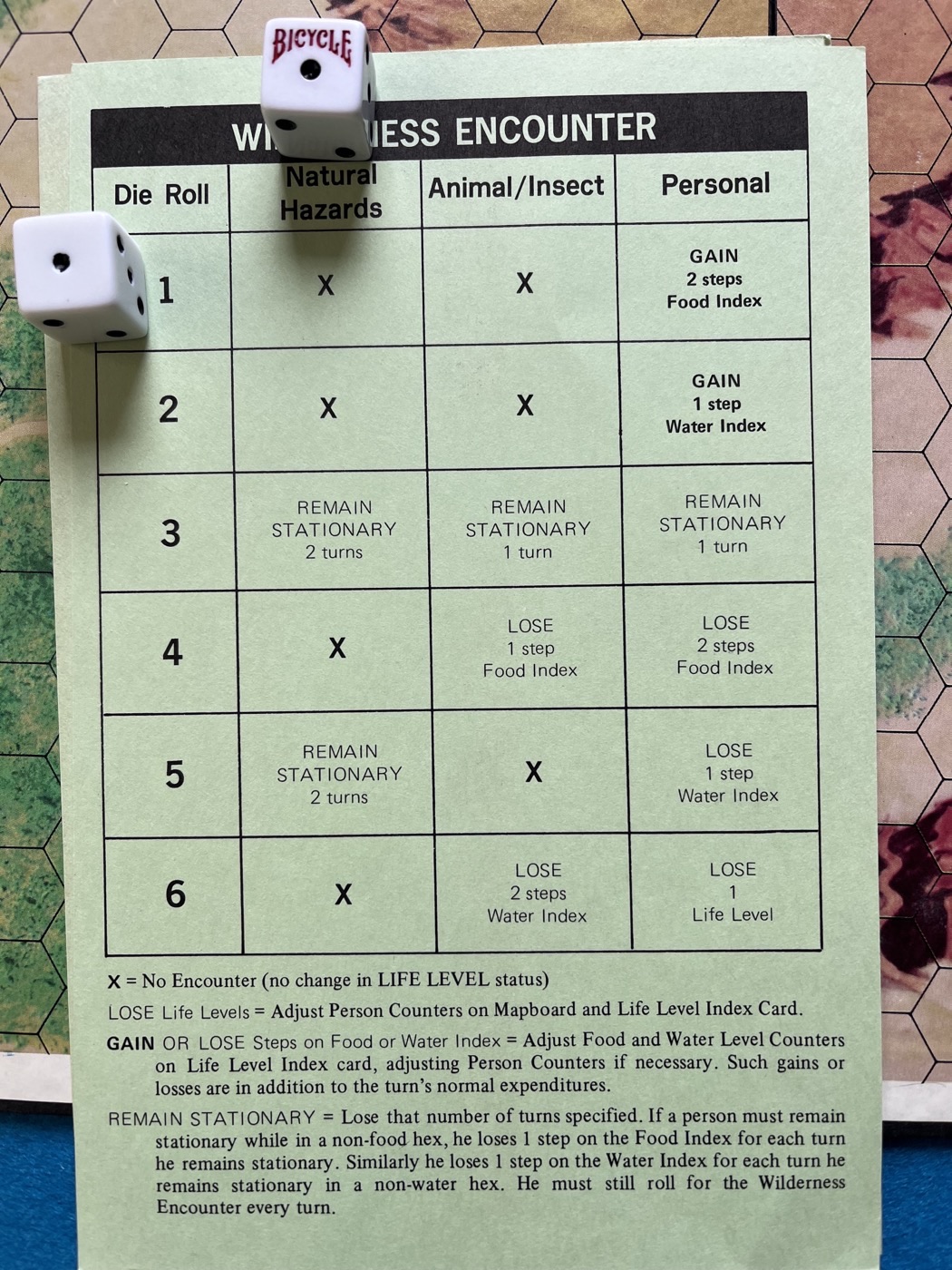
Another Wilderness Encounter is indicated but I have another lucky roll and avoid delay.
Turn 6
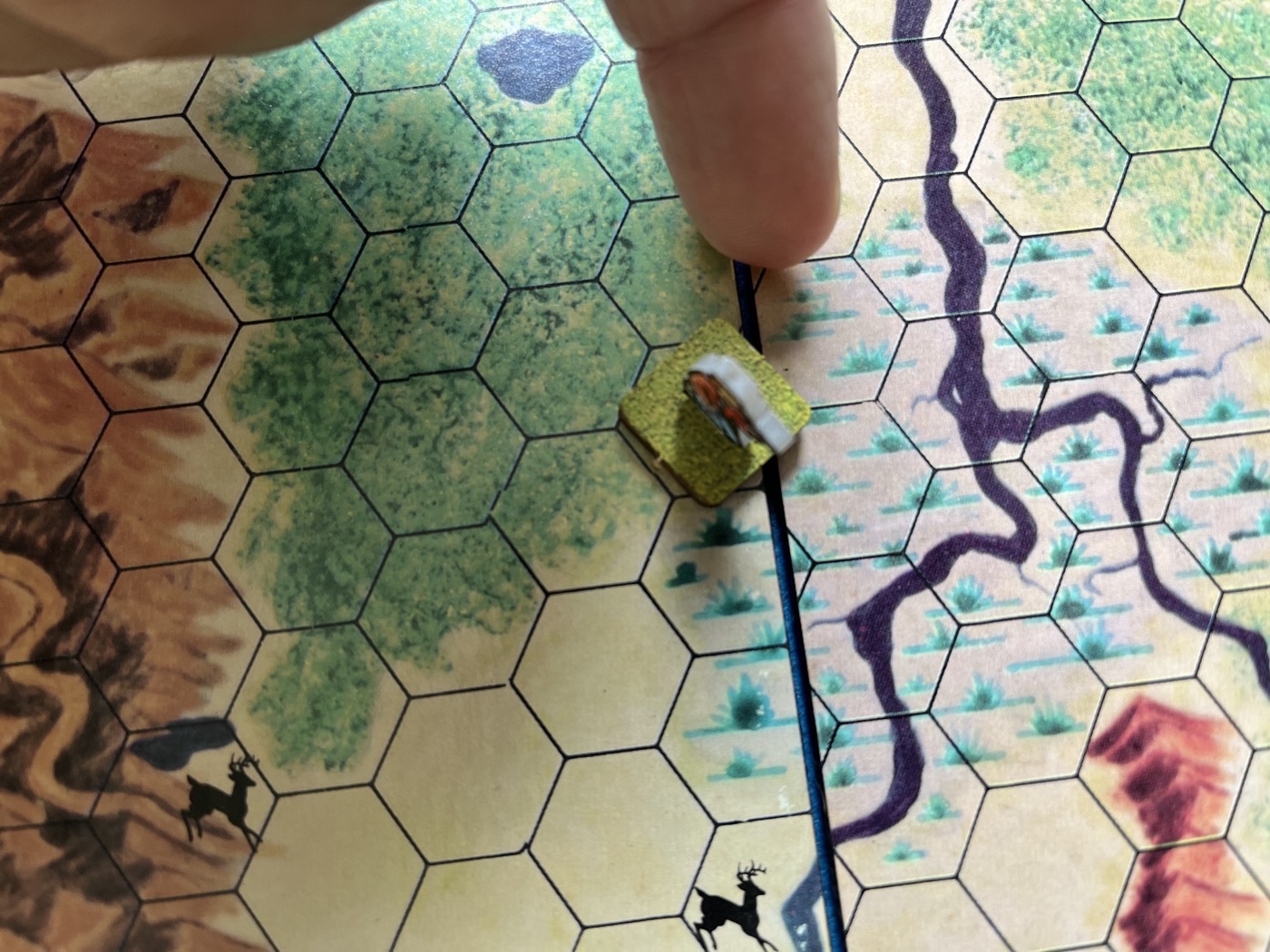
We cross over the river (3 movement points) and enter a forested hex (2 movement points) on the edge of the swamp. Our situation seems to be fine at this point. After all, we seem to be about half way to our destination with plenty of water and enough food to make it without a detour.
Turn 7
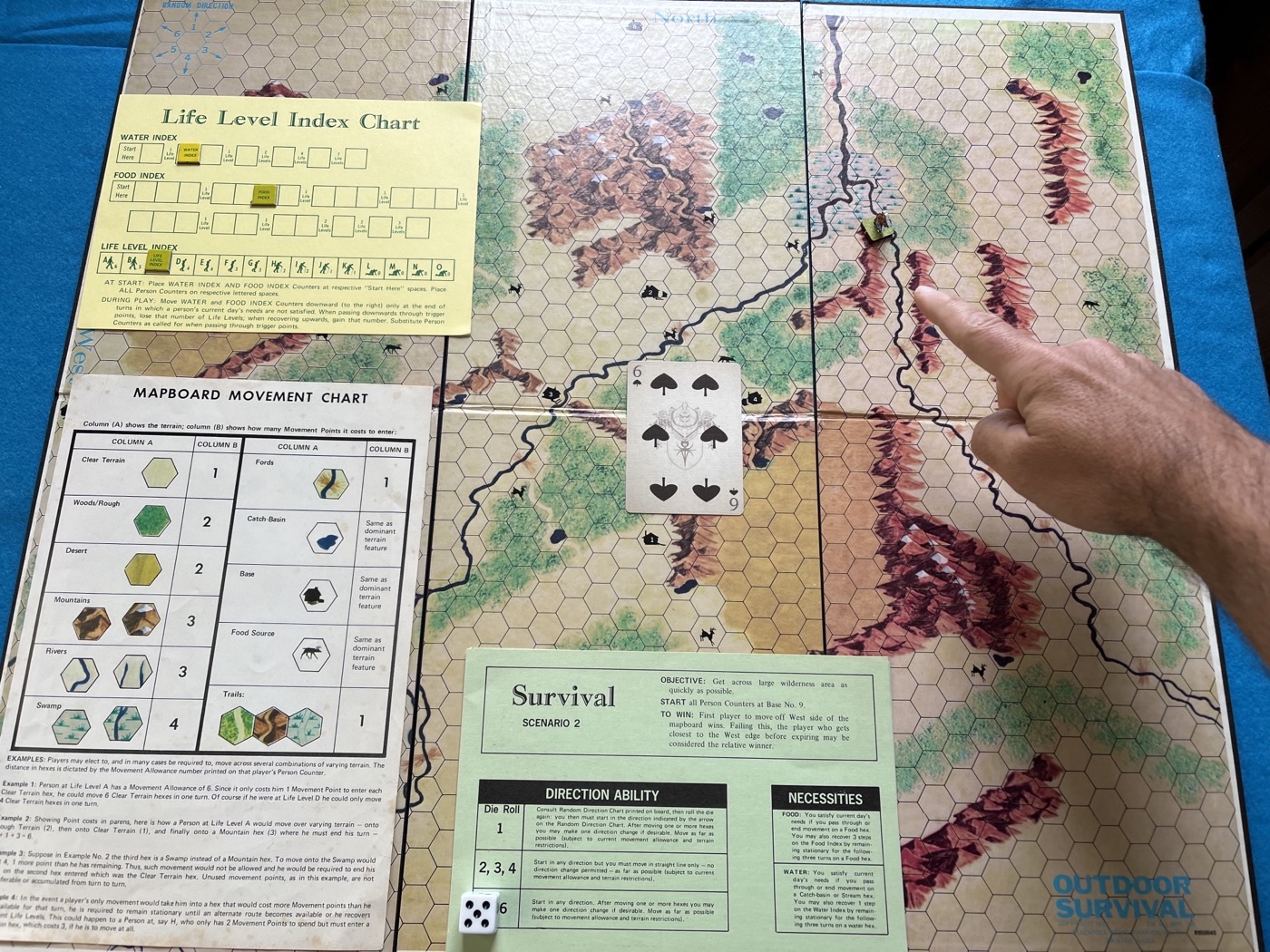
The roll roll on the Direction Ability chart means we must move in a straight line. Since the plan is to follow the river to the confluence, we enter the swamp (4 movement points) and have insufficient movement to pass into the next swamp hex.
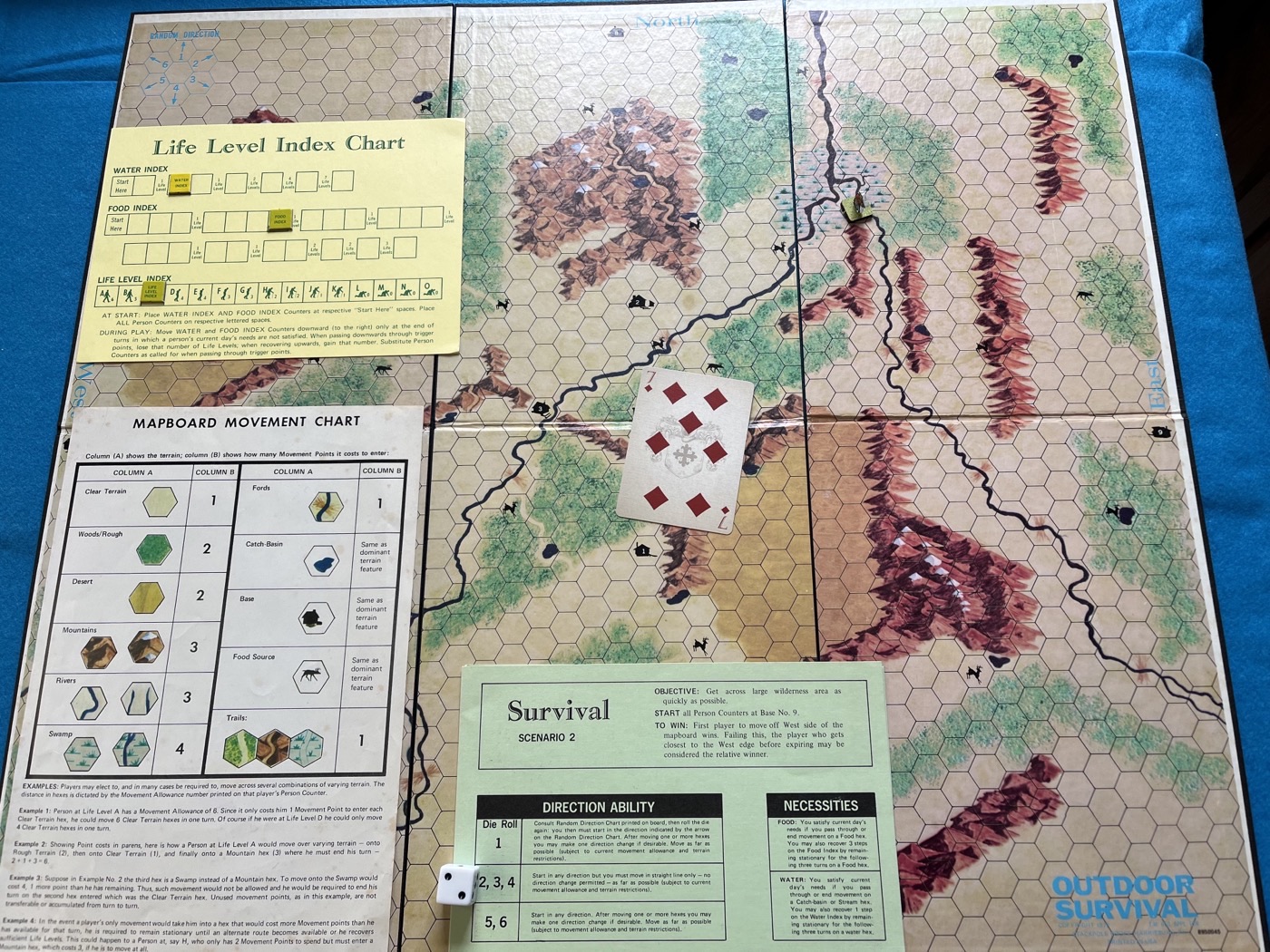
We avoid another Wilderness Encounter.
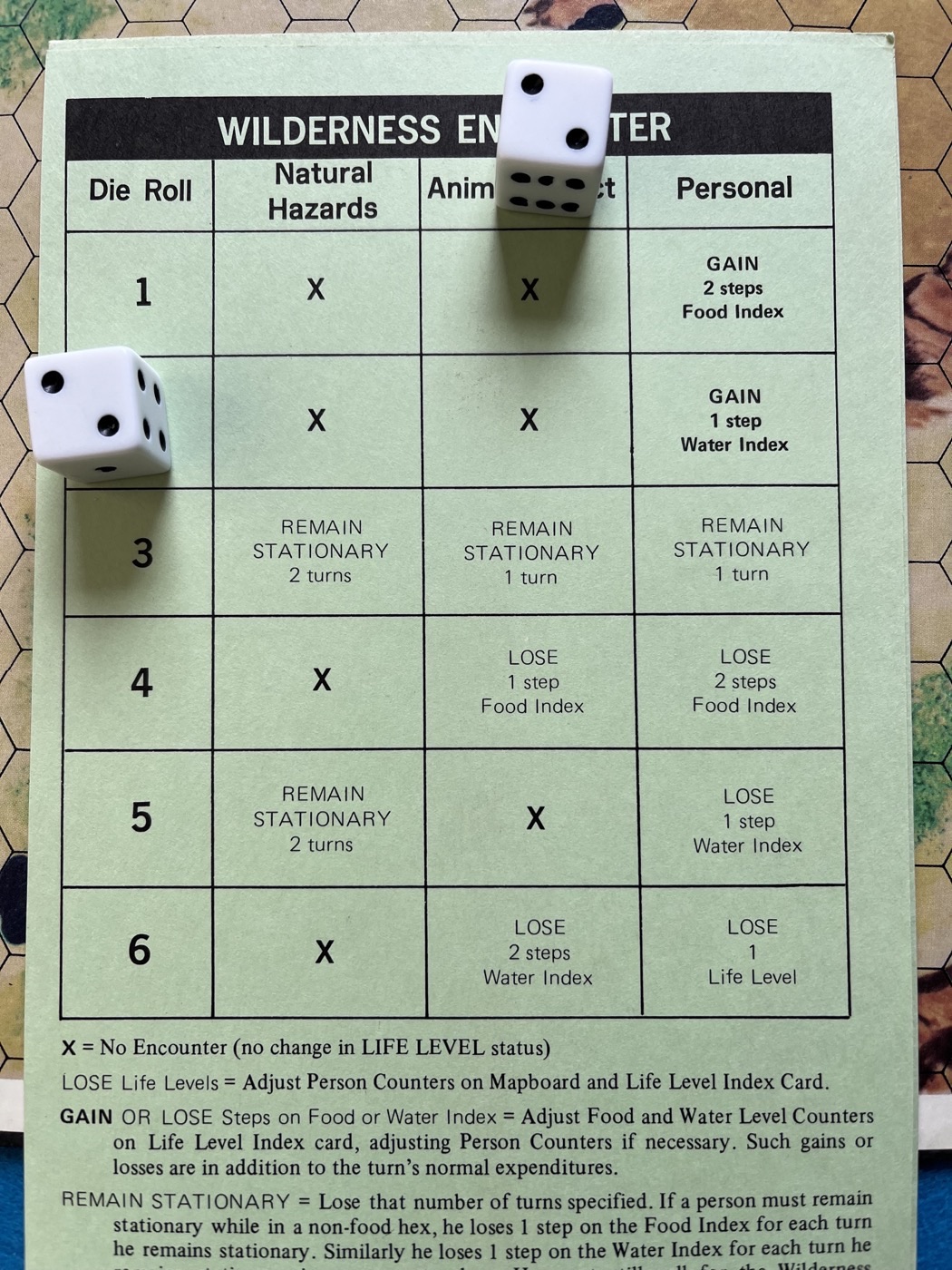
Turn 8
Still mired in the swamp, our food index moves downward costing us a life level. At level D we now have only 4 points of movement per turn.
Turn 9
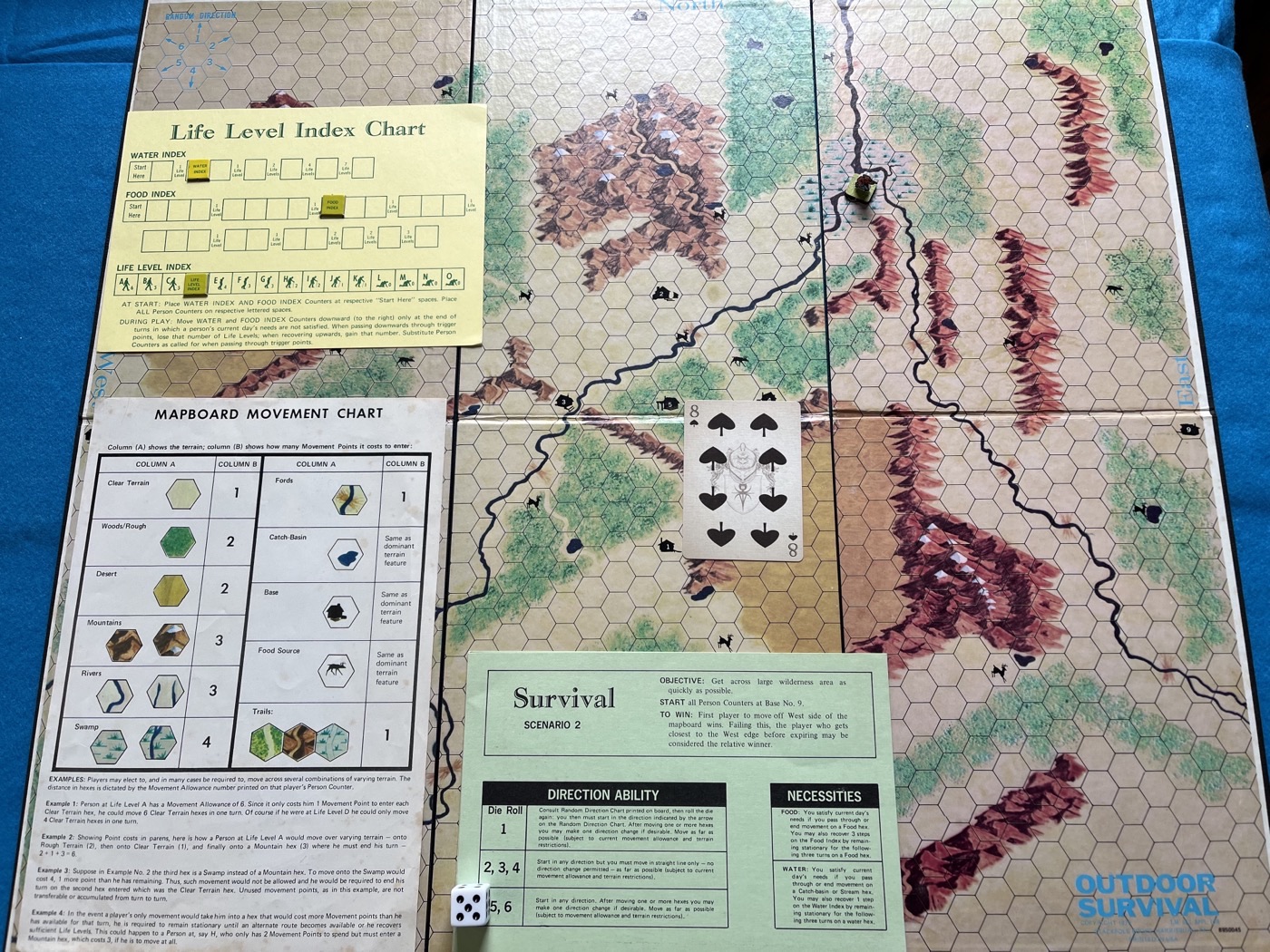
We cross over the river but cannot move out of the swamp.
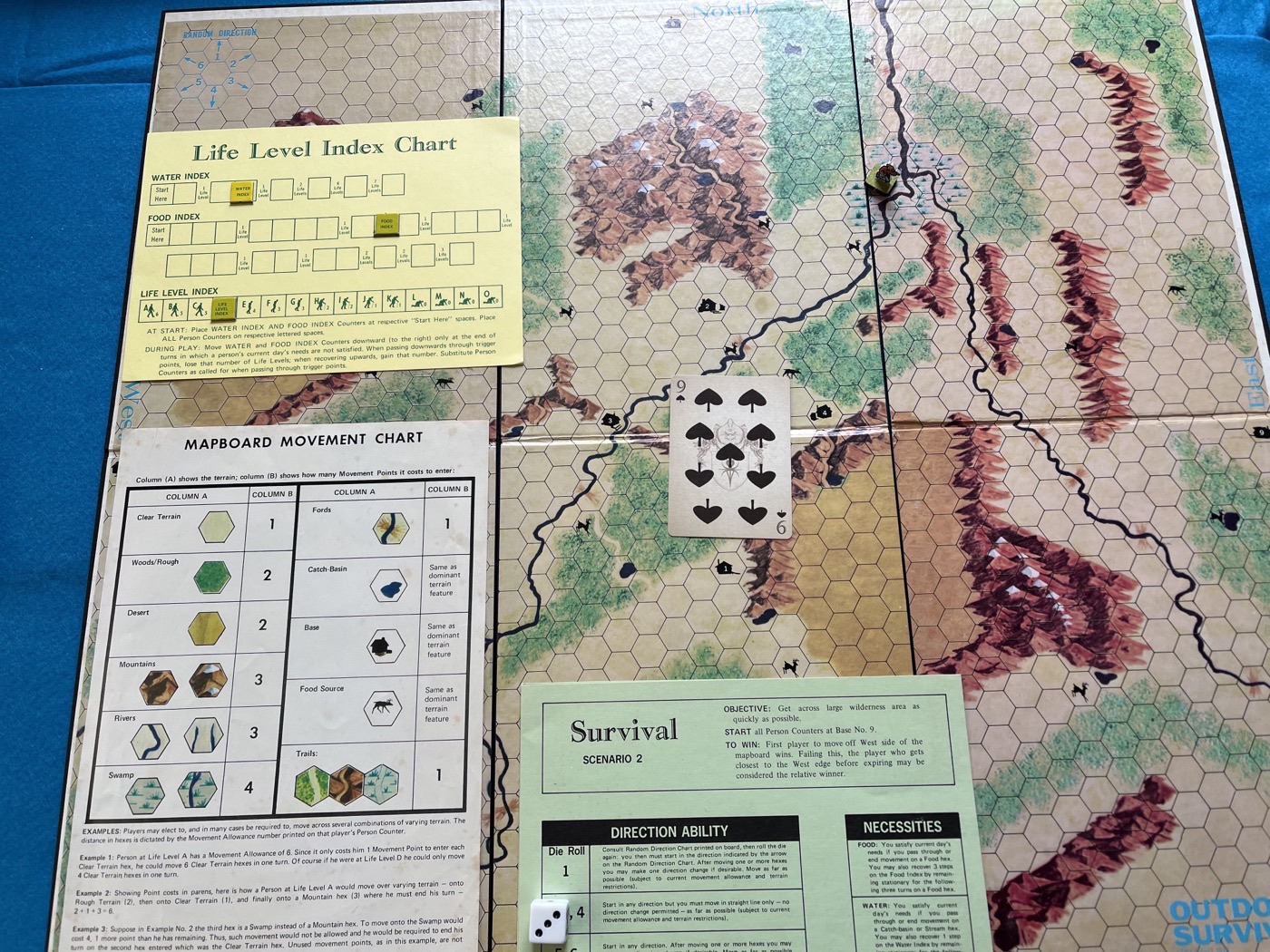
Turn 10
We switch to the Lost scenario card since we are moving back into unfamiliar territory with no clear landmarks to guide us. Furthermore, we get a bad roll which means our initial direction is up to chance.
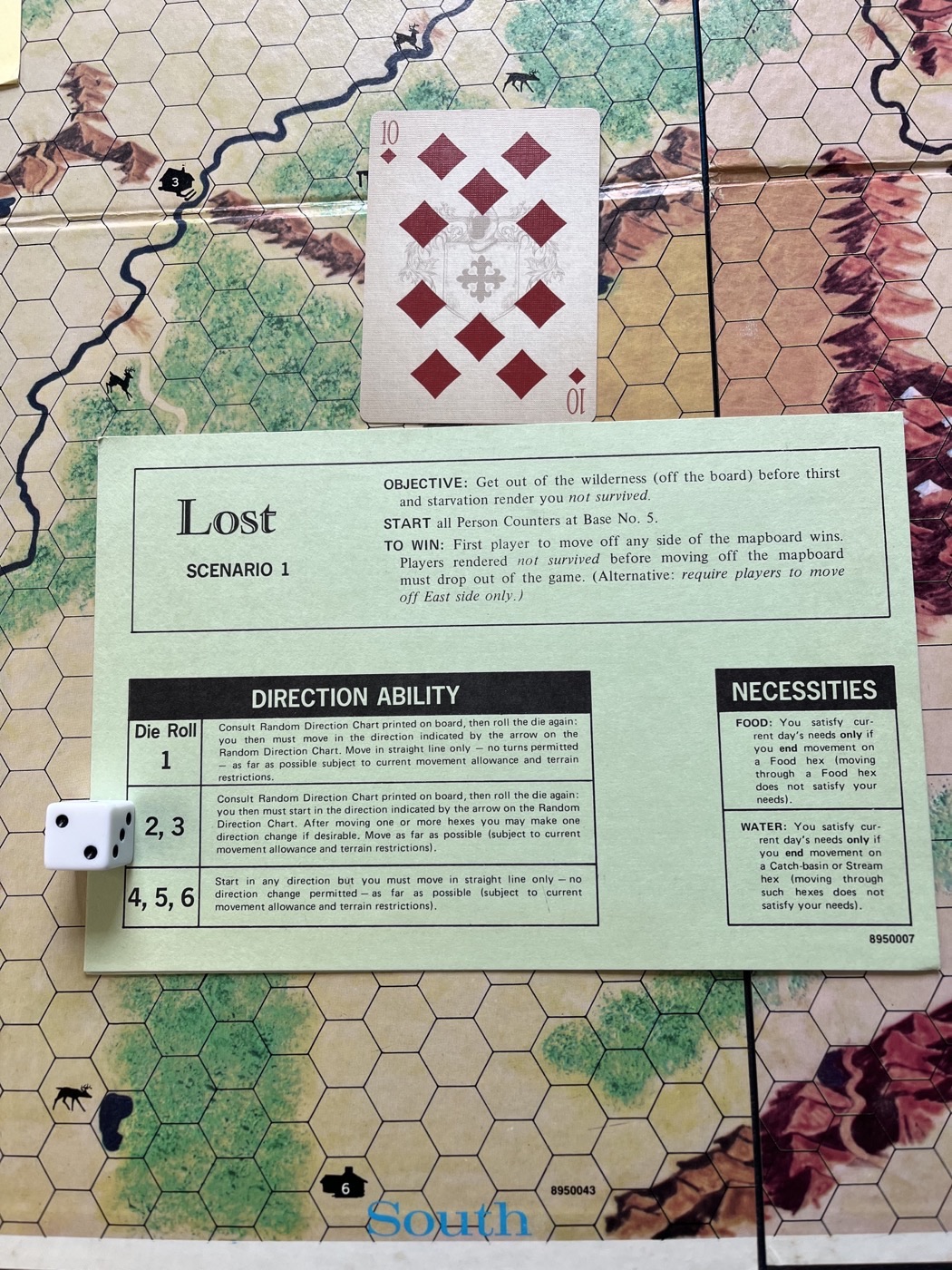
Sadly, I roll a 3 and all of our movement is expended re-crossing the river back toward the heart of the swamp. Truly devastating. The only silver lining is that our water index is staying the same since we are next to the river.
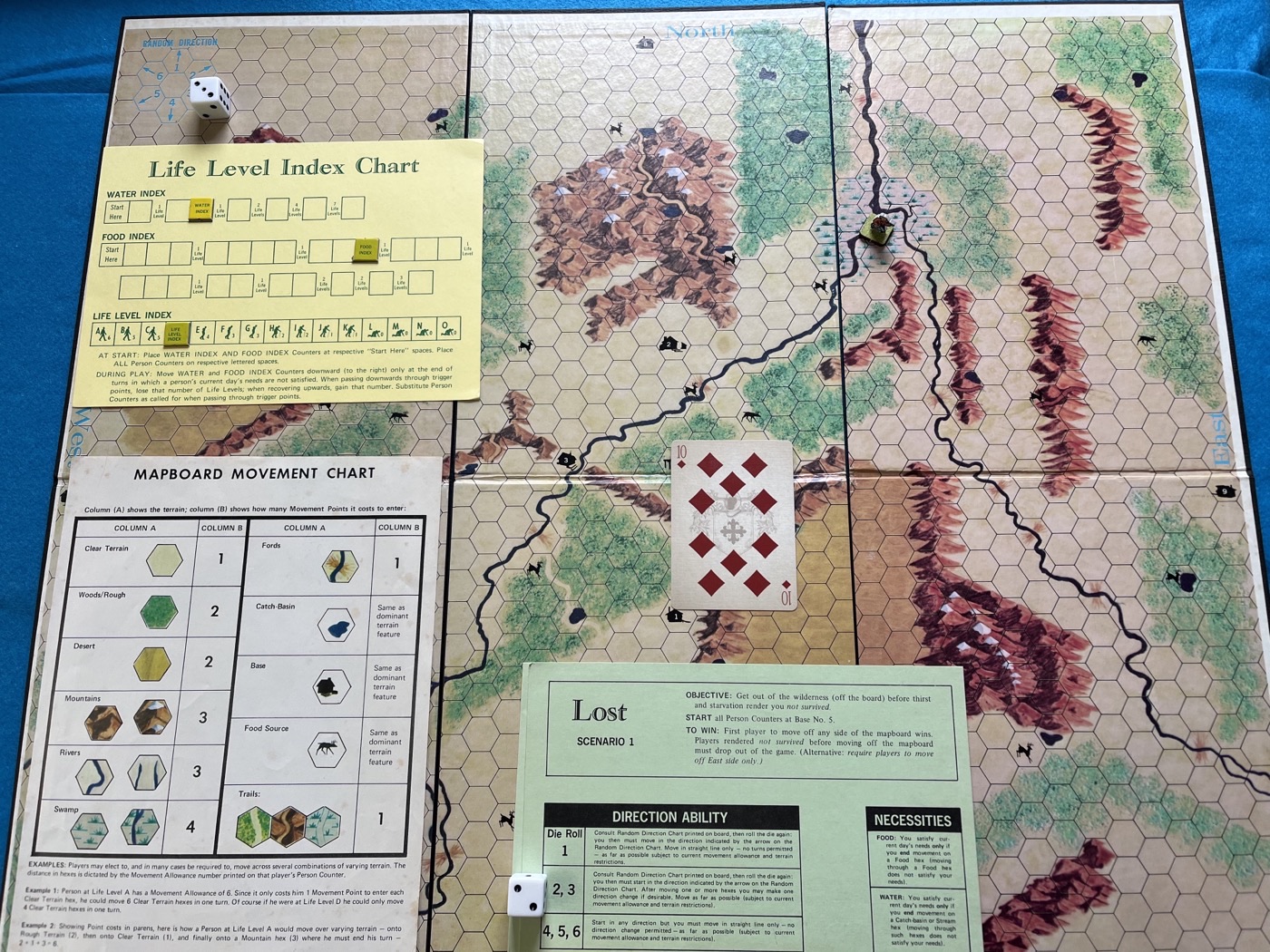
Turn 11
We retrace our steps, having come to our senses. Our food is now critical and our life level is F which means we have only 3 movement points per turn. If we get another bad Direction Ability roll, that will end our game.
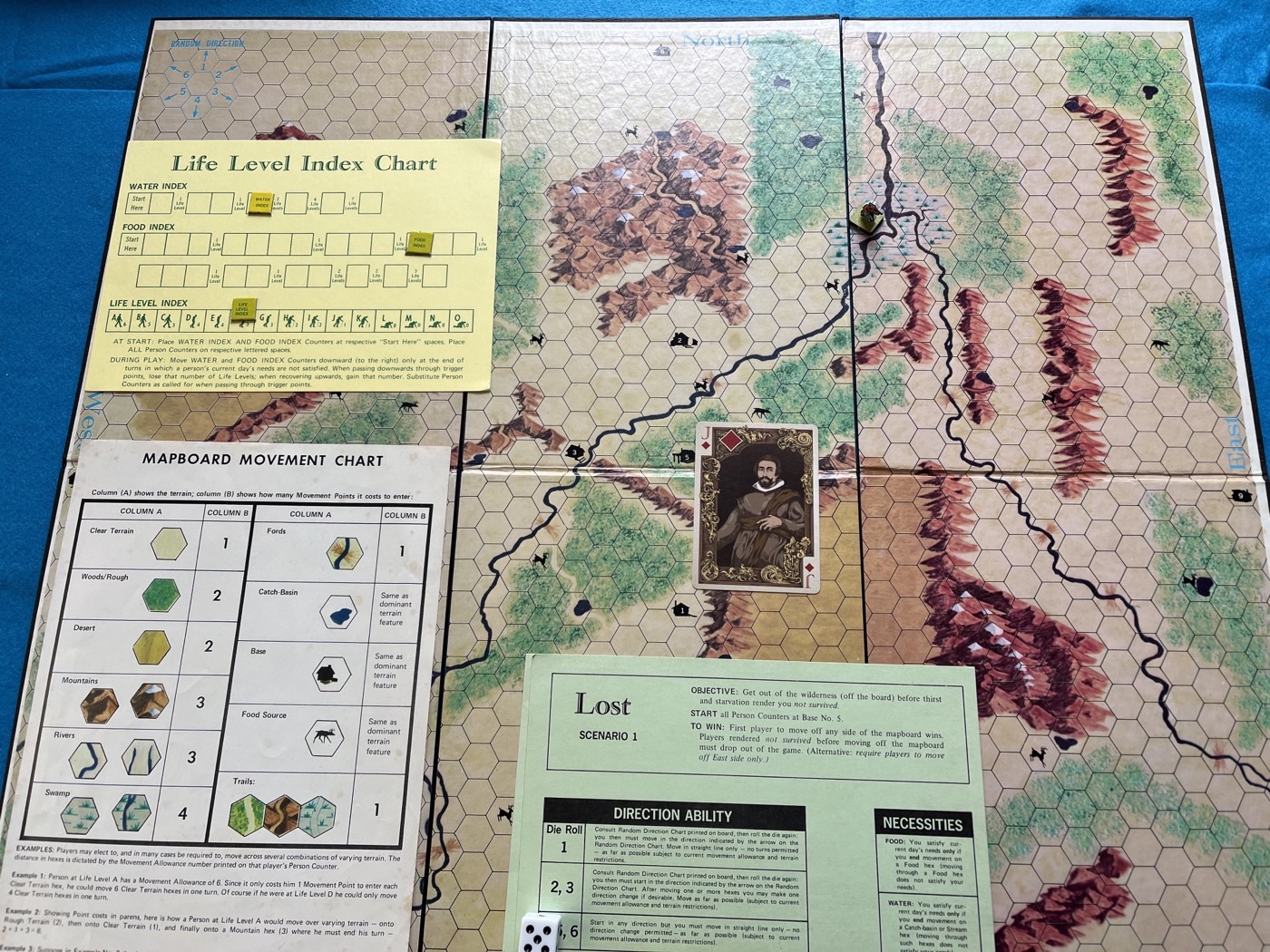
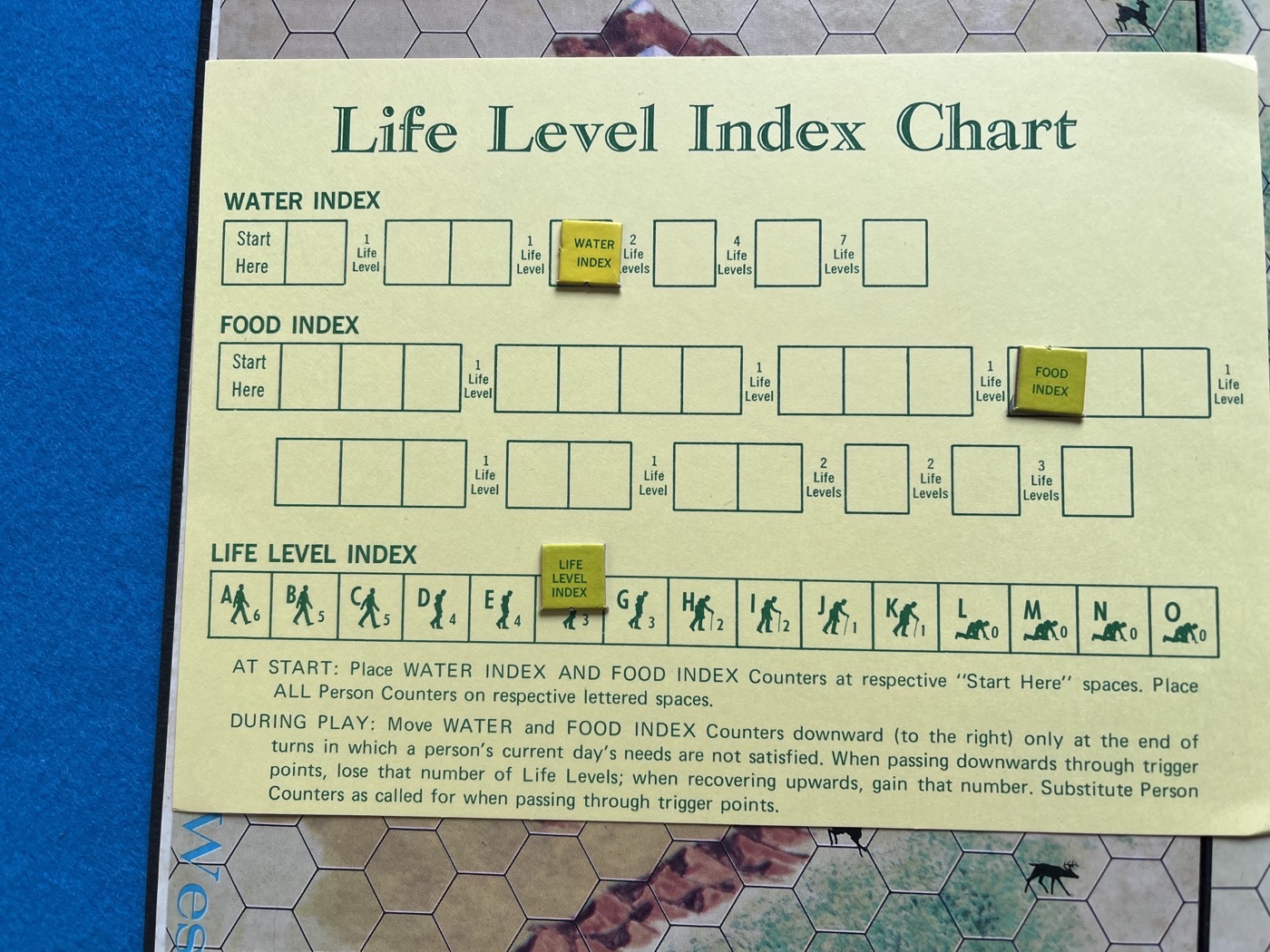
Turn 12
Heading into the forest costs 2 movement points. There is insufficient movement to allow further progress for the day.
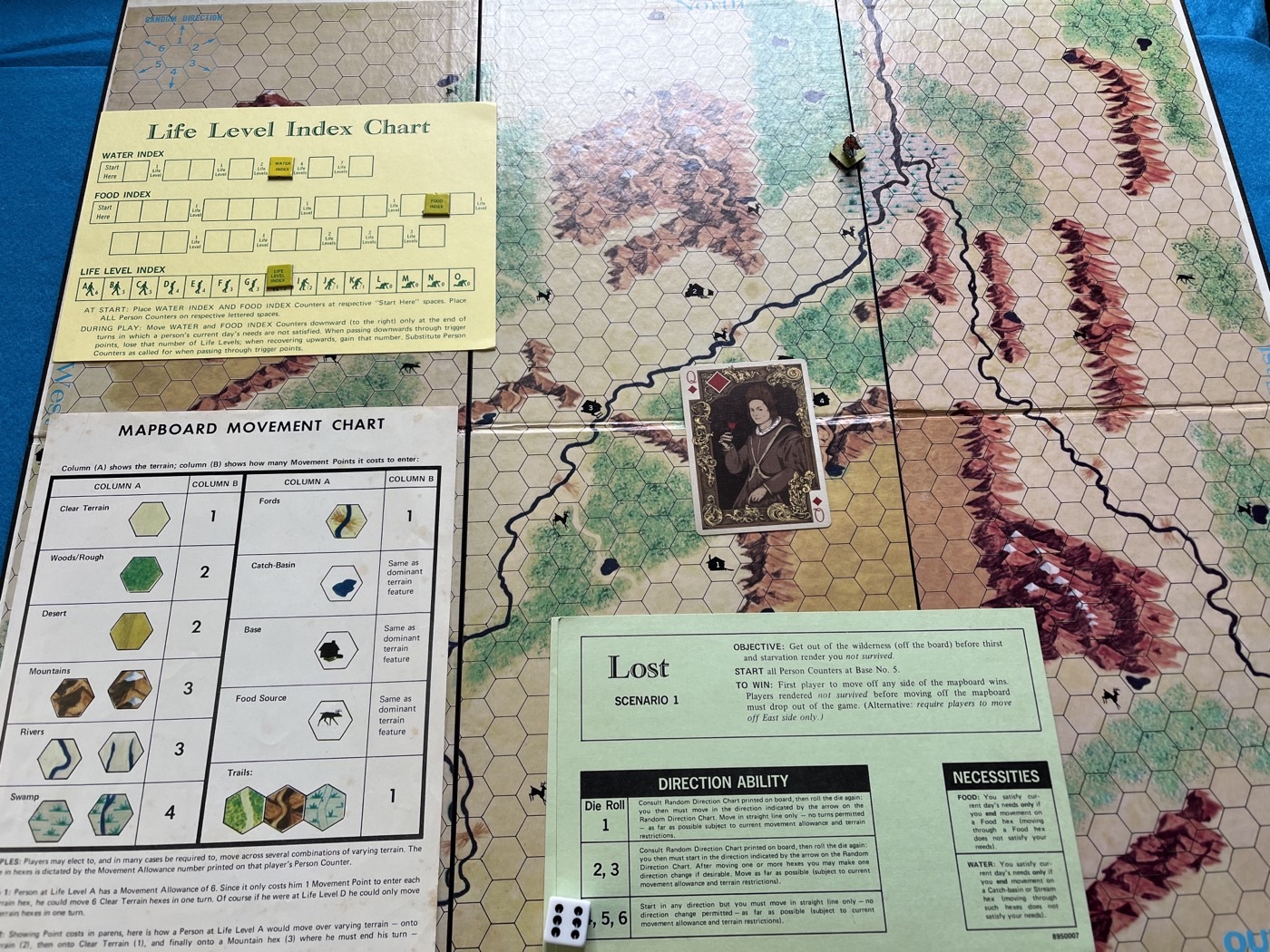
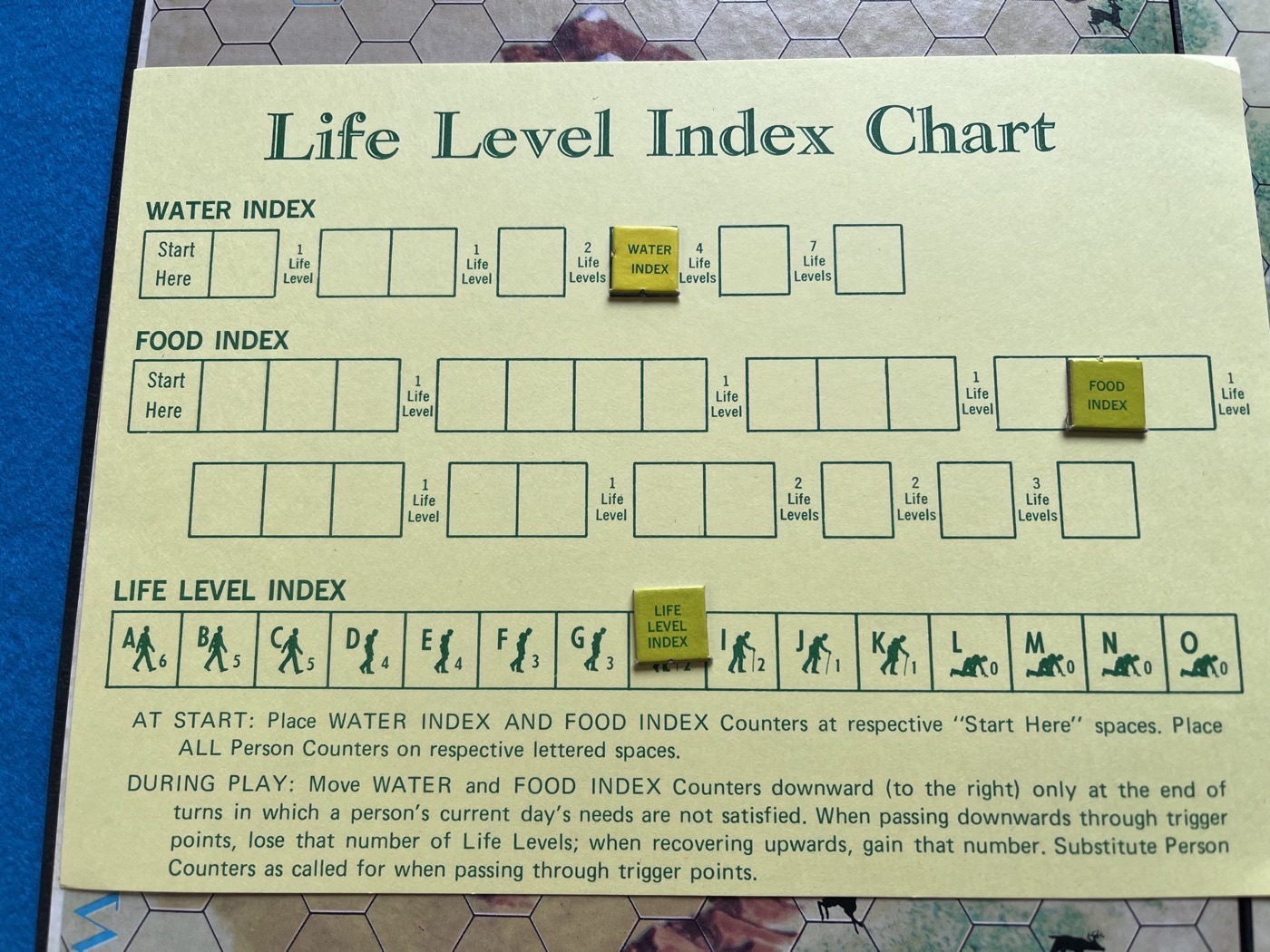
Water and food continue to dwindle. At life level H we have only 2 movement points now.
Another Wilderness Encounter with no ill (or beneficial) effect.
Turn 13
The direction roll only permits us to go northeast, but we are too weak to make this move into swampland (cost 4). An alternate reading of the Direction Ability text would allow us to proceed 1 hex to the northeast, but this takes us away from the goal. It’s almost curtains.
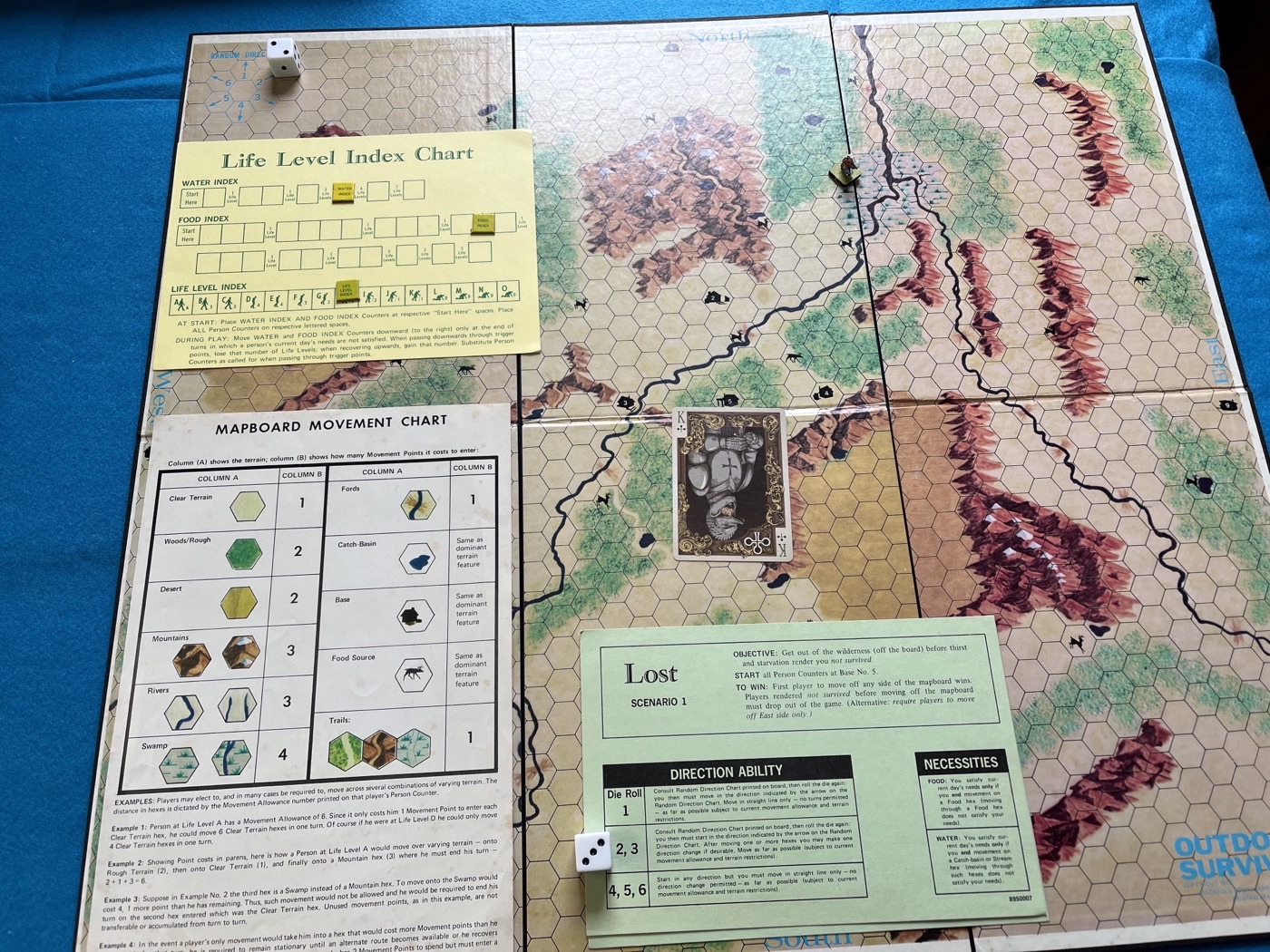
Since we are not next to water, this decrement is going to hurt a lot. Losing 4 life levels seals our fate.
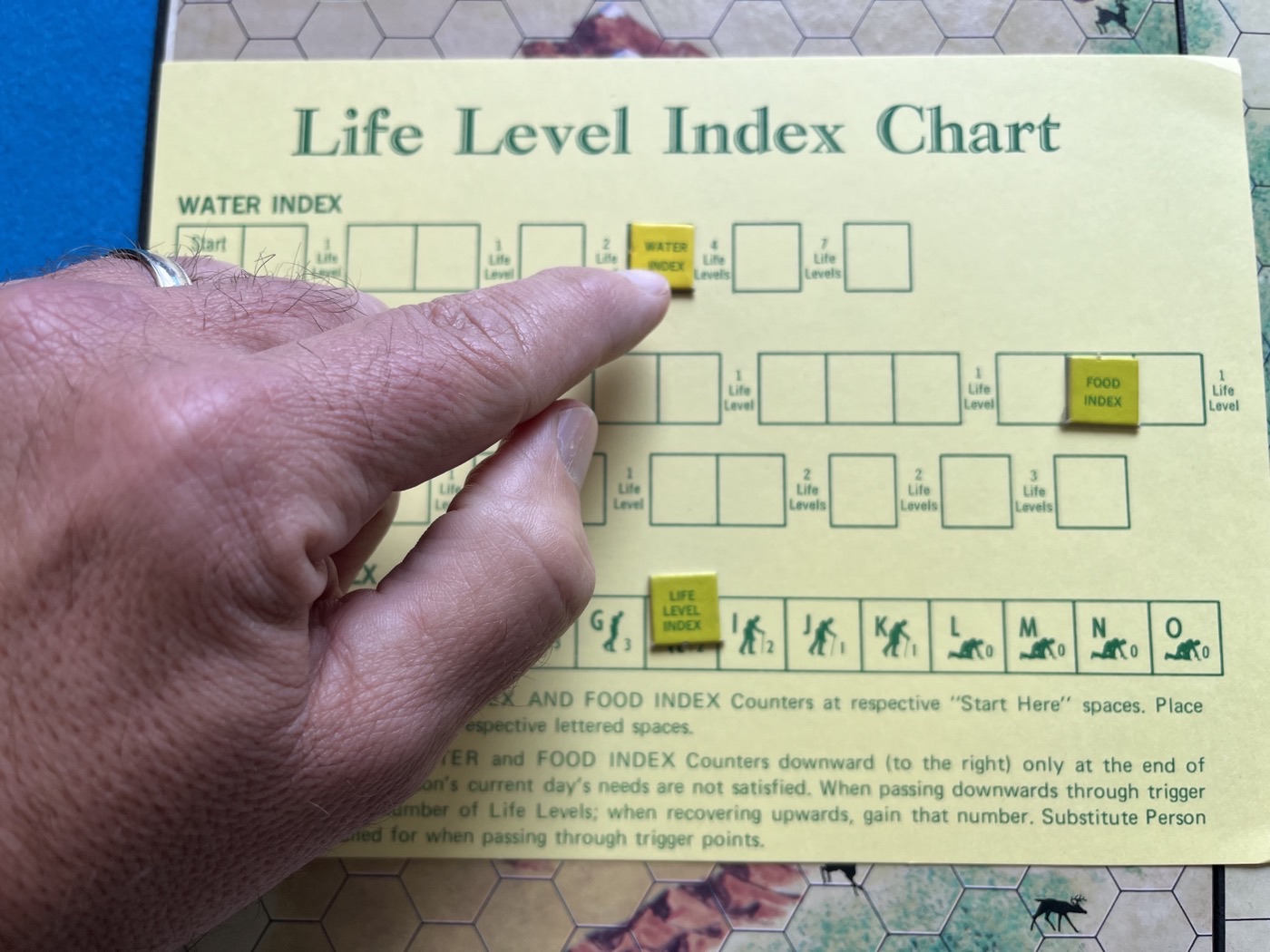
With 0 movement points, we die in the forest.
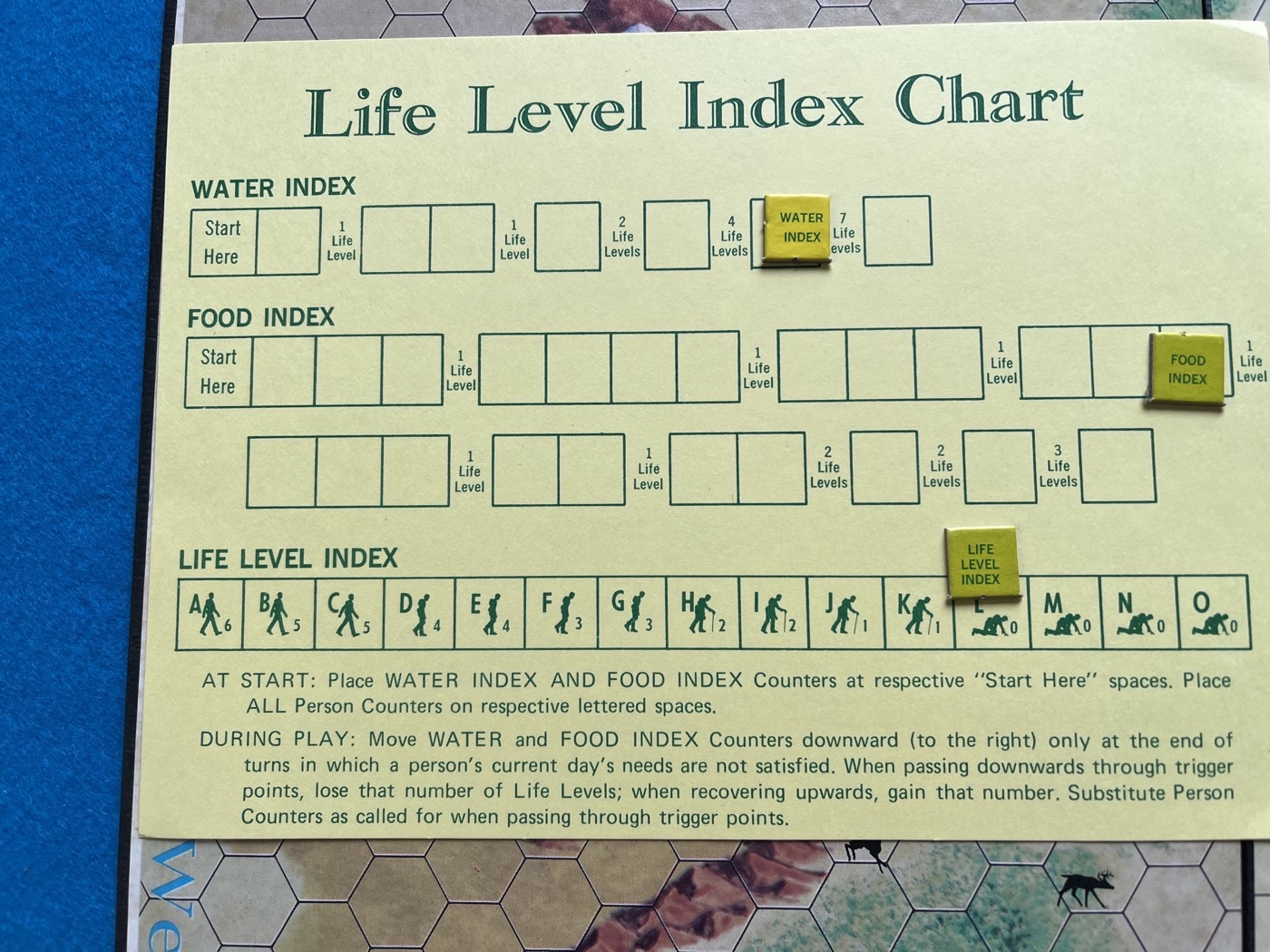
Preliminary Conclusion
Outdoor Survival likely has multiple such pathways that will inevitably result in death. This game is not a satisfactory substitute for counting beans and bullets. Since Boot Hill 1st edition has no wilderness rules (other than those relating to a chase), it is best to either use the supplementary material from the modules or else just move to 2nd edition like everyone else.
Pat on the Back and Self Promotion
For these many reasons, I already extracted the best parts of Outdoor Survival when I wrote Dragons Beyond. If you like what you see, consider getting a copy.
Originally published on Substack on August 31, 2025.