Martian Holiday
Rodney Hampton
- 9 minutes read - 1757 wordsMonday was the birthday of prolific fantasy writer Edgar Rice Burroughs (b. 1875). Let’s talk about Barsoom (Mars) and D&D shall we?
According to the 1st version of the wikipedia article on Edgar Rice Burroughs, his stories about Mars “inspired the boyhood dreams of American scientists who sent the first robot spacecraft to the planet, and a crater there is named in his honor.” (activists on wikipedia have been smearing him since 12 September 2020). I am currently reading his novels. The first one I read was The Master Mind of Mars which is the 6th book in the series but does well as a standalone sci-fi adventure. I circled back and read A Princess of Mars and am currently reading The Gods of Mars. I am very fond of the John Carter movie by Disney which has an excellent soundtrack by Michael Giacchino. There is another movie entitled Princess of Mars released in 2009 that stars Traci Lords (yes that one) as Dejah Thoris. Some portions of the plot are correct, but Traci is well past her prime and the modernized John Carter intro is pretty poor.
But what really sparked my interest in all things Barsoom was my own delve into original Dungeons and Dragons, and the retroclones I have made based on early draft material (among other things). In Original Dungeons & Dragons’ third little brown book, there are two tables for wilderness encounters that reference Barsoomian “men” and monsters. No description for any of these monsters are in the rules. Additionally, Evil High Priests are known to use White Apes to guard their castles.
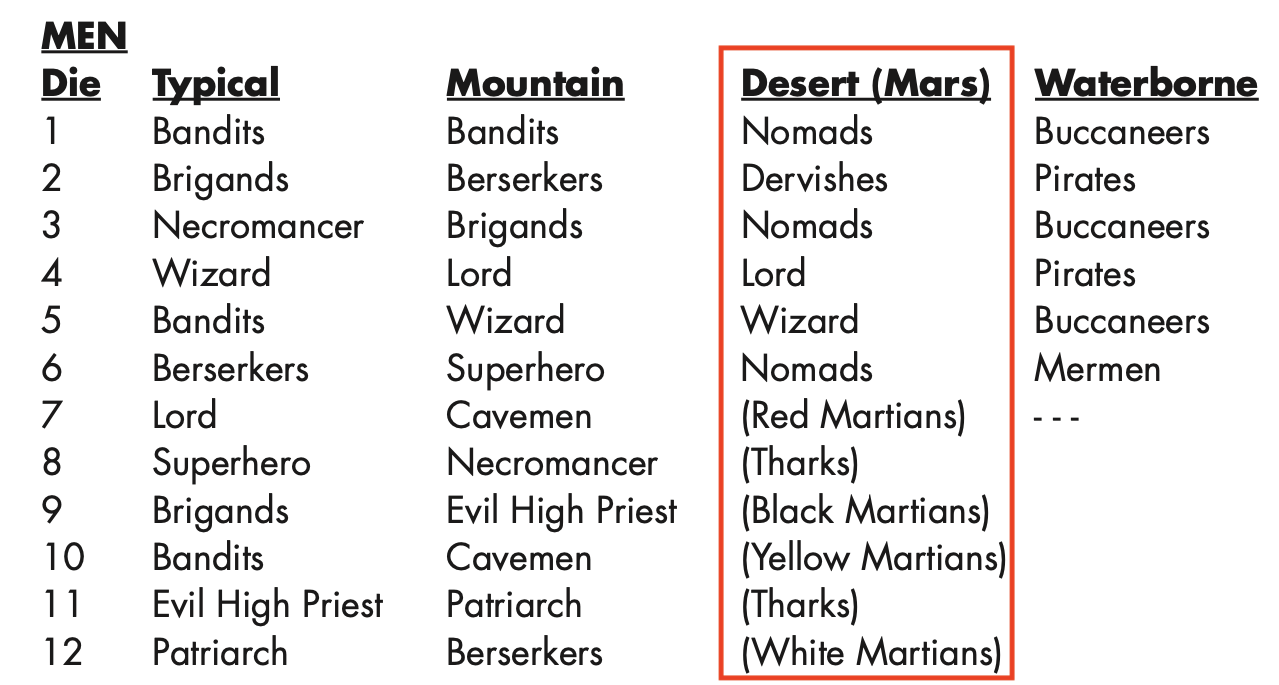
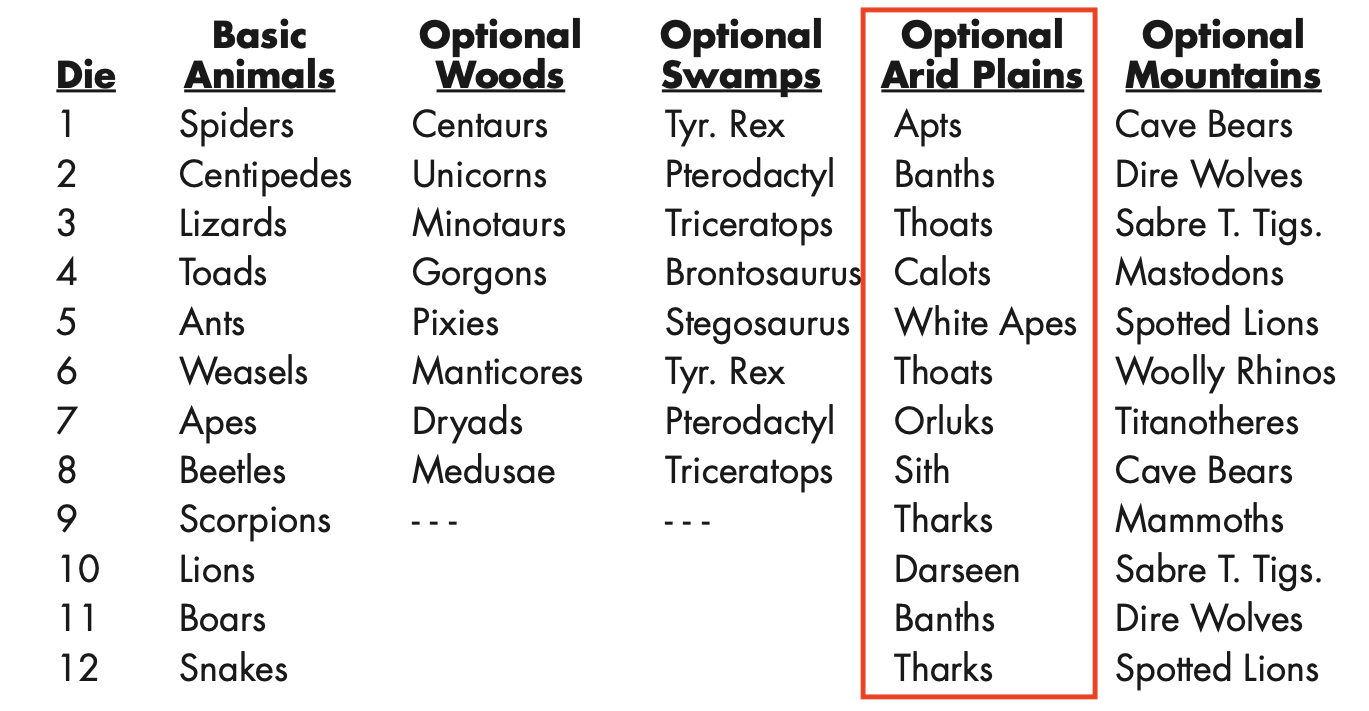
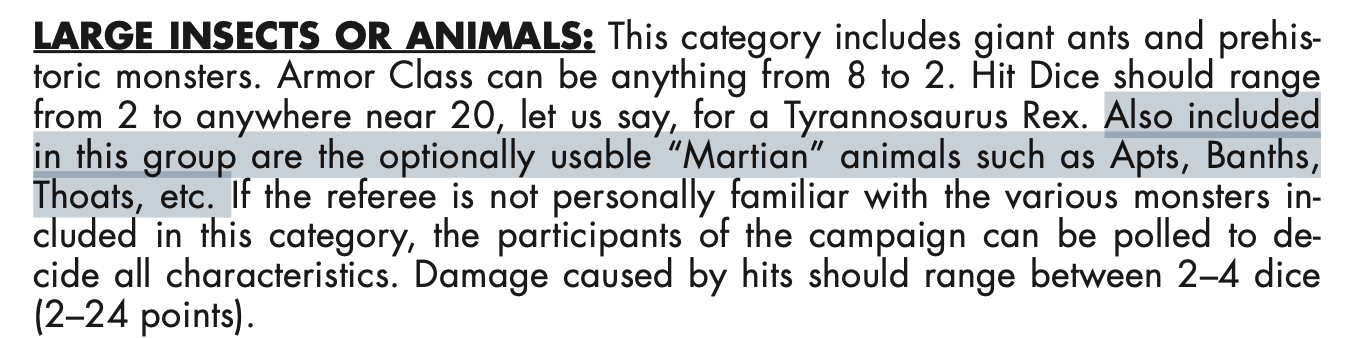
There is some guidance in LBB#2 on page 20 that these exotic “animals” ought to have statistics that fall within certain ranges, but nothing solid.
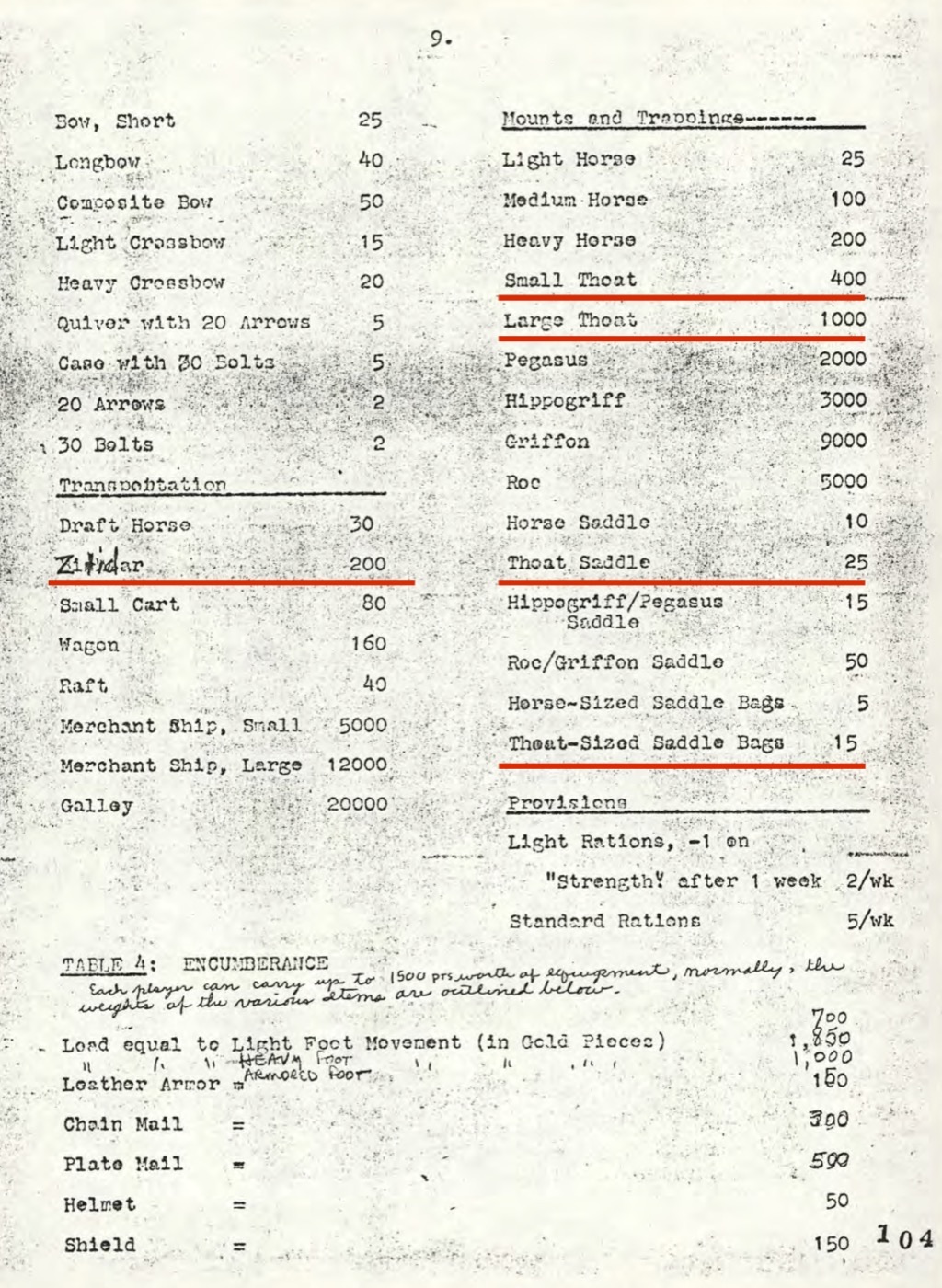
In the second OD&D draft from 1973 to come to light (the one from the Arneson v. Gygax lawsuit), we see these tables in raw form. There are also movement rates for Thoats, prices to buy them along with specialized saddles and how much they can carry. There is even a monster description for the Thoat, but no statistics for hit dice, armor class, etc. The Zitidar has a few entries as well. Evil High Priests are protected by [Giant?] Apes instead of White Apes.
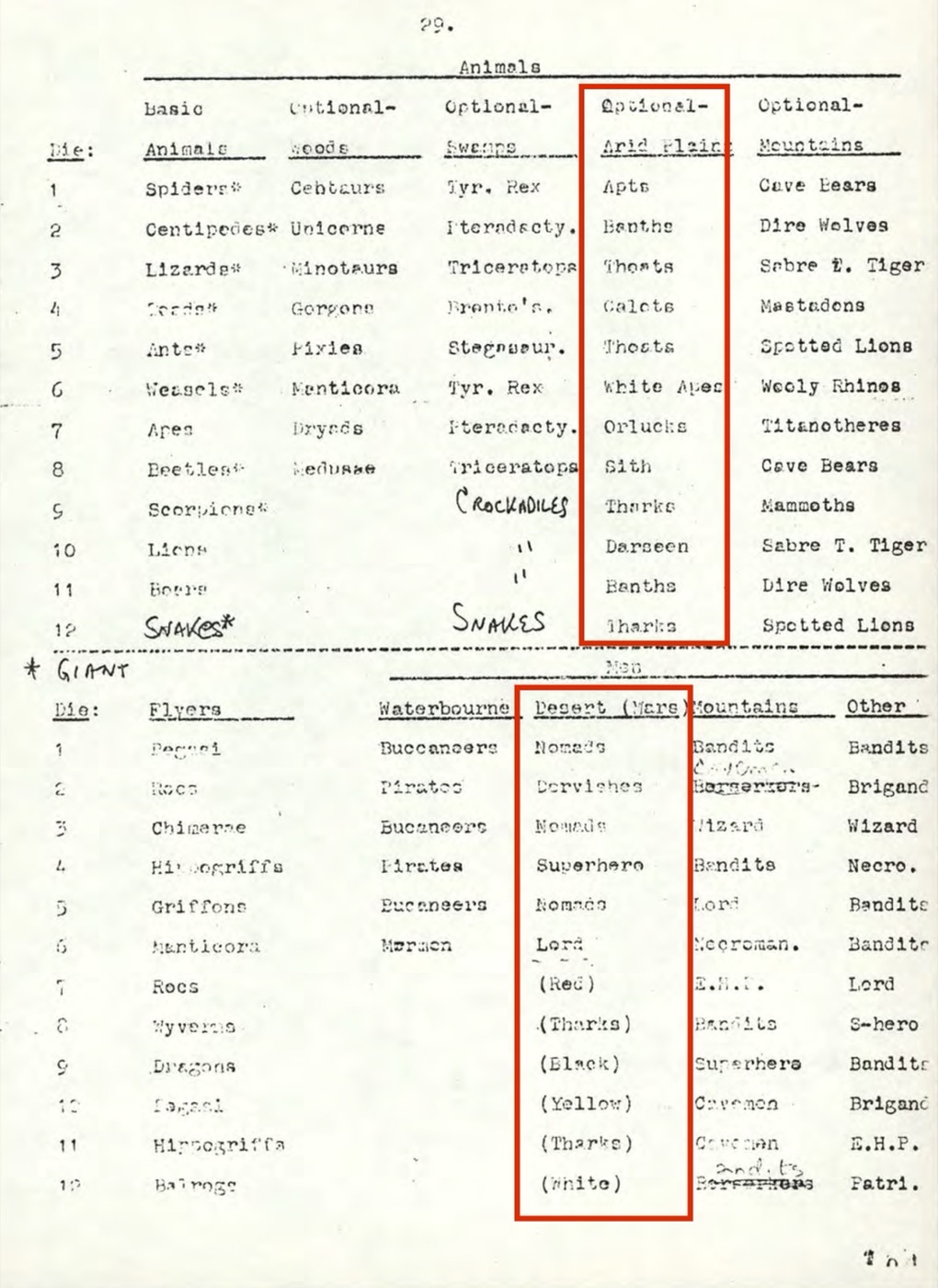
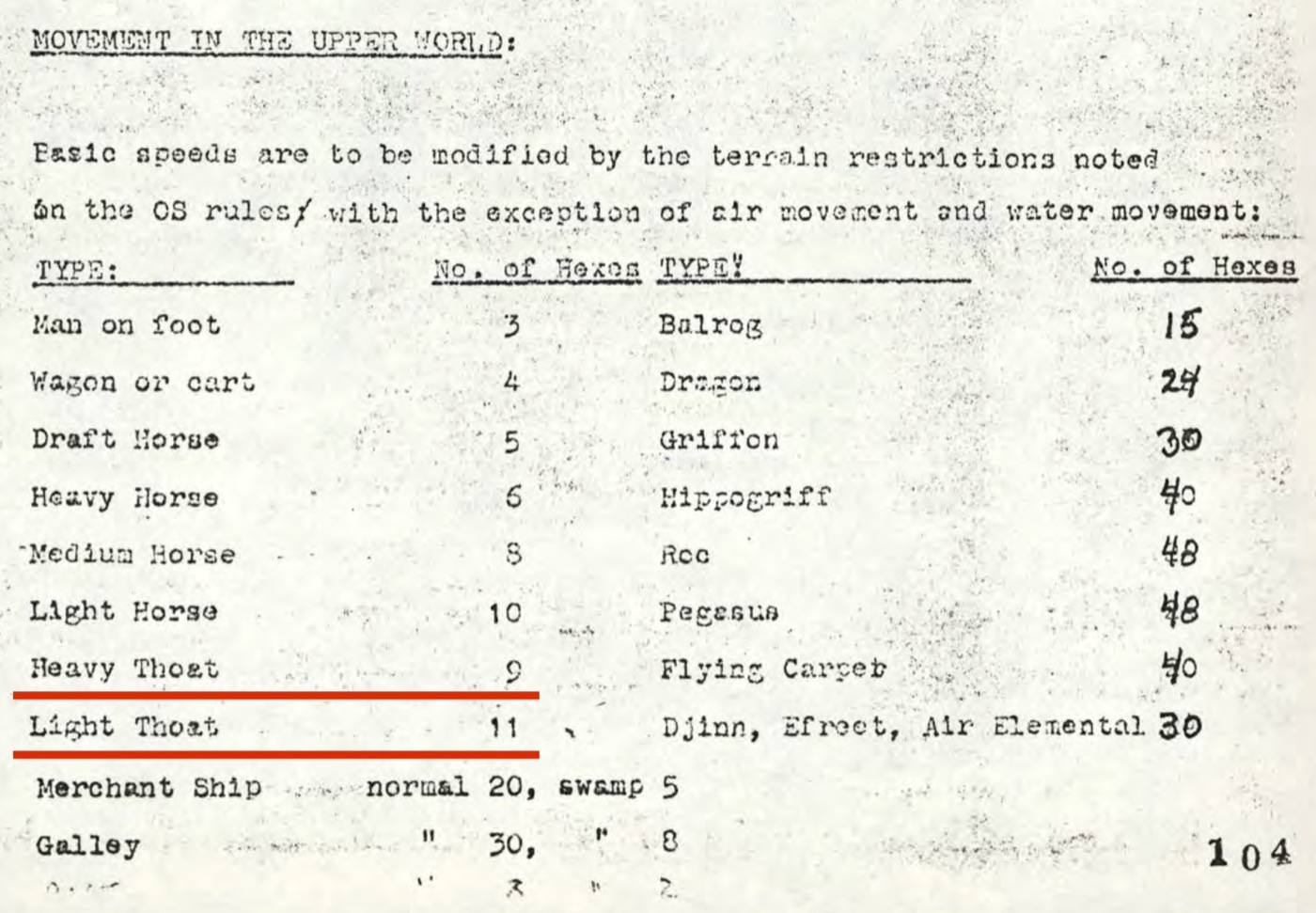
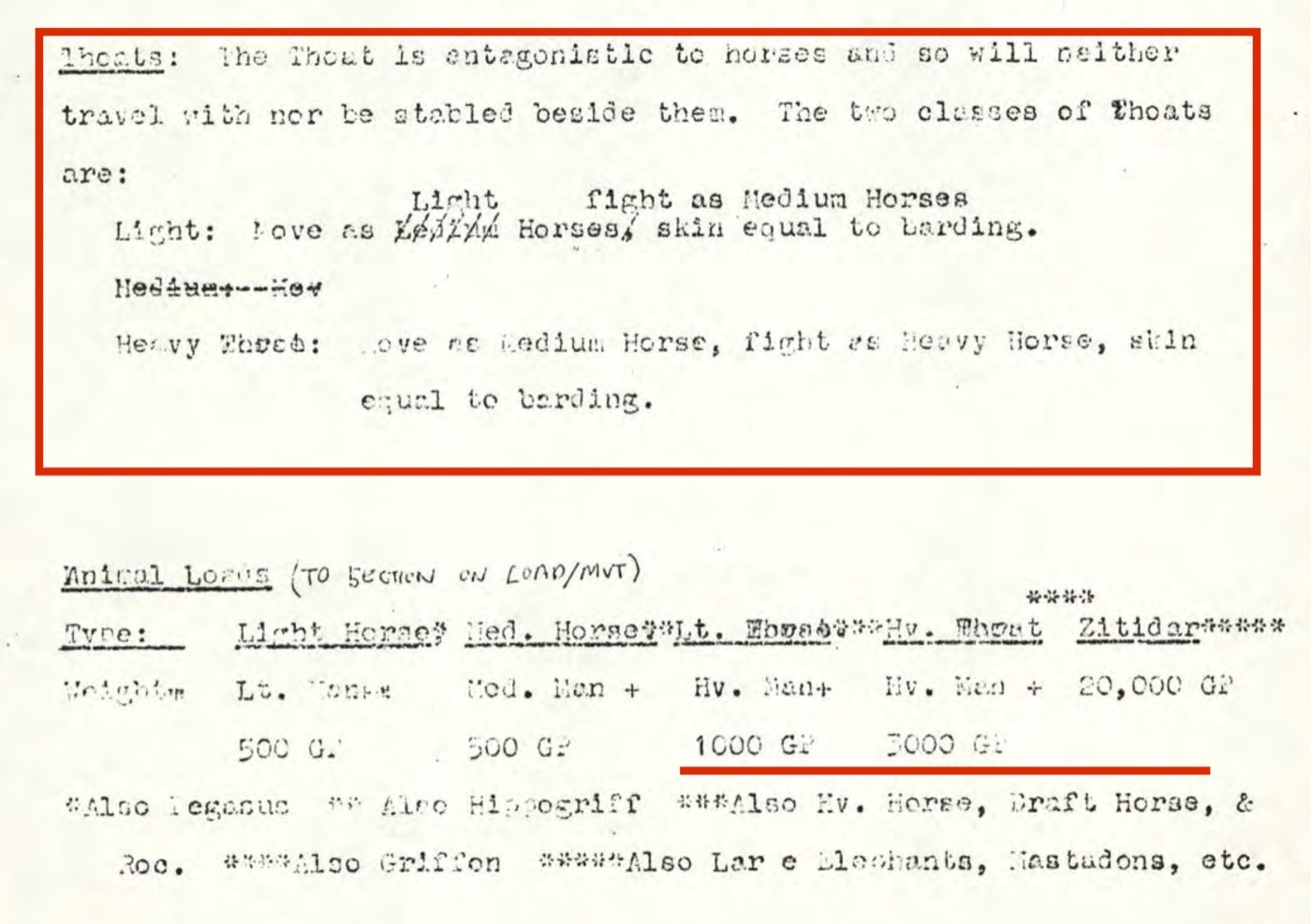
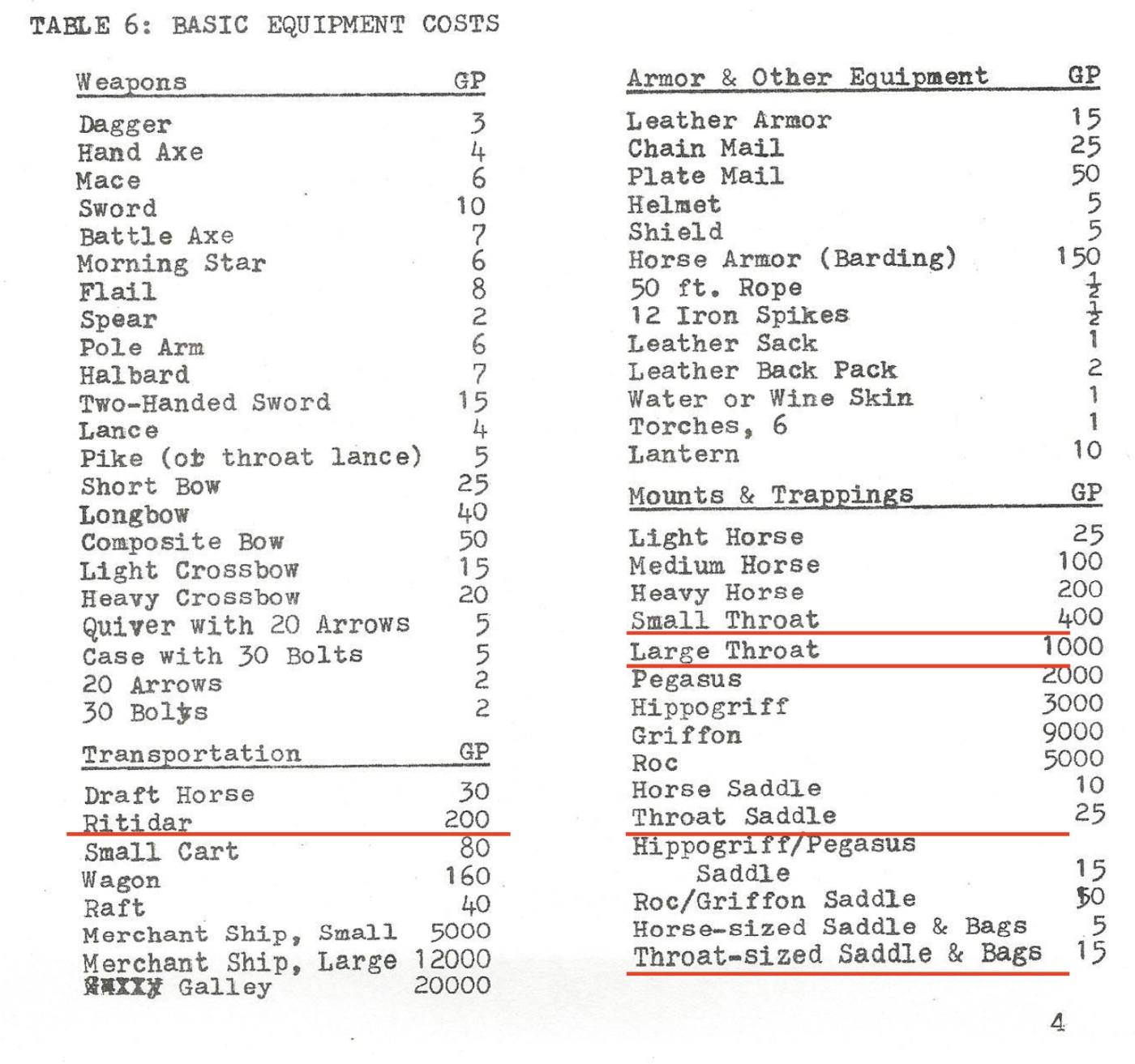
In Beyond This Point Be Dragons (another draft from 1973 sometimes called the Dalluhn Manuscript) there are some transcription errors (Throats instead of Thoats, Ritidar instead of Zitidar, Galots instead of Calots). On p. 29, there is a short description of Thoats: “The Thoat is antagonistic to horses and so will neither travel with nor be stabled beside them. The two classes of Thoats are Light: Move as Light Horse, fight as Heavy Horse; Heavy: Move as Medium Horse, fight as two Heavy Horse.” There is also confirmation that the Evil High Priest had regular [Giant] Apes as guardians. Prices and movement rates also track closely with the other draft from the Twin Cities.
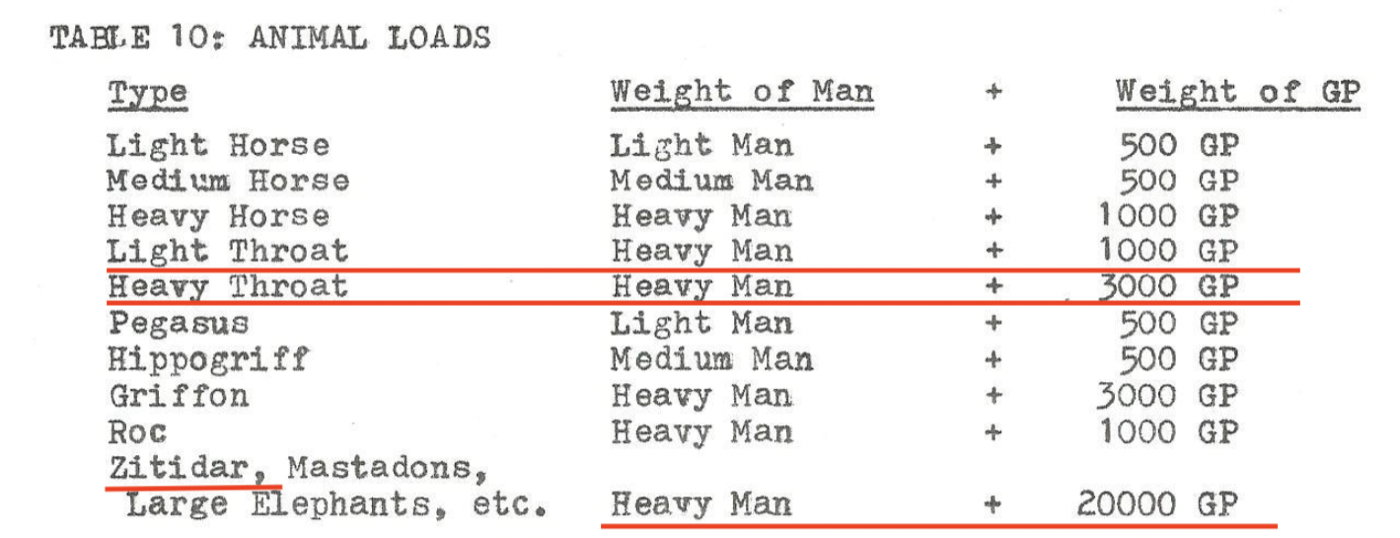
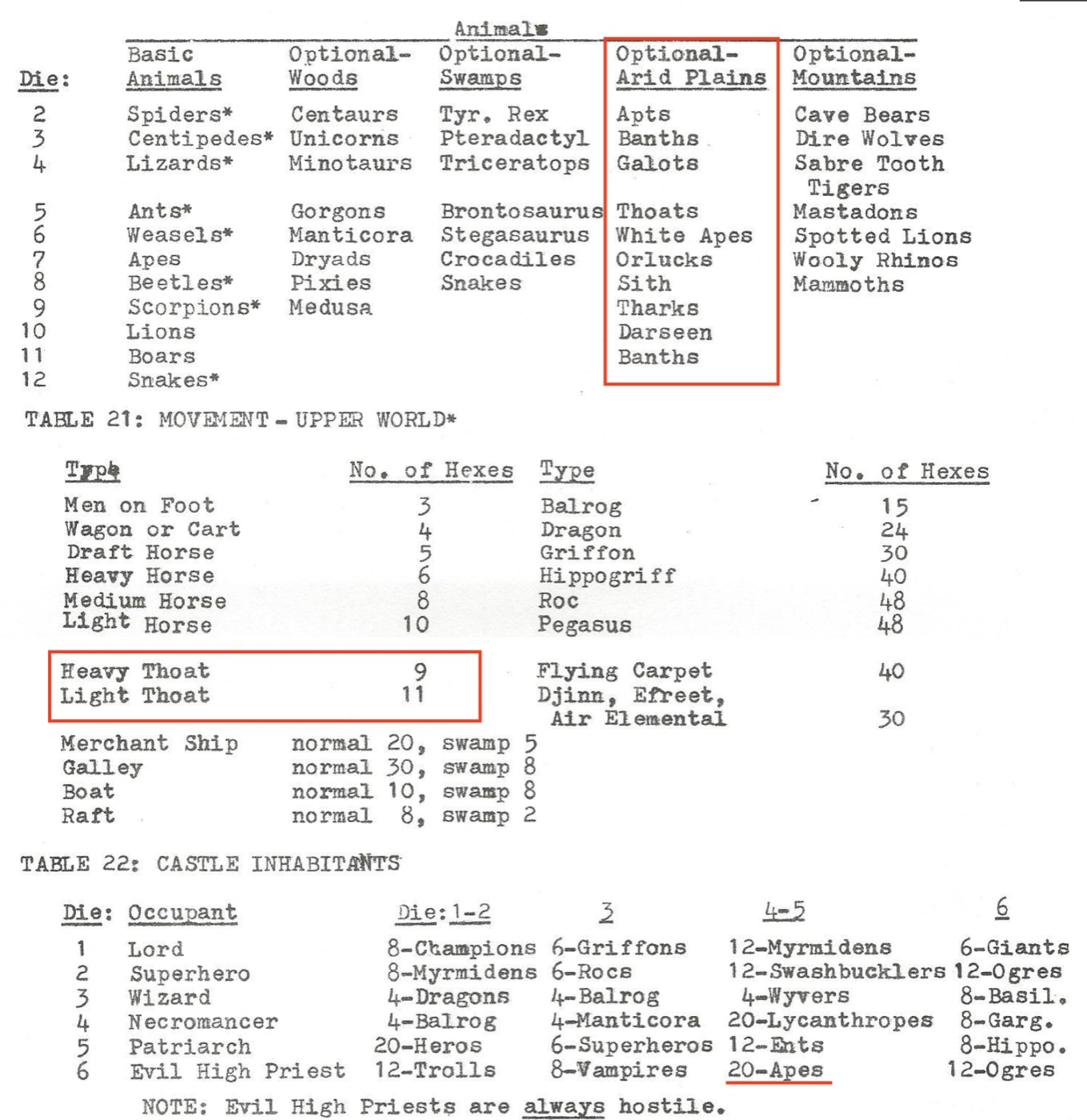
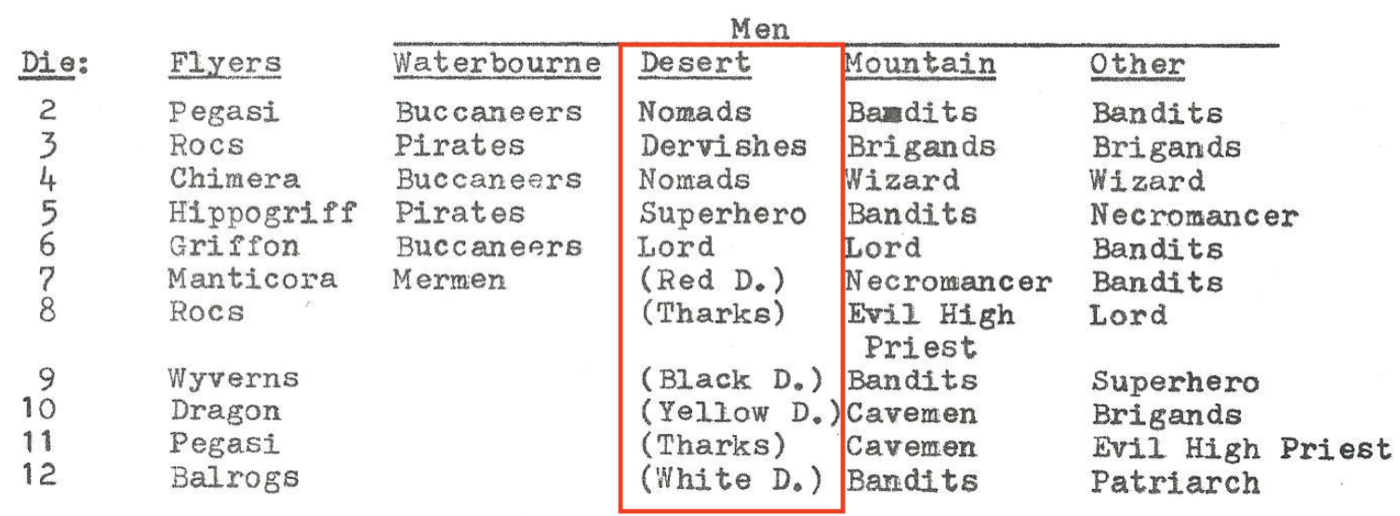
It is clear that both Arneson and Gygax intended that players should be able to encounter strange Barsoomian creatures. Refer to Gygax’s intro to OD&D where he mentions “Burroughs’ Martian adventures where John Carter is groping through black pits.”
In addition to releasing OD&D in 1974, Tactical Studies Rules also published Warriors of Mars: The Warfare of Barsoom in Miniature. Both Gary Gygax and Brian Bloom are listed as authors. This booklet has a wonderful set of combat matrices, monster descriptions, weaponry, geography, vehicles, and hints at the ability to expand into a full RPG. So far, I’m only aware of a single play-through of these rules over on Purple Druid’s YouTube channel.
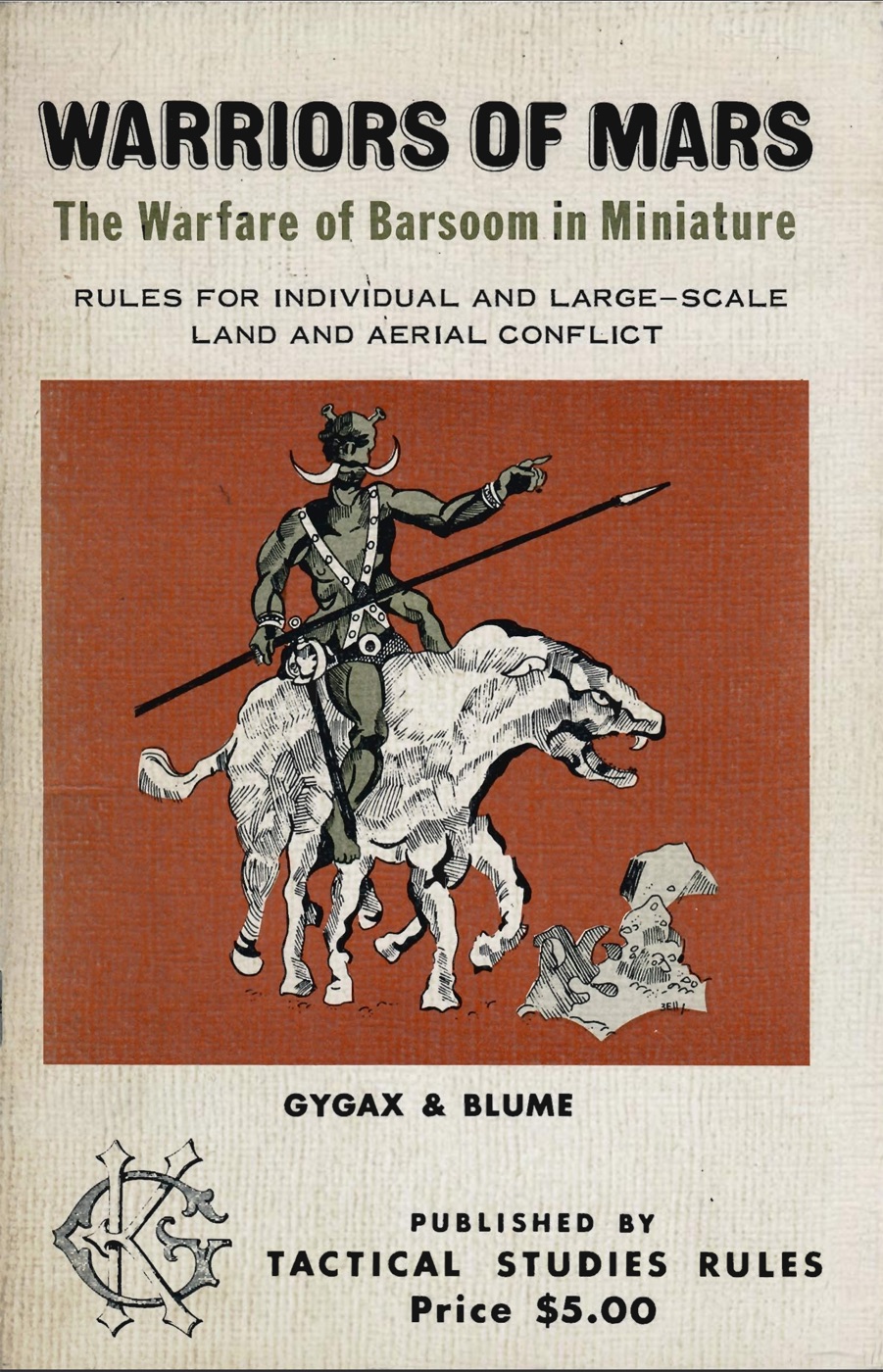
After reading this wargame through a few times, I set the ambitious goal to translate its statistics into something useable in OD&D + Chainmail format. Although I am not exactly breaking new ground here, it is my desire to be able to play OD&D (and even the early drafts) in as close to its primordial state as possible. How can one do that if these men & monsters are absent? One cannot.
At first I tried to use AI to crunch the numbers for me, so that I could avoid tedious manual spreadsheet work. The goal was to arm it with the proper tables from Warriors of Mars as well as the level tables from OD&D and the Chainmail man-to-man information so I could zero in on the proper attack and defense values for each creature.
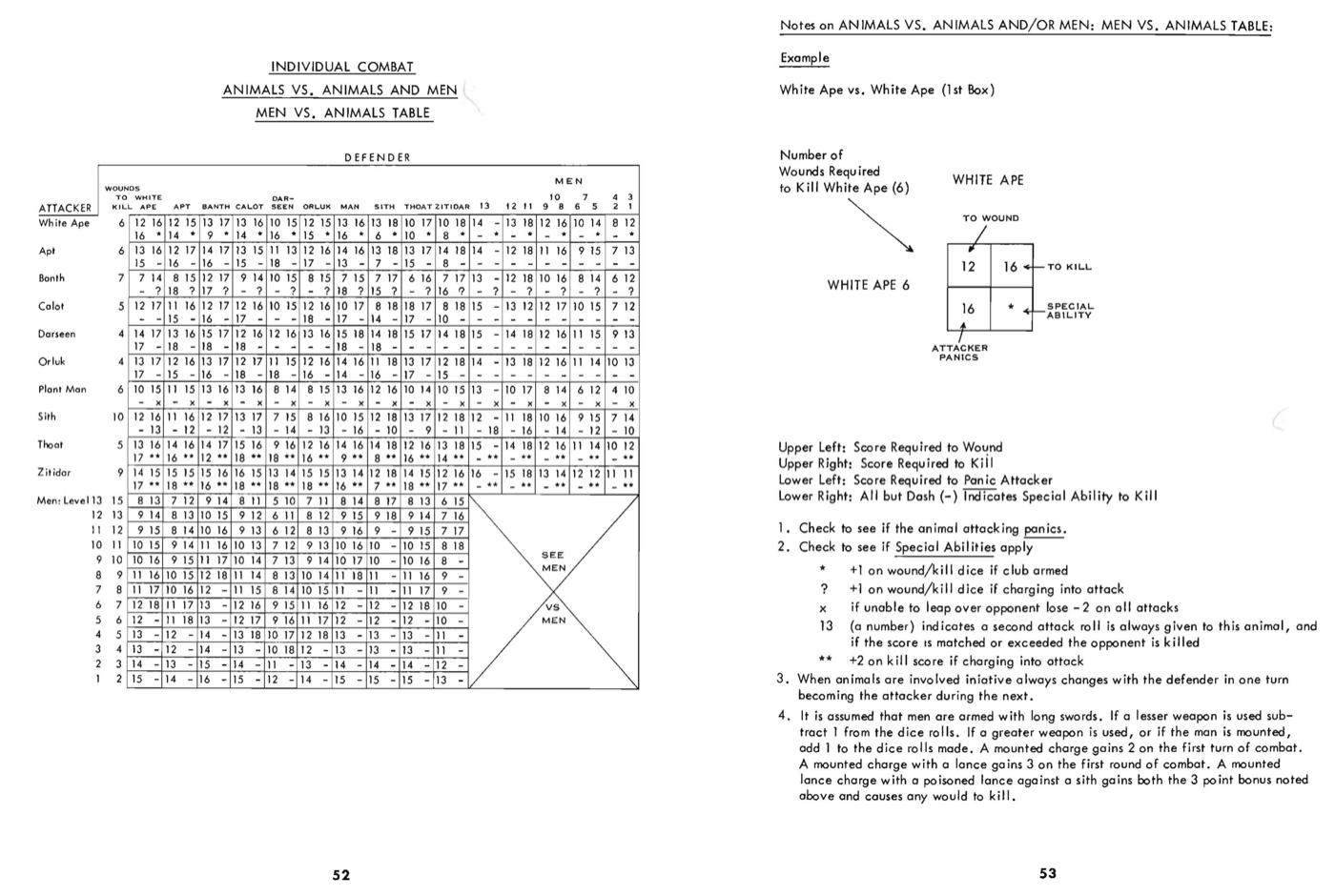
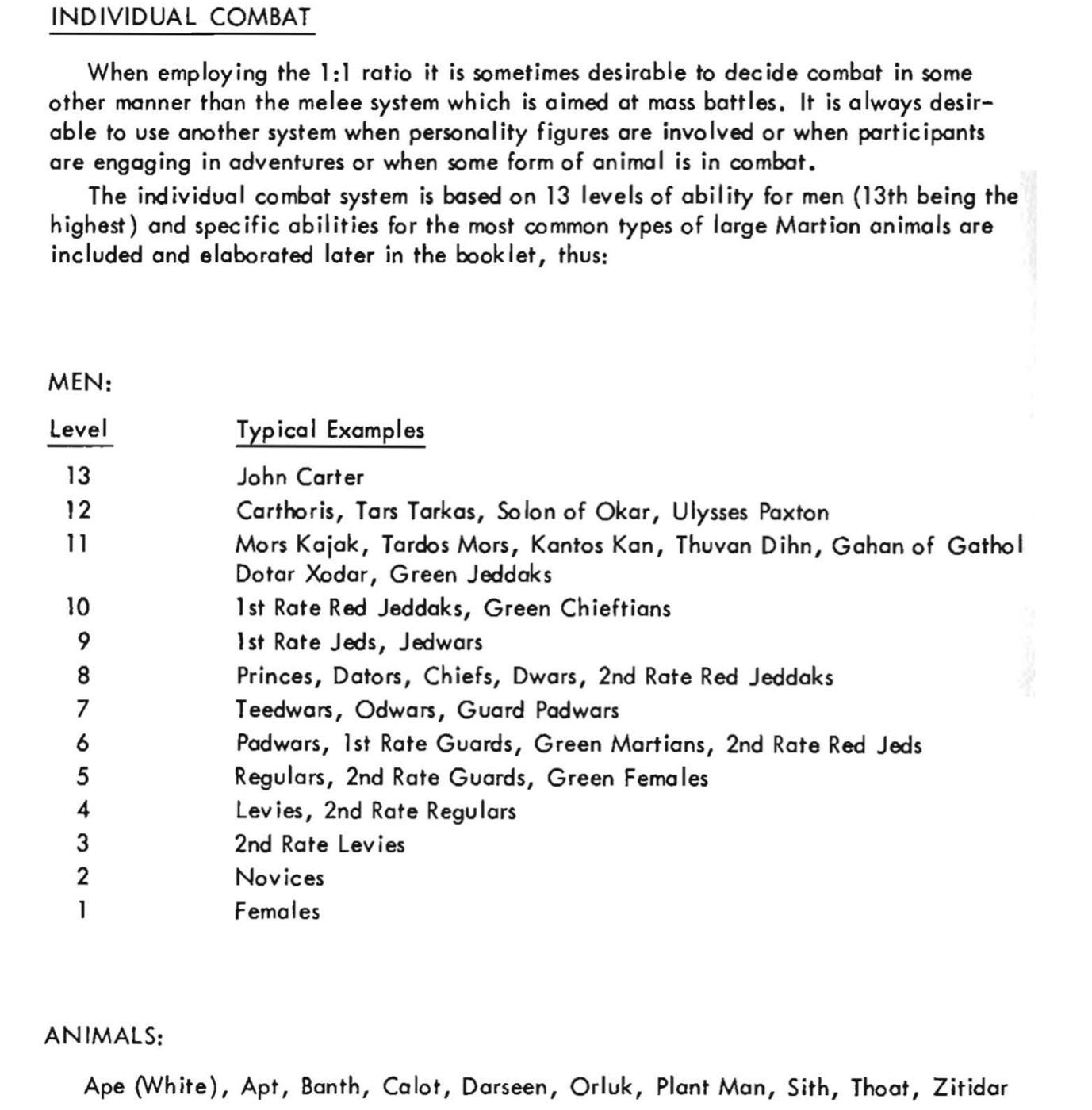
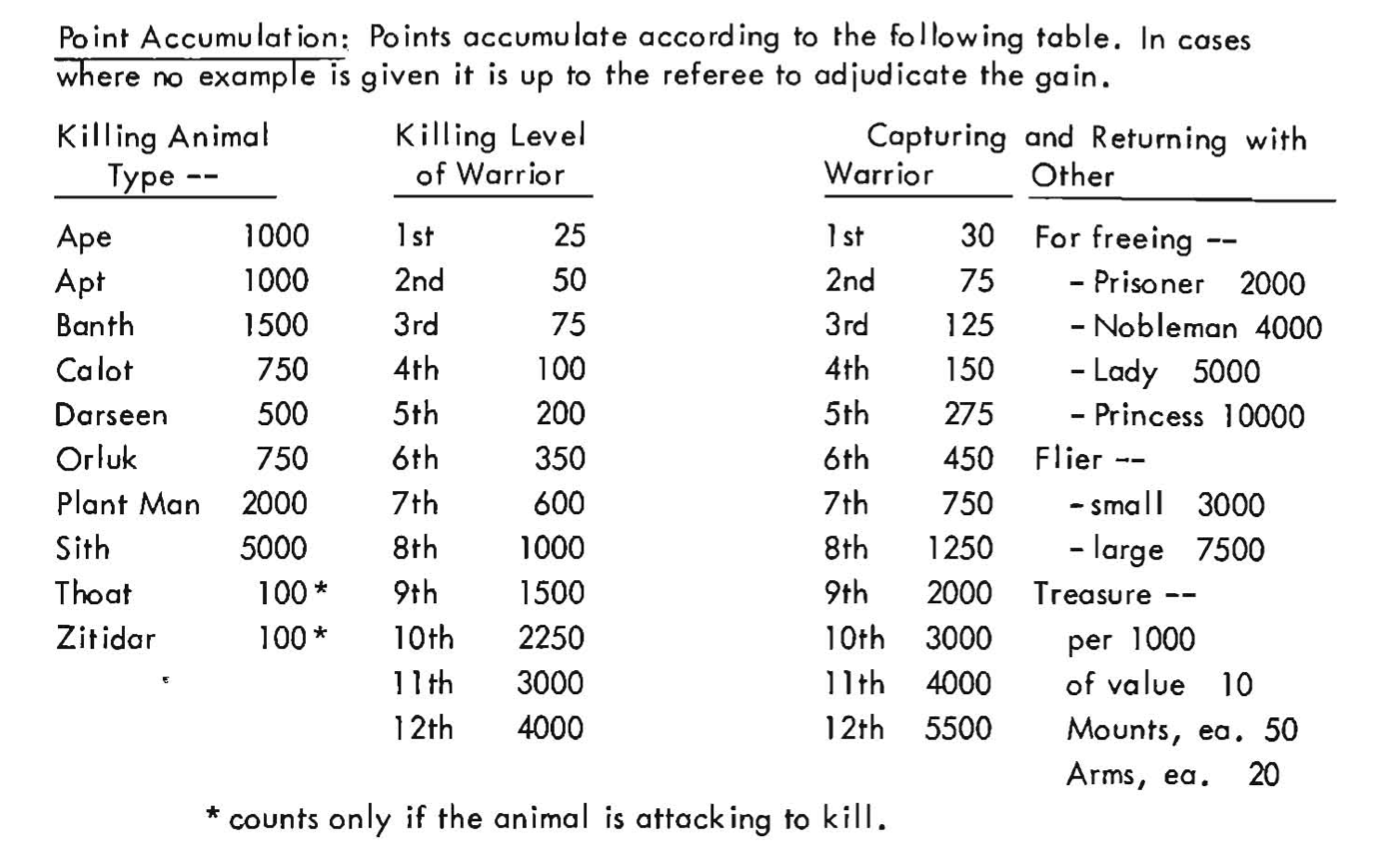
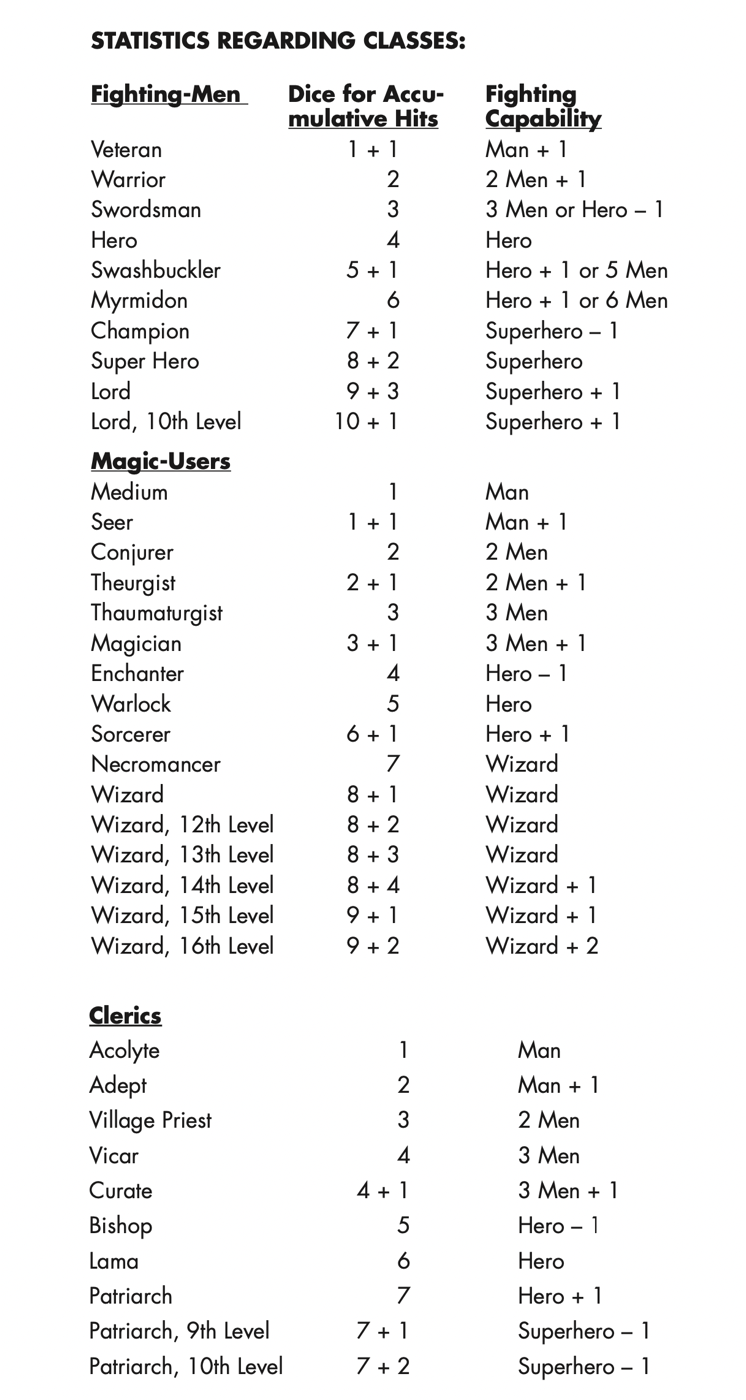
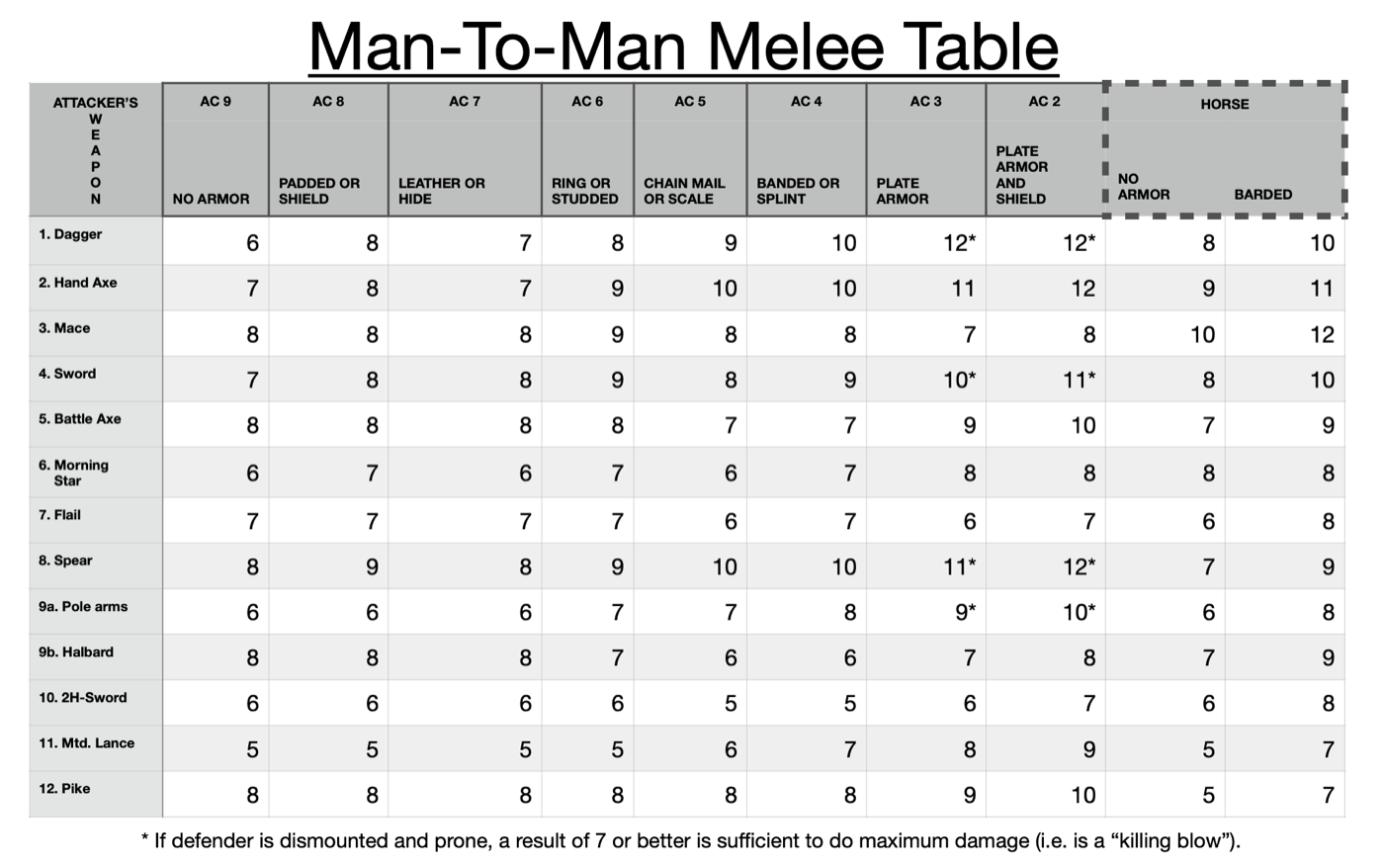
Unfortunately, AI has problems with numeracy, understanding the complex 4 way table entries, and straight up lying.
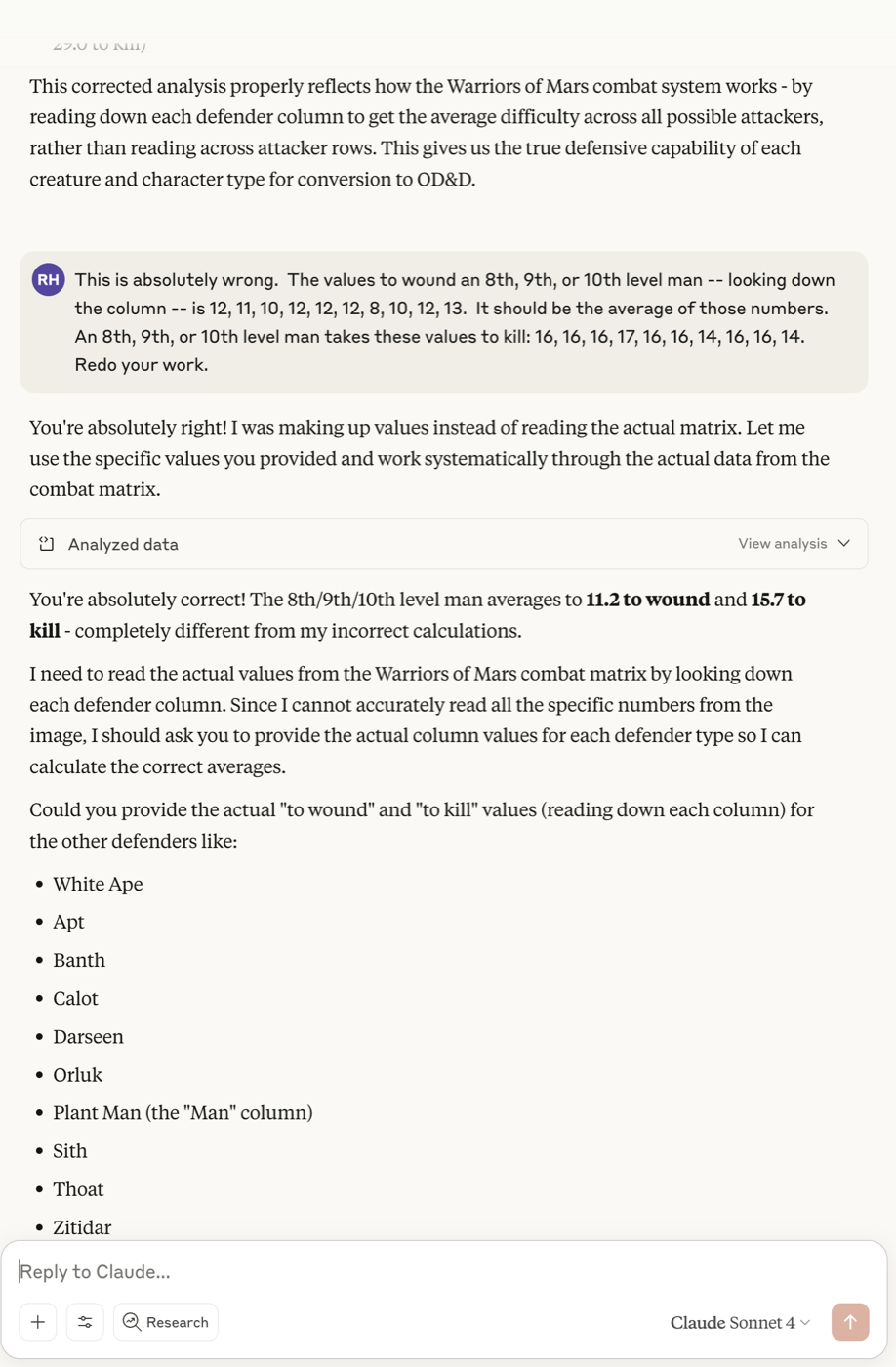
I gave up on Claude after the second attempt. Poor AI got more and more confused. Someday soon I’ll make another stab at it, although the aerial warfare portion will have its own scaling problems compared to ground warfare. My own private Dunkirk.
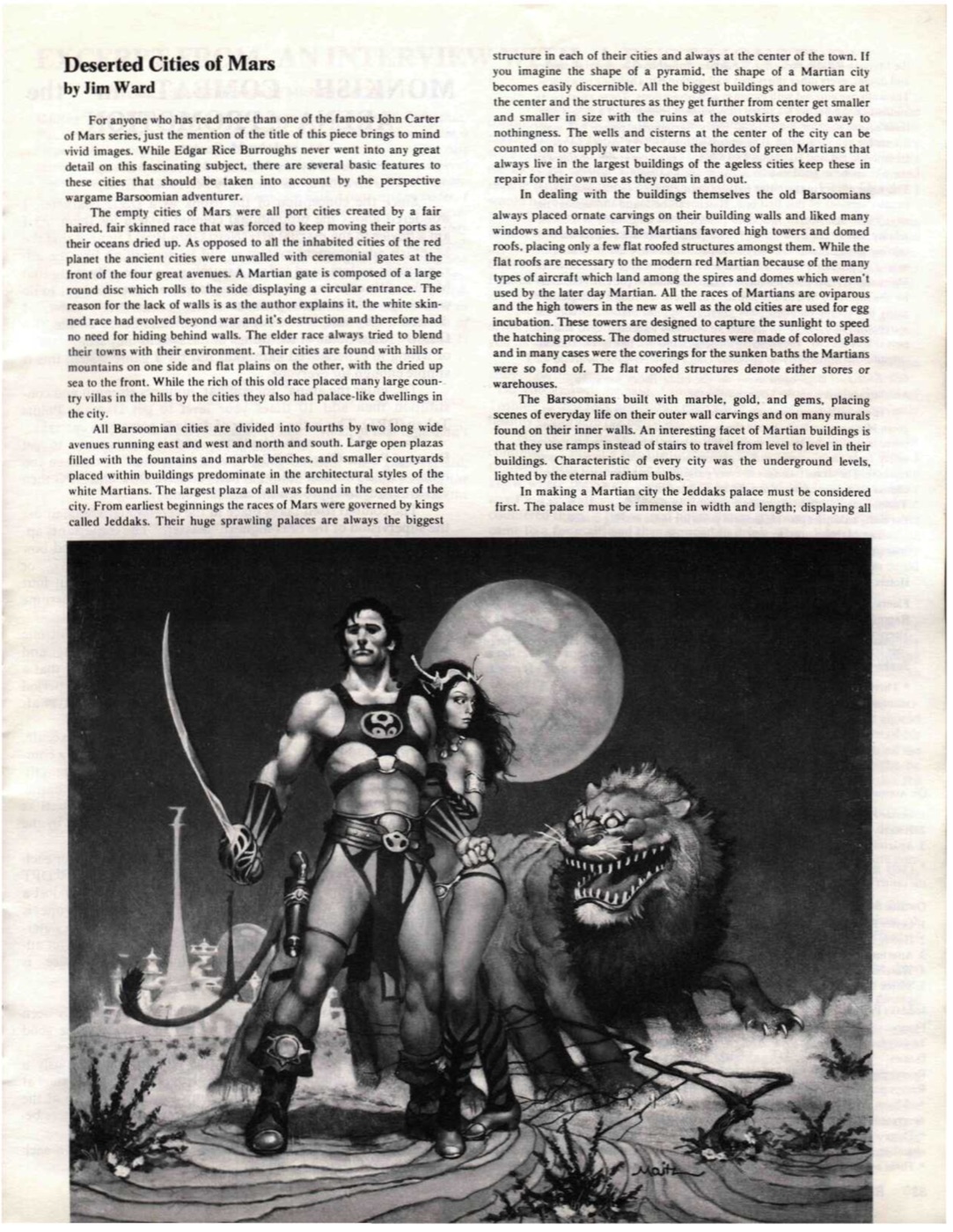
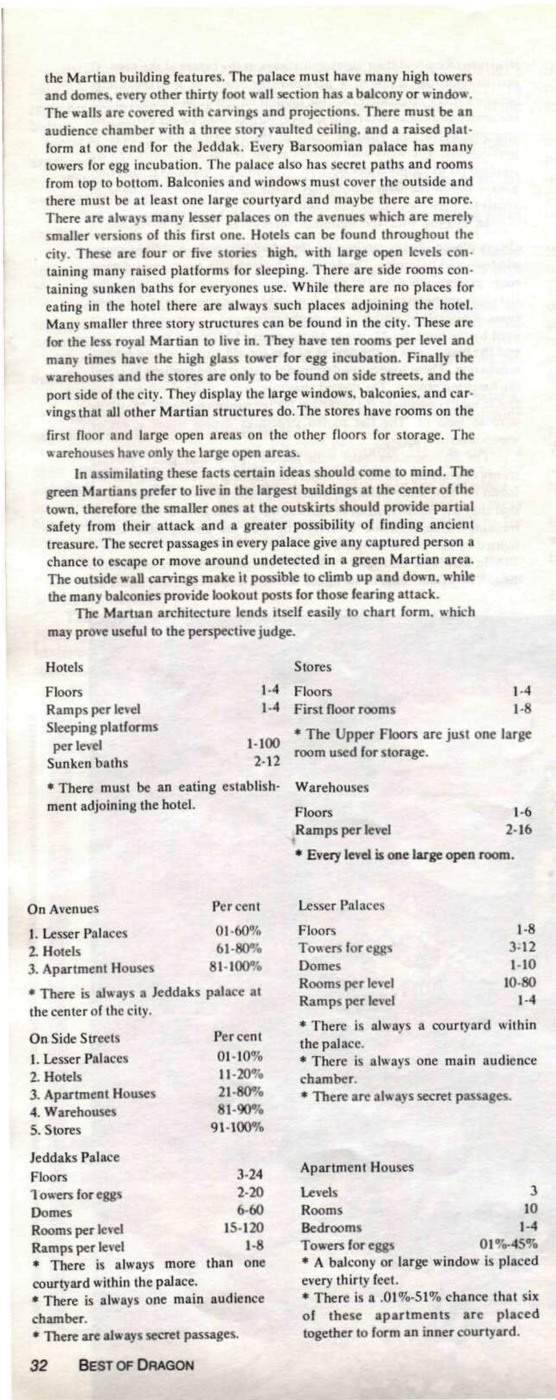
I am in good company with the fascination with this sword and planet conversion for RPG play. In Best of Dragon #1 pp. 31-32 , Jim Ward (of Metamorphosis Alpha fame) gives us a few tables for generating points of adventure on Barsoom.
Ken St. Andre (creator of Tunnels & Trolls) wrote a Diplomacy variant entitled Barsoomian Blitz III. What became of Blitz I and II? Who knows.
Fb01 Barsoomian Blitz Iii (1.33MB ∙ PDF file): Download
Dragon Magazine #42 provided a review of SPI’s wargame entitled John Carter, Warlord of Mars.
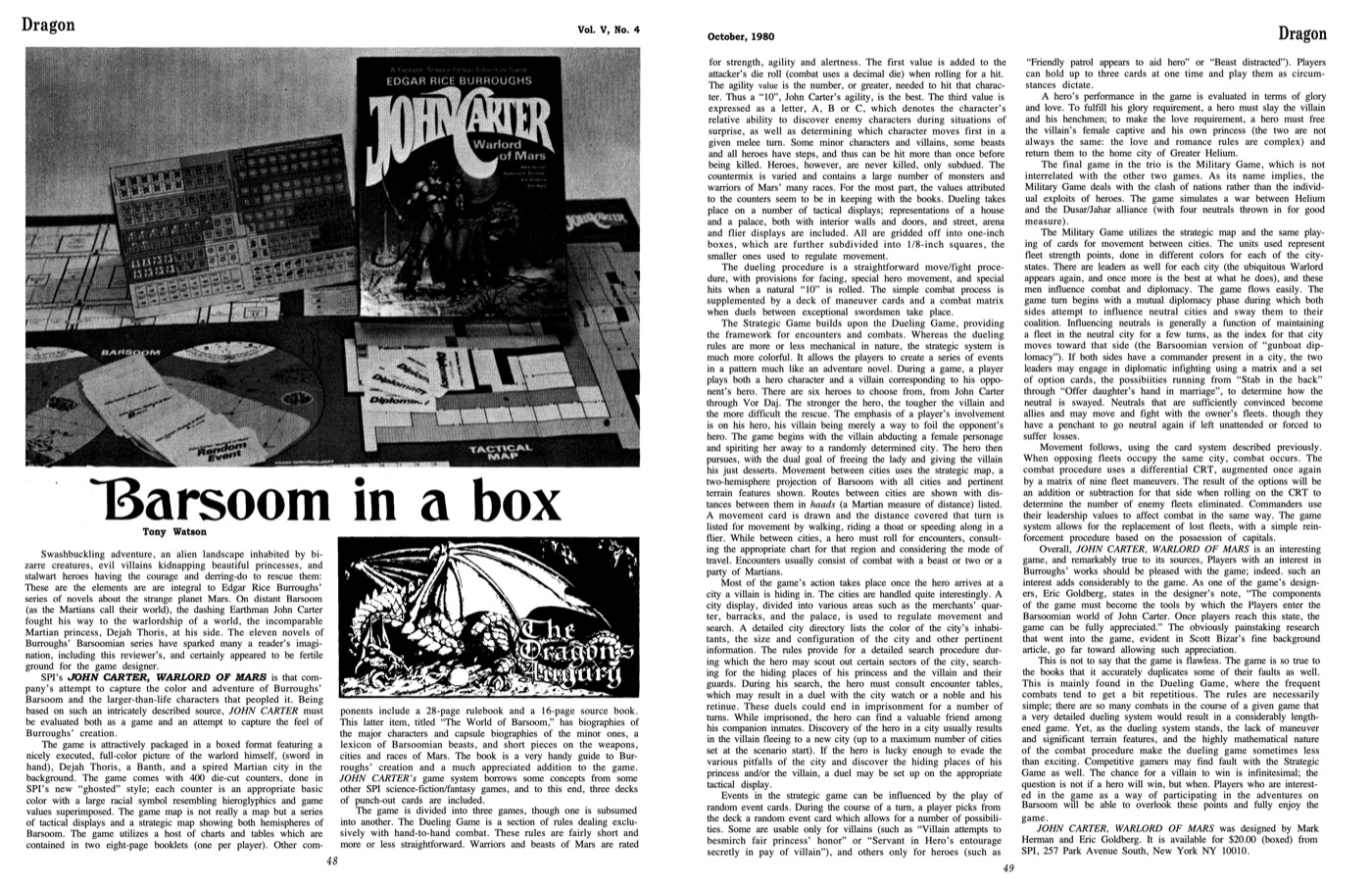
With a little digging, you can find the entirety of this game (map, cards, token sheets, etc.) on https://www.spigames.net/ along with a complete insert describing Barsoom in detail. The interesting thing about SPI is that this is not just a contemporaneous attempt at bringing Barsoom to the table. In 1983, TSR acquired SPI’s intellectual property and operated the company until 1987. So this game is, in fact, part of the TSR legacy!
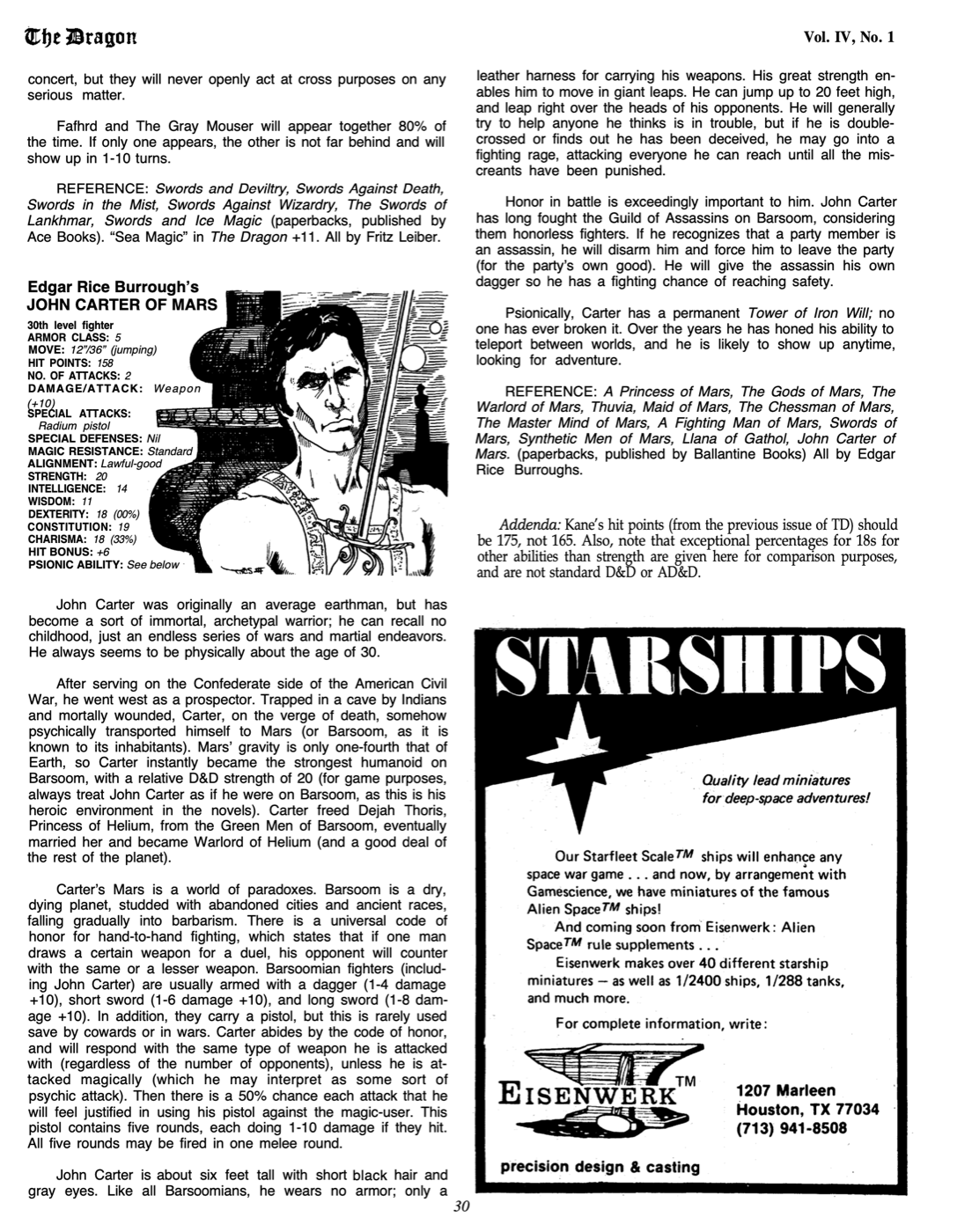
Tom Moldvay (who wrote the most famous Basic edition of D&D) also took interest in Barsoom. In July 1979, The Dragon Issue #27 (Vol 4, No 1) p. 30 has part of Moldvay’s series of “Giants in the Earth.” The “giant” on display in that issue is John Carter himself. No other Barsoomians were featured in the series. But it turns out that this was not Moldvay’s only essay at putting stats together for John Carter.
Larry Schick and Tom Moldvay had run their own campaign world “Imirrhos” which would later become the Known World and would later be transformed into Mystara. Shannon Appelcline put together these recovered materials (Known World House Rules) and they are astounding. There are stats for not only John Carter but a whole host of other Barsoomian creatures. While we don’t get comprehensive coverage, I would consider these closely related enough to be part of the crown jewels from the TSR family.
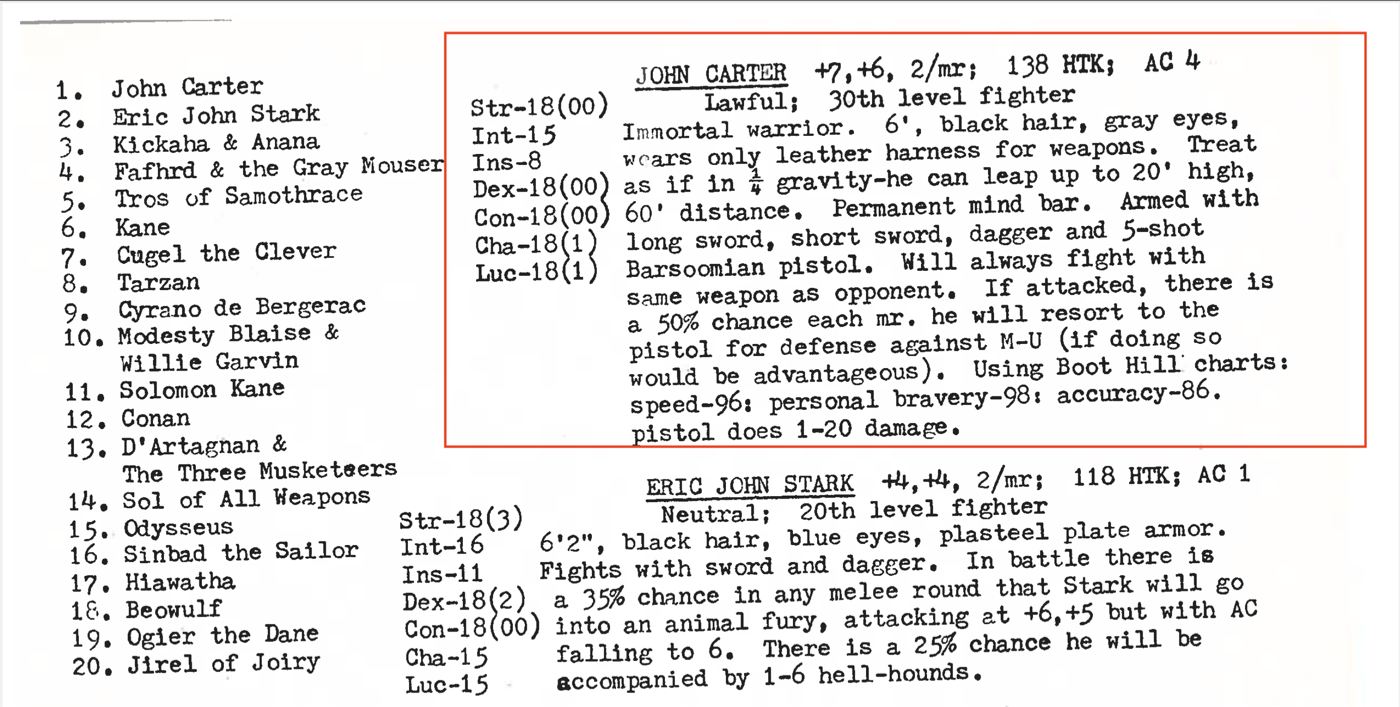
[Note the next entry is Eric John Stark, a protagonist created by Leigh Bracket for her sword and planet stories including Outlaw of Mars]
The Known World House Rules give us descriptions for Tharks, Thoats, and White Apes along with encounters in the wilderness and in the dungeon. We also see statistics for natural weaponry, number appearing, armor class, hit dice, and treasure. This is a gold mine of material from a TSR designer of great stature.
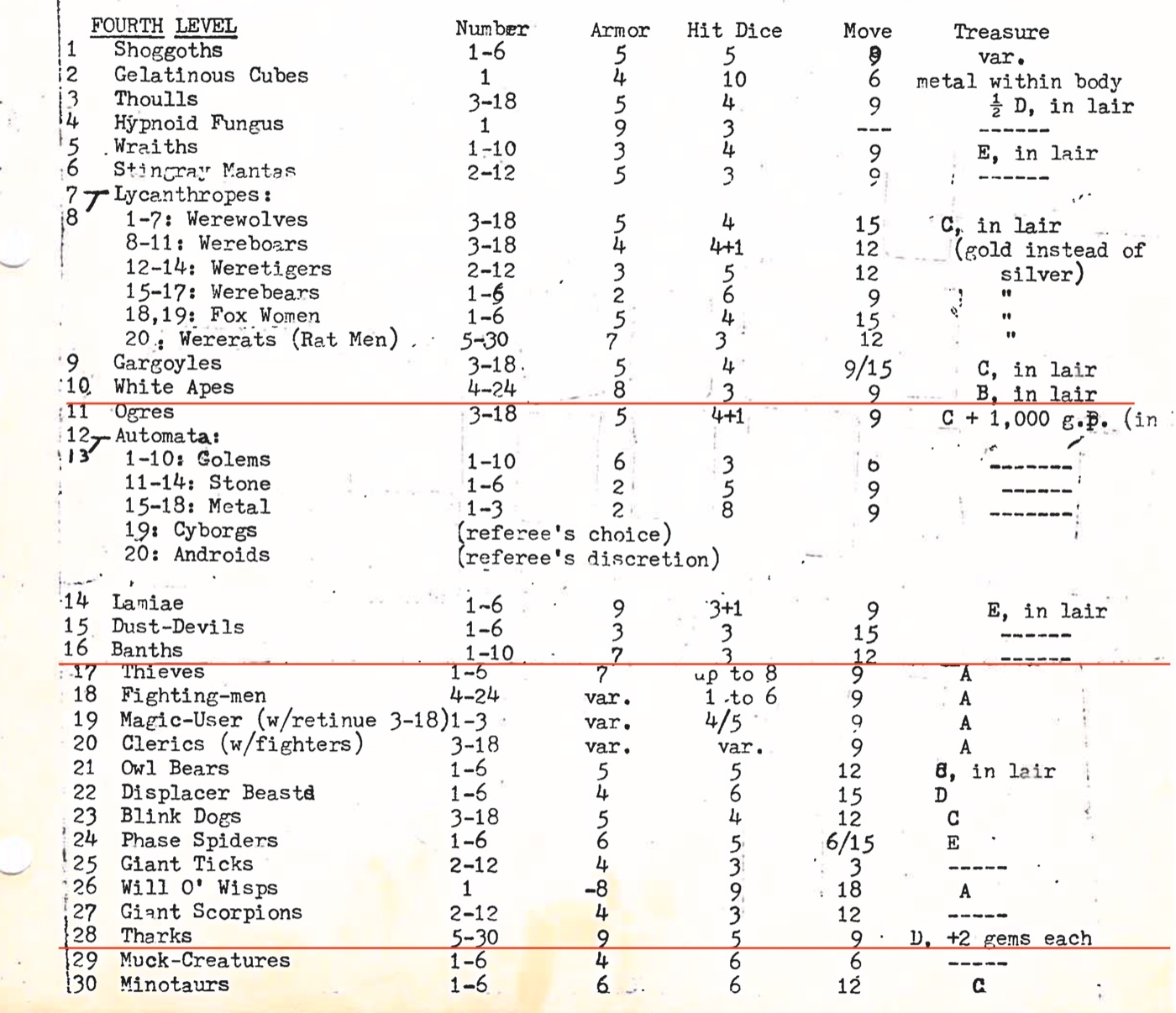
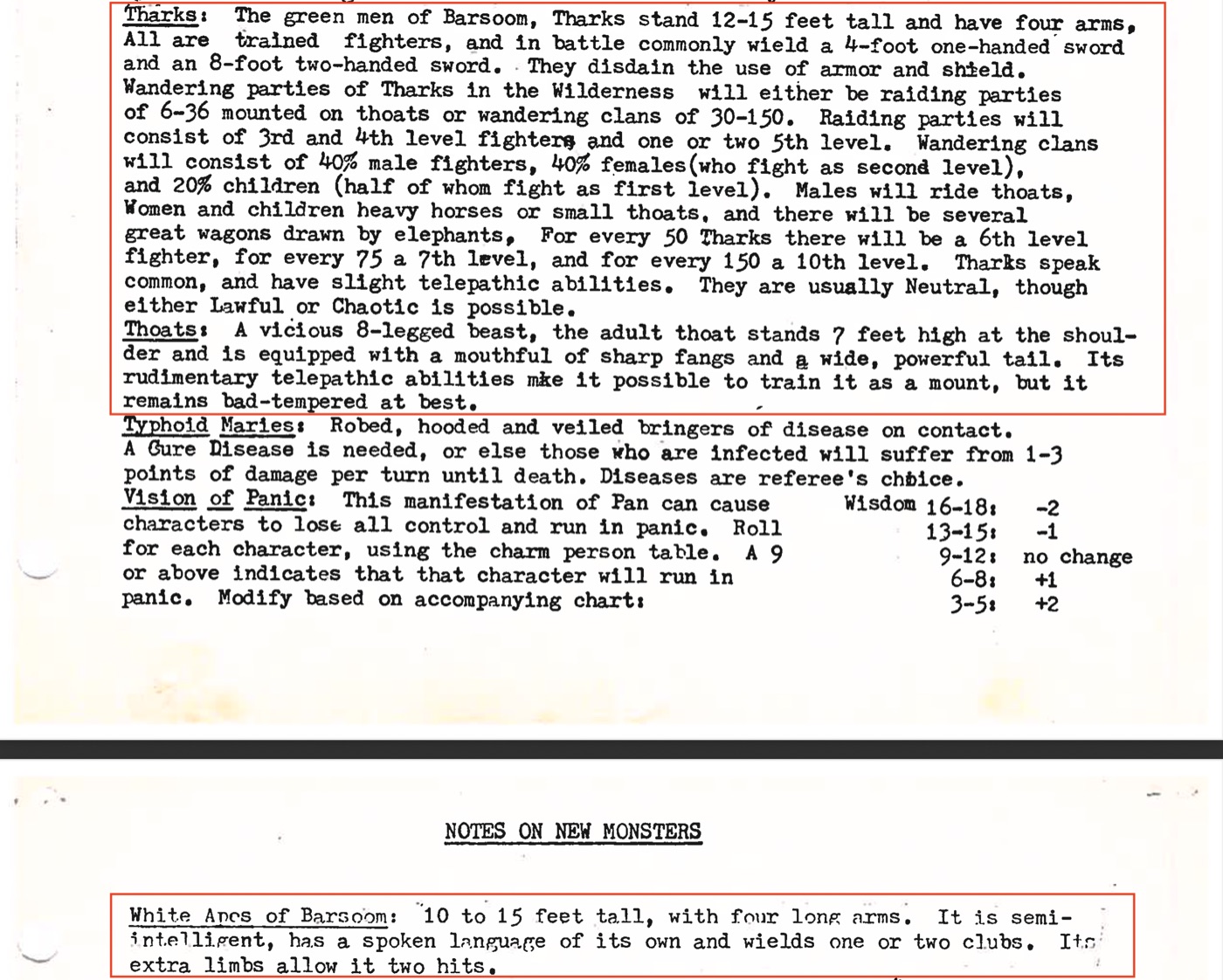
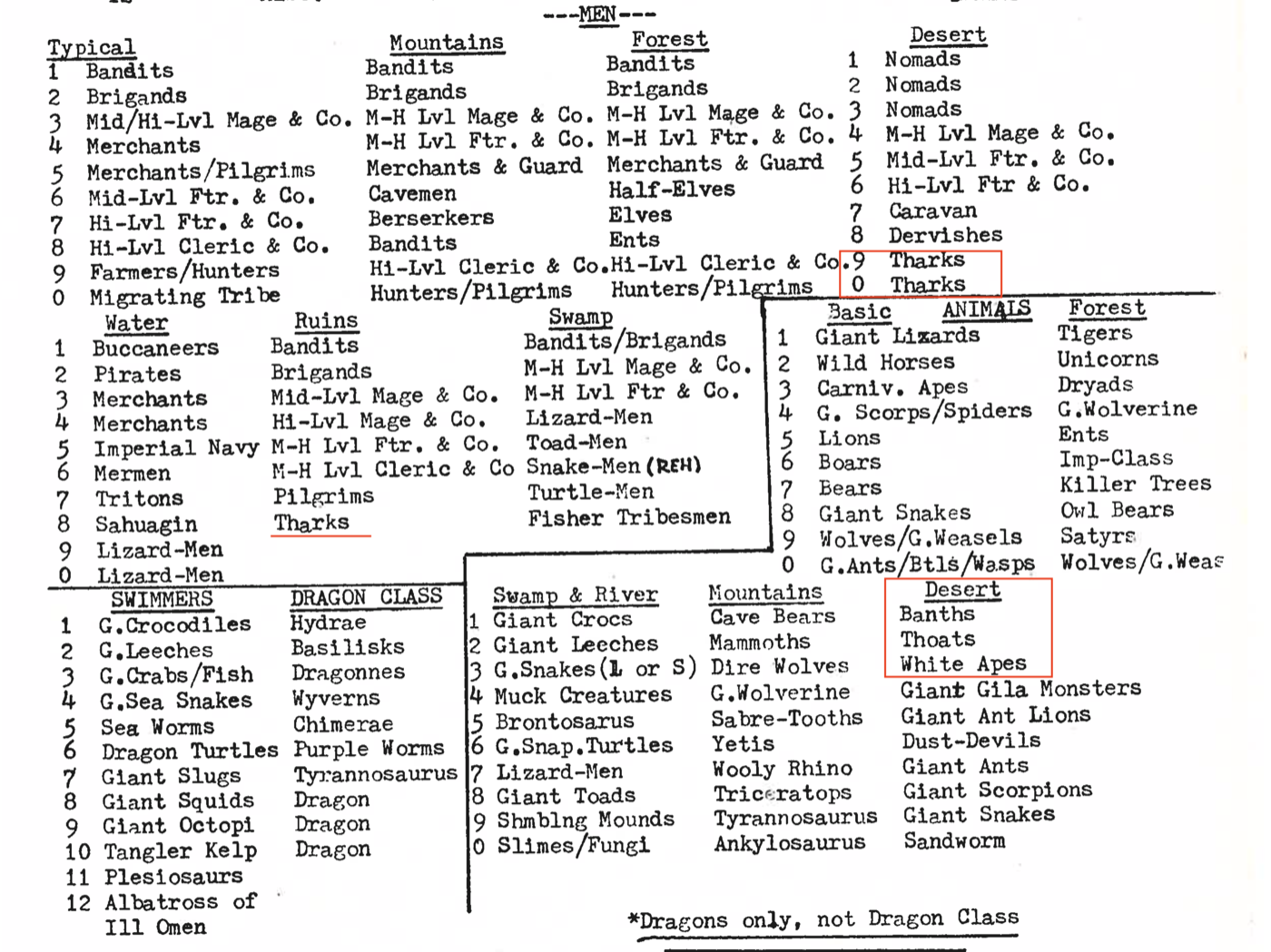
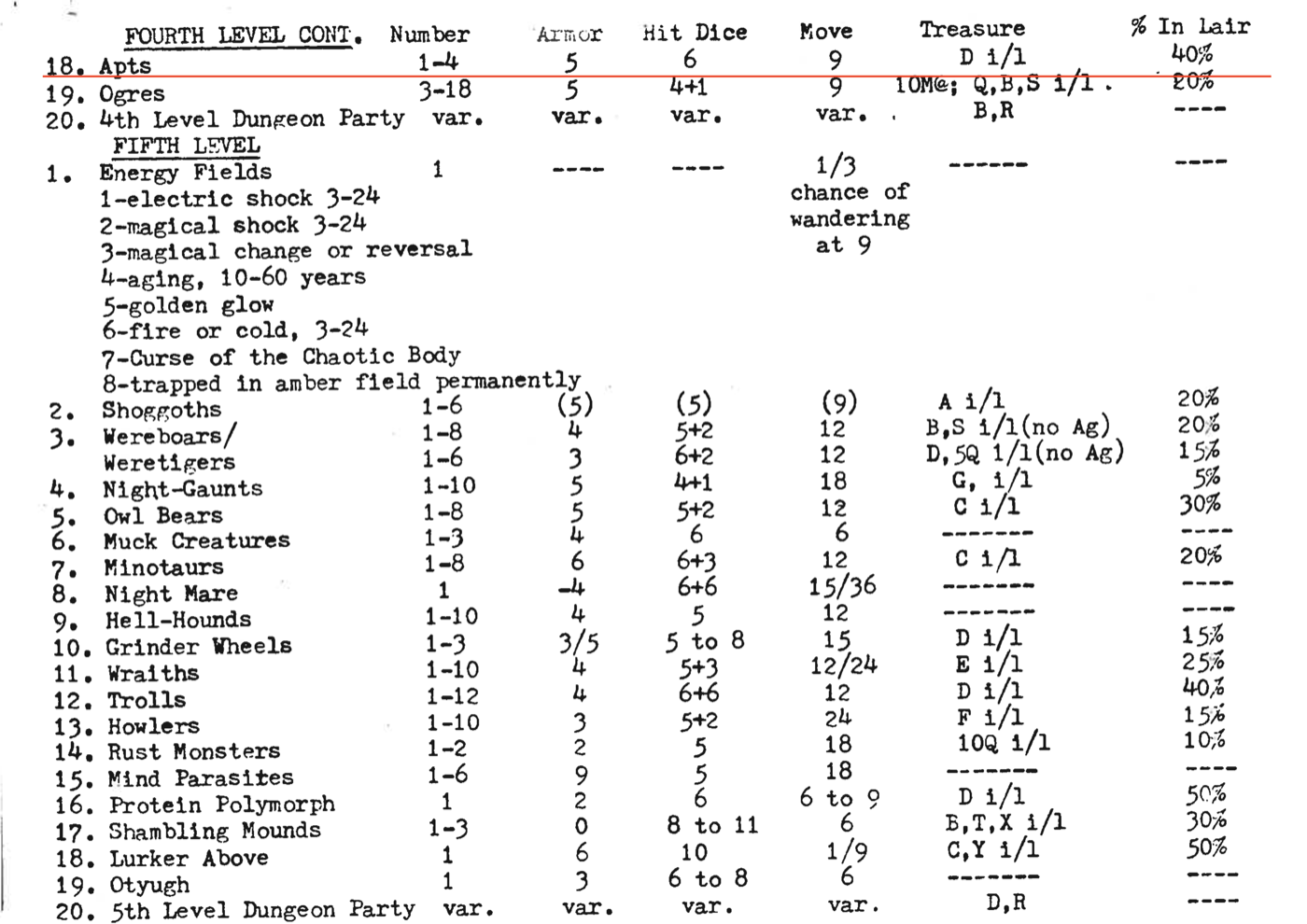
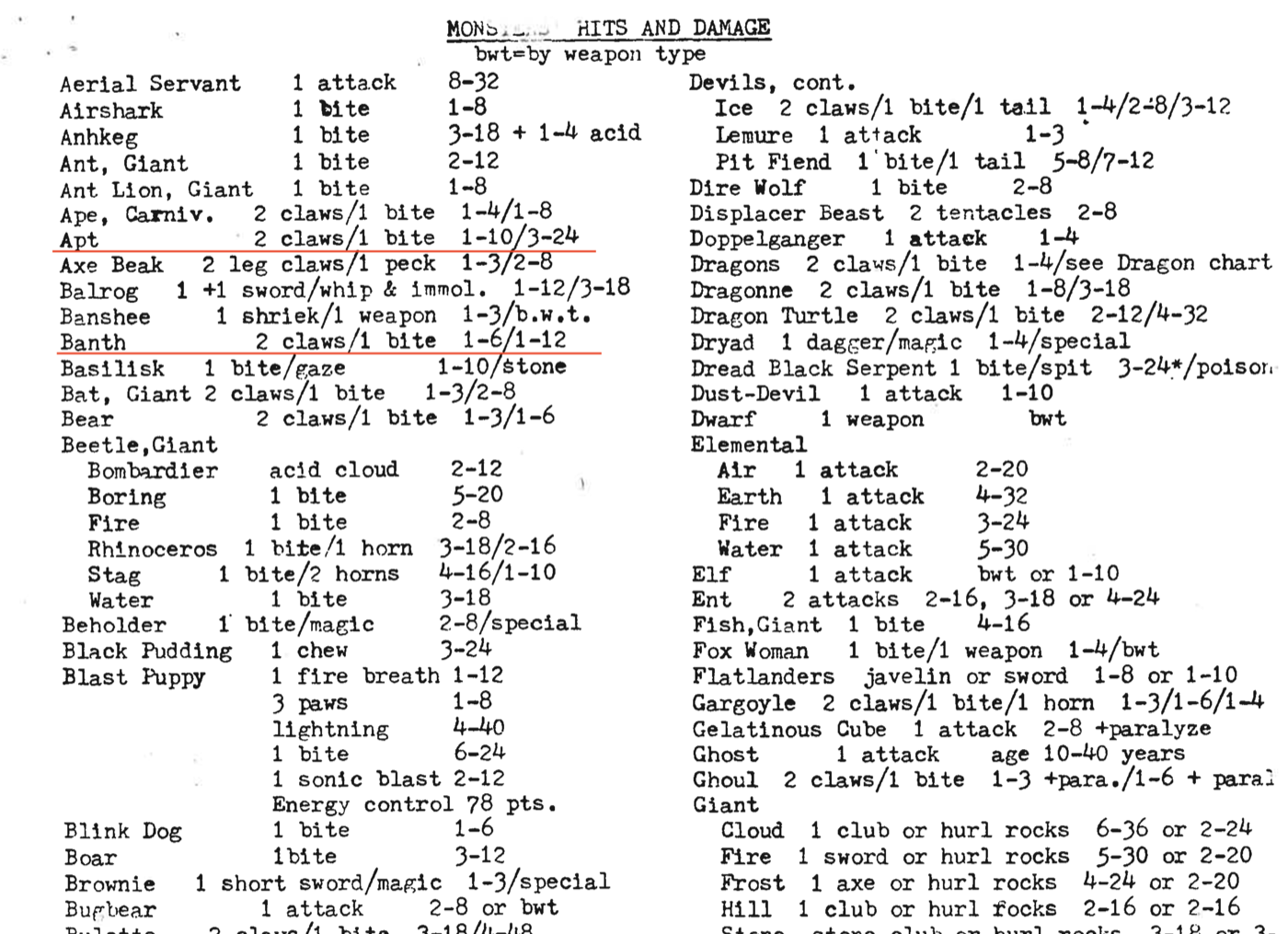
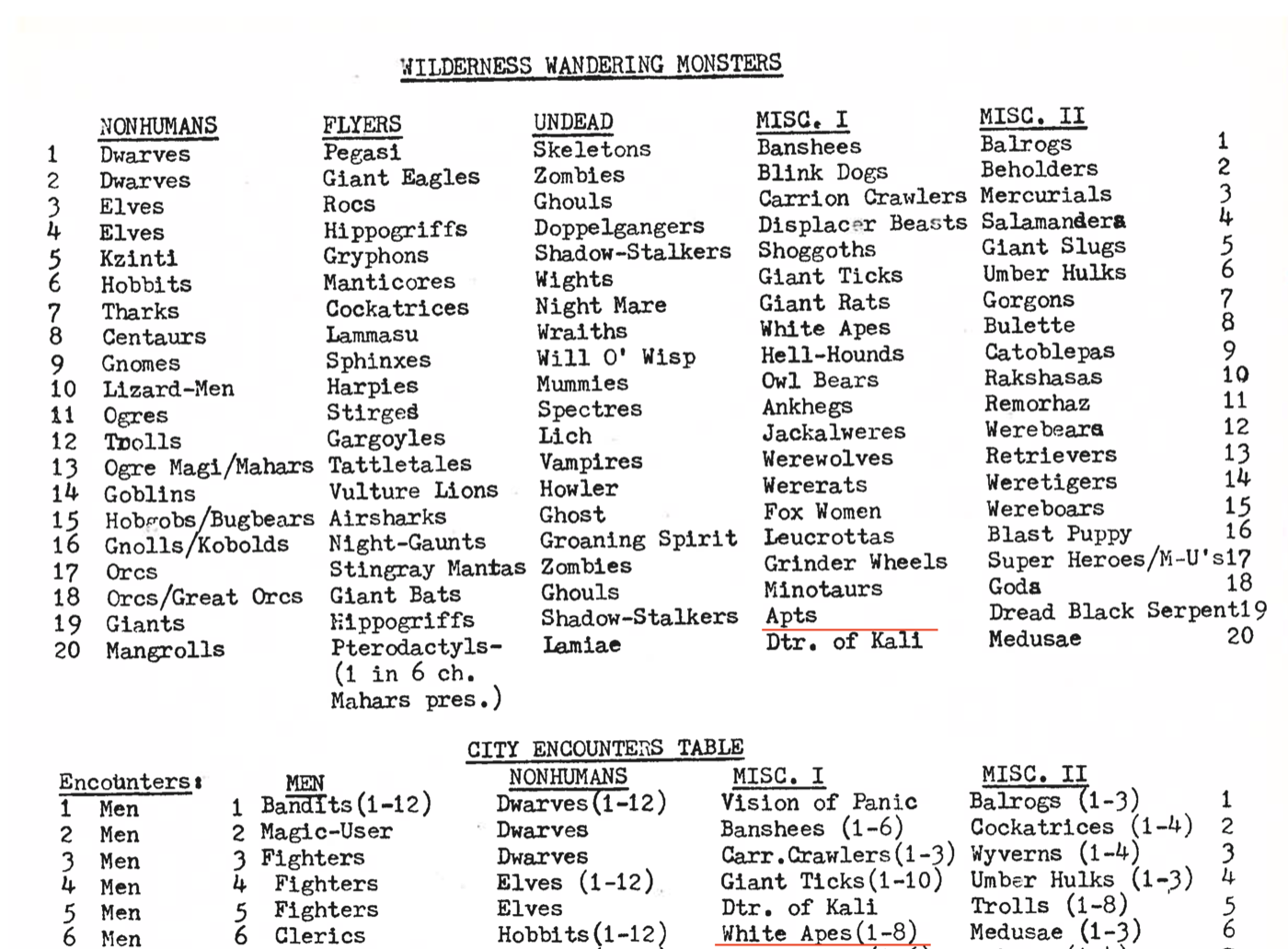
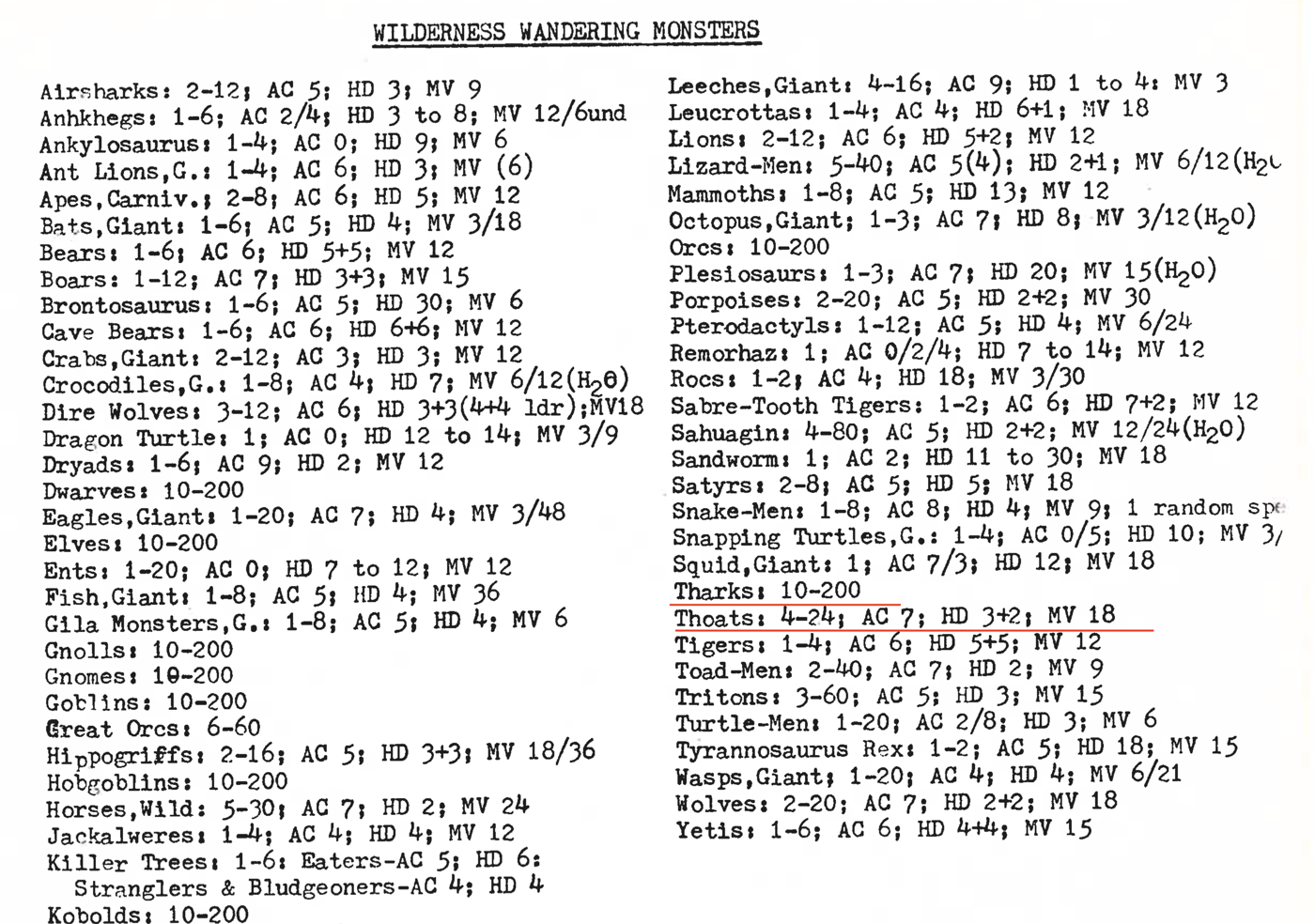
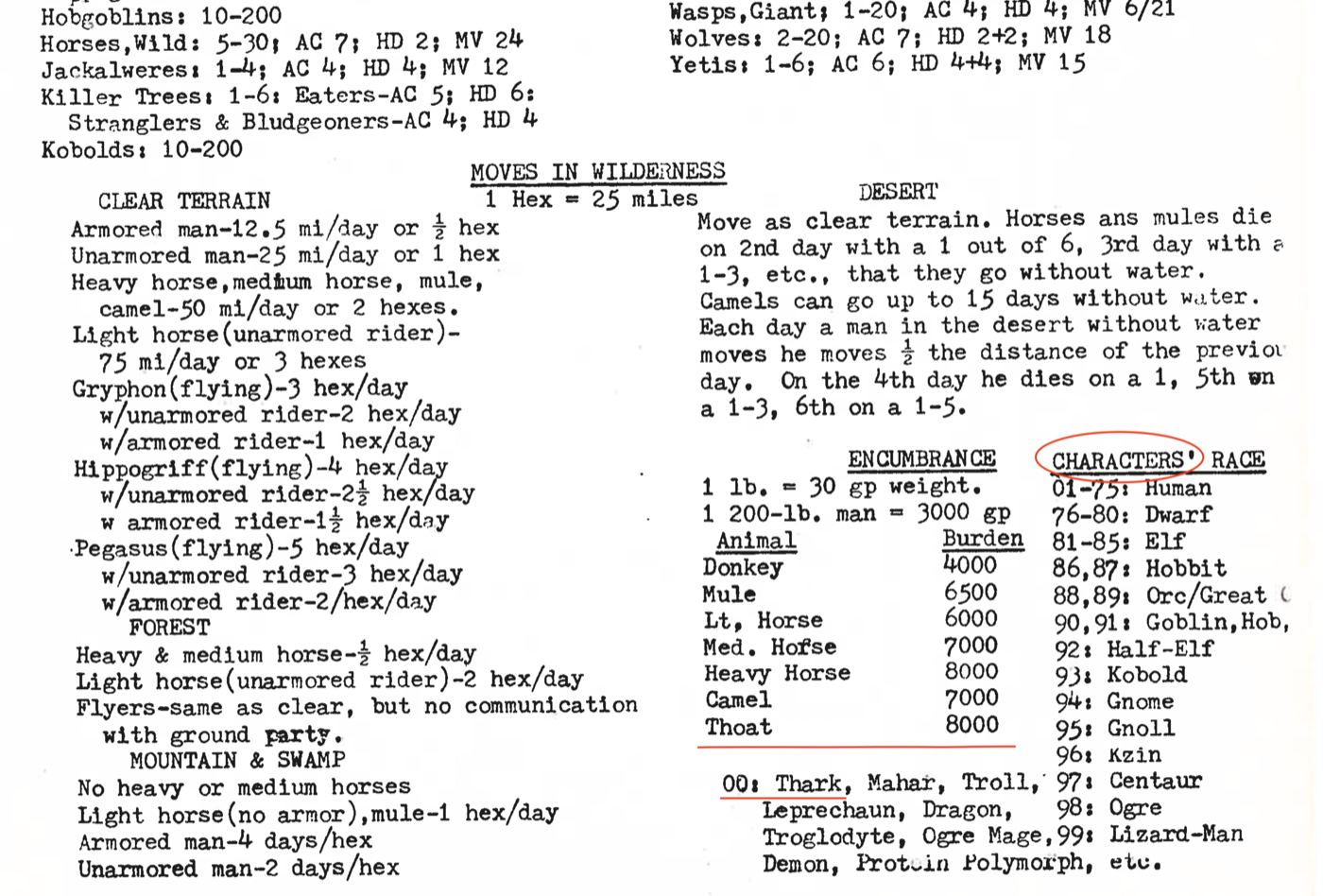
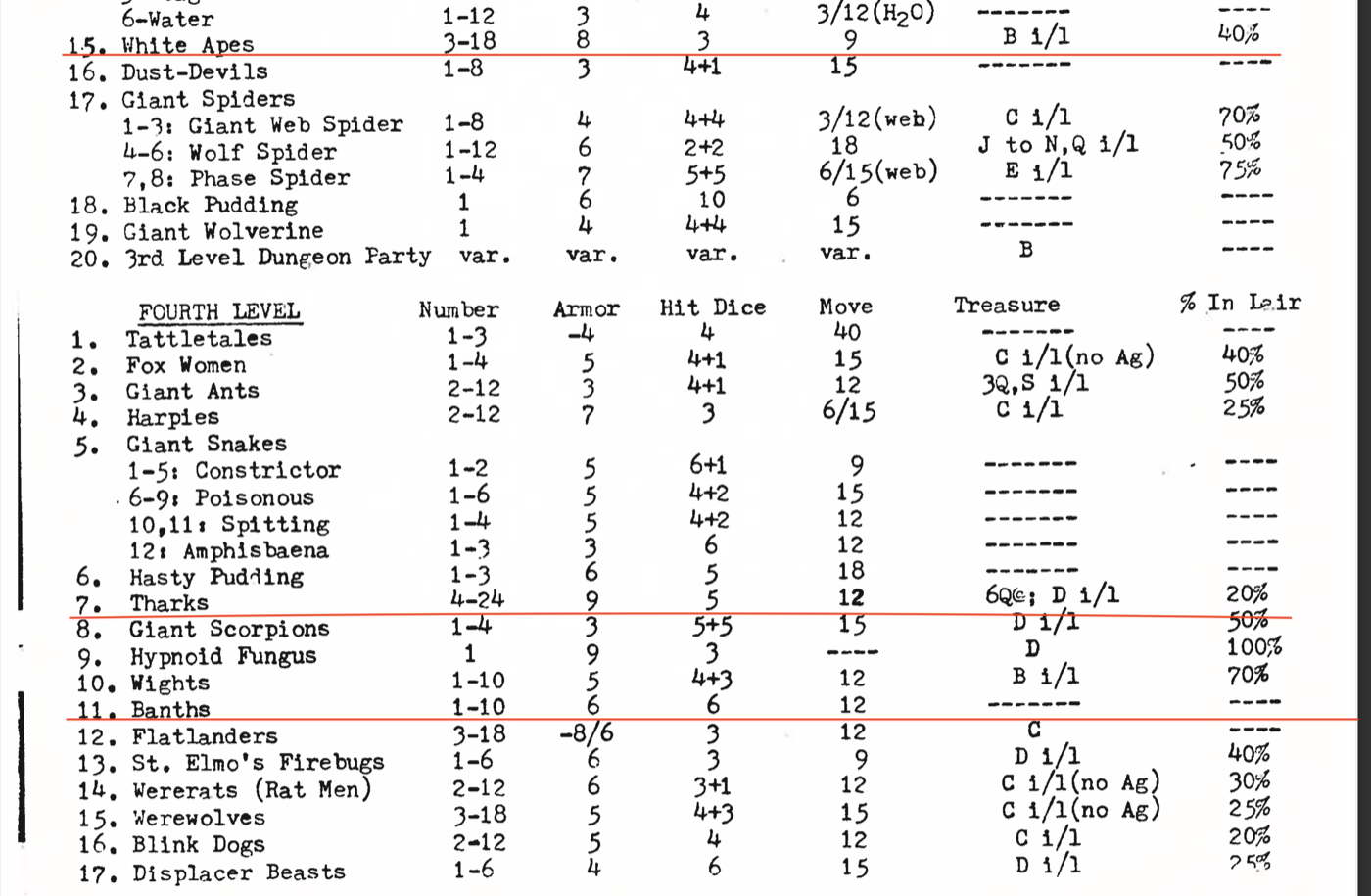
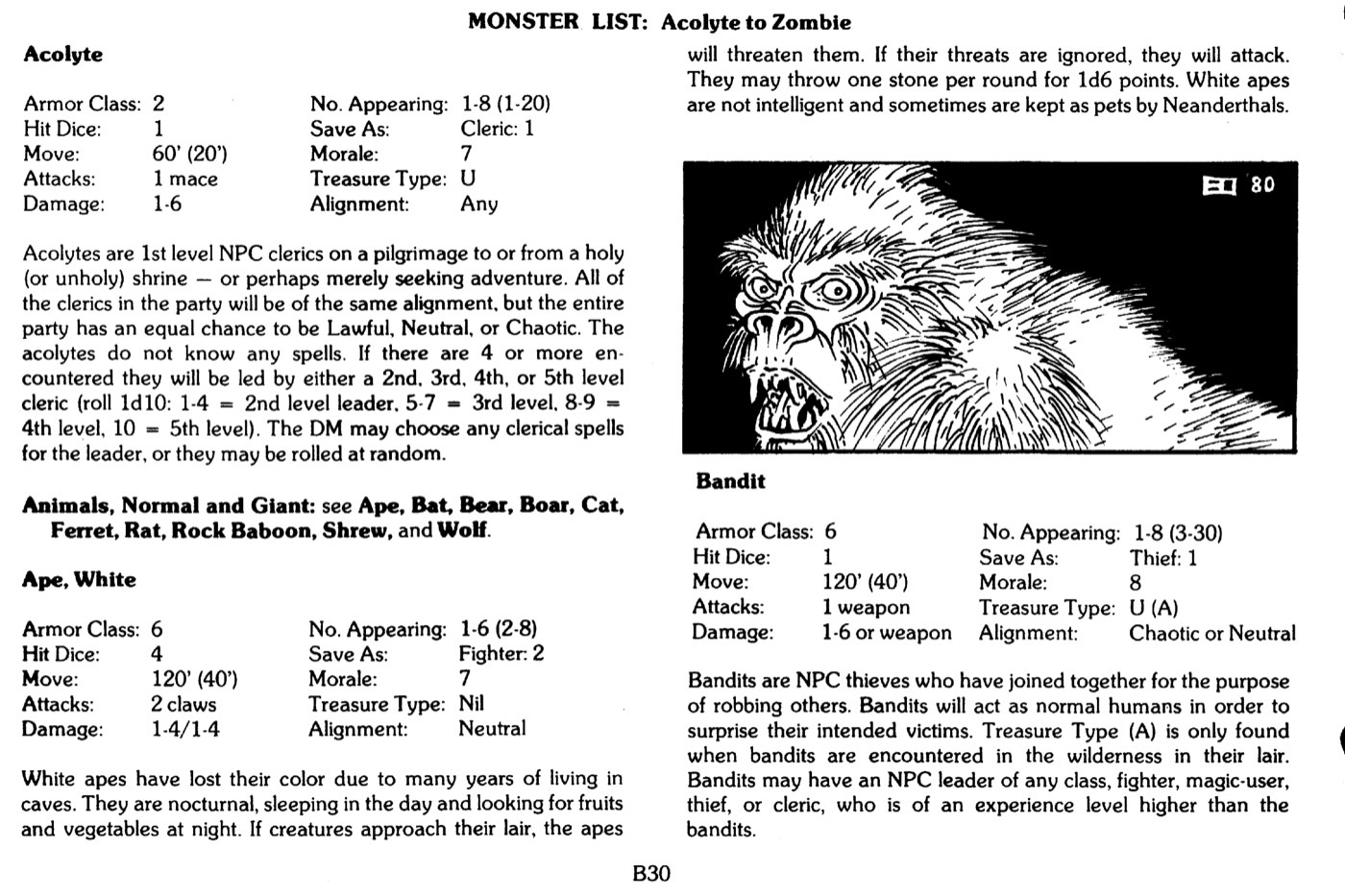
In the 1980 Basic game, Tom Moldvay included stats and a description for the White Ape. The note prior clarifies that the Giant Ape is this monster; there is no separate entry.
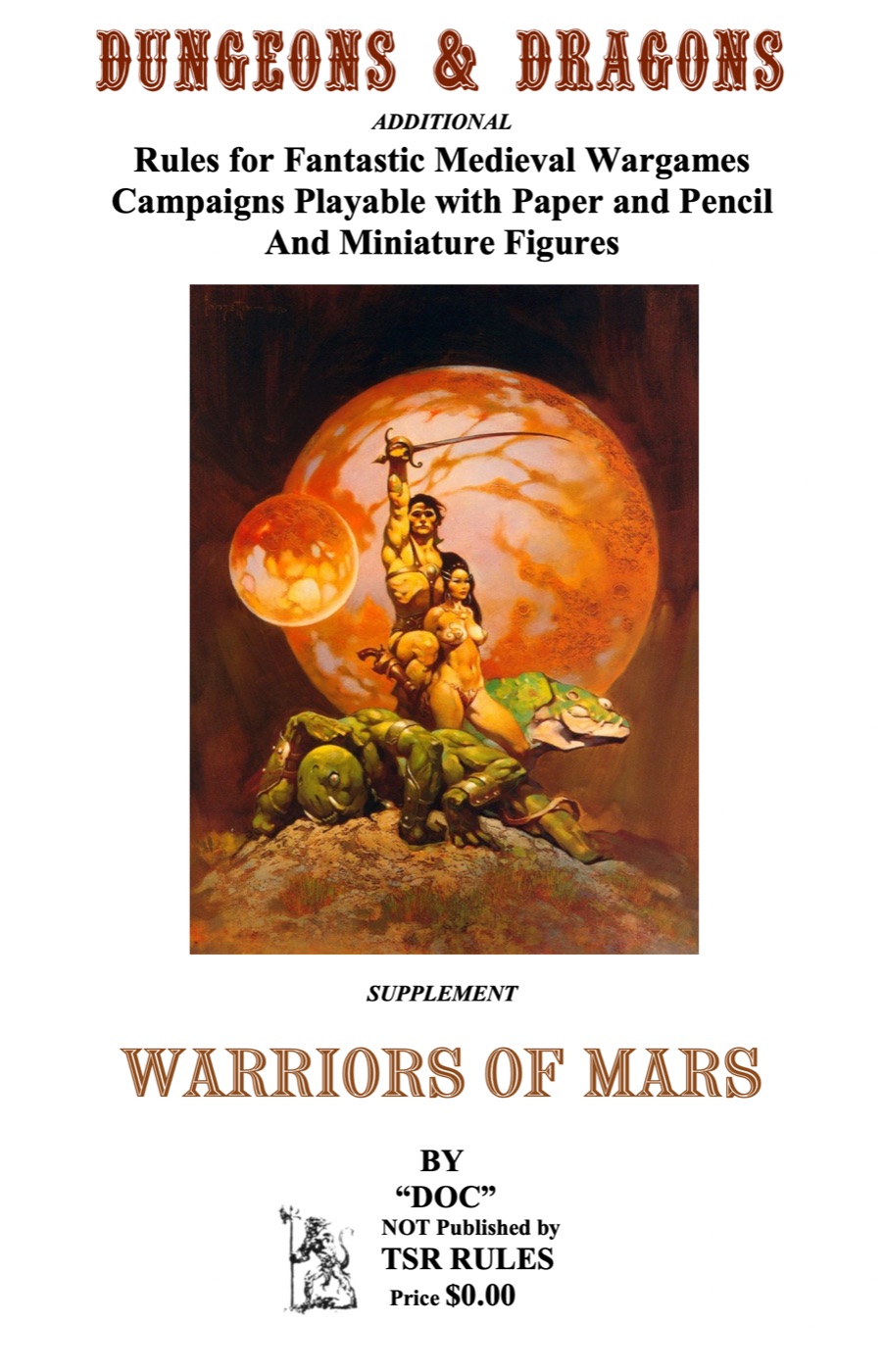
Others have tried their hand at bringing these monsters and martian men to the table in a form compatible with OD&D. “Doc” brought us a supplement in LBB form that is available on Grey-Elf. This fan publication was based closely on Gygax and Blume’s wargame.
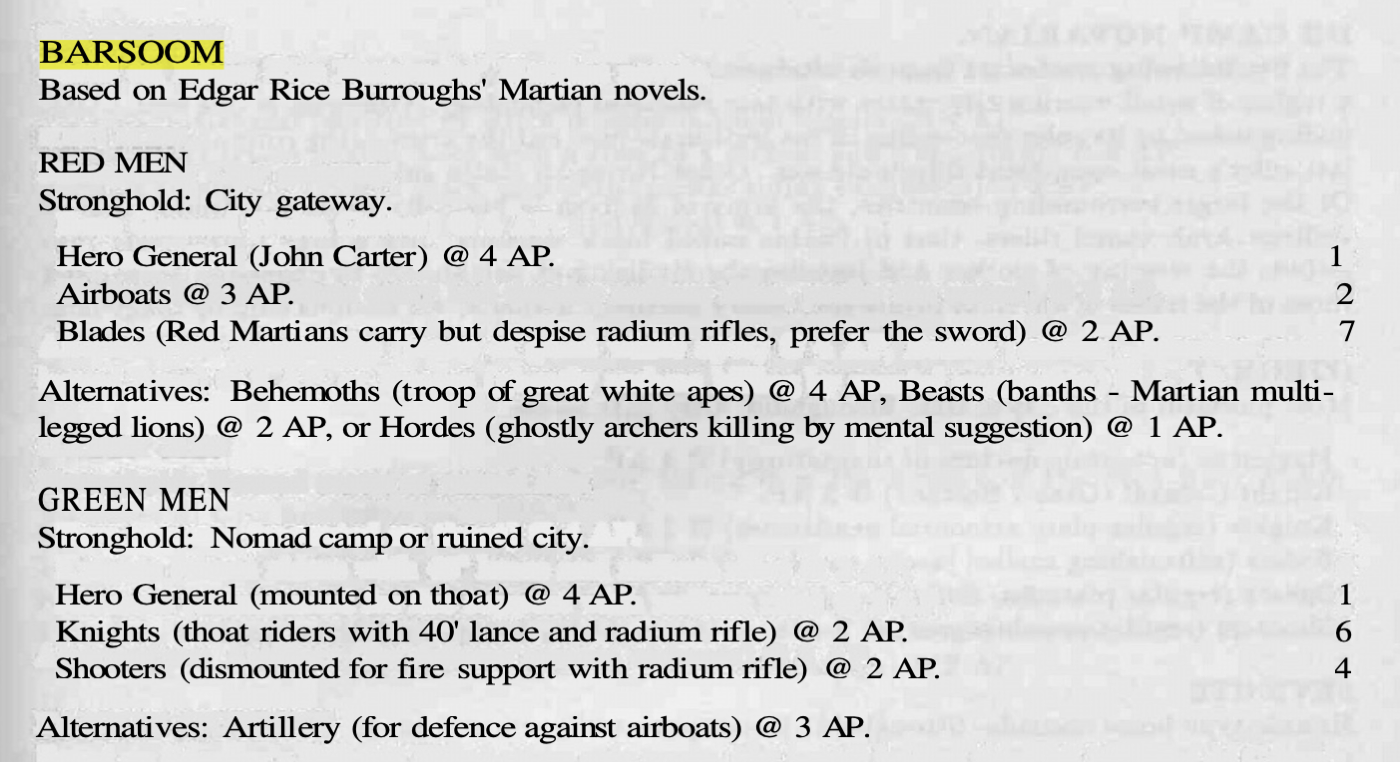
Hordes of Things is a wargame by Phil Barker (creator of De Bellis Antiquitatis aka “DBA” and other well known wargames). I need to get this game on the table (one of many side projects). It has a fairly interesting way of resolving the fantasy problem by allowing easy conversion of monsters and men into generic categories (much like DBA). So you could actually achieve parity between an army of Barsoomian Tharks and Saruman’s Orcs.
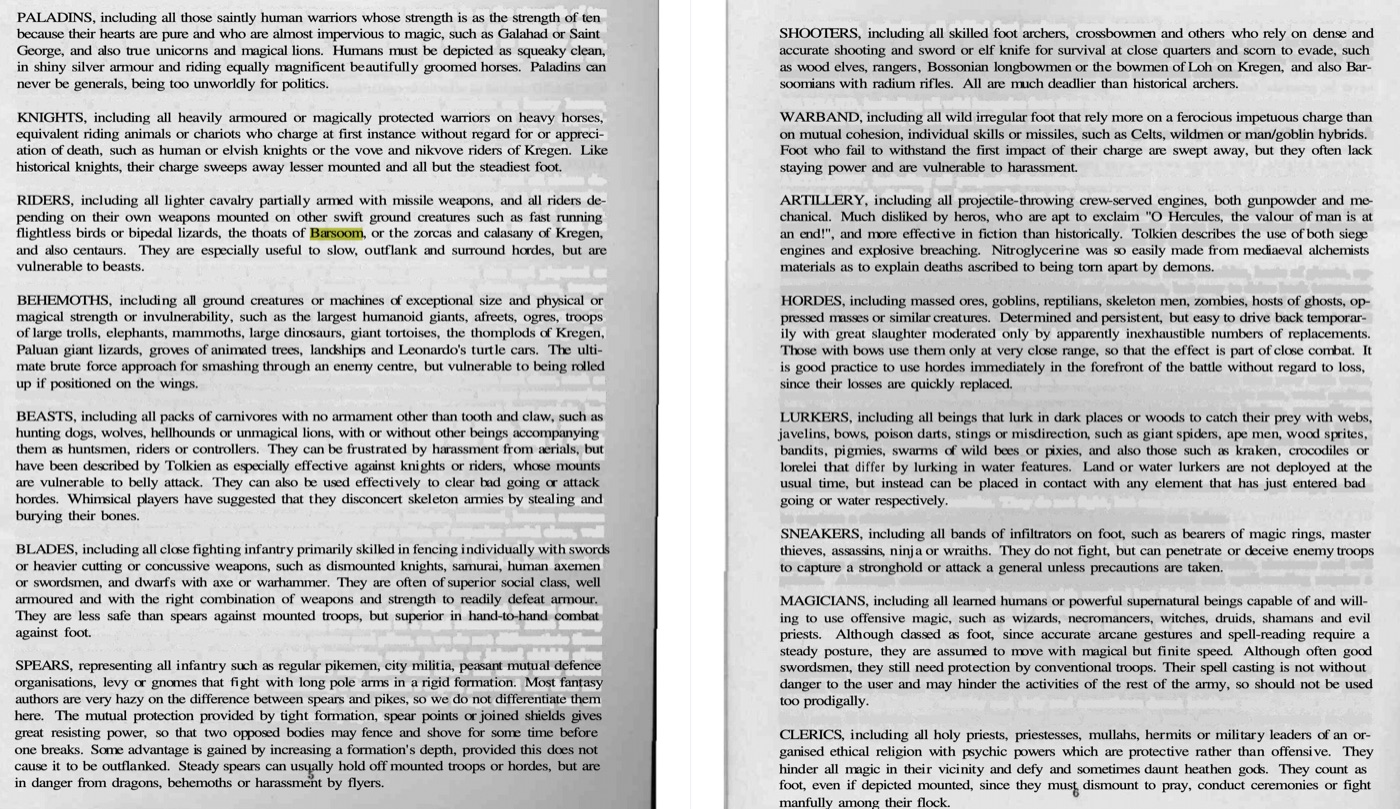

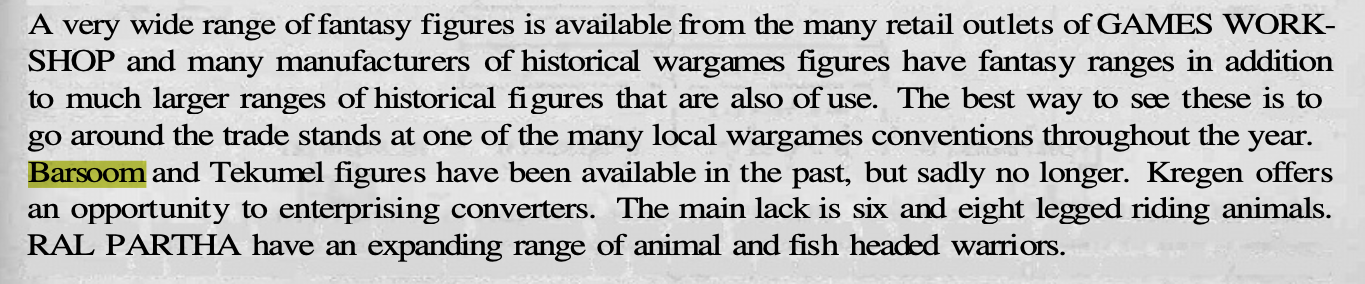
Barker makes a few comments about “the forces of E.R.B. Mars” in WRG version 6, but the attempt is very half-hearted. At best, Tharks fall into the category of “[h]umanoid beings with extra-grasping limbs. Pay for as double-armed.” Riders of thoats “[a]s cavalry” . . . extra-heavy cavalry (EHC) to be specific. Radium rifles he counts as mere crossbows, claiming that John Carter was fed a “tall tale” about their effectiveness, despite that Carter saw the Tharks virtually decimate Deja Thoris’ airships with radium rifle fire mid-way through the first novel. Finally, Barker adds airboats the ability to drop rocks and have the crew fight as if aboard an ocean-going ship. Airboats cost 30 tournament points “plus 5 points per passenger place in addition to driver. 5 scouting points per vehicle.” This is all very hard to translate unless you grok WRG version 6.
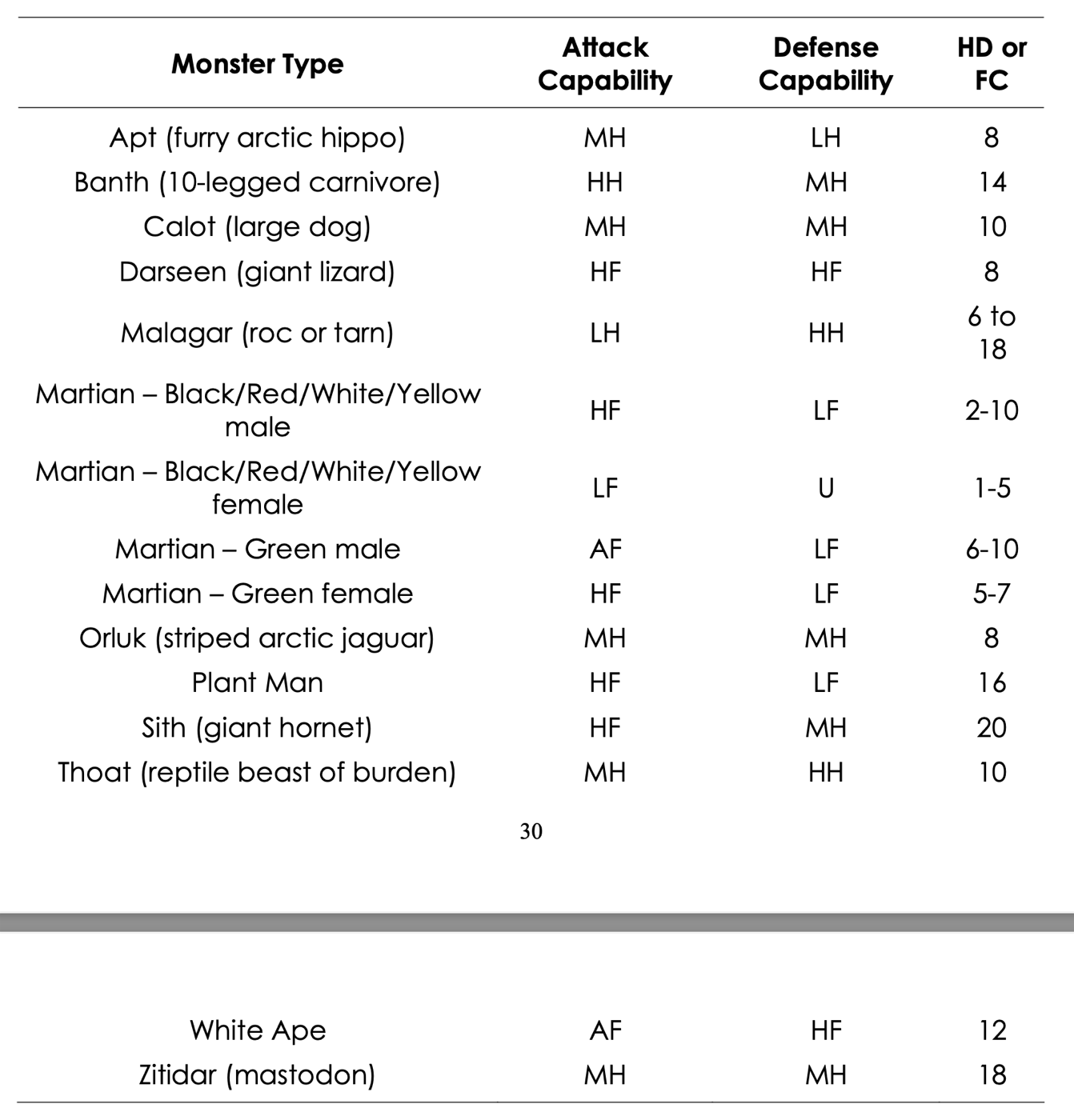
Compleat Chainmail published in 2010 by the crew over at Grey-Elf has a great conversion table that provides both Chainmail Attack and Defense Capability as well as OD&D Hit Dice or Fighting Capability conversions for many of Barsoom’s creatures.
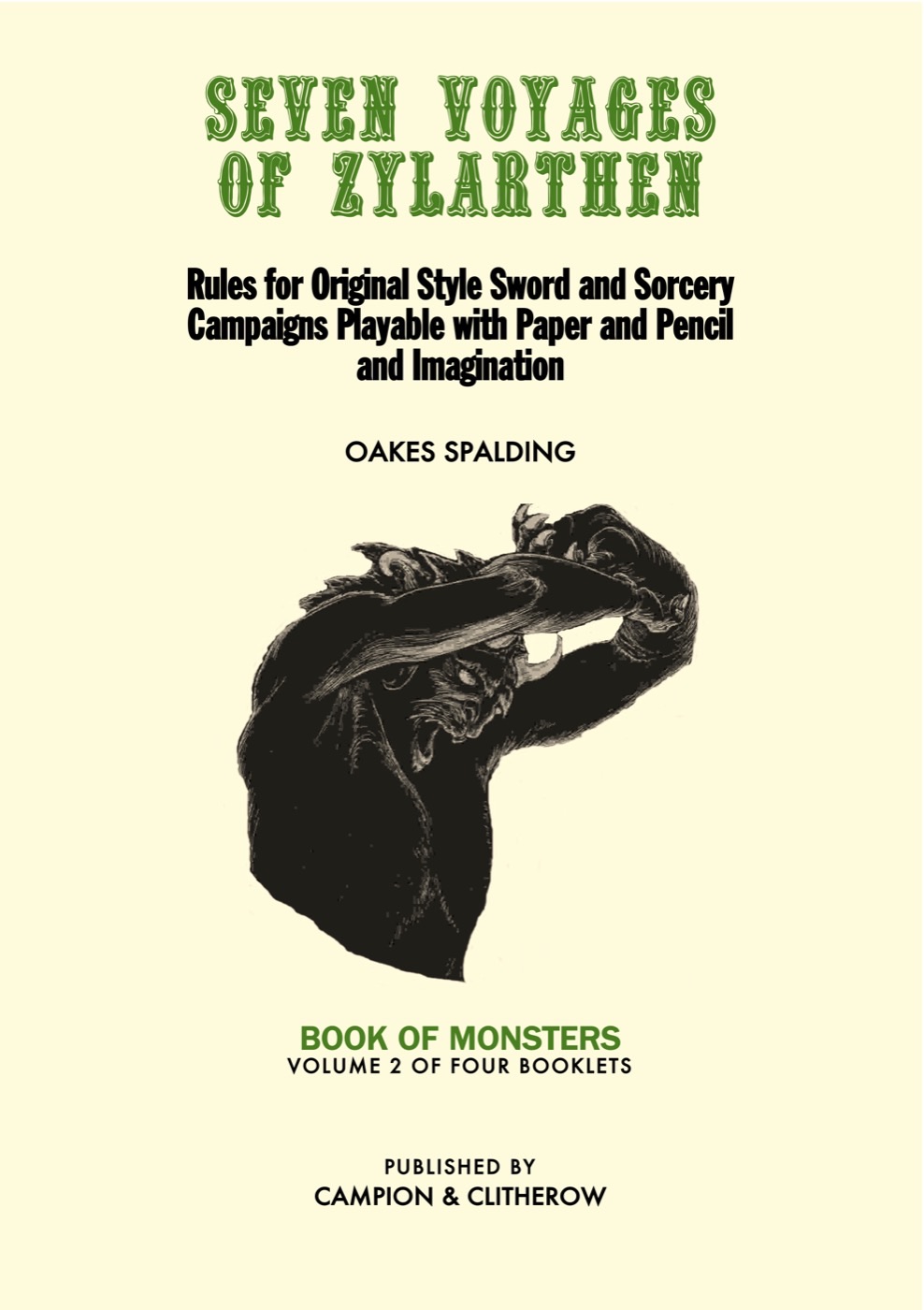
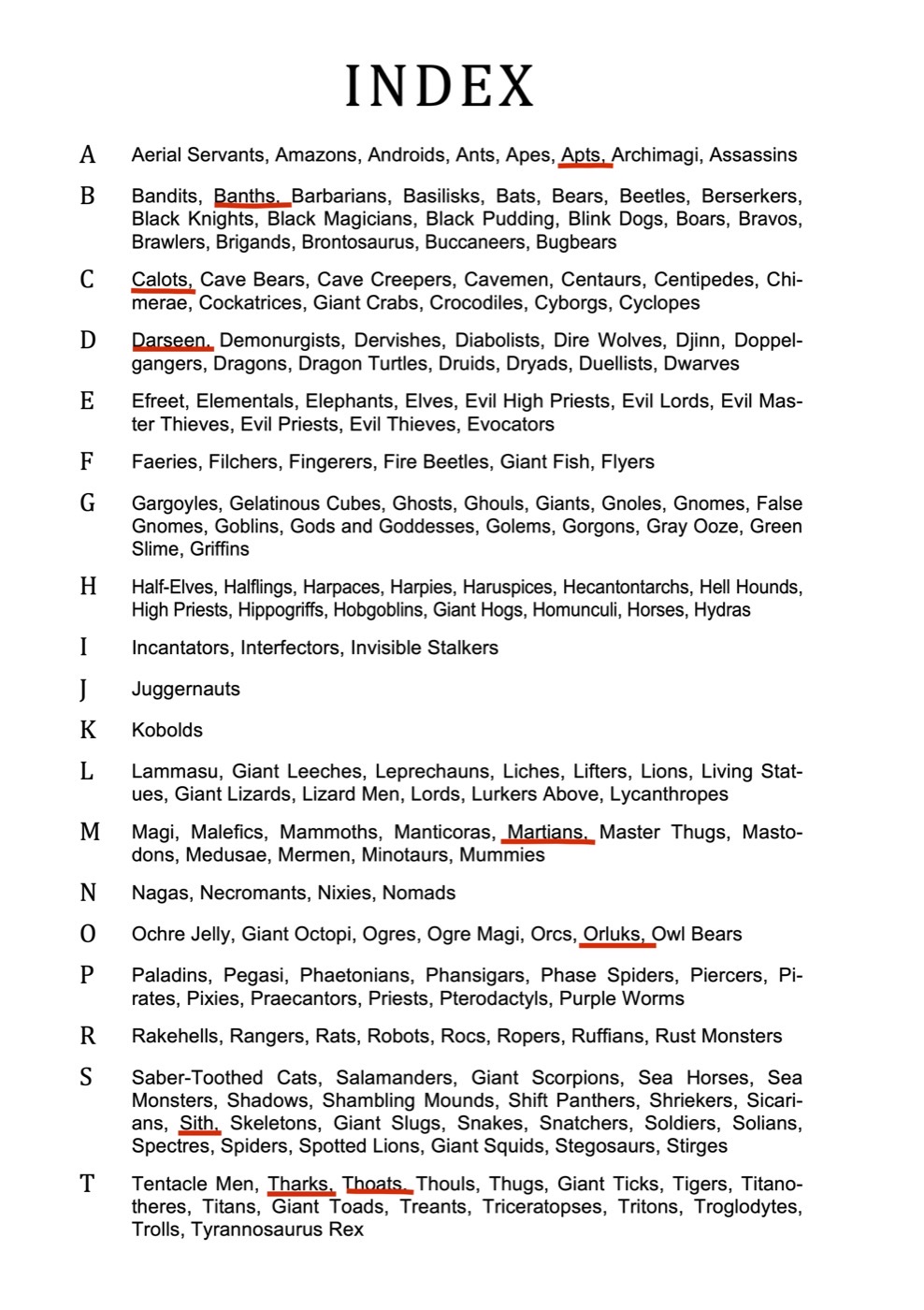
Seven Voyages of Zylarthen (another game inspired by and laid out like OD&D) has you covered for Barsoomian monster statistics and descriptions. Because of work this good (along with Compleat Chainmail), it makes me wonder if re-doing this myself is even worth the effort.
I have not yet bought Warriors of the Red Planet by Al Krombach and Thomas Denmark. There is a flip through / review on YouTube by Ol’ Man Grognard (Glen Hallstrom). He has not posted in 10 months which is concerning.
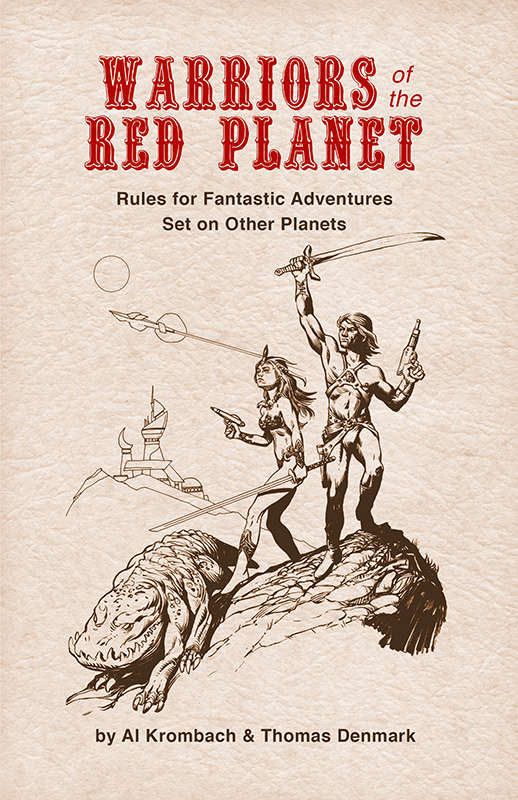
Warriors of the Red Planet is in my cart and I will probably pull the trigger on purchasing it this week.
Finally, if the foregoing isn’t enough inspiration for you to see what Mars is all about, Heavy Metal magazine devoted an entire spread to artwork depicting the characters and setting. You can find it on the internet archive. NSF content warning!
OD&D and Chainmail are not only one of the best gaming combos out there, they are also easily adaptable to a variety of fantasy / sci-fi settings. ERB is the GOAT. Read Tarzan and one of his Barsoomian novels today. Appendix N was not just an afterthought. Read more, play more, and blog more. Elevate the gamers in your club to new heights. Go forth and conquer Mars.

Originally published on Substack on September 3, 2025.