Crafting a First Level Dungeon
Rodney Hampton
- 15 minutes read - 3002 wordsStep-by-step recreation of how I did it
Problem Statement
Gary Gygax left us plenty of procedures, but he never - to my recollection - walked through exactly how he created his iconic dungeon adventures: B2 - The Keep on the Borderlands, the Giant + Underdark series (G1-G2-G3-D1-D2), S1 - Tomb of Horrors, S4 - The Lost Caverns of Tsojcanth, T1 - The Village of Hamlet.
Likewise, although Tom Moldvay gave us a simple procedure in the back of his edition of Basic Dungeons & Dragons, he did not let us in on how he created (or co-created) several classic adventures: X1 - Isle of Dread, X2 - Castle Amber, B4 - The Lost City, A2 - Secret of the Slaver’s Stockade.
Right now, several people in (or on the periphery) of the BrOSR are creating 1st level dungeons and opening themselves up to critique. This is helpful. But without the PROCEDURE that led to the OUTPUT, we may be missing a lot. For example, there could be commonalities - call them replicable and reliable, righteous patterns. Conversely, an anti-pattern might emerge that can be quashed.
Introduction
When I created Sir Dunder’s Dungeon Inter-loo-d, I began with the germ of an idea that I would make light of the interplay between Jeffro Johnson and Dunder Moose.
I use Bear instead of Evernote now. It is so much cheaper. But it is missing many features, such as a complete version history for every note. All I can see is the last version (before I moved it into substack) and when I began working on this project.
Nevertheless, let me walk you through how this project evolved.
Step 1
The “Call to Adventure” came first. I haven’t written a sewer dungeon in a long time (I created a pretty large one for module I1: Dwellers of the Forbidden City when I was DM in high school).
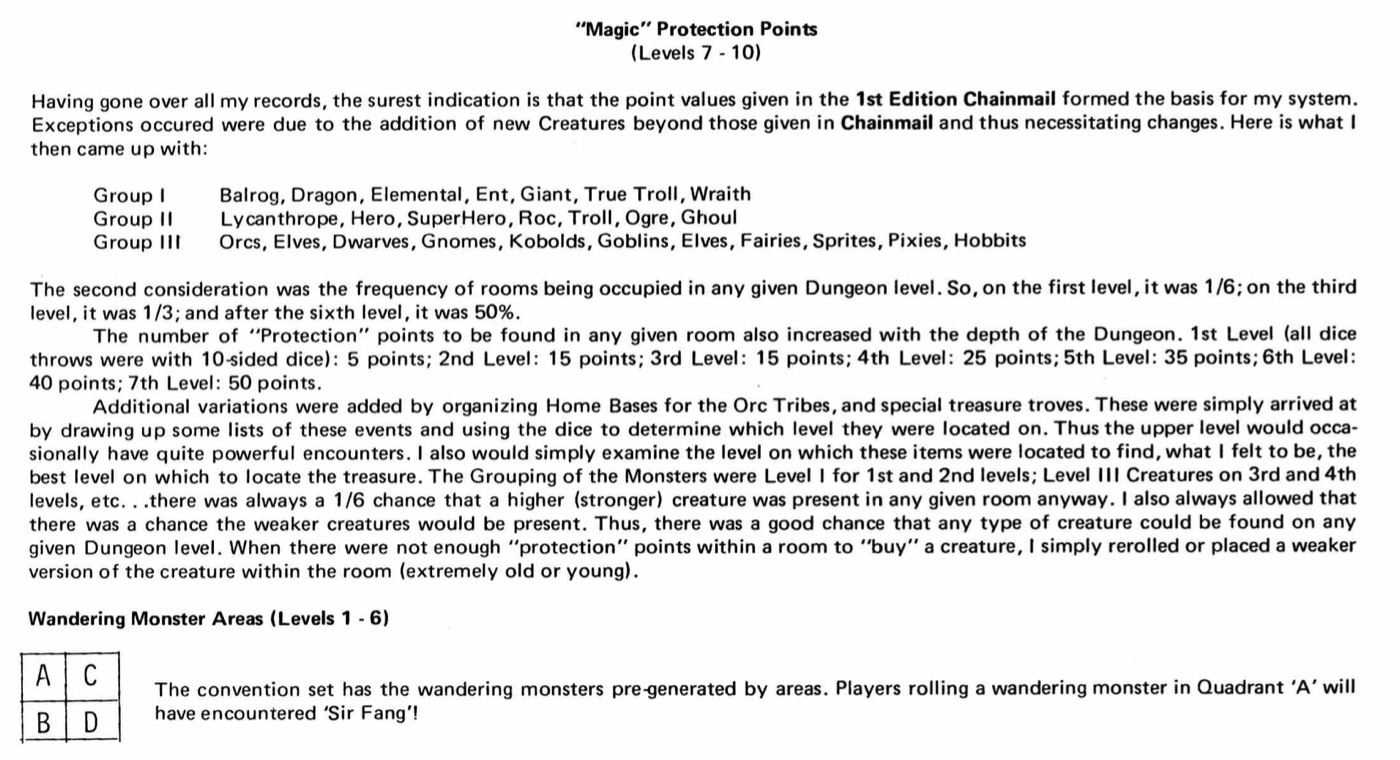
One other idea that I’ve had for a while (since delving into Arneson’s First Fantasy Campaign (FFC) and writing Midwest Fantasy Wargame: The Primeval RPG) was Arneson’s idea of 1-in-6 encounters being weaker than the dungeon level and 1-in-6 being stronger. Not just stronger or weaker by a single “level” of difficulty, though. For Arneson, you see Sir Fang, a Vampire, appearing as a wandering monster in the upper part of the dungeon beneath Castle Blackmoor. Anything stronger can show up. Likewise, anything weaker. Arneson used Protection Points linked to the CHAINMAIL point values of monsters, but left room for adjustment and narrative. This sparked the idea that you see play out with the Giant Spider and “Beware the Spider King” in Areas 1-1 and 1-2. This particular monster and signal was already well defined, so I roughed those in first. You also see this concept show up with the wounded Carrion Crawler with just 1d6 hit points in the wandering monster table for SEWER SECTION 4 (the 2nd level of the dungeon).
Next, I created the headings for the four “Quarters” of the town that sits above the dungeon. I did not want to create a unique wandering monster table for all four quarters. Again, this is an Arnesonian invention. In FFC, he also describes having “Quadrants” for the wandering monsters in Blackmoor dungeon.
Digression
The way Arneson describes stocking and protection points is at odds with how he actually did it in practice. I have receipts:
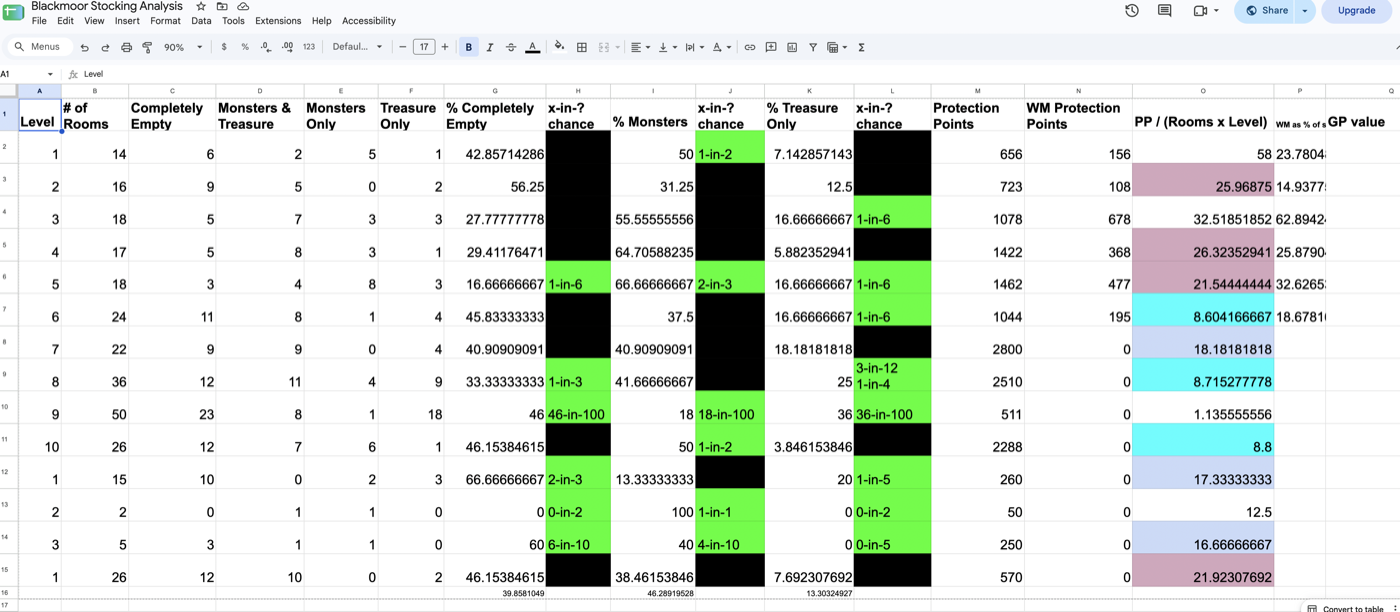
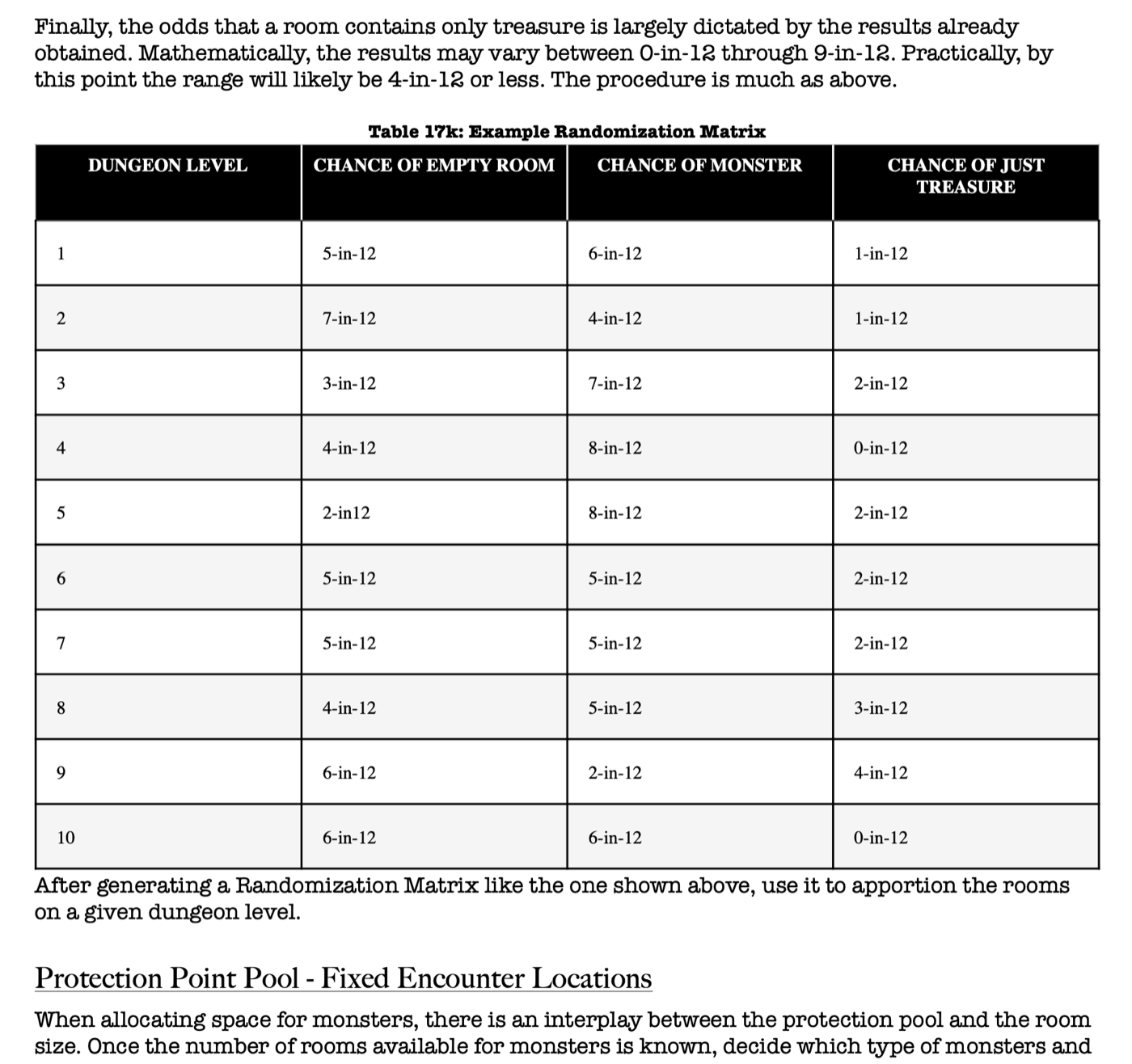
I recreated his process in my 0e retroclone Dragons Beyond by reverse engineering what Arneson actually did. For example, I created a matrix Arneson could have used to output Blackmoor’s megadungeon thus:
End digression.
Step 2
Having spilled out one of my canned “bright ideas” and the inspiration for the entire dungeon (Baron Johnson and Sir Dunder), I moved into the easy procedural portion: the wandering monster tables.
Why did I do this? Because I earnestly believe that letting the dice fall where they may is the absolute best way to avoid stagnant play. If it’s my tired old brain roughing things in based on tropes, that’s going to lead to boring, cookie-cutter results.
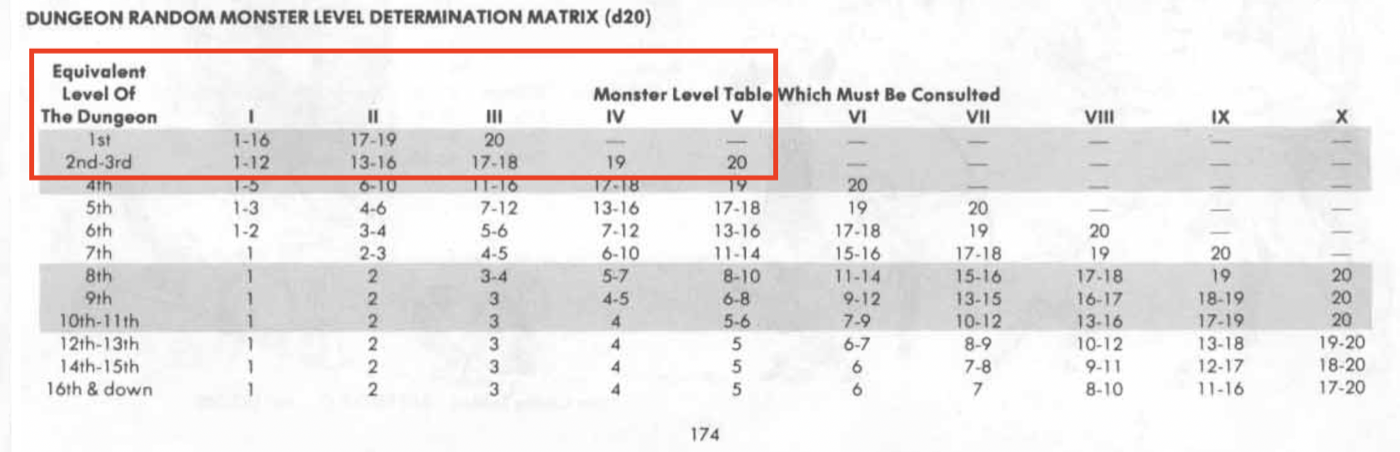
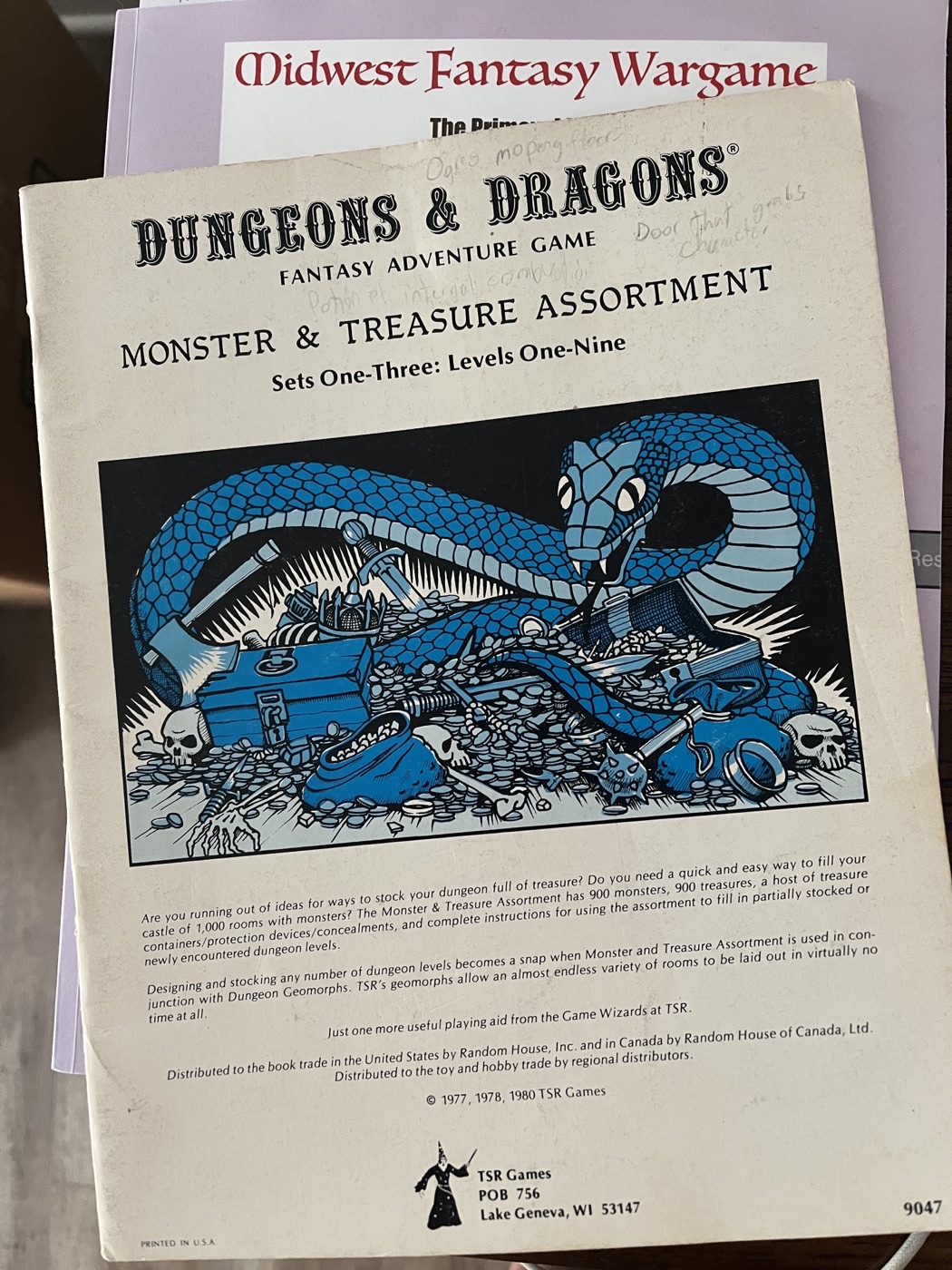
In this case, I created the 3 WM tables - and, again harkening back to Arneson’s era, I just used six entries so a d6 would do. To get these 18 monsters, I consulted the AD&D DMG p. 174. I rolled a lot of d20s. I mis-used this table. Instead of rolling on the DMG table, I just used (I, II, III, IV, V) to give me Hit Dice values. I know, I know. What a failure! But I also wanted to use a resource most of you probably don’t know about: The Monster & Treasure Assortment. In the olden-days this came in 3 different booklets, but I have the 1980 version with all the levels combined.
I have highlighted some of the rows. These aren’t the exact numbers I rolled (there are duplicate entries), but does show where I got the number appearing and some armaments info. The first wandering monster I rolled was a set of Giant Rats. My mantra for many years has been “the dice always know.” How fitting for a sewer!
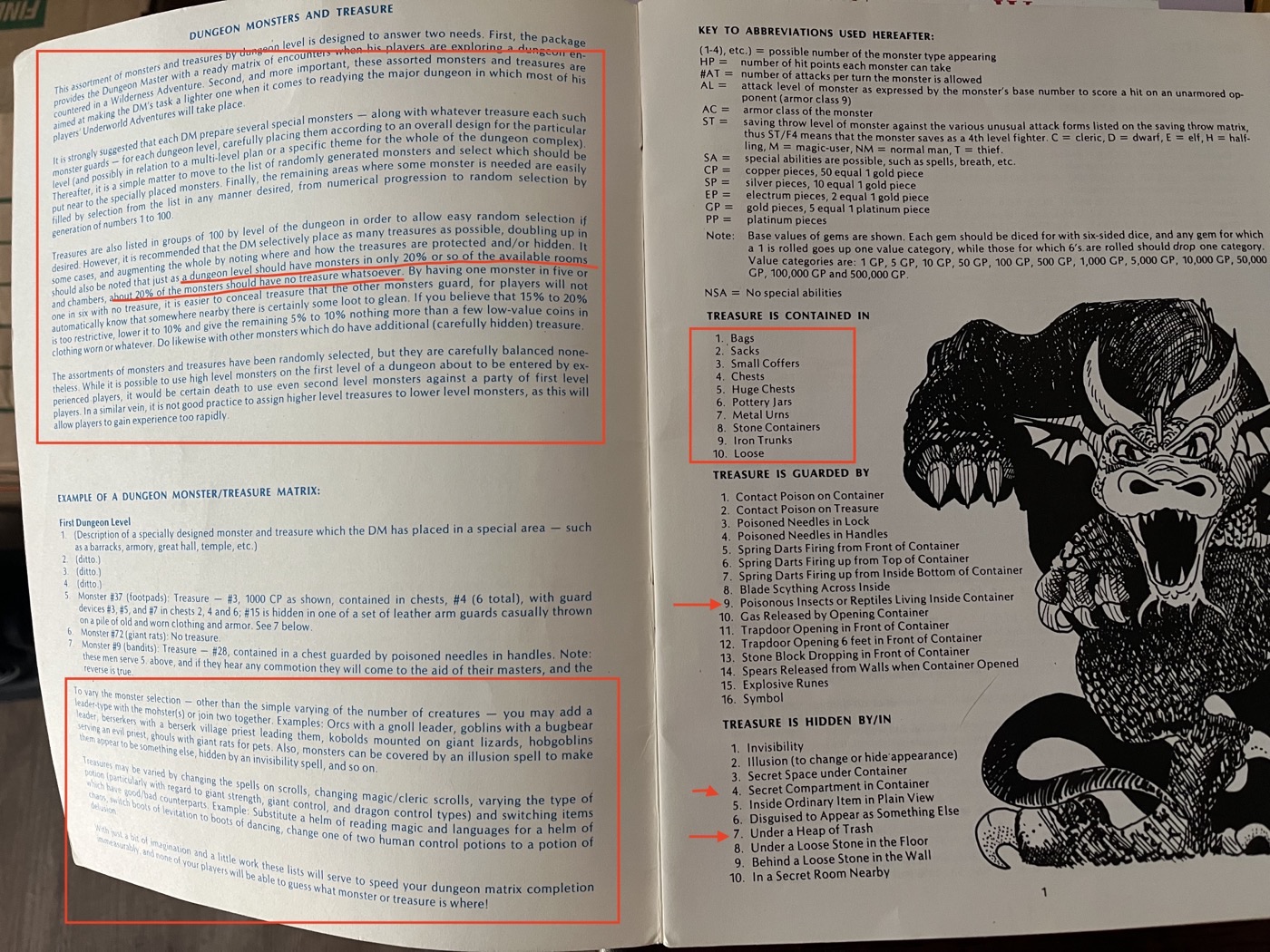
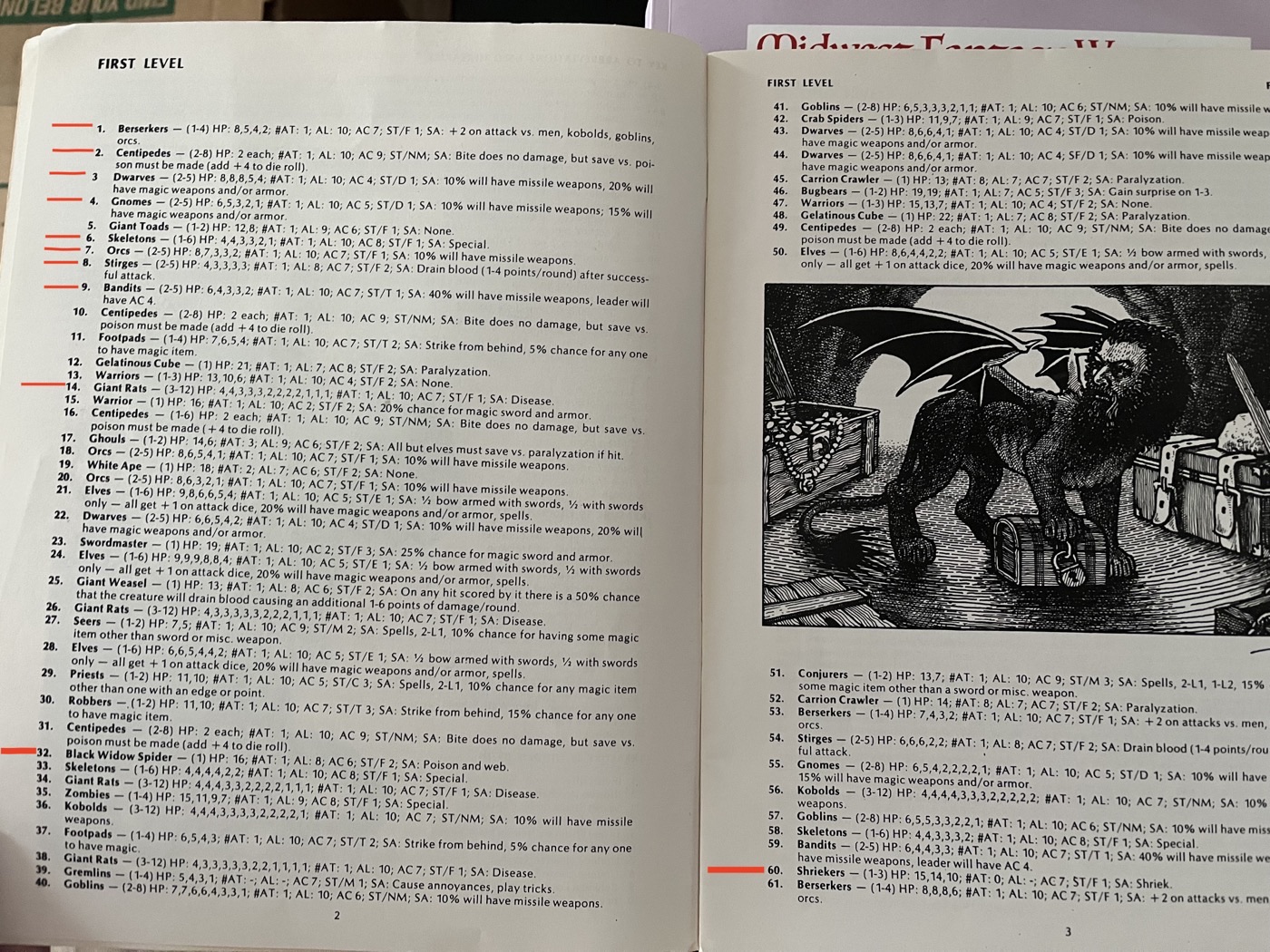
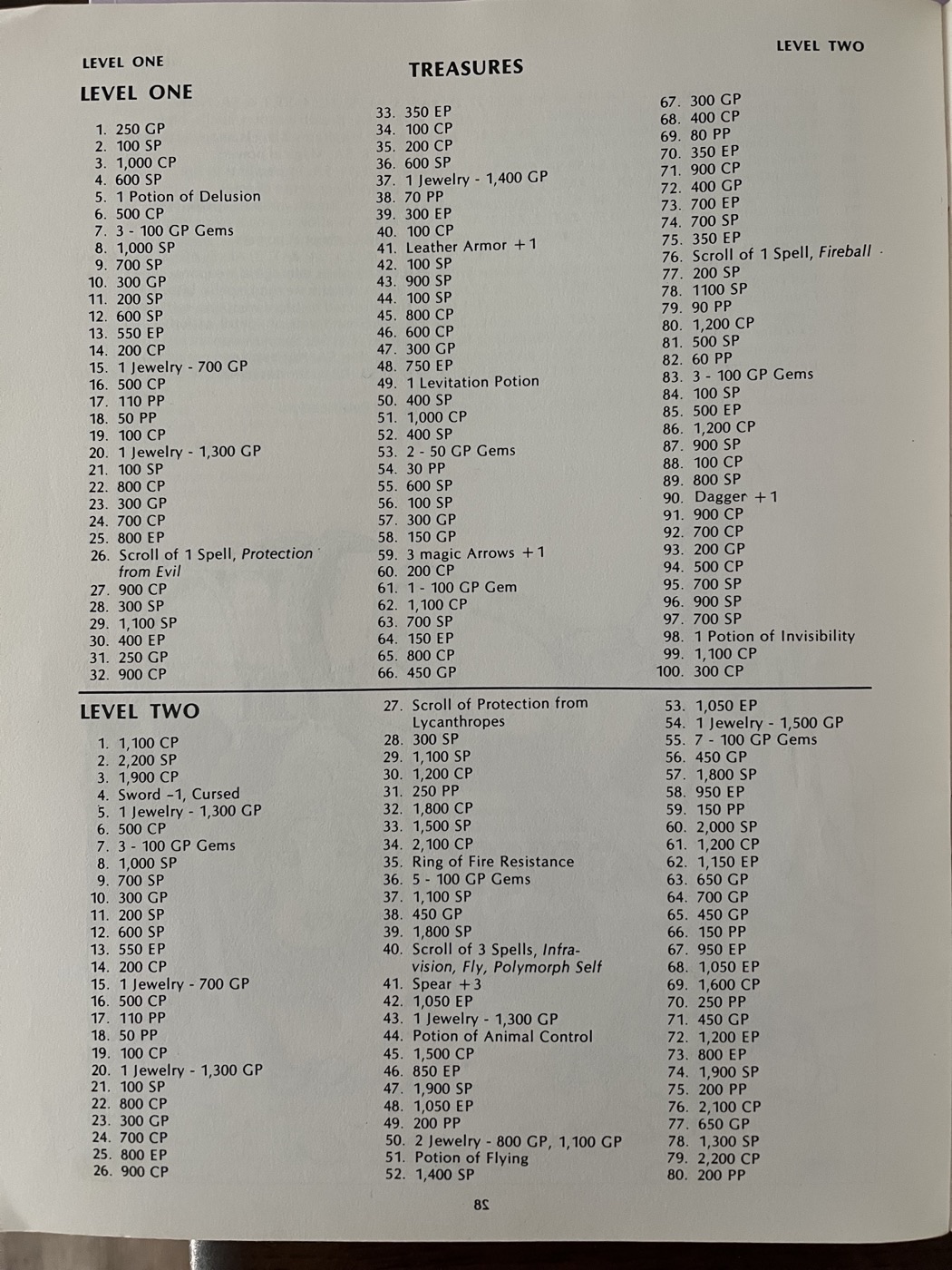
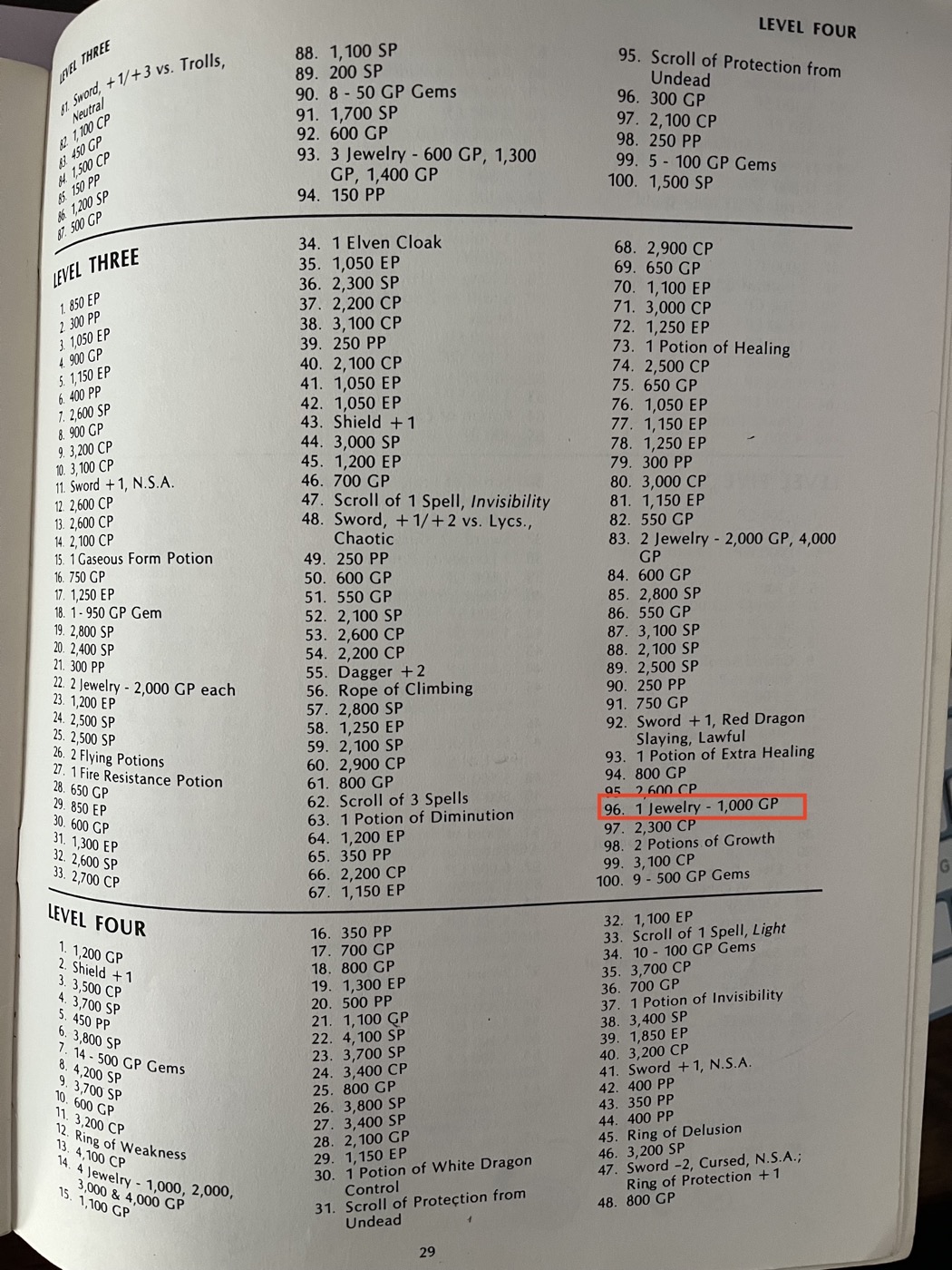
The presence of a “Black Widow” spider was used to further refine Area 1-1 and Area 1-2. Black widows have messy webs (instead of concentric, geometric patterns) and prefer warm and dry environments. Since I already had a shell keep at the highest elevation, this made positioning those rooms easy. At that point, I only had a mental map, roughly, of how the sewers would be organized.
When I rolled for treasure for the 3rd level cutpurse - I actually rolled a 1,000 gp piece of jewelry even though I had decided on that value way at the start of the ideation process. To reiterate, the dice always know!
Rumors
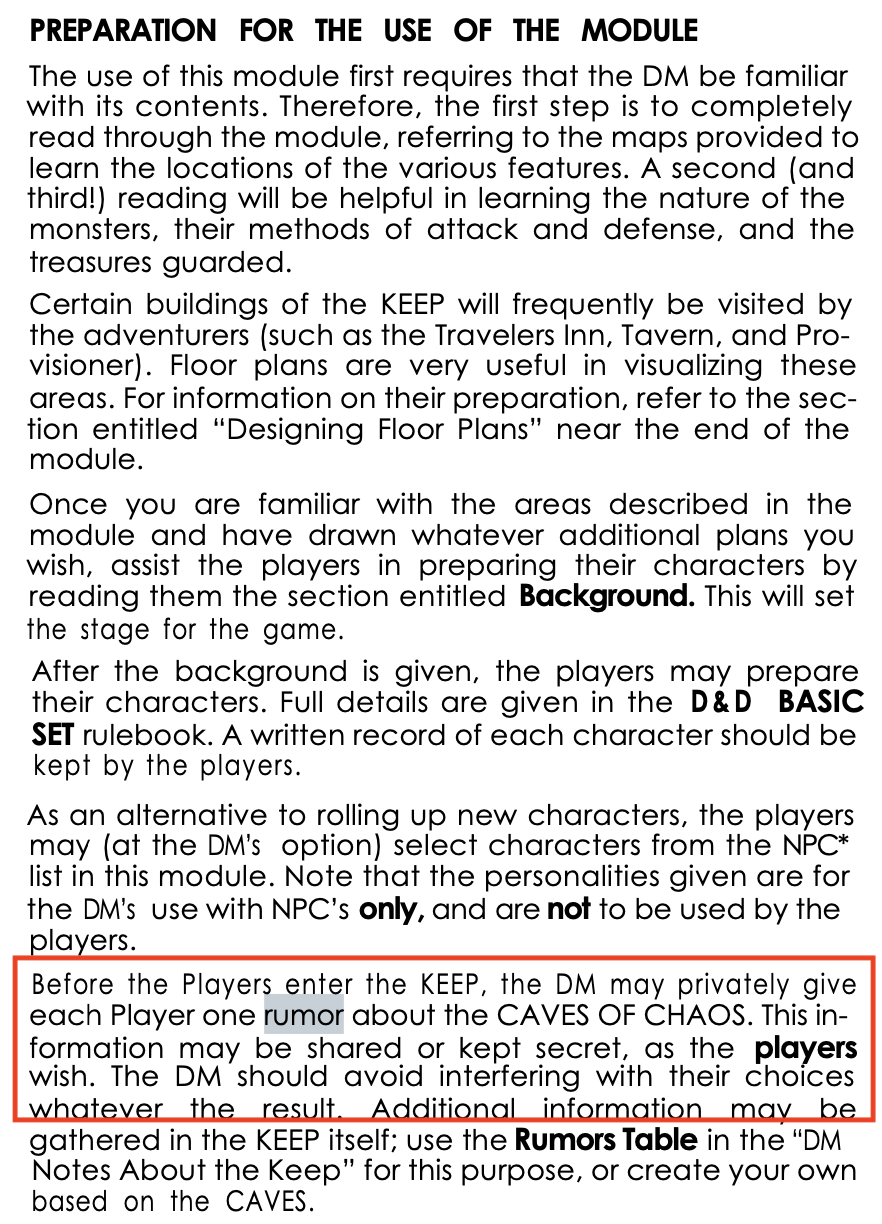
I paused about mid-way through the wandering monster populating so fill out my rumor table. For this, I first copied the rumor table from B2 in its entirety. Then I started editing it down. I made sure 50% of the rumors were true and 50% false in keeping with the general flavor for old school modules (yes, at one point I pulled a bunch of pdfs and looked at frequencies of T/F in these rumors).
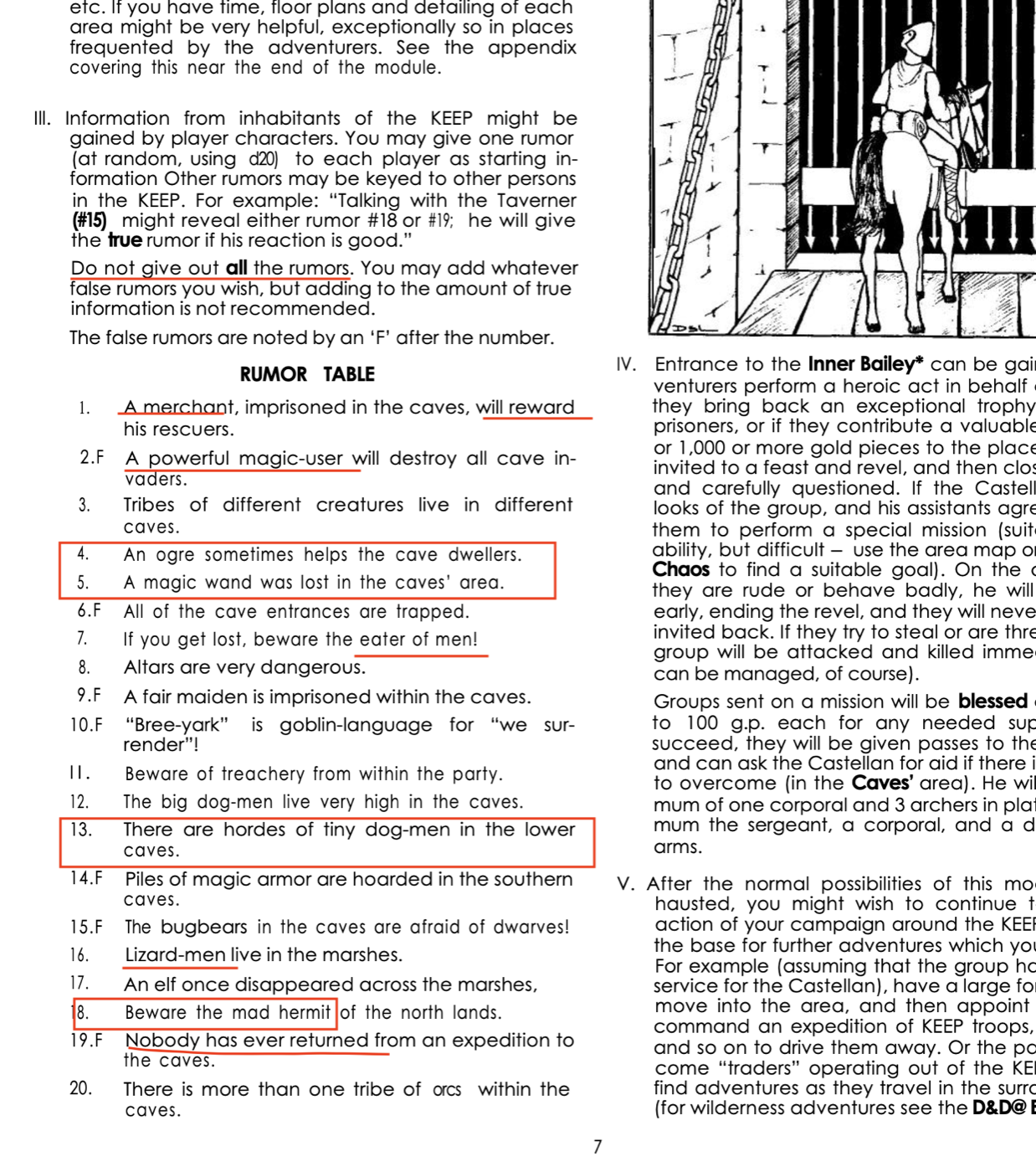
Here is my rumor table for comparison:
T 1. The Sir Dunder, the merchant, will reward anyone who returns the necklace.
F 2. The necklace is magical and that’s why there’s so much fuss about it.
T 3. Some say an Ogre wanders about in the sewers.
F 4. Baron Johnson is behind the robbery. He hates Sir Dunder.
T 5. Beware the mad hermit who lives in the sewers under the merchants quarter.
F 6. There’s a crocodile that lives in the sewer. Big fella. That’s why people disappear down there.
T 7. The Baron’s mage lost a powerful magic wand down the sewers a few months back (don’t ask how). It’s still missing!
F 8. There are hordes of tiny dog-men in the sewers near the port quarter.
At this point, I knew rumor 8 was going to be false because there weren’t any Kobolds. I had rolled some Orcs. I decided that there was an Orc tribe in the sewers somewhere, that these would be pig-faced p-Orcs, and that the majority of the tribe was going to be off-map and out of scope for the level 1 adventure since their lair deserved a level of its own.
The Ogre was left as the man-eating Minotaur stand-in. Thus he needed a lair. B2 has, hidden in one room, a lost magic wand (of Paralyzation). I simply took the need for a powerful magic user and a lost wand and, in my head, linked that up to the Skeletons that I had rolled. As pointed out by NoizyDragon in the comments, I did not make that clear on the page. So I went back and edited the necromancy into the description for Baron Johnson’s mage. As for the Mage’s name, I did some homage to BDubs by naming him Bjorn Uumlaut. B-double Us (literally). I rolled the Wand of Enemy Detection at random from the DMG, assigned it charges as the rules required, and decided it was a bone. In B2 the [wood?] wand is hidden in a pile of kindling. In my dungeon, it’s another bone around the neck of some other bones. And the fact that it is worth so much gold (if sold) and experience is off-set by the disguised purpose and randomness of even finding it.
The Lizard-men from B2 inspired me, along with National Enquirer stories from my childhood about Giant Alligators or Crocs in the sewers, and the post about Crocodile armor, to coalesce around the Berserkers. I made them sea raiders (pirates basically), who had a small base of operations in the sewers (toward the seaward drainpipe exit).
The Mad Hermit from B2 was transplanted almost word for word. Half of the description, I used for the Cutpurse. I had already decided the thief who stole the necklace from Madame Dunder was a 3rd level thief. I just grabbed the treasure and equipment from the Mad Hermit in B2, changed it up a bit, and added that to the loot for the cutpurse. For example, instead of the dagger +1, I rolled a different miscellaneous weapon: arrows +1. However, I had already decided the container for the treasure was an iron coffer (too small for arrows). So I just gave the players the arrowheads (disguising the magical nature) and left it to them to find a bowyer (which is actually a thing in 1st editional AD&D). Know the manuals inside and out, and all of this stuff will connect together when writing a dungeon!!!!
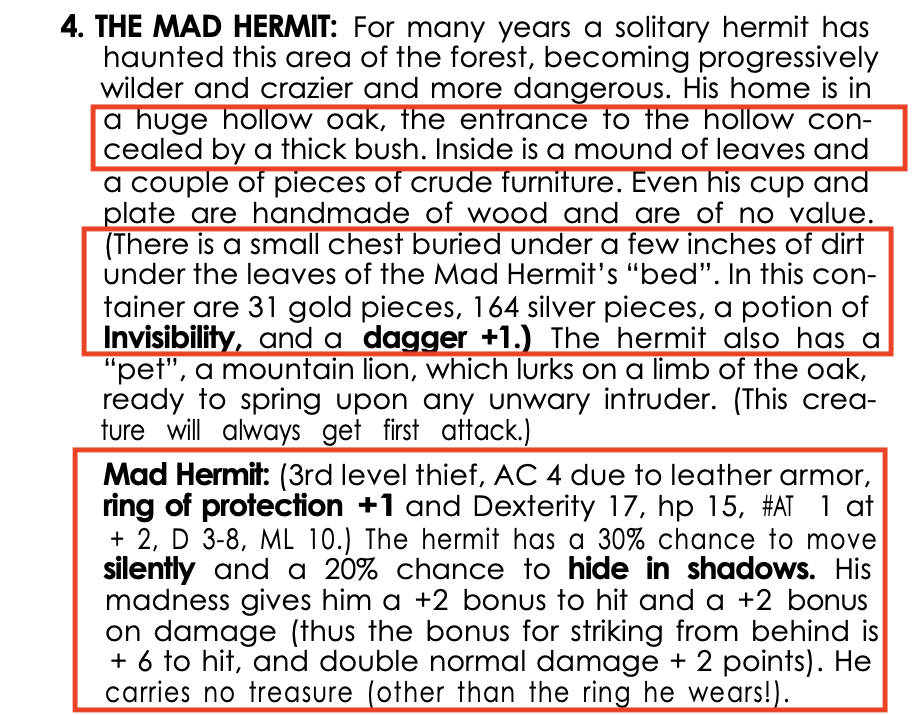
The Cutpurse needed to have AD&D thief stats. So I updated them with the correct percentages from the Players Handbook.
Unlike B2, the Mad Hermit does not have a pet. And I had stripped away his thief abilities for the Cutpurse. So I added something different. I decided he had horrible b.o. The kind the worst homeless folks have. I recalled that Troglodytes have a horrible stench. But instead of moving it over one for one, I instead gave the Mad Hermit the ability to use his halitosis as a “breath weapon” with three uses when in melee. A nice surprise - I thought - and fitting variation on AD&D monster themes.
Finally, I decided that his madness would have him thinking of himself as a King and reacting to people in exactly the opposite way one might expect. Thus, if someone with high Charisma interacted with him, it would be off-putting whilst interacting with someone of lowly and humble demeanor (low Charisma) would be endearing to him.
Monsters with / without Lairs
The Warriors would obviously have come from above-ground. And they were on the Wandering Monster table for the sewers under the Ruling Quarter. It did not take a huge leap to make them watches w/serjeants from above. This, then, allowed me to fill in the details for the garrison of the shell keep, the patrols, the stables, the footprint of the old motte-and-bailey and shell keep itself (radius of Restormel Castle). I would revisit these details when creating the map.
The Dwarves, I decided, would be doing high-value repairs and construction in the sewers while the Gnomes would be the workmen. Somewhere around here I filled in how the sewer entrances were going to operate (grates, chance of the Hue and Cry, division of chances into night and day, Port Quarter having Drunks, Harlots, and Press Gangs). After I figured that out, along with the depths of the sewer (10’ Ruling Quarter —> 15’ Common and Merchant Quarter —> 20’ Port Quarter aka level 2). Lastly, I made the “call to adventure” slide into the Port Quarter sewers link back up with the DMG rules about climbing slippery surfaces. Again, mastery of the rules creates different risks that you can apply to the topography of your world. I wanted the entry points to the dungeon to have different risk profiles including increased risk of disease in the “lowest” sewer level.
The Bandits were originally a one-off with no connection to anything. But I finally backfilled a story that they, too, are after the Cutpurse. Why is left to the DM to decide. Perhaps the Cutpurse was part of their gang? Perhaps they want the jeweled necklace for themselves? At any rate, the Bandits might be seen as a rival faction or cooperating faction depending on the person running the dungeon and the reaction rolls when they are encountered.
With all of these things out of the way, I now needed to start filling in rooms. I decided on 5 rooms for each section of the sewers [kind of a play on the 5-room dungeon trope except none of this is planned to be linear.]. I knew I needed a lair for the Berserkers, the Ogre, the Cutpurse, the Mad Hermit, and the Giant Black Widow Spider. With that in mind, I turned to the 1st edition DMG to fill in more details for Area 1-1 through 4-5.
Monsters & Treasure (& Empty Rooms)
Appendix A: Random Dungeon Generation had the “easy button” for me here. I simply had to roll 20d20 and viola I could rough in all of my rooms. With the notation: Empty, M, M&T, T. Specials were ignored with one exception: the waterfall. Specials in this table simply provide connectivity between levels. I was already going to have several sewer entrances scattered between the town’s Quarters so I felt I had this well covered. Trick/Trap, however, was also a possibility. This came into play twice: the Spear Trap and the Pit w/debris.
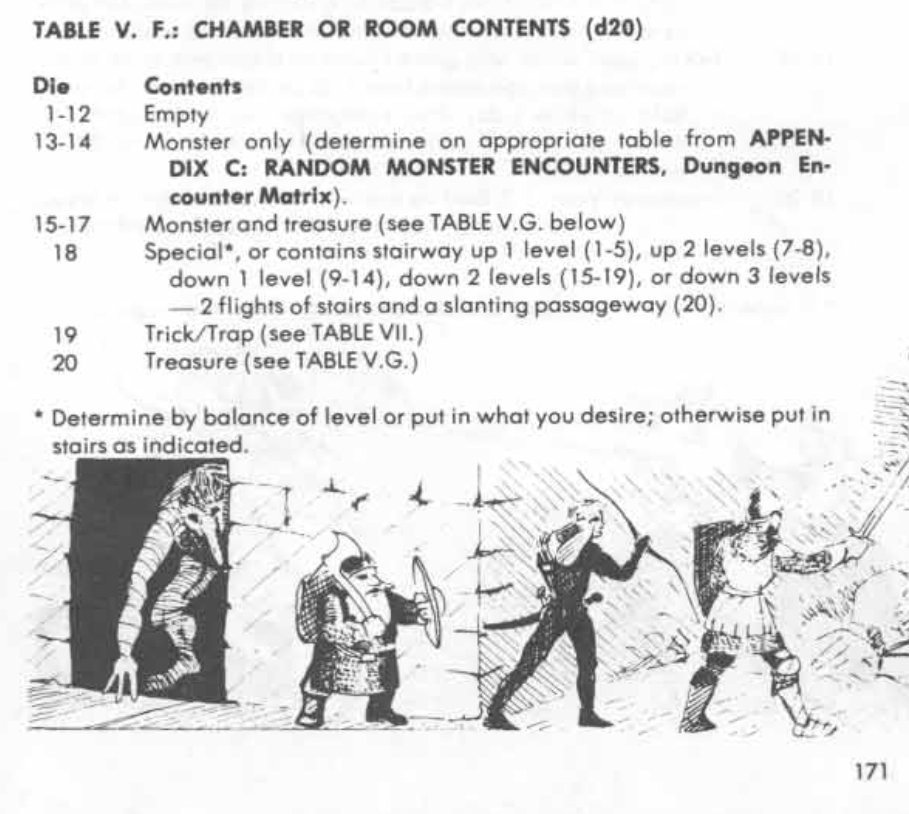
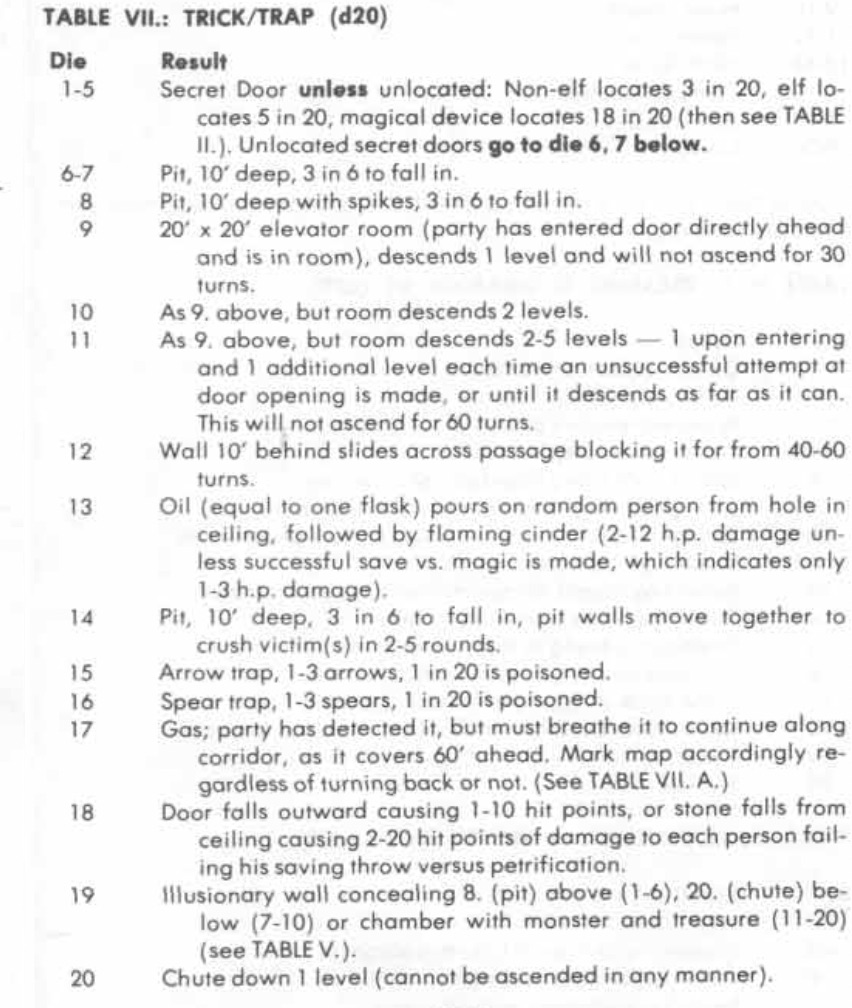
For the Spear Trap, I tied it into a story with the Orcs setting the “fish trap,” checking on its contents occasionally and having gotten the spears by killing some hapless watchmen. I decided to leave the lethality just as high as specified. I did convert the poisoned tips so that they simply triggered additional disease rolls. I hid the trap below water shooting upward. Easy peasy and all within the themes that had already developed.
For the “pit” trap, I reduced the lethality to d3 damage. I justify this based on the permissibility of adjustments (per PHB p. 105) and some guidance in the Dungeoneer’s Survival Guide p. 20 that significantly reduces falls done from a height into water.
For the Monsters, I started placing them and then if Treasure accompanied, I used the Monster & Treasure Assortment. Likewise I used the Monster & Treasure assortment for standalone treasures. There was one exception to this and it was the type K individual treasure for the Berserkers. I gave them a penchant for gambling to allow a positive reaction roll to lead to a game of chance in the guard room (and giving the DM the chance to use Appendix F: Gambling from the DMG).
I placed Madame Dunder’s necklace with two other treasures hidden within a heap of trash. The hope (for me as a DM) is that they give up searching the pile once the first treasure is found. Bwa ha ha ha ha. Of course, there is also a chance that they find the necklace first and stop searching, thus missing two other treasurers. Bwa ha ha ha ha.
If the monster was HD 1, I used a level 1 treasure from Monster & Treasure Assortment. In one case, where 500 cp was indicated, I converted these into copper pipes. For HD 2+ I rolled on the level 2 treasure table, etc.
Treasures were held in bags, urns, loose, etc. based on the table at the front of Monster & Treasure Assortment (Gary repurposed this in Appendix A as well). Same thing for how some treasures were hidden. I rolled. But not for every item. The Giant Centipedes were a bit of protection for one treasure but that was off of the “Treasure is Guarded By” table. I gave them a nice reddish hue (in accordance with their description in the Monster Manual) since this is, after all, a level one dungeon exercise.
For Empty Rooms, I ended up using the Dungeon Dressing tables in DMG Appendix I for noises, odors, random elements, etc. and tieing things back to the wandering monsters or other themes. For example, a discarded flask turned into a little more than that (a room where the Orcs might carouse a bit). No room is ever truly Empty in a dungeon. That’s boring and unrealistic. What you can do, as a DM, is provide just enough dressing to waste a party’s time and resources (torches and oil).
The Cutpurse’s Lair
The inspiration for the Cutpurse’s little crawlspace has been watching the adventurers of a stealth camper on YouTube. In particular, this video:
The Cutpurse is not going to get into a straight up fight if he can help it. He will hide. He will negotiate. He will flee and evade. And then he will stab the most vulnerable player in the back. Assume this guy knows his way around. And a first level party isn’t going to just bowl him over in a straight fight. But he hides his loot (again something he can use to negotiate his way out of trouble). And it is possible the party will find it without the Cutpurse even knowing. You can win at RPGs if you are smart. But if you aren’t, then you’re probably going to end up dead in a sewer.
Post Script
Did you notice that Gary Gygax sets up a potential player versus player situation in B2 with the rumor table? This is definitely not meant for the “get-along gang” style play. Even my own call to adventure is only given to only one player. What he or she tells the others when organizing this little expedition is left to the agency of the player - not to the DM.
Originally published on Substack on August 16, 2026.